
Aircraft Line Maintenance Market Trends, Share & Demand by 2034
Coverage: By Service (Component Replacement and Rigging Service, Defect Rectification Service, Aircraft on Ground (AOG) Service, Engine and APU Service, Line Station Setup and Management Service); Aircraft Type (Narrow Body Aircraft, Wide Body Aircraft, Very Large Body Aircraft, Regional Aircraft, Others); Technology (Traditional Line Maintenance, Digital Line Maintenance) , and Geography (North America, Europe, Asia Pacific, and South and Central America)
- Status : Data Released
- Report Code : TIPTE100001325
- Category : Aerospace and Defense
- No. of Pages : 150
- Available Report Formats :


- Last update date : November 02, 2026


2025 Market Size
US$ 24.68 Bn
Base year value
2034 Forecast
US$ 39.49 Bn
Projected by 2034
CAGR 2026-2034
5.36 %
Growth rate
Addressable Market
US$ 291.01 Bn
(2026-2034)
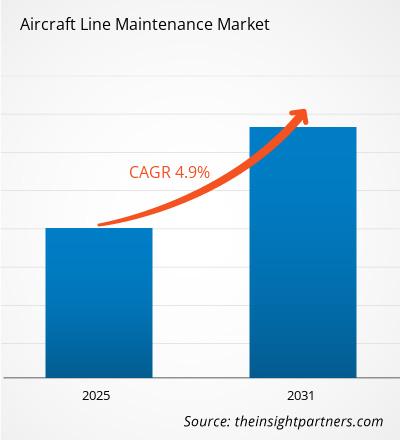
The aircraft line maintenance market was valued at US$ 24.68 Billion in 2025 and is projected to reach US$ 39.49 Billion by 2034, registering a CAGR of 5.36% from 2026 to 2034. The market covers maintenance activities performed during aircraft turnaround, transit, overnight, and short-duration ground periods, including defect rectification, component replacement and rigging, aircraft-on-ground support, engine and APU services, and line station management.
North America is expected to expand at a CAGR of ~5% through 2034, supported by a large installed aircraft base, high aircraft utilization, extensive MRO infrastructure, and sustained demand for rapid technical response at major airline hubs. Aircraft Line Maintenance Market share is also supported by the increasing use of digital maintenance records, condition monitoring, and specialized support for new-generation engines, strengthening the region’s line-service requirements.
Aircraft Line Maintenance Market Assessment and Insights
Regional Outlook
- North America: ~35% of the global market in 2025 | ~5% CAGR through 2034. Market position: North America holds the largest regional position, supported by a large commercial fleet, mature airline-MRO networks, high utilization rates, established regulatory infrastructure, and strong demand for rapid defect rectification and AOG support.
- US: ~78% of North American market revenue in 2025 | ~5% CAGR through 2034. Market position: The US represents the principal national market within North America, supported by extensive airline operations, major maintenance hubs, a broad technician base, and demand for engine, component, avionics, and turnaround support across domestic and international networks.
- Europe: ~27% of the global market in 2025 | ~4% CAGR through 2034. Market position: Europe represents a mature regional market supported by dense airline networks and established MRO capabilities. Germany, the UK, France, Spain, and Italy provide substantial demand, with Germany representing the leading country in Europe through its airline and MRO ecosystem.
- Asia Pacific: ~24% of the global market in 2025 | ~7% CAGR through 2034. Market position: Asia Pacific is the fastest-growing regional market as expanding fleets, rising passenger traffic, new airline networks, and increasing local MRO capacity raise demand. China, Japan, India, South Korea, and Australia are key contributors, with China the leading country in Asia Pacific.
Segment Outlook
- Narrow Body Aircraft: ~68% Share in 2025 | ~6% CAGR through 2034. Market position: Narrowbody fleets generate frequent line-maintenance events because of intensive short- and medium-haul utilization. High fleet volumes, turnaround frequency, and expanding low-cost and regional airline networks support sustained demand for inspections, rectification, component replacement, and AOG assistance.
- Digital Line Maintenance: ~18% Share in 2025 | ~9% CAGR through 2034. Market position: Digital line maintenance is expanding rapidly as operators seek faster technical decisions, electronic records, predictive diagnostics, remote support, and better maintenance planning. Integration of cloud platforms, mobile applications, and aircraft data can reduce administrative workload and improve maintenance visibility.
Competitive Coverage
British Airways, Delta TechOps, FL Technics, Hong Kong Aircraft Engineering Company Limited, Lufthansa Technik AG, SAMCO Aircraft Maintenance B.V., SIA Engineering Company Limited, SR Technics Switzerland AG, Turkish Airlines Technic A.Ş., United Airlines, Inc.
Methodology
The Insight Partners follows Data Collection & Secondary Research, Primary Research, Data Analysis, and Data Triangulation & Final Review to validate market estimates and insights.
Source: The Insight Partners' analysis based on proprietary research, government publications, company annual reports, investor presentations, industry databases, and expert interviews.
Aircraft line maintenance market development has increasingly followed changes in fleet composition, aircraft utilization, maintenance technology, and airline operating models. Earlier maintenance activities depended heavily on physical records, station-based technical teams, and manual troubleshooting. The operating environment is shifting toward mobile maintenance applications, electronic records, centralized technical support, remote diagnostics, and integrated maintenance-control platforms. New-generation aircraft also introduce more sophisticated avionics, propulsion systems, and data architectures, requiring technicians to combine conventional hands-on expertise with digital diagnostic capabilities. Supply-chain constraints have further increased the value of rapid component identification, parts availability, and coordinated AOG response.
Through 2034, the Aircraft Line Maintenance Market forecast is expected to increasingly reflect investment in emerging aviation hubs and maintenance capabilities close to expanding airline fleets. Asia Pacific is particularly important as airlines add capacity and MRO providers develop local networks in China, India, Southeast Asia, and other growth markets. Regulatory requirements for continuing airworthiness and maintenance records will continue to support qualified service providers, while airline efforts to improve aircraft availability will encourage outsourcing and multi-station service agreements. The resulting outlook combines fleet expansion with greater localization of technical capabilities.
Aircraft Line Maintenance Market Report Scope
| Report Attribute | Details |
|---|---|
| Market size in 2025 | US$ 24.68 Billion |
| Market Size by 2034 | US$ 39.49 Billion |
| Global CAGR (2026 - 2034) | 5.36% |
| Historical Data | 2021-2024 |
| Forecast period | 2026-2034 |
Aircraft Line Maintenance Market Analysis
Aircraft Line Maintenance Market trends are strongly influenced by aircraft utilization because every additional flight cycle creates requirements for transit inspections, scheduled checks, defect rectification, component replacement, and troubleshooting. Narrowbody fleet growth is particularly significant since high-frequency short hauls present repeated maintenance opportunities. There is also an urgent need for AOG interventions where aircraft technical issues pose a risk to the schedule. All these considerations render proximity, availability of technicians, tooling, access to spare parts, and certification abilities key considerations for selecting service providers.
The ecosystem includes not only airlines and aircraft lessors but also independent MRO players, engineering organizations affiliated with airlines, spare parts providers, aircraft and engine manufacturers, airports, regulators, and digital solutions providers. Supply conditions are increasingly driven by the availability of technicians, spare parts, late deliveries of aircraft, and maintenance backlogs on engines. Service providers that have extensive station networks are able to manage manpower, tooling, components, and engineering abilities at several stations at once, while airlines consider line maintenance agreements based on response speed and engineering capabilities.
Competition in the aircraft line maintenance market combines airline-owned technical organizations with independent MRO providers. Delta TechOps, Lufthansa Technik AG, SIA Engineering Company Limited, Hong Kong Aircraft Engineering Company Limited, and SR Technics Switzerland AG have large networks of technical operations, while FL Technics and SAMCO Aircraft Maintenance B.V. offer line support. British Airways and United Airlines, Inc. also have significant internal engineering capacities, whereas Turkish Airlines Technic A.Ş. offers combined airline-related MRO operations and international services.
The investment is focused now on network extension, capacities for modern aircraft, development of digital maintenance solutions, training of specialists, and localized technical capabilities. Lufthansa Technik AG is developing digital services and international MRO capabilities, while SIA Engineering Company Limited develops capacity in the Asia Pacific region. HAECO is also developing regional capacity. This trend demonstrates that competitive positioning will depend on network size, aircraft types approval, technical capabilities, data management, and capacity to support airlines at multiple operational points.
● REPORT CUSTOMIZATION
Tailor This Report To Align With Your Specific Business Requirements
This report can be customized to align precisely with your business objectives, scope, and target markets. Customization options include tailored segmentation, geography, competitive analysis, and strategic insights to support informed decision-making.
Customize This Report →WHAT YOU CAN ADJUST
- ● Segmentations
- ● Geography
- ● Competitive Analysis
- ● Language Preferences
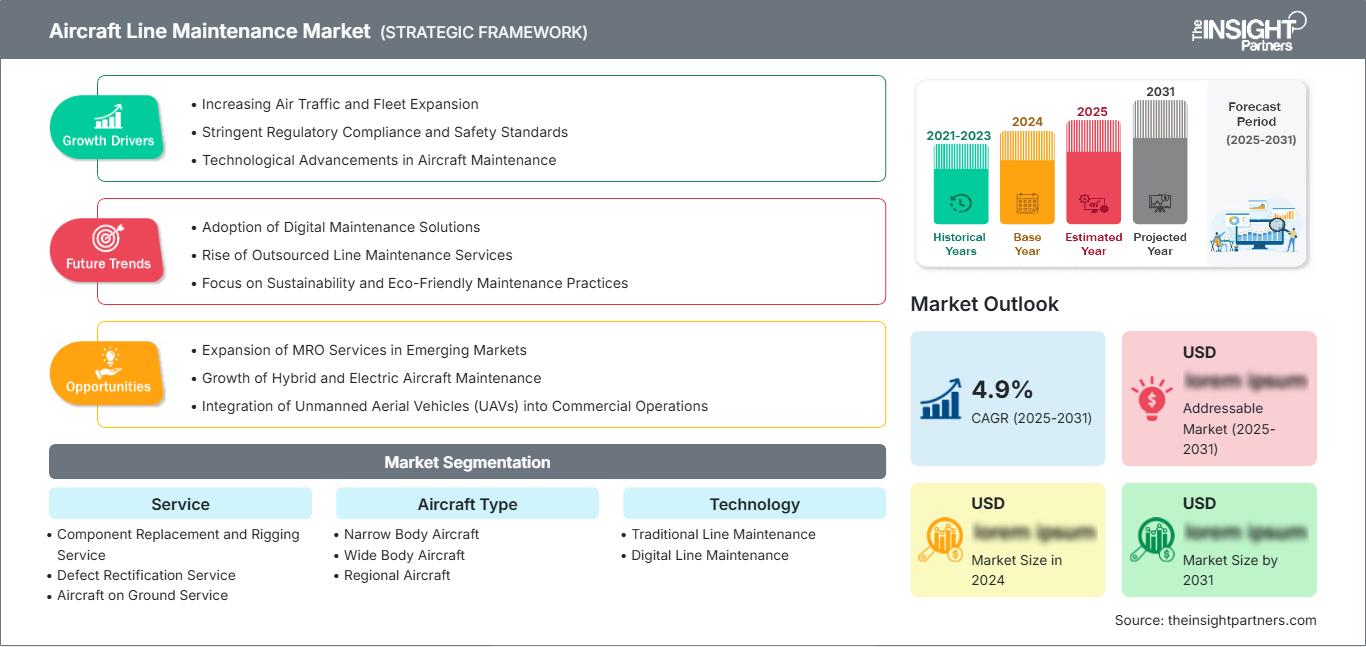
Aircraft Line Maintenance Market: Strategic Insights
Regional Insights
North America Aircraft Line Maintenance Market
North America remains the largest regional market, accounting for ~35% of global revenue in 2025 and expanding at a CAGR of ~5% through 2034. A large installed base of commercial aircraft, extensive domestic connectivity, a high aircraft utilization rate, and well-developed maintenance capabilities are the strengths of the region. High demand for transit checks, overnight support, defect repair, engine, components support, and AOG support is created by big airlines’ hubs. Mature certification and regulatory framework further facilitate the development of specialty providers.
The US is the leading demand center for the North American region, with big airline fleets and extensive networks providing connections to domestic and international destinations. Airlines are paying more attention to aircraft availability due to the high cost associated with schedule disruptions. Competition among providers in North America is based on station coverage, specialist technicians, tooling, availability of parts and fast responses. Digitalization and maintenance control systems become more important as airlines integrate technical data between stations. The development of the market is driven by big fleets and high aircraft utilization and maintenance capabilities and will continue up to 2034.
U.S. Aircraft Line Maintenance Market
The U.S. accounts for ~78% of North American aircraft line maintenance market revenue in 2025 and is expected to expand at a CAGR of ~5% through 2034. This market position depends on the country’s large fleet of aircraft, airport infrastructure and concentration of engineering services companies affiliated with airlines and MRO providers operating independently. High aircraft utilization in domestic flights makes it necessary to perform inspections, component changes and troubleshooting on a repetitive basis.
United Airlines, Inc. and Delta TechOps are examples of the significance of maintenance facilities linked with airlines. International MRO providers have a presence at US stations as well. Narrowbody and widebody aircraft constitute the major requirement for this market, where narrowbody aircraft create a need for more turnarounds. Technology is playing an important role in creating new demand for maintenance, as modern engine technologies require specific training and expertise in performing maintenance work.
Europe Aircraft Line Maintenance Market
Europe represented ~27% of the global aircraft line maintenance market in 2025 and is expected to grow at a CAGR of ~4% through 2034. There is a highly developed network of airlines and airports, cross-border activity, as well as numerous established MRO service providers in the region. Germany leads the region due to its robust airline engineering infrastructure and Lufthansa Technik AG. In addition, the contribution of the UK comes mainly from the operations of airlines, while that of France comes from the aviation industry and the international routes of the country.
The technical capabilities of Germany serve different aircraft and maintenance activities, while the UK has benefited from the density of international connections as well as the airline engineering capability. The importance of France results from the country's aviation manufacturing and airliners, which creates demand for competent maintenance organizations. The demand in Italy and Spain stems from commercial aviation, tourism, and numerous major airports. In the region, operators are focusing on aircraft availability, efficient turnaround processes, electronic documentation, and advanced aircraft systems.
In Europe, the maintenance companies are also focusing on digitalization and international network expansion. This is because the regulatory framework demands that there should be continuing airworthiness management, technician qualifications, approved maintenance organizations, and release procedure documents. Such demands act as a barrier to entry for maintenance companies and encourage them to have wide certification coverage. However, the mature state of the market restricts the rate at which it can grow compared to other developing aviation markets.
APAC Aircraft Line Maintenance Market
Asia Pacific accounted for ~24% of the global aircraft line maintenance market in 2025 and is expected to expand at a CAGR of ~7% through 2034. China leads in the Asia Pacific, whereas other countries such as India, Japan, South Korea, and Australia supplement the demand. Growth in passenger movements, fleet size, airport capacity, and increasing station MRO services is driving higher demands for station technical support services.
China is characterized by a large aviation market with a growing fleet, and India is working on expanding its maintenance capabilities to cope with the rapidly growing airline operations. Japan and South Korea are providing mature technical solutions, while Australia is serving as a hub for maintenance activities. Station providers are extending their reach closer to the airline operational bases to lower the aircraft positioning needs.
Middle East & Africa Aircraft Line Maintenance Market
The Middle East and Africa region is expected to expand at a CAGR of ~6% through 2034. Developments of the aviation infrastructure are taking place in Saudi Arabia, the UAE, South Africa and other regions, but at the same time, the major Gulf operators have wide international route networks which necessitate technical support at many stations. UAE is the top country in the Middle East and Africa region on the basis of industry evidence available, which makes it the biggest international aviation hub.
While Saudi Arabia is expanding aviation capacity with the development of airports and airlines, the UAE is benefiting from the presence of big hub airports and internationally connected airlines. On the other hand, South Africa still plays an important role as a technical center for the whole of the African region. Long-range operations, difficult environmental conditions at some airports and fast recovery from AOGs are other determinants of line maintenance requirements.
Segmentation Analysis
Service
The Aircraft Line Maintenance Market Service segment is expected to expand at a CAGR of ~5% from 2026 to 2034. Demand is distributed across scheduled and unscheduled maintenance activities, with airlines seeking integrated support that combines routine inspections, technical troubleshooting, component replacement, and AOG response. Contract structures increasingly emphasize availability, turnaround time, station coverage, and coordination with airline maintenance-control functions.
- Component Replacement and Rigging Service: Supports replacement and adjustment of aircraft components during scheduled or unscheduled maintenance. Demand depends on fleet utilization, component reliability, technician certification, and access to approved replacement parts and specialized tooling.
- Defect Rectification Service: Addresses technical defects identified during aircraft operation, inspections, or maintenance-control reviews. Rapid rectification is strategically important because unresolved defects can delay departures, increase aircraft downtime, and require engineering escalation.
- Aircraft on Ground Service: Provides urgent technical intervention when an aircraft cannot operate because of a maintenance issue. Providers compete through response speed, mobile teams, parts logistics, engineering support, and geographically distributed coverage.
- Engine and APU Service: Covers troubleshooting, replacement support, inspections, and other on-wing technical activities for propulsion and auxiliary power systems. New-generation engines increase requirements for specialized training, tooling, diagnostics, and authorized technical procedures.
- Line Station Setup and Management Service: Enables airlines to establish or outsource technical capabilities at operating stations. Providers manage personnel, tooling, procedures, parts coordination, and regulatory requirements, making this model relevant to network expansion and international route growth.
Aircraft Type
The Aircraft Line Maintenance Market Aircraft Type segment is expected to grow at a CAGR of ~6% through 2034. Narrowbody aircraft generate frequent maintenance events because of high utilization and repeated turnaround cycles, while widebody fleets create demand for technically complex services. Regional aircraft and specialized fleets add localized requirements depending on route structure and operator fleet composition.
- Narrow Body Aircraft: Represents the largest aircraft-type demand base because high-frequency short- and medium-haul operations generate recurring transit checks, inspections, defect rectification, and component replacement requirements.
- Wide Body Aircraft: Requires specialized technical capabilities for long-haul fleets, including complex avionics, propulsion, structural, and cabin systems. International hubs create concentrated demand for qualified widebody line maintenance.
- Regional Aircraft: Supports airline networks connecting smaller cities and regional airports. Maintenance demand is influenced by utilization patterns, aircraft age, station infrastructure, and availability of trained regional-aircraft technicians.
Technology
The Aircraft Line Maintenance Market Technology segment is expected to expand at a CAGR of ~8% through 2034 as operators move from predominantly manual workflows toward connected maintenance processes. Digital platforms can integrate aircraft records, technical logs, maintenance planning, parts information, and engineering support, enabling faster decisions and improving visibility across geographically distributed stations.
- Traditional Line Maintenance: Remains important because physical inspection, troubleshooting, component replacement, and technician intervention are fundamental to aircraft maintenance. It will continue to represent the operational foundation while adopting selected digital tools.
- Digital Line Maintenance: Combines mobile applications, electronic records, aircraft data, cloud systems, remote technical support, and analytics. Its strategic importance is increasing as airlines seek faster diagnostics, better documentation, and improved maintenance-control coordination.
Opportunity Snapshot
| Service | Revenue Contribution | Trend Tag | Adoption Stage |
| Component Replacement and Rigging Service | High | Fleet Reliability | Mature |
| Defect Rectification Service | High | Rapid Rectification | Mature |
| Aircraft on Ground Service | High | AOG Response | Scaling |
| Engine and APU Service | High | Engine Support | Scaling |
| Line Station Setup and Management Service | Medium | Network Expansion | Scaling |
Aircraft Line Maintenance Market Growth Drivers and Impact Analysis
Increasing Aircraft Utilization and Fleet Expansion
Higher aircraft utilization directly increases the frequency of line maintenance events because aircraft undergo more operating cycles, turnarounds, inspections, and technical checks. Fleet expansion adds another layer of recurring maintenance requirements as airlines introduce additional aircraft across existing and new stations. Narrowbody fleets are particularly important because high-frequency routes create repeated opportunities for inspections and defect rectification. The impact extends beyond scheduled work because higher utilization leaves less tolerance for extended aircraft downtime. Airlines therefore place greater value on maintenance providers that can respond during short ground windows and coordinate technicians, parts, tooling, and engineering support. Fleet growth in emerging aviation markets also encourages service providers to establish local stations, creating additional opportunities for outsourced line maintenance contracts.
Aircraft Delivery Delays and Aging Fleet Requirements
Delays in new-aircraft deliveries can extend the operating life of existing fleets and increase maintenance requirements. Airlines retaining older aircraft must manage additional inspections, component replacement, engine support, and reliability interventions while maintaining scheduled operations. Supply-chain disruptions can intensify the effect because shortages of parts and engines may extend maintenance turnaround times. The resulting environment encourages airlines to strengthen spare-parts planning, establish wider technical support networks, and use AOG services when aircraft availability is threatened. For line maintenance providers, the impact is a broader requirement for defect rectification and troubleshooting expertise across mixed-generation fleets. Providers that combine technical knowledge with parts logistics and engineering escalation can address more maintenance events without requiring aircraft to move to distant base-maintenance facilities.
Digitalization of Maintenance Control and Technical Records
Digital maintenance systems are changing how technicians receive work instructions, document findings, access aircraft history, and communicate with engineering teams. Electronic maintenance records and connected platforms can reduce dependence on paper processes while improving information availability across stations. Mobile applications can also support standardized inspection workflows and faster transmission of technical findings to maintenance-control centers. The impact is particularly relevant to operators with geographically distributed fleets because centralized technical teams can monitor maintenance activity without relying solely on local paperwork. Digital tools do not replace physical maintenance work, but they can improve coordination around it. As airlines seek higher dispatch reliability and more efficient technician utilization, providers with integrated digital capabilities can differentiate through faster information flow and more consistent maintenance execution.
Aircraft Line Maintenance Market Future Trends
AI-Assisted Technical Decision Support
Artificial intelligence is expected to become more deeply integrated into line maintenance workflows through automated analysis of technical log entries, repeat defects, maintenance records, and aircraft data. Rather than replacing technicians, AI-based systems can help identify recurring problems, prioritize troubleshooting paths, and surface relevant maintenance information before an aircraft enters a station. This can shorten diagnostic cycles and support more consistent technical decisions. Over time, maintenance-control centers may combine aircraft health information with station staffing, parts availability, and scheduled flight data to determine the most efficient intervention. The trend is likely to favor providers capable of integrating digital platforms with established maintenance procedures while maintaining appropriate human review and regulatory controls.
Connected Mobile Maintenance Across Distributed Stations
Mobile maintenance environments are expected to become more connected as technicians increasingly use tablets, secure applications, digital task cards, electronic technical logs, and real-time communication tools. This trend will be particularly relevant to airlines operating across large international networks, where technical information must move quickly between stations and centralized engineering teams. Connected workflows can improve access to aircraft configuration information, maintenance history, task instructions, and parts status. They can also support standardized procedures across outsourced and internally operated stations. By 2034, the distinction between physical line maintenance and its supporting information infrastructure is likely to become less pronounced, with digital connectivity functioning as an operational layer around routine inspections, troubleshooting, and AOG recovery.
Aircraft Line Maintenance Market Opportunities
Localized MRO Networks in High-Growth Aviation Markets
Airlines expanding into Asia Pacific, the Middle East, and other emerging aviation markets create opportunities for line maintenance providers to establish stations close to new routes and growing fleets. Localized capabilities can reduce aircraft repositioning, improve response times, and support airline expansion without requiring every operator to build a complete internal technical organization. Providers can pursue opportunities through station-management contracts, joint ventures, partnerships with airlines, and shared infrastructure arrangements. The strongest opportunities are likely to emerge at airports combining high aircraft movements with limited specialized maintenance capacity. Providers can further strengthen returns by combining line maintenance with component logistics, engineering support, training, and AOG recovery, allowing a single station to address multiple airline technical requirements.
Integrated Maintenance Contracts for Multi-Station Airline Networks
Airlines operating international networks increasingly need consistent technical standards across multiple airports rather than isolated station-by-station support. This creates opportunities for MRO companies to offer integrated contracts covering line stations, AOG response, technical support, component coordination, and maintenance-control interfaces. Such arrangements can provide airlines with standardized procedures and centralized performance monitoring while reducing the complexity of managing multiple suppliers. Providers can improve the attractiveness of these models by integrating digital records, technician scheduling, parts logistics, and engineering escalation into a unified service structure. Long-term contracts can also support investment in workforce training and station infrastructure, particularly where airlines are introducing new aircraft types and require certified capabilities across a growing network.
Frequently Asked Questions

- Comprehensive Market Sizing and Forecast Analysis
- Detailed Segmentation Analysis
- In-Depth Market Dynamics Assessment
- Regional and Country-Level Insights
- Competitive Landscape and Company Benchmarking
- Strategic Business Intelligence
Recent Reports
Testimonials

The Insight Partners provided valuable market intelligence that supported our global go-to-market strategy. Their team was professional, responsive, and attentive to our feedback, providing thoughtful analysis and helpful methodological clarifications throughout the project.
Junmo Kim Chief Financial Officer (CFO), Enertech Co., Ltd.
The Insight Partners' SCADA System Market report is comprehensive, with valuable insights on current trends and future forecasts. The team was highly professional, responsive, and supportive throughout. We are very satisfied and highly recommend their services.
RAN KEDEM Partner, Reali Technologies LTDs
I requested a report on a very specific software market and the team produced the report in a few days. The information was very relevant and well presented. I then requested some changes and additions to the report. The team was again very responsive and I got the final report in less than a week.
JEAN-HERVE JENN Chairman, Future Analytica
We worked with The Insight Partners for an important market study and forecast. They gave us clear insights into opportunities and risks, which helped shape our plans. Their research was easy to use and based on solid data. It helped us make smart, confident decisions. We highly recommend them.
PIYUSH NAGPAL Sr. Vice President, High Beam Global
The Insight Partners delivered insightful, well-structured market research with strong domain expertise. Their team was professional and responsive throughout. The user-friendly website made accessing industry reports seamless. We highly recommend them for reliable, high-quality research services
YUKIHIKO ADACHI CEO, Deep Blue, LLC.
This is the first time I have purchased a market report from The Insight Partners.While I was unsure at first, I visited their web site and felt more comfortable to take the risk and purchase a market report.I am completely satisfied with the quality of the report and customer service. I had several questions and comments with the initial report, but after a couple of dialogs over email with their analyst I believe I have a report that I can use as input to our strategic planning process.Thank you so much for taking the extra time and making this a positive experience.I will definitely recommend your service to others and you will be my first call when we need further market data.
JOHN SUZUKI President and Chief Executive Officer, Board Director, BK Technologies
I wish to appreciate your support and the professionalism you displayed in the course of attending to my request for information regarding to infectious disease IVD market in Nigeria. I appreciate your patience, your guidance, and the fact that you were willing to offer a discount, which eventually made it possible for us to close a deal. I look forward to engaging The Insight Partners in the future, all thanks to the impression you have created in me as a result of this first encounter.
DR CHIJIOKE ONYIA MANAGING DIRECTOR, PineCrest Healthcare Ltd.Reason to Buy
- Informed Decision-Making
- Understanding Market Dynamics
- Competitive Analysis
- Identifying Emerging Markets
- Customer Insights
- Market Forecasts
- Risk Mitigation
- Boosting Operational Efficiency
- Strategic Planning
- Investment Justification
- Tracking Industry Innovations
- Aligning with Regulatory Trends





 Get Free Sample for