
Alcohol And Drug Testing Market Growth, Trends & Forecast by 2034
Coverage: by Equipment Type (Alcosensor, Breathalyzer, Chromatographic Instruments, Hair Testing Devices, Immuno Assay Analyzers, Intoxilyzer, Oral Fluid Testing Devices, Urine Testing Devices); Application (Alcohol Detection, Drug Detection); End User (Federal Departments, Hospitals, Private Sectors, Rehabilitation Centers, Others) , and Geography (North America, Europe, Asia Pacific, and South and Central America)
- Status : Data Released
- Report Code : TIPRE00008191
- Category : Life Sciences
- No. of Pages : 150
- Available Report Formats :


- Last update date : July 10, 2026


2025 Market Size
US$ 34.51 Bn
Base year value
2034 Forecast
US$ 67.51 Bn
Projected by 2034
CAGR 2026-2034
7.74 %
Growth rate
Addressable Market
US$ 459.29 Bn
(2026-2034)
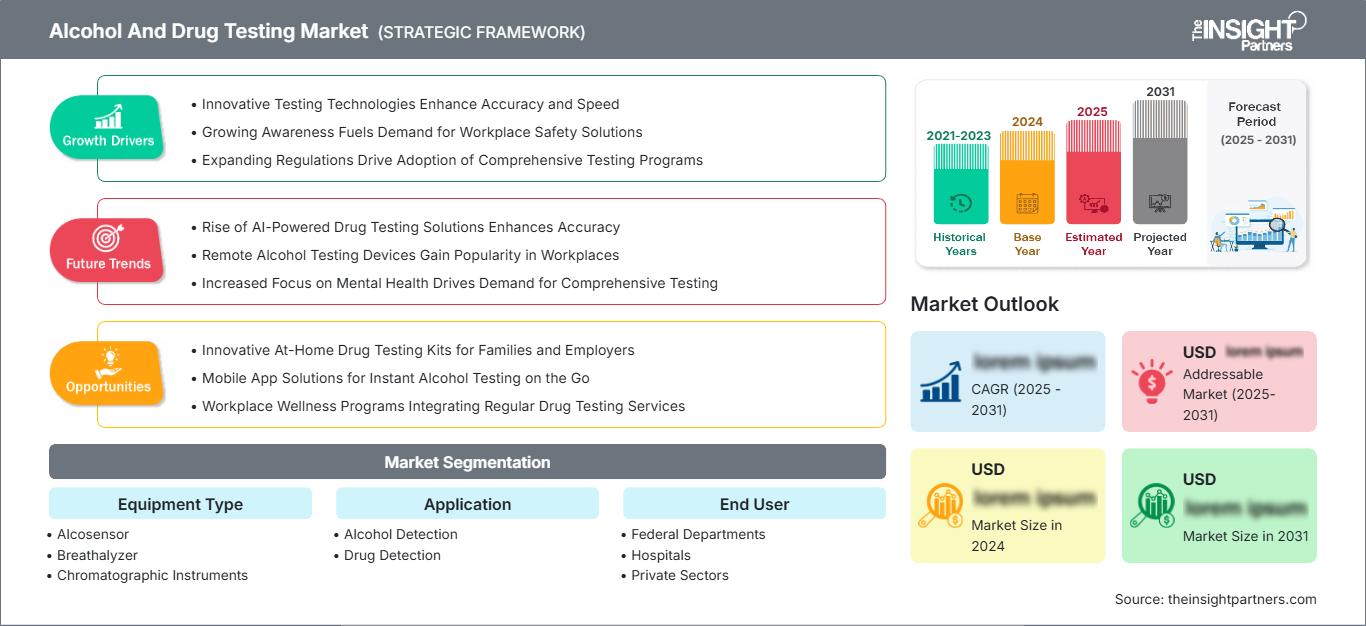
The alcohol and drug testing market was valued at US$ 34.51 Billion in 2025 and is projected to reach US$ 67.51 Billion by 2034, registering a CAGR of 7.74% during 2026–2034. This is influenced by growth in the number of regulatory actions in transport, workplace drug testing programs, and criminal justice systems. Also influencing growth is the development of innovations such as rapid drug detection devices and chromatography.
North America is projected to be the leader in the industry with an annual growth rate of 7.5-8.0% during the forecast period. North American alcohol and drug testing market size will be positively impacted by regulatory measures on drug testing at workplaces, advanced forensics facilities, and increased use of alcohol monitoring technology in police and rehab programs. Also contributing to growth is the high prevalence of opioids.
Alcohol And Drug Testing Market Assessment and Insights
- North America: North America accounted for 38–42% of the alcohol and drug testing market share in 2025 and is projected to grow at a CAGR of 7.5–8.0% during 2026–2034. Strong regulatory enforcement, workplace testing mandates, and advanced forensic systems continue to drive regional dominance.
- U.S.: The U.S. held 80–84% of North America in 2025 and is expected to grow at 7.6–8.1% CAGR, supported by federal drug enforcement policies and large-scale workplace testing programs.
- Europe: Europe represented 27–31% share in 2025 and is projected to grow at 7.0–7.5% CAGR, led by Germany, the UK, and France due to stringent road safety and occupational testing regulations.
- Asia Pacific: Asia Pacific held 20–24% share in 2025 and is expected to grow at 8.2–8.8% CAGR, driven by rising workplace compliance in China, India, Japan, and Australia.
- Largest Segment (Equipment Type): Equipment Type accounted for 40–44% share in 2025 and is projected to grow at 7.4–7.9% CAGR, driven by adoption of breathalyzers and chromatographic instruments.
- High Growth Segment (Application – Drug Detection): Drug detection applications held 52–56% share in 2025 and are expected to grow at 7.8–8.3% CAGR due to rising opioid screening requirements.
- Key companies analyzed in detail: Abbott, Alcolizer, Alcohol Countermeasure Systems Corp., AK Solutions, Akers Biosciences, Alere Inc., Alcovisor, Applied Nanodetectors Ltd., BACtrack, Bio-Rad Laboratories Inc.
Source: The Insight Partners' analysis based on proprietary research, government publications, company annual reports, investor presentations, industry databases, and expert interviews.
As per the alcohol and drug test market report, important aspects are discussed which prove useful in the technique of breath and urine testing, as well as in the understanding of digital forensic systems. Early implementations were restricted to checkpoint tests by police forces and laboratories of toxicology clinics. But because of rising abuse of drugs and stringent workplace safety norms, there is now a greater inclination towards continuous testing systems, portable devices, and automated laboratories.
The dynamics within manufacturing are rapidly shifting towards miniaturization, connectivity in real time, and multi-sample detection. The trend within firms is towards purchasing portable breathalyzer kits, rapid oral fluid tests, and cloud connected forensic tools in order to optimize the compliance workflow process.
The future market trends would see more use of AI-based diagnostic analysis systems and the growth of decentralized testing methods. There are increased investments being made in work place drug testing facilities in developing nations from Asia Pacific and Latin America. Stringent regulations in the areas of transport, defense, and healthcare industries would ensure that demand for the product remains high, along with improvements in technology for non-invasive testing systems.
Alcohol And Drug Testing Market Report Scope
| Report Attribute | Details |
|---|---|
| Market size in 2025 | US$ 34.51 Billion |
| Market Size by 2034 | US$ 67.51 Billion |
| Global CAGR (2026 - 2034) | 7.74% |
| Historical Data | 2021-2024 |
| Forecast period | 2026-2034 |
Alcohol And Drug Testing Market Analysis
The Alcohol and Drug Testing Market growth is driven by increased regulation of workplace safety, higher needs of substance abuse testing, and increased use of screening among the transport sector, healthcare organizations, police, and rehabilitation centers. Factors that drive demand include the increasing use of rapid test kits, which decrease processing time. Value chain participants include biosensors developers, makers of diagnostic equipment, laboratories, software platform providers, distributors, hospitals, employers, and governmental organizations.
Dynamics in the supply side are moving towards portability, automation, and connectivity of testing systems. Suppliers are targeting breathalyzers, testing of oral fluid, immunoassay analyzers, chromatographic systems, and multi-substance testing kits for various testing environments. Increasing importance of factors such as accuracy, calibration stability, chain of custody compliance, data security, and deployability influences procurement decisions.
The Alcohol and Drug Testing Market analysis indicates a moderately competitive landscape shaped by diagnostic innovation, regulatory approvals, brand reliability, and distribution reach. Competitors like Abbott, Alcolizer, Alcohol Countermeasure Systems Corp., AK Solutions, Akers Biosciences, Alere Inc., Alcovisor, Applied Nanodetectors Ltd., BACtrack, and Bio-Rad Laboratories Inc. differentiate themselves through their unique product ranges targeting professional, forensic, clinical, and consumer alcohol and drug testing.
Strategic investment is now being focused on non-invasive testing procedures, use of AI technologies for data analysis, portable diagnostic devices, and cloud solutions for compliance management. Faster detection, wider range of drugs tested for, and usability of devices in the field are among the top differentiators now. Strategic cooperation with employers, federal agencies, rehabilitation centers, and diagnostic labs is increasingly important.
● REPORT CUSTOMIZATION
Tailor This Report To Align With Your Specific Business Requirements
This report can be customized to align precisely with your business objectives, scope, and target markets. Customization options include tailored segmentation, geography, competitive analysis, and strategic insights to support informed decision-making.
Customize This Report →WHAT YOU CAN ADJUST
- ● Segmentations
- ● Geography
- ● Competitive Analysis
- ● Language Preferences
Alcohol And Drug Testing Market: Strategic Insights
Regional Insights
North America Alcohol and Drug Testing Market
North America will continue to dominate with a 38-42% share in 2025, with a forecasted growth of 7.5-8.0% CAGR until 2034. The stringent implementation of workplace drug screening regulations, forensic testing in criminal justice systems, and a high rate of adoption of modern diagnostic techniques are some of the main structural drivers. According to the market analysis of the alcohol and drug testing industry, federal government spending on substance abuse programs adds up to institutional demand.
A well-developed infrastructure of accredited labs, breathalyzer and testing devices manufacturers, and software companies offering compliance solutions are among the main advantages of the region. The growing number of opioid abuse instances and the increasing attention to road safety inspections are driving the adoption of breathalyzers and rapid testing devices. Expansion of corporate compliance regulations in the transportation and military industries is enhancing market potential.
U.S. Alcohol and Drug Testing Market
The U.S. accounts for 80–84% of North America’s market share in 2025 and is expected to grow at a CAGR of 7.6–8.1% through 2034. Federal workplace drug testing programs, Department of Transportation regulations, and widespread adoption of forensic toxicology systems are key growth enablers. The alcohol and drug testing market growth is further reinforced by large-scale screening across correctional facilities and rehabilitation centers.
The advanced use of breath analyzers, chromatography instruments, and oral fluid testing instruments is spreading within both the government and non-government sectors. The prominent players in the market are making continuous investments in portable test systems integrated with artificial intelligence technology that will boost their accuracy and efficiency. It will have a positive impact on the growth of the market in the country.
Europe Alcohol and Drug Testing Market
Europe held 27–31% share in 2025 and is projected to grow at a CAGR of 7.0–7.5% through 2034. Stringent road safety rules, occupational alcohol testing, and development of forensic laboratory facilities have been driving the demand for such tests in this region. Some countries like Germany, the UK, and France have been adopting them due to strong regulatory environment and occupational safety laws. Alcohol and Drug Testing Market Analysis finds that automation is becoming more common in lab testing processes.
In Germany there is high demand due to compliance with industrial safety requirements and testing of transportation employees. In the UK, drug testing is being used more widely within rehabilitation and criminal justice systems, while in France, Italy, and Spain testing in workplaces is being strengthened along with clinical toxicology.
Asia Pacific Alcohol and Drug Testing Market
The Asia Pacific market captured 20-24% share in 2025 and will witness the highest CAGR of 8.2-8.8% during the period 2026-2034. The drivers of market growth include fast pace of industrialization, stringent regulation in workplace safety, and increased awareness about drug abuse. Market scope is widening in China, India, Japan, South Korea, and Australia, owing to compliance-related measures undertaken by governments.
China and India are experiencing a faster adoption rate on account of growing transportation and manufacturing industries that necessitate testing of employees. Japan and South Korea are concentrating on developing forensic testing solutions whereas Australia is emphasizing on roadside testing for alcohol.
Middle East & Africa Alcohol and Drug Testing Market
The Middle East & Africa region is expected to grow at a CAGR of 5.8–6.4% during 2026–2034, supported by increasing regulatory enforcement in workplace safety and transportation sectors. The alcohol and drug testing market analysis indicates gradual adoption driven by government initiatives aimed at reducing substance-related accidents and improving public safety compliance.
The Saudi Arabia market is at the forefront in the region because of its strict laws and expanding healthcare facilities. The UAE market is experiencing increased adoption in the corporate and aviation industries, whereas the South Africa market is improving its forensic and rehabilitation testing services. RoMEA market is steadily adopting portable testing equipment.
Segmentation Analysis
Equipment Type
The Equipment Type segment is projected to grow at a CAGR of 7.4–7.9% during 2026–2034, driven by increasing demand for portable, accurate, and rapid diagnostic systems. The growth is attributed to the rising demand for portable and accurate diagnostic equipment. This is further backed by developments in technologies such as breathalyzer devices, chromatographic equipment, and immunoassay analyzers.
- Alcosensor: Widely used for portable alcohol detection in law enforcement and workplace screening, offering rapid results and ease of use in field environments.
- Breathalyzer: Core technology for alcohol detection, extensively deployed in roadside testing and occupational screening due to high accuracy and fast response time.
- Chromatographic Instruments: Used in forensic laboratories for precise drug and alcohol compound separation and identification with high analytical accuracy.
- Hair Testing Devices: Enable long-term substance abuse detection by analyzing historical drug exposure over extended periods.
- Immuno Assay Analyzers: Provide rapid laboratory-based screening for drug metabolites with high throughput efficiency.
- Intoxilyzer: Advanced breath testing system used in legal enforcement scenarios requiring evidentiary-grade results.
- Oral Fluid Testing Devices: Offer non-invasive, rapid screening for drug and alcohol presence, increasingly used in workplace testing.
- Urine Testing Devices: Most widely used method for drug screening due to cost efficiency and established laboratory protocols.
Application
The Application segment is expected to grow at a CAGR of 7.6–8.2% during 2026–2034. This market segment will benefit from the increased enforcement of substance abuse laws in various industries. Growing applications of alcohol testing and drug testing are driven by the need for higher compliance in the transport industry, work environments, and criminal justice systems.
- Alcohol Detection: Focused on identifying blood alcohol concentration levels for legal enforcement, workplace safety, and transportation compliance applications.
- Drug Detection: Rapidly expanding due to rising opioid, cannabis, and prescription drug abuse cases, requiring multi-panel screening across clinical and forensic environments.
End User
The End User segment is projected to grow at a CAGR of 7.5–8.0% during 2026–2034, driven by institutional adoption across federal departments, healthcare systems, and private organizations. Increasing regulatory enforcement and workplace safety mandates continue to strengthen demand across all end-user categories in the alcohol and drug testing market.
- Federal Departments: Key adopters for law enforcement, roadside testing, and criminal justice applications requiring high-accuracy forensic testing systems.
- Hospitals: Utilize testing systems for emergency care, toxicology screening, and substance abuse treatment monitoring programs.
- Private Sectors: Corporate organizations implement workplace drug and alcohol testing to ensure safety compliance and productivity management.
- Rehabilitation Centers: Use continuous testing systems to monitor patient recovery and prevent relapse in substance abuse treatment programs.
Opportunity Snapshot
| End User | Revenue Contribution | Trend Tag | Adoption Stage |
| Federal Departments | High | Compliance Tech | Mature |
| Private Sectors | High | Workplace Safety | Scaling |
| Rehabilitation Centers | Medium | Recovery Monitoring | Scaling |
| Hospitals | Medium | Clinical Toxicology | Mature |
Alcohol And Drug Testing Market Growth Drivers and Impact Analysis
Increasing Workplace Safety Regulations
Increasing strictness on occupational safety regulations has proven to be one of the primary factors affecting the implementation of testing solutions in various industrial, transportation, and corporate settings. Regulatory agencies are introducing screening programs as a way of reducing work accidents caused by impairment. This has resulted in increased demand for efficient detection devices, which can give quick and accurate tests. Various industries such as manufacturing, logistics, airlines, and construction are adopting testing methods in their safety program strategies. This trend is leading firms to invest in advanced testing machinery, software, and monitoring systems.
Rising Demand for Rapid Diagnostic Technologies
Portable test technology innovations are helping in the improvement of the accessibility, effectiveness, and operability in various applications. Companies are now favoring tools that provide quick results and do not need complex laboratory setup. Advances in bio-sensing technology, connectivity, and automation are facilitating real-time screening in various organizations such as health care institutions, companies, and governmental agencies. In cases of transport and other field applications, portable technology plays an important role since decisions must be made in a timely manner. Such tendencies related to decentralized test technologies affect product development by companies in their innovative solutions.
Expansion of Substance Abuse Monitoring Programs
Increased consciousness about prevention and rehabilitation from substance abuse is resulting in more testing being adopted in hospitals, rehabilitation centers, and public organizations. It is important that such testing programs have reliable devices that can test for a wide range of drugs with high levels of precision. More money and effort being put into healthcare facilities and preventive medicine are further driving the demand for diagnostics equipment. Continuous monitoring techniques are also becoming popular as organizations aim to get better results from their treatments and minimize chances of a relapse.
Alcohol And Drug Testing Market Future Trends
Integration of Connected Testing Platforms
The Alcohol and Drug Testing Market trends have now become dependent on the emergence of connected diagnosis systems that integrate testing instruments with data handling systems. The future solutions will include cloud computing that supports the management of reports, automatic results tracking, and remote monitoring features. Such tools could make operations more efficient by making sure that organizations are able to handle their testing programs using an integrated platform. Integration with electronic medical records and workforce management software could make the technology more user-friendly in healthcare settings as well as corporate settings. Interoperability could be a critical feature among the priorities of manufacturers.
Development of Non-Invasive Testing Solutions
Any future development in terms of testing technologies will be aimed at enhancing user experience by means of developing non-invasive testing methods and more effective detection systems. Methods such as oral fluid testing, use of sensors, and portable detection equipment will be in the spotlight since companies need to find some more convenient options compared to conventional methods. Moreover, this way of testing can provide an opportunity for increasing efficiency of testing processes. Currently, researches are being conducted in order to increase sensitivity, precision, and effectiveness of multi-substance detection of such systems. With the increased acceptance of regulatory measures, such testing methods may become more popular in the field.
Alcohol And Drug Testing Market Opportunities
Expansion Across Emerging Healthcare Systems
Developing healthcare systems in Asia Pacific, Latin America, and Middle Eastern countries present significant opportunities for technology providers. The Alcohol and Drug Testing Market Forecasts indicate that increasing healthcare investments, expanding diagnostic infrastructure, and growing awareness of substance monitoring will support future adoption. Companies can explore partnerships with hospitals, government agencies, and healthcare distributors to improve accessibility. Emerging markets are also witnessing increased workplace safety requirements, creating demand beyond traditional healthcare applications. Strategic localization of products, pricing models, and service networks can help manufacturers address regional needs. Investments focused on affordable and scalable testing platforms may create additional growth pathways in underserved markets.
Advancement in Multi-Substance Detection Platforms
Development of advanced platforms capable of detecting multiple substances through a single testing process offers strategic opportunities for industry participants. Manufacturers can strengthen competitive positioning by investing in integrated technologies that improve efficiency and reduce operational complexity. Organizations managing large-scale testing programs increasingly require solutions that provide comprehensive screening capabilities with minimal processing time. Collaboration between technology developers, diagnostic companies, and research institutions may accelerate innovation in sensor technologies and analytical methods. Companies focusing on flexible systems with improved accuracy and digital integration can address evolving customer expectations. These advancements may support broader adoption across government, healthcare, and private sector applications.
Recent Developments
- March 2026: Abbott Laboratories advanced its point-of-care toxicology testing portfolio by expanding integration of rapid immunoassay drug screening cartridges across decentralized healthcare settings. The initiative focuses on improving turnaround time for workplace and clinical screening workflows while supporting higher testing throughput in emergency and rehabilitation environments. The development strengthens Abbott’s position in rapid diagnostic alcohol and drug testing solutions globally.
- November 2025: 3M Company enhanced its occupational health and safety testing portfolio through upgraded breath alcohol detection systems designed for law enforcement and industrial compliance programs. The updated devices emphasize improved sensor accuracy, calibration stability, and integration with digital reporting platforms, supporting regulatory adherence across high-risk workplaces.
- June 2025: BACtrack introduced next-generation portable breathalyzers with improved semiconductor sensor technology aimed at consumer and professional-grade alcohol monitoring. The update strengthens adoption across personal safety, fleet management, and rehabilitation monitoring applications, reinforcing the company’s role in alcohol detection technologies.
Frequently Asked Questions

- Comprehensive Market Sizing and Forecast Analysis
- Detailed Segmentation Analysis
- In-Depth Market Dynamics Assessment
- Regional and Country-Level Insights
- Competitive Landscape and Company Benchmarking
- Strategic Business Intelligence
Recent Reports
Testimonials

The Insight Partners' SCADA System Market report is comprehensive, with valuable insights on current trends and future forecasts. The team was highly professional, responsive, and supportive throughout. We are very satisfied and highly recommend their services.
RAN KEDEM Partner, Reali Technologies LTDs
I requested a report on a very specific software market and the team produced the report in a few days. The information was very relevant and well presented. I then requested some changes and additions to the report. The team was again very responsive and I got the final report in less than a week.
JEAN-HERVE JENN Chairman, Future Analytica
We worked with The Insight Partners for an important market study and forecast. They gave us clear insights into opportunities and risks, which helped shape our plans. Their research was easy to use and based on solid data. It helped us make smart, confident decisions. We highly recommend them.
PIYUSH NAGPAL Sr. Vice President, High Beam Global
The Insight Partners delivered insightful, well-structured market research with strong domain expertise. Their team was professional and responsive throughout. The user-friendly website made accessing industry reports seamless. We highly recommend them for reliable, high-quality research services
YUKIHIKO ADACHI CEO, Deep Blue, LLC.
This is the first time I have purchased a market report from The Insight Partners.While I was unsure at first, I visited their web site and felt more comfortable to take the risk and purchase a market report.I am completely satisfied with the quality of the report and customer service. I had several questions and comments with the initial report, but after a couple of dialogs over email with their analyst I believe I have a report that I can use as input to our strategic planning process.Thank you so much for taking the extra time and making this a positive experience.I will definitely recommend your service to others and you will be my first call when we need further market data.
JOHN SUZUKI President and Chief Executive Officer, Board Director, BK Technologies
I wish to appreciate your support and the professionalism you displayed in the course of attending to my request for information regarding to infectious disease IVD market in Nigeria. I appreciate your patience, your guidance, and the fact that you were willing to offer a discount, which eventually made it possible for us to close a deal. I look forward to engaging The Insight Partners in the future, all thanks to the impression you have created in me as a result of this first encounter.
DR CHIJIOKE ONYIA MANAGING DIRECTOR, PineCrest Healthcare Ltd.Reason to Buy
- Informed Decision-Making
- Understanding Market Dynamics
- Competitive Analysis
- Identifying Emerging Markets
- Customer Insights
- Market Forecasts
- Risk Mitigation
- Boosting Operational Efficiency
- Strategic Planning
- Investment Justification
- Tracking Industry Innovations
- Aligning with Regulatory Trends





 Get Free Sample for