
Alcohol-free Hand Sanitizer Market Size, Trends & Growth by 2034
Coverage: By Product (Gel, Liquid, Others); Distribution Channel (Supermarket and hypermarket, Convenience Stores, Online Retail, Others) , and Geography (North America, Europe, Asia Pacific, and South and Central America)
- Status : Data Released
- Report Code : TIPRE00026988
- Category : Consumer Goods
- No. of Pages : 150
- Available Report Formats :


- Last update date : August 10, 2026


2025 Market Size
US$ 2.24 Bn
Base year value
2034 Forecast
US$ 6.36 Bn
Projected by 2034
CAGR 2026-2034
13.93 %
Growth rate
Addressable Market
US$ 40.93 Bn
(2026-2034)
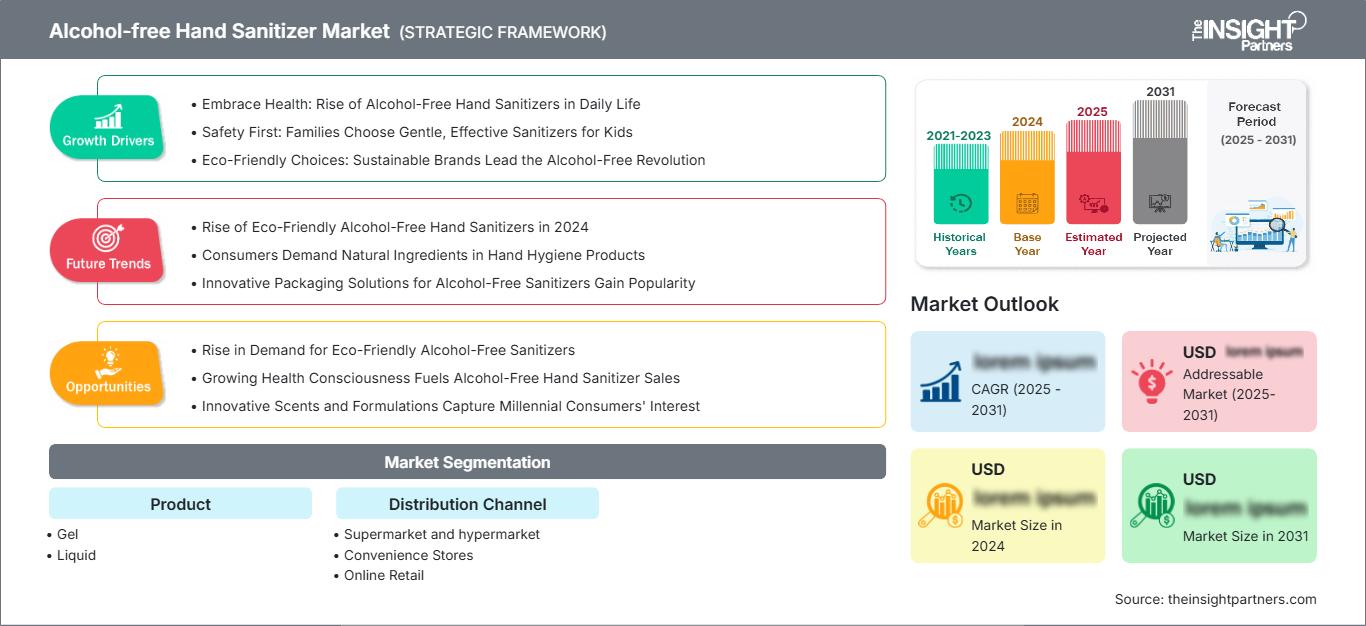
The alcohol-free hand sanitizer market was valued at US$ 2.24 Billion in 2025 and is projected to reach US$ 6.36 Billion by 2034, expanding at a CAGR of 13.93% during 2026–2034. Rising preference for skin-friendly antimicrobial solutions, growing adoption across educational and healthcare facilities, and expanding consumer awareness regarding non-flammable hygiene products continue to support demand. Product innovation centered on benzalkonium chloride, botanical actives, and moisturizing formulations is further strengthening adoption across institutional and household applications.
Across North America, regulatory focus on hygiene compliance, workplace wellness programs, and demand for low-irritation sanitization products are creating favorable conditions. The alcohol-free hand sanitizer market size is supported by increasing procurement from schools, food service facilities, and healthcare providers. The regional market is estimated to expand at a CAGR range of 12.8–14.2% through 2034, with manufacturers emphasizing dermatologically tested formulations and sustainable packaging formats.
Alcohol-free Hand Sanitizer Market Assessment and Insights
- North America: Share in 2025: 34–38%. CAGR between 2026–2034: 12.8–14.2%. Strong institutional adoption, advanced retail penetration, and persistent focus on infection prevention continue to support regional demand.
- US: Share in 2025: 78–82% of North America. CAGR between 2026–2034: 12.5–14.0%. High brand visibility, healthcare procurement, and educational sector usage remain key growth catalysts.
- Europe: Share in 2025: 26–30%. CAGR between 2026–2034: 12.0–13.5%. Germany, the UK, and France lead regional consumption owing to hygiene regulations and premium personal-care demand.
- Asia Pacific: Share in 2025: 24–28%. CAGR between 2026–2034: 15.0–16.5%. China, India, Japan, and South Korea drive volume growth through expanding retail and e-commerce channels.
- Largest Segment: Gel. Market share in 2025: 58–62%. CAGR between 2026–2034: 13.0–14.0%. Convenience, portability, and user familiarity support segment leadership.
- High Growth Segment: Online Retail. Market share in 2025: 22–26%. CAGR between 2026–2034: 16.5–18.0%. Digital purchasing and direct-to-consumer strategies accelerate growth.
- Key companies analyzed in detail: SC Johnson & Son, Inc.; Best Sanitizers, Inc.; Essity Hygiene and Health AB; Himalaya Global Holdings Ltd.; GOJO Industries, Inc.; Procter & Gamble Company; Unilever PLC; Henkel Corporation; Reckitt Benckiser Group plc; Vi-Jon, LLC.
Source: The Insight Partners' analysis based on proprietary research, government publications, company annual reports, investor presentations, industry databases, and expert interviews.
Consumer demand changes are driving the development of antimicrobial solutions that can condition the skin, be non-fragranced, and be botanical. Manufacturers are including humectants, aloe extract, and low irritation components in their products to distinguish them. In parallel with this, retailers are increasing shelf space for alcohol-free products as consumers look for products that would suit kids, people with sensitive skin, and situations where alcohol-based products might face difficulties in handling.
Future developments include opportunities in Asia Pacific, the Middle East, and institutional purchasing programs. Hygiene initiatives by the government, organized retail, and investments in domestic manufacturing of personal care products are enabling their use. Innovation in refills, packaging materials, and multifunctional sanitization solutions is foreseen as an avenue for commercialization and market penetration.
Alcohol-free Hand Sanitizer Market Report Scope
| Report Attribute | Details |
|---|---|
| Market size in 2025 | US$ 2.24 Billion |
| Market Size by 2034 | US$ 6.36 Billion |
| Global CAGR (2026 - 2034) | 13.93% |
| Historical Data | 2021-2024 |
| Forecast period | 2026-2034 |
Alcohol-free Hand Sanitizer Market Analysis
The alcohol-free hand sanitizer market growth trajectory is being driven by increasing demand for non-flammable and skin-friendly hygiene products. Customers prefer products with formulations that feature benzalkonium chloride and botanical extracts, offering antimicrobial benefits without drying out the skin excessively. Some of the major sources of demand include hospitals, educational institutions, food service businesses, and domestic buyers. Supply chains have diversified due to the sourcing of functional ingredients from various parts of the world to limit supply risks.
Value-chain integration is increasing for industry players by entering into product packaging agreements, participating in electronic business activities, and employing a manufacturing close to the customer approach. Competitive differentiators include proof of efficacy, skin compatibility, sustainable credentials, and convenience. The growing prevalence of private-label products adds to the competitive pressures.
The alcohol-free hand sanitizer market analysis indicates a moderately consolidated competitive environment characterized by brand recognition, innovation capability, and distribution reach. Organizations like GOJO Industries, Inc., Reckitt Benckiser Group plc, Unilever PLC, SC Johnson & Son, Inc., and Procter & Gamble Company leverage consumer trust and retail distribution channels. Specialized distributors such as Best Sanitizers, Inc. and Vi-Jon, LLC stay relevant by offering specialized institutional products.
Investment in recent years has been made in product re-engineering, automation in manufacturing processes, and e-commerce operations. Positioning in current times is geared towards sustainability, refills, sensitive skin, and healthcare system collaboration to secure repeat business and customer loyalty.
● REPORT CUSTOMIZATION
Tailor This Report To Align With Your Specific Business Requirements
This report can be customized to align precisely with your business objectives, scope, and target markets. Customization options include tailored segmentation, geography, competitive analysis, and strategic insights to support informed decision-making.
Customize This Report →WHAT YOU CAN ADJUST
- ● Segmentations
- ● Geography
- ● Competitive Analysis
- ● Language Preferences
Alcohol-free Hand Sanitizer Market: Strategic Insights
Regional Insights
North America alcohol-free hand sanitizer market
North America accounted for 34–38% of global revenue in 2025 and is projected to grow at a 12.8–14.2% CAGR through 2034. The region benefits from mature retail infrastructure, extensive hygiene awareness, and widespread institutional procurement. Demand is supported by schools, healthcare facilities, hospitality operators, and corporate workplaces seeking alternatives suitable for frequent use.
The region holds the largest alcohol-free hand sanitizer market share globally. Product innovation emphasizing skin hydration, fragrance-free solutions, and sustainable packaging continues attracting consumers. Regulatory oversight, strong brand presence, and broad product availability across supermarkets and online channels reinforce long-term growth prospects.
U.S. alcohol-free hand sanitizer market
The United States represented 78–82% of North American revenue in 2025 and is expected to expand at a 12.5–14.0% CAGR through 2034. Strong consumer familiarity with hand hygiene products, combined with workplace wellness programs, supports stable adoption. Educational settings continue generating substantial recurring demand.
Major suppliers, including GOJO Industries, Inc., Procter & Gamble Company, SC Johnson & Son, Inc., and Reckitt Benckiser Group plc, maintain extensive market visibility. Growth is increasingly linked to premium formulations, child-safe products, and digital retail channels. Subscription purchasing models and direct-to-consumer distribution are gaining traction.
Europe alcohol-free hand sanitizer market
Europe accounted for 26–30% of global demand in 2025 and is anticipated to expand at a 12.0–13.5% CAGR through 2034. Germany remains the leading market due to strong healthcare spending and consumer preference for dermatologically tested products. The region also benefits from sustainability-focused packaging initiatives.
The UK records strong demand from retail and workplace hygiene applications, while Germany benefits from pharmaceutical-grade quality preferences. France, Italy, and Spain continue supporting growth through personal-care consumption and institutional procurement. Regional producers increasingly prioritize recyclable packaging and plant-derived ingredients to align with evolving consumer expectations.
APAC alcohol-free hand sanitizer market
Asia Pacific captured 24–28% of global revenue in 2025 and is forecast to grow at a 15.0–16.5% CAGR, the fastest among major regions. China and India lead volume expansion, supported by rising hygiene awareness and increasing organized retail presence.
Japan, South Korea, and Australia contribute through premium product adoption and regulatory compliance. Growing e-commerce penetration and local production initiatives continue enhancing accessibility across urban and semi-urban markets.
Middle East & Africa alcohol-free hand sanitizer market
The Middle East & Africa market is forecast to grow at a 11.5–13.0% CAGR through 2034. Saudi Arabia and the UAE benefit from investments in healthcare infrastructure, tourism, and public hygiene initiatives.
South Africa remains an important regional contributor, while other MEA countries are witnessing increasing retail availability. Infrastructure development and healthcare modernization continue to support demand for effective and skin-friendly sanitation products.
Segmentation Analysis
Product
Product is a core differentiator in the market, with manufacturers focusing on user convenience, skin compatibility, and antimicrobial performance. The segment is projected to expand at a 13.0–14.5% CAGR during 2026–2034. The alcohol-free hand sanitizer market scope continues widening as product innovation addresses sensitive-skin requirements while maintaining efficacy standards.
- Gel – Maintains the largest position due to ease of application, controlled dispensing, portability, and strong consumer familiarity across household, educational, and workplace environments.
- Liquid – Favored in commercial facilities and high-traffic locations because of rapid spreading characteristics and compatibility with automated dispensing systems.
Distribution Channel
Distribution Channel remains critical for market expansion and is anticipated to grow at a 14.0–15.5% CAGR during 2026–2034. Digital transformation, omnichannel retail strategies, and institutional procurement partnerships are increasing product accessibility while improving market penetration.
- Supermarket and hypermarket – Continues serving as a key sales avenue through product visibility, consumer trust, and immediate purchase convenience.
- Convenience Stores – Supports impulse purchasing and localized availability, particularly in urban centers and travel-oriented locations.
- Online Retail – Gains momentum through wider product selection, subscription options, direct-to-consumer models, and targeted promotional strategies.
Opportunity Snapshot
| Distribution Channel | Revenue Contribution | Trend Tag | Adoption Stage |
| Supermarket and hypermarket | High | Shelf Expansion | Mature |
| Convenience Stores | Medium | Travel Purchase | Scaling |
| Online Retail | High | Digital Commerce | Scaling |
Alcohol-free Hand Sanitizer Market Growth Drivers and Impact Analysis
Rising demand for skin-friendly hygiene solutions
Customers now look for sanitization solutions that reduce irritation due to frequent application. Alcohol-free solutions with moisturizing components and aloe extracts have found favor among healthcare professionals, educators, parents, and office personnel. This trend facilitates the production of high-end products, thus inspiring firms to come up with innovative products for sensitive skin users. With the rising understanding of the importance of skin health over time, the use of such products spreads from the healthcare sector to households, hospitality centers, and business establishments.
Expansion of institutional procurement programs
Learning centers, food processing units, transport facilities, and offices are progressively adopting non-alcohol sanitizers for their hygiene routines. The purchase decisions are motivated by safety issues, minimized risks of flammability, and frequent usability. The long-term contracts will guarantee a regular stream of orders for the manufacturer while ensuring a steady supply. The performance consistency and conformity to the hygiene standards are appreciated by institutional buyers. The managers at the facilities take into consideration the health of their employees and guests, and thus develop an infection prevention strategy.
Growth of organized retail and e-commerce channels
The modernization of retail operations and growth in digital commerce keep making it easier for consumers to access products in both developed and developing nations. There is increased visibility of premium and specialized products on supermarket chains, hypermarkets, and even online platforms. There are various ways of ensuring that the consumer makes informed buying decisions, which include product reviews, subscription services, and comparison shopping. There are also benefits for manufacturers who can engage directly with the consumers.
Alcohol-free Hand Sanitizer Market Future Trends
Botanical and clean-label formulation development
The alcohol-free hand sanitizer market trends increasingly point toward clean-label formulations that combine antimicrobial performance with naturally derived ingredients. It is anticipated that the manufacturers will increase their application of botanical extracts, products without fragrances, and eco-friendly packaging. Increased awareness on the part of consumers regarding the safety of ingredients will force manufacturers to be more transparent in their practices and obtain dermatological certification. During the coming years, the product ranges will focus more on multiple effects like skin moisturizing, odor protection, and increased comfort.
Smart dispensing and refill ecosystem integration
It is expected that commercial customers will embrace dispensers that have connectivity features that will enable them to monitor the usage habits, the stock level, and refilling needs. This can result in increased efficiency in operations and reduced wastage. There is also an expectation that refillable packaging will become more popular as organizations make procurement decisions in accordance with their sustainability goals. The integration of monitoring technology with facility management software will help in achieving this objective.
Alcohol-free Hand Sanitizer Market Opportunities
Expansion across emerging institutional sectors
Significant opportunities exist in educational campuses, logistics facilities, hospitality operations, and public transportation networks. These environments require high-frequency hand hygiene solutions that are safe for repeated use and suitable for diverse user groups. Companies able to establish institutional procurement partnerships can benefit from recurring demand and predictable revenue streams. Product customization, bulk packaging formats, and automated dispensing compatibility are expected to become important competitive differentiators. Alcohol-free hand sanitizer market Forecasts indicate that expanding institutional adoption could represent one of the most attractive long-term growth avenues.
Premiumization through dermatological positioning
There is a growing investment opportunity in premium category products focused on skin health, child-friendly, and eco-friendly ingredients. Consumer ability to pay more for improved skin compatibility provides opportunities for differentiating brands. The manufacturers will benefit from conducting clinical tests, getting sustainable certifications, and being more open about their ingredients in order to build better market positioning. Collaboration with health care experts and wellness retailers could be another way to enhance credibility.
Frequently Asked Questions

- Comprehensive Market Sizing and Forecast Analysis
- Detailed Segmentation Analysis
- In-Depth Market Dynamics Assessment
- Regional and Country-Level Insights
- Competitive Landscape and Company Benchmarking
- Strategic Business Intelligence
Recent Reports
Testimonials

The Insight Partners' SCADA System Market report is comprehensive, with valuable insights on current trends and future forecasts. The team was highly professional, responsive, and supportive throughout. We are very satisfied and highly recommend their services.
RAN KEDEM Partner, Reali Technologies LTDs
I requested a report on a very specific software market and the team produced the report in a few days. The information was very relevant and well presented. I then requested some changes and additions to the report. The team was again very responsive and I got the final report in less than a week.
JEAN-HERVE JENN Chairman, Future Analytica
We worked with The Insight Partners for an important market study and forecast. They gave us clear insights into opportunities and risks, which helped shape our plans. Their research was easy to use and based on solid data. It helped us make smart, confident decisions. We highly recommend them.
PIYUSH NAGPAL Sr. Vice President, High Beam Global
The Insight Partners delivered insightful, well-structured market research with strong domain expertise. Their team was professional and responsive throughout. The user-friendly website made accessing industry reports seamless. We highly recommend them for reliable, high-quality research services
YUKIHIKO ADACHI CEO, Deep Blue, LLC.
This is the first time I have purchased a market report from The Insight Partners.While I was unsure at first, I visited their web site and felt more comfortable to take the risk and purchase a market report.I am completely satisfied with the quality of the report and customer service. I had several questions and comments with the initial report, but after a couple of dialogs over email with their analyst I believe I have a report that I can use as input to our strategic planning process.Thank you so much for taking the extra time and making this a positive experience.I will definitely recommend your service to others and you will be my first call when we need further market data.
JOHN SUZUKI President and Chief Executive Officer, Board Director, BK Technologies
I wish to appreciate your support and the professionalism you displayed in the course of attending to my request for information regarding to infectious disease IVD market in Nigeria. I appreciate your patience, your guidance, and the fact that you were willing to offer a discount, which eventually made it possible for us to close a deal. I look forward to engaging The Insight Partners in the future, all thanks to the impression you have created in me as a result of this first encounter.
DR CHIJIOKE ONYIA MANAGING DIRECTOR, PineCrest Healthcare Ltd.Reason to Buy
- Informed Decision-Making
- Understanding Market Dynamics
- Competitive Analysis
- Identifying Emerging Markets
- Customer Insights
- Market Forecasts
- Risk Mitigation
- Boosting Operational Efficiency
- Strategic Planning
- Investment Justification
- Tracking Industry Innovations
- Aligning with Regulatory Trends





 Get Free Sample for