
Alternative Protein Market Trends, Size & Forecast by 2034
Coverage: By Source (Plant, Microbial, Insects); Application (Food and Beverages, Animal Feed, Nutraceuticals, Others) , and Geography (North America, Europe, Asia Pacific, and South and Central America)
- Status : Data Released
- Report Code : TIPRE00007141
- Category : Food and Beverages
- No. of Pages : 150
- Available Report Formats :


- Last update date : August 18, 2026


2025 Market Size
US$ 19.45 Bn
Base year value
2034 Forecast
US$ 48.37 Bn
Projected by 2034
CAGR 2026-2034
12.06 %
Growth rate
Addressable Market
US$ 322.86 Bn
(2026-2034)
The alternative protein market was valued at US$ 19.45 Billion in 2025 and is projected to reach US$ 48.37 Billion by 2034, advancing at a CAGR of 12.06% during 2026–2034. Expansion is supported by broader consumer acceptance of non-animal protein sources, advances in fermentation technologies, and increasing incorporation of sustainable protein ingredients across food manufacturing, feed formulation, and health-focused nutrition products.
Across North America, strong innovation ecosystems, expanding flexitarian consumption patterns, and investments in protein ingredient processing continue to strengthen demand fundamentals. The alternative protein market size in the region is supported by large-scale commercialization capabilities, favorable venture funding activity, and growing adoption of plant-derived and microbial proteins by major food producers. Regional growth is expected to remain in the low-to-mid teens throughout the forecast period.
Alternative Protein Market Assessment and Insights
- North America: Share in 2025: 36–40%. CAGR between 2026–2034: 11.0–12.5%. Strong ingredient innovation, established retail penetration, and growing demand for sustainable nutrition maintain regional leadership.
- US: Share in 2025: 72–76% of North America. CAGR between 2026–2034: 11.5–13.0%. Expanding foodservice adoption and concentration of protein technology developers support market expansion.
- Europe: Share in 2025: 28–32%. CAGR between 2026–2034: 11.5–13.0%. Germany, the UK, France, and the Netherlands remain key markets due to sustainability policies and alternative food innovation.
- Asia Pacific: Share in 2025: 22–26%. CAGR between 2026–2034: 13.0–14.5%. China, Japan, South Korea, India, and Australia benefit from protein security initiatives and manufacturing investments.
- Largest Segment: Food and Beverages. Market share in 2025: 62–66%. CAGR between 2026–2034: 11.5–12.8%. Product diversification and mainstream retail adoption sustain segment dominance.
- High Growth Segment: Microbial. Market share in 2025: 12–16%. CAGR between 2026–2034: 15.0–17.0%. Precision fermentation and biomass protein technologies drive accelerated growth.
- Key companies analyzed in detail: Archer Daniels Midland Company (ADM), Corbion Biotech, Inc., DuPont de Nemours, Inc., Entocycle Ltd., Glanbia plc, Ingredion Incorporated, Kerry Group plc, MGP Ingredients, Inc., Protix B.V., Roquette Frères, DSM-Firmenich AG.
Source: The Insight Partners' analysis based on proprietary research, government publications, company annual reports, investor presentations, industry databases, and expert interviews.
Rapid diversification of protein sources has reshaped product development strategies within the alternative protein market. Plants still provide the highest income from protein ingredients, thanks to economies of scale and distribution networks, but fermentation-based products are getting better in terms of taste, mouthfeel, and functional nutrition.
The prospects for future growth will be based primarily on market penetration, government regulations, and economics of production. New markets in Asia and the Middle East are gaining interest in investments in sustainable food systems, while public support for food security projects is fueling capacity building. Synergies between the suppliers of protein ingredients and food manufacturers will be the key factor in the rapid commercialization of new protein technologies.
Alternative Protein Market Report Scope
| Report Attribute | Details |
|---|---|
| Market size in 2025 | US$ 19.45 Billion |
| Market Size by 2034 | US$ 48.37 Billion |
| Global CAGR (2026 - 2034) | 12.06% |
| Historical Data | 2021-2024 |
| Forecast period | 2026-2034 |
Alternative Protein Market Analysis
The alternative protein market growth trajectory is supported by evolving dietary preferences, sustainability objectives, and concerns surrounding resource-intensive livestock production. Food processors have started to use plant-based proteins, fermentation products, and insect-based nutrition in their product lines. With consumer interest in a high-protein diet and an increase in understanding of the environmental effects of traditional protein production methods, this base keeps growing.
Value chains range from feedstocks, through biotech firms, ingredient producers, food processors, to nutraceuticals, and distribution channels. Supply chains become more diverse as suppliers strive for reliable sources and regional manufacturing capability. Advances in protein extraction, fermentation productivity, and formulation know-how are overcoming issues of taste, texture, and scale.
The analysis indicates a competitive environment characterized by innovation-led growth and strategic capacity expansion. Existing companies providing ingredients have been expanding their portfolios through acquisition deals, partnerships, and launching innovative products. Competition will be based on functionalities, clean labels, nutritionals, and efficiency as opposed to merely replacing proteins.
The key players in the industry, such as Archer Daniels Midland Company, Roquette Frères, Ingredion Incorporated, Kerry Group plc, Glanbia plc, Protix B.V., and DSM-Firmenich AG, are exploring next-generation formulations and production capacity expansion strategies. Business strategies are now largely dependent upon advanced processing technologies, worldwide distribution networks, sustainability, and scalability in food and feed applications.
● REPORT CUSTOMIZATION
Tailor This Report To Align With Your Specific Business Requirements
This report can be customized to align precisely with your business objectives, scope, and target markets. Customization options include tailored segmentation, geography, competitive analysis, and strategic insights to support informed decision-making.
Customize This Report →WHAT YOU CAN ADJUST
- ● Segmentations
- ● Geography
- ● Competitive Analysis
- ● Language Preferences
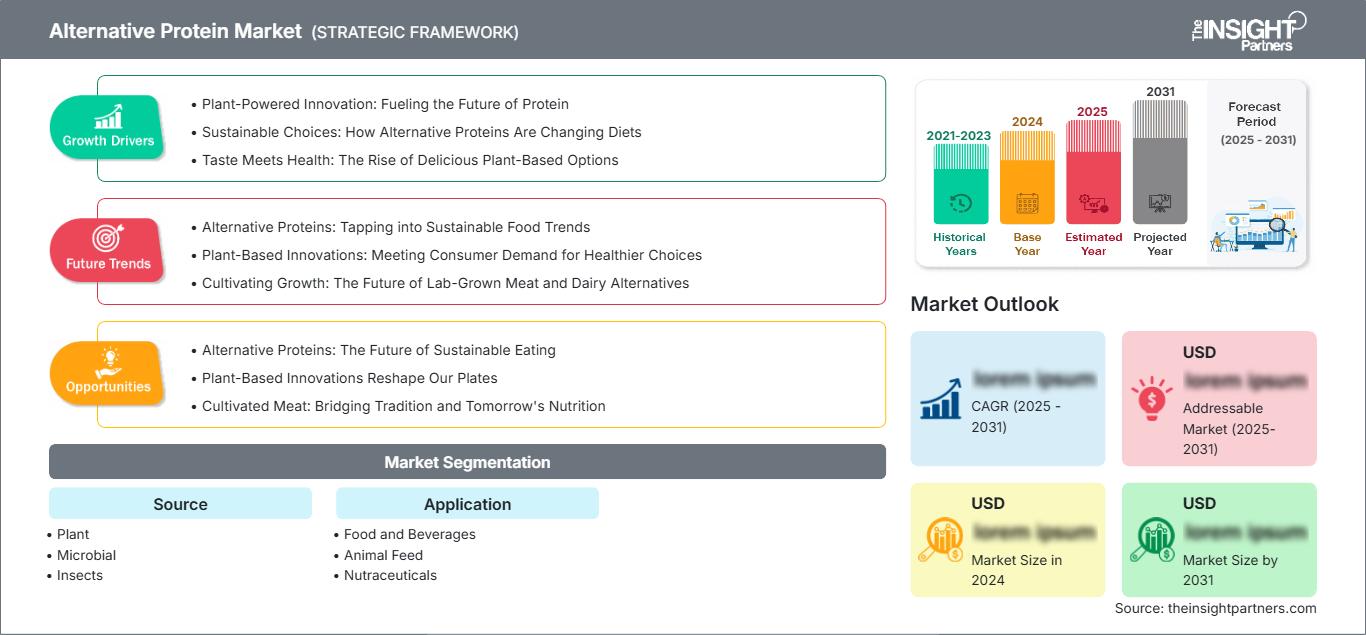
Alternative Protein Market: Strategic Insights
Regional Insights
North America alternative protein market
North America accounted for 36–40% of global revenue in 2025 and is projected to expand at a CAGR of 11.0–12.5% through 2034. The region benefits from mature food innovation ecosystems, significant venture capital activity, and high consumer awareness regarding sustainable nutrition. The alternative protein market share remains supported by established retail distribution and strong commercialization capabilities.
Growing demand for protein-enriched foods, increasing adoption of flexitarian diets, and investments in fermentation infrastructure continue to support expansion. Regulatory clarity, advanced biotechnology research, and collaborations between ingredient suppliers and consumer brands are creating favorable conditions for long-term market development across the United States and Canada.
U.S. alternative protein Market
The United States represented 72–76% of North American revenue in 2025 and is forecast to expand at a CAGR of 11.5–13.0%. Innovators, biotechnology companies, and large food producers are actively participating in commercialization efforts within various protein segments. The need for functional nutrition and sustainability in the food industry has been playing an important role as a driving factor.
The use cases are expanding in plant-based foods, sports nutrition, meal replacement products, and animal feed. The companies such as ADM, Ingredion Incorporated, Kerry Group plc, and MGP Ingredients, Inc. hold strong market positions. The current investments are directed towards precision fermentation, ingredient functionality, and technologies that allow for large-scale production.
Europe alternative protein Market
Europe accounted for 28–32% of global revenue in 2025 and is expected to grow at a CAGR of 11.5–13.0%. There is substantial regional demand for sustainability objectives, food systems change projects, and the adoption of alternative nutrition by consumers. Germany leads in national markets due to product development, production facilities, and consumer acceptance.
The UK derives advantage from food technology investments, retail engagement, and increasing interest in sustainable eating habits. Germany still draws investment in ingredients and biotechnology that help in scaling up the alternatives and making quality products.
The demand in France, Italy, and Spain comes from their expansion of plant-based product range and nutrition innovations. The producers include multiple protein sources in food and beverage products.
APAC alternative protein Market
Asia Pacific held 22–26% of global revenue in 2025 and is forecast to register a CAGR of 13.0–14.5%, making it the fastest-expanding major region. China leads regional development through investment in food technology and protein security initiatives.
Japan, South Korea, India, and Australia are strengthening commercialization through research programs and manufacturing investments. Rising urbanization, dietary diversification, and sustainability objectives support continued demand growth throughout the region.
Middle East & Africa alternative protein Market
The Middle East & Africa market is projected to grow at a CAGR of 10.5–12.0% through 2034. Food security priorities and increasing interest in resource-efficient nutrition are contributing to adoption across selected countries.
Saudi Arabia and the UAE are investing in advanced food production systems, while South Africa remains an important innovation hub within the region. Infrastructure development and growing awareness of sustainable food solutions support gradual market expansion.
Segmentation Analysis
Source
The source segment is expected to grow at a CAGR of 12.0–13.0% during 2026–2034. The market scope continues to broaden as manufacturers diversify beyond traditional plant ingredients toward microbial and insect-derived protein solutions. Greater emphasis on sustainability, nutrient density, and supply-chain resilience is encouraging adoption of multiple protein platforms across food, feed, and nutrition categories.
- Plant – The dominant source category due to mature supply chains, broad consumer familiarity, scalable production, and widespread integration into meat alternatives, dairy alternatives, beverages, snacks, and nutritional products.
- Microbial – Fermentation-derived proteins are gaining strategic importance because of consistent production, reduced land requirements, improved amino acid profiles, and increasing suitability for commercial food applications.
- Insects – Insect protein is increasingly used in feed and specialized nutrition applications owing to efficient resource utilization, favorable sustainability metrics, and expanding regulatory acceptance in several markets.
Application
The application segment is projected to grow at a CAGR of 11.8–12.8% between 2026 and 2034. Demand varies according to nutritional requirements, product innovation cycles, and commercial maturity. Continuous investment in formulation technologies and ingredient functionality is expanding deployment opportunities across consumer and industrial end uses.
- Food and Beverages – The leading application area, supported by demand for protein-enriched foods, meat alternatives, dairy alternatives, beverages, and clean-label formulations designed for health-conscious consumers.
- Animal Feed – Increasingly important as producers seek sustainable protein ingredients capable of reducing dependence on traditional feed sources while maintaining nutritional performance.
- Nutraceuticals – Growing usage within sports nutrition, dietary supplements, healthy aging products, and clinical nutrition applications, where protein quality and functionality are critical purchasing criteria.
Opportunity Snapshot
| Application | Revenue Contribution | Trend Tag | Adoption Stage |
| Food and Beverages | High | Protein Fortification | Mature |
| Animal Feed | Medium | Sustainable Feed | Scaling |
| Nutraceuticals | Medium | Active Nutrition | Scaling |
Alternative Protein Market Growth Drivers and Impact Analysis
Sustainability goals reshape global protein sourcing
Environmentally related problems with conventional livestock farming are making food producers, food retailers, and even governments rethink the diversity of protein supply chains. Alternative proteins tend to be less land-intensive and thus able to help companies achieve their sustainability goals better. Commitments to net zero, resource efficiency, and food systems resilience make companies substitute ingredients in various sectors. As companies get more concerned about environmentally-friendly reporting in their purchasing processes, they need to increase the demand for ingredients that show a good reduction of resource consumption and better sustainability performance. Investors, regulators, and even consumers are putting increasing pressure on companies to include sustainable sources of protein in their product portfolio.
Advances in fermentation and processing technologies
These technological advances are greatly contributing to making commercial feasibility possible in the industry. New fermentation technologies, protein extraction methods, and optimized ingredients are resulting in increased functionality while cutting down the cost of production. Improvements in flavor, texture and nutrition profile are helping in ensuring better acceptance among consumers. Precision fermentation, biomass growth, and advanced processing methods are helping manufacturers tackle problems relating to quality that have previously constrained their adoption. All of these advances are helping in making scaling and commercialization possible in applications related to food, feed, and nutraceuticals, thus providing a good platform for future growth in the industry.
Growing consumer focus on protein-rich nutrition
The importance of protein as an ingredient for purchase in the area of health and wellness has become paramount. The need for consumers to incorporate protein-based products in their diets has become a priority for more people, looking to obtain food items that will suit their specific health and diet-related needs. Flexitarian diets have been on the increase globally, and hence the need for alternative protein products, as opposed to a total elimination of conventional animal proteins from the diets of people who are following this type of dietary lifestyle. This is advantageous to producers whose products are able to meet nutritional, cost, and taste requirements.
Alternative Protein Market Future Trends
Hybrid protein formulations gain commercial momentum
The alternative protein market trends increasingly point toward hybrid formulations combining plant, microbial, and conventional ingredients. These solutions allow manufacturers to improve nutrition, taste, and affordability while reducing formulation complexity. Hybrid approaches provide practical pathways for consumers seeking sustainability benefits without dramatic dietary change. Continued advances in functionality and processing are expected to encourage broader adoption across prepared foods, beverages, and nutrition products. The trend supports gradual mainstream integration rather than niche specialization.
AI-enabled ingredient optimization and product design
AI-based solutions will help accelerate the pace of ingredients discovery, formulation development, and manufacture. More businesses use data analysis to determine which protein blends are the best, as well as improve sensory effects. Data-driven strategies may help speed up the process of commercialization and resource allocation. With time, the inclusion of AI into the industry will allow for more productive innovations and faster scaling of new technologies.
Alternative Protein Market Opportunities
Expansion of precision fermentation infrastructure
The rise of precision fermentation presents a significant investment opportunity across ingredient production and food manufacturing ecosystems. Market participants can benefit from expanding production capacity, licensing proprietary technologies, and developing specialized ingredients for nutrition-focused applications. Alternative protein market Forecasts indicate strong long-term demand potential for high-functionality microbial proteins capable of addressing scalability and sustainability requirements. Early investment in manufacturing infrastructure may provide strategic advantages as commercial volumes increase and production economics improve.
High-growth potential in emerging food security markets
Emerging economies represent attractive growth opportunities due to population expansion, changing dietary patterns, and rising concerns regarding protein supply resilience. Investors and manufacturers can establish regional production platforms designed to support local demand while minimizing supply-chain risks. Partnerships with governments, research institutions, and food manufacturers may accelerate commercialization. Markets prioritizing food security and sustainable agricultural development are particularly well-positioned to support long-term adoption of alternative protein technologies.
Frequently Asked Questions

- Comprehensive Market Sizing and Forecast Analysis
- Detailed Segmentation Analysis
- In-Depth Market Dynamics Assessment
- Regional and Country-Level Insights
- Competitive Landscape and Company Benchmarking
- Strategic Business Intelligence
Recent Reports
Testimonials

The Insight Partners' SCADA System Market report is comprehensive, with valuable insights on current trends and future forecasts. The team was highly professional, responsive, and supportive throughout. We are very satisfied and highly recommend their services.
RAN KEDEM Partner, Reali Technologies LTDs
I requested a report on a very specific software market and the team produced the report in a few days. The information was very relevant and well presented. I then requested some changes and additions to the report. The team was again very responsive and I got the final report in less than a week.
JEAN-HERVE JENN Chairman, Future Analytica
We worked with The Insight Partners for an important market study and forecast. They gave us clear insights into opportunities and risks, which helped shape our plans. Their research was easy to use and based on solid data. It helped us make smart, confident decisions. We highly recommend them.
PIYUSH NAGPAL Sr. Vice President, High Beam Global
The Insight Partners delivered insightful, well-structured market research with strong domain expertise. Their team was professional and responsive throughout. The user-friendly website made accessing industry reports seamless. We highly recommend them for reliable, high-quality research services
YUKIHIKO ADACHI CEO, Deep Blue, LLC.
This is the first time I have purchased a market report from The Insight Partners.While I was unsure at first, I visited their web site and felt more comfortable to take the risk and purchase a market report.I am completely satisfied with the quality of the report and customer service. I had several questions and comments with the initial report, but after a couple of dialogs over email with their analyst I believe I have a report that I can use as input to our strategic planning process.Thank you so much for taking the extra time and making this a positive experience.I will definitely recommend your service to others and you will be my first call when we need further market data.
JOHN SUZUKI President and Chief Executive Officer, Board Director, BK Technologies
I wish to appreciate your support and the professionalism you displayed in the course of attending to my request for information regarding to infectious disease IVD market in Nigeria. I appreciate your patience, your guidance, and the fact that you were willing to offer a discount, which eventually made it possible for us to close a deal. I look forward to engaging The Insight Partners in the future, all thanks to the impression you have created in me as a result of this first encounter.
DR CHIJIOKE ONYIA MANAGING DIRECTOR, PineCrest Healthcare Ltd.Reason to Buy
- Informed Decision-Making
- Understanding Market Dynamics
- Competitive Analysis
- Identifying Emerging Markets
- Customer Insights
- Market Forecasts
- Risk Mitigation
- Boosting Operational Efficiency
- Strategic Planning
- Investment Justification
- Tracking Industry Innovations
- Aligning with Regulatory Trends





 Get Free Sample for