
Aluminum Extrusion Market Growth, Size & Forecast by 2034
Coverage: by Product Type (Mill-finished, Anodized, Powder coated); End-Use Industry (Building and Construction, Transportation, Electrical and Electronics, Consumer Durables, Machinery and Equipment, Solar Energy); and Geography (North America, Europe, Asia Pacific, and South and Central America)
- Status : Data Released
- Report Code : TIPMC00002732
- Category : Chemicals and Materials
- No. of Pages : 150
- Available Report Formats :


- Last update date : August 10, 2026


2025 Market Size
US$ 103.94 Bn
Base year value
2034 Forecast
US$ 205.25 Bn
Projected by 2034
CAGR 2026-2034
7.85 %
Growth rate
Addressable Market
US$ 1,391.11 Bn
(2026-2034)
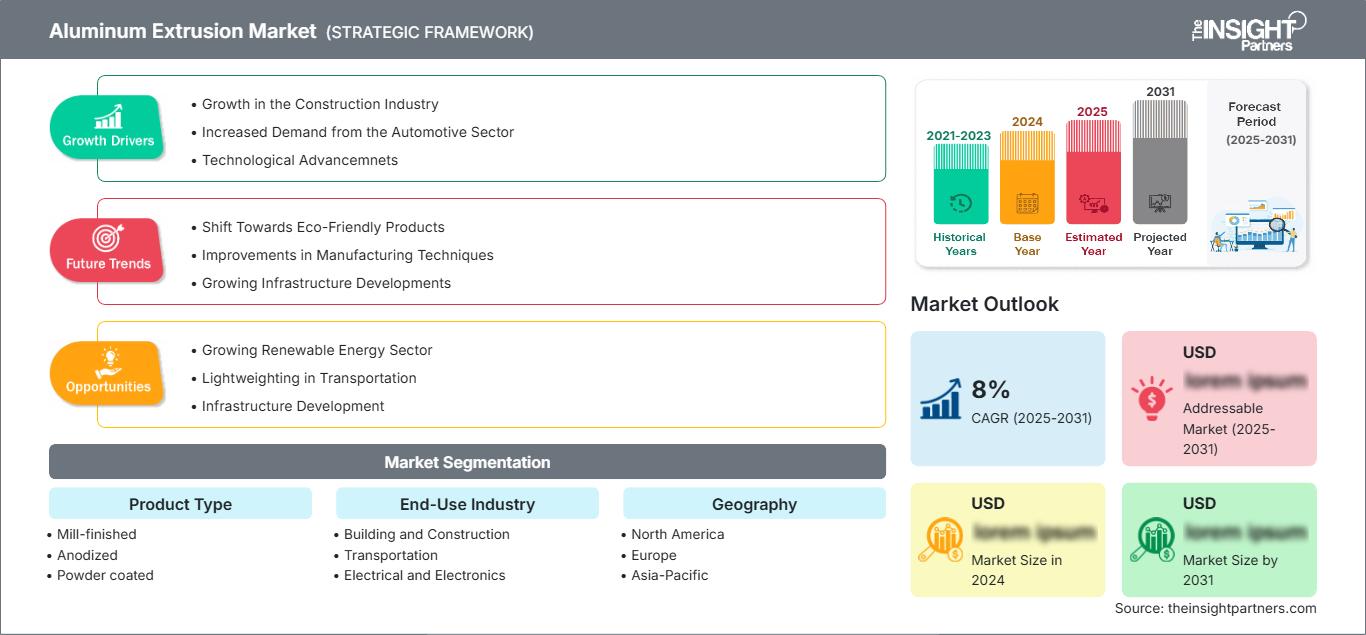
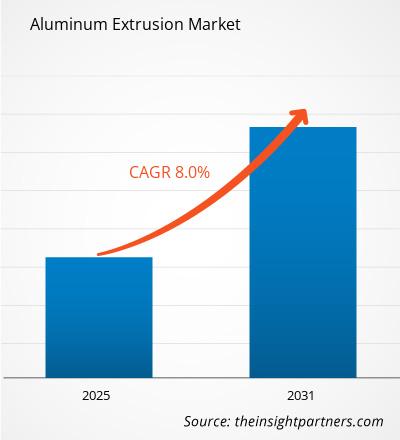
The Aluminum Extrusion Market was valued at US$ 103.94 Billion in 2025 and is projected to reach US$ 205.25 Billion by 2034, registering a CAGR of 7.85% during 2026–2034. Market expansion is supported by increasing utilization of lightweight, corrosion-resistant, and recyclable aluminum profiles across construction, transportation, renewable energy, electrical infrastructure, and industrial manufacturing. Growing investments in sustainable infrastructure, electric vehicles, and energy-efficient buildings continue strengthening long-term demand for precision-engineered extruded aluminum products across developed and emerging economies.
North America is expected to register a CAGR of 7.2–7.7% during the forecast period, supported by infrastructure modernization, expansion of electric vehicle manufacturing, and rising investments in renewable energy projects. The aluminum extrusion market size in the region is further reinforced by growing adoption of lightweight structural materials across commercial construction, industrial machinery, and advanced transportation applications. Increasing domestic manufacturing initiatives and recycling capabilities continue improving supply chain resilience while supporting sustainable production of high-value aluminum extrusions.
Aluminum Extrusion Market Assessment and Insights
- North America: Accounted for 24–28% share in 2025 and is projected to grow at a CAGR of 7.2–7.7% during 2026–2034. Demand is supported by commercial construction, automotive lightweighting initiatives, renewable energy projects, and modernization of manufacturing infrastructure across the United States and Canada.
- U.S.: Represented 82–86% of the North American market in 2025 and is expected to expand at a CAGR of 7.3–7.8% through 2034, driven by infrastructure investments, electric vehicle manufacturing, industrial automation, and strong demand from commercial building projects.
- Europe: Held a 22–26% share in 2025 and is anticipated to grow at a CAGR of 7.0–7.5%, supported by Germany, Italy, France, and the UK through sustainable construction practices, transportation electrification, and circular economy initiatives.
- Asia Pacific: Accounted for a 39–43% share in 2025 and is projected to register the fastest CAGR of 8.3–8.8%, led by China, India, Japan, and South Korea owing to rapid industrialization, urban infrastructure development, and expanding manufacturing capacity.
- Largest Segment: Building and Construction accounted for 38–42% market share in 2025 and is projected to expand at a CAGR of 7.7–8.2%, supported by increasing use of lightweight, durable, and energy-efficient building materials.
- High Growth Segment: Solar Energy represented 9–13% market share in 2025 and is expected to grow at a CAGR of 9.4–9.9%, driven by accelerating photovoltaic installations and global renewable energy investments.
- Key companies analyzed in detail: Galco Group, Banco Aluminium Limited, Norsk Hydro ASA, Arconic Corporation, Constellium SE, Gulf Extrusions Co. LLC, Barrak Al-Fares Company, Capital Aluminium Extrusions Limited, Hindalco Industries Limited, Novelis Inc., Aluminium Products Company (ALUPCO).
Source: The Insight Partners' analysis based on proprietary research, government publications, company annual reports, investor presentations, industry databases, and expert interviews.
Continuous advancements in extrusion press technologies, precision die engineering, digital process monitoring, and automated finishing systems are transforming aluminum extrusion manufacturing. Producers increasingly adopt high-capacity presses, energy-efficient billet heating systems, and AI-enabled quality inspection to improve dimensional accuracy, production efficiency, and material utilization. Growing emphasis on recycled aluminum billets and low-carbon production technologies further enhances sustainability while supporting demand from transportation, construction, and renewable energy industries seeking lightweight structural solutions with reduced environmental impact.
Looking ahead, demand is expected to accelerate across emerging economies as infrastructure investments, urbanization, and clean energy deployment continue expanding. Manufacturers are increasing investments in regional production facilities, downstream fabrication capabilities, and advanced alloy development to address application-specific requirements. Government incentives promoting domestic manufacturing, recycling, and decarbonization are anticipated to strengthen supply chain resilience while creating new opportunities for high-value aluminum extrusion applications across multiple industrial sectors.
Aluminum Extrusion Market Report Scope
| Report Attribute | Details |
|---|---|
| Market size in 2025 | US$ 103.94 Billion |
| Market Size by 2034 | US$ 205.25 Billion |
| Global CAGR (2026 - 2034) | 7.85% |
| Historical Data | 2021-2024 |
| Forecast period | 2026-2034 |
Aluminum Extrusion Market Analysis
The aluminum extrusion market growth is being driven by increasing adoption of lightweight structural materials across transportation, construction, renewable energy, electrical equipment, and industrial machinery. Aluminum extrusions combine high strength-to-weight ratio, corrosion resistance, recyclability, and design flexibility, making them suitable for structural frameworks, window systems, vehicle components, solar panel mounting structures, and electrical enclosures. The industry value chain comprises bauxite mining, alumina refining, primary and recycled aluminum production, billet casting, extrusion, heat treatment, surface finishing, fabrication, distributors, OEMs, and end-use industries. Growing investments in sustainable infrastructure and electrification continue strengthening long-term consumption of advanced extrusion products.
Supply dynamics continue evolving through increasing utilization of recycled aluminum, capacity expansion in Asia Pacific and the Middle East, and modernization of extrusion facilities incorporating automation and digital manufacturing. While fluctuations in alumina, energy, and primary aluminum prices influence production economics, manufacturers increasingly mitigate risks through long-term supply contracts, circular material sourcing, and energy-efficient production technologies. Rising availability of recycled feedstock also supports cost optimization and sustainability objectives throughout the extrusion ecosystem.
The competitive landscape remains characterized by global integrated aluminum producers alongside regional extrusion specialists competing through manufacturing scale, customized product development, downstream fabrication capabilities, and sustainability initiatives. This aluminum extrusion market analysis indicates that companies such as Norsk Hydro ASA, Hindalco Industries Limited, Novelis Inc., Constellium SE, Arconic Corporation, Banco Aluminium Limited, and Gulf Extrusions Co. LLC continue expanding value-added extrusion portfolios serving automotive, construction, industrial equipment, and renewable energy customers. Regional manufacturers including Capital Aluminium Extrusions Limited and Aluminium Products Company (ALUPCO) strengthen their positions through localized production and customer-specific engineering capabilities.
Strategic investments increasingly focus on high-tonnage extrusion presses, advanced alloy development, recycled aluminum utilization, and integrated fabrication services rather than commodity extrusion production. Manufacturers continue expanding downstream machining, anodizing, powder coating, and precision finishing operations to improve margins while serving application-specific requirements. Partnerships with automotive OEMs, solar system manufacturers, and construction companies are expected to strengthen long-term competitiveness as demand shifts toward lightweight, low-carbon, and high-performance aluminum solutions.
● REPORT CUSTOMIZATION
Tailor This Report To Align With Your Specific Business Requirements
This report can be customized to align precisely with your business objectives, scope, and target markets. Customization options include tailored segmentation, geography, competitive analysis, and strategic insights to support informed decision-making.
Customize This Report →WHAT YOU CAN ADJUST
- ● Segmentations
- ● Geography
- ● Competitive Analysis
- ● Language Preferences
Aluminum Extrusion Market: Strategic Insights
Regional Insights
North America Aluminum Extrusion Market
North America accounted for 24–28% of the global aluminum extrusion market share in 2025 and is anticipated to register a CAGR of 7.2–7.7% during 2026–2034. Regional demand is supported by infrastructure modernization, commercial construction, electric vehicle manufacturing, renewable energy installations, and industrial automation. The implementation of large-scale public infrastructure programs and reshoring of manufacturing activities continue increasing consumption of structural aluminum extrusions across transportation, electrical systems, and industrial machinery. Growing emphasis on recycled aluminum utilization and low-carbon manufacturing further strengthens regional competitiveness.
Manufacturers continue expanding fabrication capabilities, precision machining services, and value-added finishing operations to meet demand from OEMs and construction companies. Investments in domestic billet production, recycling facilities, and automated extrusion presses are improving supply chain resilience while reducing dependence on imported semi-finished products. Increasing adoption of aluminum framing systems, curtain walls, battery enclosures, and solar mounting structures is expected to sustain regional market expansion throughout the forecast period.
U.S. Aluminum Extrusion Market
The U.S. represented 82–86% of the North American market in 2025 and is projected to expand at a CAGR of 7.3–7.8% through 2034. Federal investments in transportation infrastructure, clean energy, semiconductor manufacturing, and commercial construction continue supporting robust demand for high-performance aluminum extrusions. Domestic manufacturers increasingly supply automotive lightweight components, architectural systems, industrial equipment, and electrical infrastructure while expanding downstream fabrication and finishing capabilities.
The rapid expansion of electric vehicle production and utility-scale solar installations continues generating significant opportunities for customized aluminum profiles. Window systems, façade structures, battery enclosures, heat management systems, and photovoltaic mounting solutions remain major application areas. Continuous investments in recycling technologies, digital manufacturing, and advanced extrusion alloys are expected to improve production efficiency while supporting sustainable domestic manufacturing and long-term competitiveness.
Europe Aluminum Extrusion Market
Europe held 22–26% of the global market in 2025 and is forecast to grow at a CAGR of 7.0–7.5% during the forecast period. Germany remains the largest regional market owing to its automotive manufacturing, industrial engineering, and machinery production capabilities. Strong regulatory emphasis on decarbonization, circular economy initiatives, and sustainable building construction continues encouraging wider adoption of recyclable aluminum extrusion products across multiple industries.
The United Kingdom drives steady demand for extrusions in commercial construction, transport infrastructure, and renewable energy development projects, while France benefits from aerospace equipment manufacturing, railway development, and energy-efficient construction. Italy and Spain are further growing their demand for extrusions in architectural structures, industrial machinery manufacturing, and photovoltaic system installations. Local producers are continually working to recycle aluminum materials, adopt energy-saving manufacturing techniques, and develop value-added products to meet stringent environmental requirements.
APAC Aluminum Extrusion Market
The Asia Pacific region accounted for 39% to 43% of the worldwide market share in 2025 and is estimated to exhibit the highest CAGR of 8.3% to 8.8% between 2026 and 2034. China continues to be the major producer in the region with extensive extrusion facilities, aluminum availability, and infrastructure spending.
Japan and South Korea are well-positioned in the automotive, electronics, and industrial machinery manufacturing sectors that rely on precision-engineering extrusion products. India is emerging as a major growth market due to rapid urbanization, the installation of renewable energy capacity, industrial corridors, and various government-supported manufacturing schemes. Australia makes its contribution through infrastructure spending on construction and mining. Expanding industrialization, rising construction investments, and increasing demand for lightweight transportation materials are expected to sustain regional growth.
Middle East & Africa Aluminum Extrusion Market
The Middle East & Africa market is expected to expand at a CAGR of 6.8–7.3% during 2026–2034. The UAE and Saudi Arabia continue investing in smart cities, commercial real estate, industrial diversification, and renewable energy projects that require durable architectural and structural aluminum extrusion products. Availability of competitively priced primary aluminum also supports regional manufacturing expansion.
South Africa continues to be a major buyer due to infrastructure development, industrial equipment manufacturing, and construction projects, while the rest of the region gradually moves toward modern aluminum construction systems. The development of logistics infrastructure, industrial parks, and solar energy projects is expected to continue to present opportunities for aluminum extrusion makers in the Middle East and Africa.
Segmentation Analysis
Product Type
The Aluminum Extrusion Market Scope encompasses a wide range of surface treatments that cater to diverse demands for performance, longevity, and aesthetics across construction, transportation, industrial applications, and consumer use. The choice of products is guided by factors such as corrosion protection, appearance, mechanical properties, and total cost of ownership. Growing trends in sustainable architecture, lightweight transport vehicles, and industrial automation spur innovations in surface treatment technology. The Product Type Segment is estimated to grow at a CAGR of 7.4-7.8% from 2026-2034.
- Mill-finished: Mill-finished extrusions account for the largest volume owing to their widespread use in structural frameworks, industrial machinery, transportation components, and fabrication applications where additional finishing is unnecessary or performed by downstream processors.
- Anodized: Anodized aluminum extrusions provide enhanced corrosion resistance, wear protection, and decorative finishes, making them suitable for architectural façades, curtain walls, windows, doors, marine equipment, and premium consumer products requiring long service life.
- Powder coated: Powder-coated extrusions offer superior weatherability, color consistency, scratch resistance, and design flexibility. Growing adoption across commercial buildings, residential construction, transportation, and outdoor infrastructure continues supporting increasing demand for powder-coated profiles.
End-Use Industry
The end-use industry segment represents the principal source of demand for aluminum extrusion products as manufacturers increasingly supply customized profiles for structural, electrical, transportation, and renewable energy applications. Excellent strength-to-weight characteristics, corrosion resistance, recyclability, and fabrication flexibility continue expanding aluminum utilization across multiple industries. Ongoing infrastructure development, vehicle electrification, renewable energy deployment, and industrial modernization are expected to sustain long-term market expansion. The End-Use Industry segment is anticipated to expand at a CAGR of 8.0–8.4% during 2026–2034.
- Building and Construction: Building and construction remains the largest end-use industry because aluminum extrusions are extensively utilized in windows, doors, curtain walls, façades, roofing systems, structural glazing, handrails, and architectural framing that require durability, lightweight performance, and corrosion resistance.
- Transportation: Transportation demand continues growing through increasing adoption in passenger vehicles, commercial vehicles, railcars, electric buses, trailers, marine vessels, and battery enclosures, supporting lightweight vehicle design, improved fuel efficiency, and extended electric vehicle driving range.
- Electrical and Electronics: Electrical and electronics manufacturers increasingly utilize aluminum extrusions for heat sinks, electrical enclosures, busbars, LED lighting systems, switchgear housings, and electronic equipment because of excellent thermal conductivity and corrosion resistance.
- Consumer Durables: Consumer durable manufacturers incorporate aluminum extrusions into appliances, furniture, modular storage systems, fitness equipment, air-conditioning units, and premium household products where lightweight construction, attractive finishes, and durability remain important purchasing criteria.
- Machinery and Equipment: Industrial machinery manufacturers employ aluminum extrusion profiles for machine frames, conveyor systems, automation equipment, robotic workstations, production lines, and modular manufacturing systems because of ease of fabrication and structural performance.
- Solar Energy: Solar energy continues to emerge as one of the fastest-growing applications through extensive use of aluminum extrusions in photovoltaic module frames, mounting structures, tracking systems, and support rails that require corrosion resistance, lightweight characteristics, and long operational lifecycles.
Opportunity Snapshot
| End-Use Industry | Revenue Contribution | Trend Tag | Adoption Stage |
| Building and Construction | High | Green Buildings | Mature |
| Transportation | High | Vehicle Lightweighting | Scaling |
| Electrical and Electronics | Medium | Grid Expansion | Scaling |
| Consumer Durables | Medium | Premium Appliances | Mature |
| Machinery and Equipment | Medium | Factory Automation | Scaling |
| Solar Energy | High | Solar Frames | Emerging |
Aluminum Extrusion Market Growth Drivers and Impact Analysis
Growing Demand for Lightweight Materials in Transportation
Stringent vehicle emission regulations and the rapid shift toward electric mobility are accelerating demand for lightweight structural materials worldwide. Aluminum extrusion technology has proven highly efficient in terms of weight-to-strength ratio, durability, and recyclability, making it preferred for use in passenger cars, commercial transportation, railway transportation, and electric buses. Automotive companies have been substituting extruded aluminum profiles for conventional steel parts in battery casings, crash management systems, roof rails, structural beams, and chassis to increase fuel efficiency and driving range. Rail and commercial transportation equipment companies have also embraced the use of aluminum to reduce operating costs while increasing durability. The continued expansion of EV production in China, Europe, and North America will boost demand for extruded aluminum products.
Rapid Expansion of Sustainable Building and Infrastructure Projects
Global investments in commercial buildings, residential developments, airports, rail stations, industrial facilities, and smart city projects continue to support strong demand for aluminum extrusion products. Aluminum has become more popular due to its various qualities, such as durability, low maintenance, corrosion resistance, ease of design, and recyclability. Extruded aluminum sections are often used in curtain walls, doors, windows, façades, roofs, structural glazing, and architectural interiors. Government incentives for energy-efficient construction and building certification systems for eco-friendly buildings are driving growth in the use of energy-efficient aluminum systems. Urbanization in the Asia-Pacific region, modernization of old buildings in North America, and renovation works in Europe will create many opportunities for extrusion manufacturers during the forecast period.
Accelerating Renewable Energy Capacity Installations
The expansion of renewable energy infrastructure is creating significant opportunities for aluminum extrusion manufacturers supplying structural and mounting components. Solar panels and modules increasingly rely on aluminum extrusions for the module frame, tracking system, mounting rail, and support structure owing to their light weight, non-corrosive nature, and longevity. Wind energy projects use extruded aluminum in their electrical systems and other equipment. Governments around the world are setting increasingly ambitious targets for renewable energy production, while utility companies are making significant investments in grid upgrades and green energy production. In response, manufacturers are developing aluminum alloys with improved structural and environmental properties.
Aluminum Extrusion Market Future Trends
Advanced Low-Carbon Aluminum Production and Circular Manufacturing
The aluminum extrusion market trends increasingly reflect customer preference for low-carbon materials produced using renewable electricity, recycled aluminum feedstock, and energy-efficient manufacturing technologies. Investment in closed-loop recycling, billet remelting, digital process management, and carbon footprint certification is being made by producers as part of their commitment to sustainability in automotive, construction, and consumer sectors. Environmental Product Declarations, along with trackable supply chain systems, have become a must-have for OEM procurement contracts. The continuous improvement in the production of sustainable aluminum is anticipated to bolster competitiveness and ensure regulatory compliance across Europe, North America, and the Asia-Pacific region.
Digitalization and Smart Extrusion Manufacturing
Industry 4.0 technologies are being adopted by manufacturers at extrusion plants to increase productivity and operational efficiency and ensure product consistency. Process monitoring through artificial intelligence, predictive maintenance, automated die changeover, robotic handling systems, and digital quality control minimizes waste during production and ensures high-dimensional accuracy. Smart manufacturing will also enable quick changeovers and product customization for use in high-value applications such as electric cars, aerospace parts, and industrial machinery. More investment in digital production technology is anticipated to boost profitability in the aluminum extrusion industry.
Aluminum Extrusion Market Opportunities
Expansion of EV Manufacturing and Battery Platform Localization
The growing investments in electric-vehicle manufacturing across North America, Europe, India, and Southeast Asia present several opportunities for extrusion manufacturers. According to the Aluminum Extrusion Market Forecasts, there is ongoing demand for battery enclosures, crash management systems, lightweight chassis parts, and thermal management systems, driven by increased OEM manufacturing at the local level. Extrusion manufacturers that can supply high-strength, high-precision extrusions made from high-performance alloys can enhance their long-term contracts with global automotive companies.
High-Growth Potential in Solar Energy Infrastructure
Rapid deployment of utility-scale and distributed solar photovoltaic projects continues creating attractive opportunities for aluminum extrusion manufacturers. Corrosion-resistant aluminum profiles are now being used for mounting, rails, and trackers for solar panels to improve installation efficiency and ensure longevity. Increasing the focus on renewable energy sources in regions such as Asia-Pacific, Europe, the Middle East, and North America leads to consistent investment in photovoltaic infrastructure. Companies that provide lightweight, high-strength aluminum extrusions designed specifically for the next generation of solar panels will have an opportunity to meet rising demand and become integral to global clean energy production.
Recent Developments
- June 2026: Zahit Aluminium confirmed the successful commissioning and commercial operation of a new 12-inch, 47-MN extrusion press supplied by Danieli Breda at its manufacturing facility in Turkey. The advanced extrusion line incorporates isothermal extrusion technology, ESED 4.0 energy-saving systems, and automation capabilities to improve operational efficiency while producing structural, architectural, framing, and photovoltaic aluminum profiles. As part of its ongoing capacity expansion strategy, the company has also ordered a second extrusion press to further strengthen production capabilities.
- April 2025: Taber Extrusions officially broke ground on its US$70 million expansion in Russellville, Arkansas. The project includes a 125,000 sq. ft. facility expansion and installation of the largest direct aluminum extrusion press in North America, significantly increasing capacity for aerospace, defense, transportation, and industrial extrusions.
Frequently Asked Questions

- Comprehensive Market Sizing and Forecast Analysis
- Detailed Segmentation Analysis
- In-Depth Market Dynamics Assessment
- Regional and Country-Level Insights
- Competitive Landscape and Company Benchmarking
- Strategic Business Intelligence
Recent Reports
Testimonials

The Insight Partners provided valuable market intelligence that supported our global go-to-market strategy. Their team was professional, responsive, and attentive to our feedback, providing thoughtful analysis and helpful methodological clarifications throughout the project.
Junmo Kim Chief Financial Officer (CFO), Enertech Co., Ltd.
The Insight Partners' SCADA System Market report is comprehensive, with valuable insights on current trends and future forecasts. The team was highly professional, responsive, and supportive throughout. We are very satisfied and highly recommend their services.
RAN KEDEM Partner, Reali Technologies LTDs
I requested a report on a very specific software market and the team produced the report in a few days. The information was very relevant and well presented. I then requested some changes and additions to the report. The team was again very responsive and I got the final report in less than a week.
JEAN-HERVE JENN Chairman, Future Analytica
We worked with The Insight Partners for an important market study and forecast. They gave us clear insights into opportunities and risks, which helped shape our plans. Their research was easy to use and based on solid data. It helped us make smart, confident decisions. We highly recommend them.
PIYUSH NAGPAL Sr. Vice President, High Beam Global
The Insight Partners delivered insightful, well-structured market research with strong domain expertise. Their team was professional and responsive throughout. The user-friendly website made accessing industry reports seamless. We highly recommend them for reliable, high-quality research services
YUKIHIKO ADACHI CEO, Deep Blue, LLC.
This is the first time I have purchased a market report from The Insight Partners.While I was unsure at first, I visited their web site and felt more comfortable to take the risk and purchase a market report.I am completely satisfied with the quality of the report and customer service. I had several questions and comments with the initial report, but after a couple of dialogs over email with their analyst I believe I have a report that I can use as input to our strategic planning process.Thank you so much for taking the extra time and making this a positive experience.I will definitely recommend your service to others and you will be my first call when we need further market data.
JOHN SUZUKI President and Chief Executive Officer, Board Director, BK Technologies
I wish to appreciate your support and the professionalism you displayed in the course of attending to my request for information regarding to infectious disease IVD market in Nigeria. I appreciate your patience, your guidance, and the fact that you were willing to offer a discount, which eventually made it possible for us to close a deal. I look forward to engaging The Insight Partners in the future, all thanks to the impression you have created in me as a result of this first encounter.
DR CHIJIOKE ONYIA MANAGING DIRECTOR, PineCrest Healthcare Ltd.Reason to Buy
- Informed Decision-Making
- Understanding Market Dynamics
- Competitive Analysis
- Identifying Emerging Markets
- Customer Insights
- Market Forecasts
- Risk Mitigation
- Boosting Operational Efficiency
- Strategic Planning
- Investment Justification
- Tracking Industry Innovations
- Aligning with Regulatory Trends





 Get Free Sample for