
Aluminum Nitride Ceramics Market Trends, Share & Demand by 2034
Coverage: By Product (ALN-170, ALN-200, Others); Application (Ceramic Substrates, Semiconductor Manufacturing Components, ALN Fillers), and Geography (North America, Europe, Asia Pacific, and South and Central America)
- Status : Data Released
- Report Code : TIPRE00017374
- Category : Chemicals and Materials
- No. of Pages : 150
- Available Report Formats :


- Last update date : August 14, 2026


2025 Market Size
US$ 1,615.43 Mn
Base year value
2034 Forecast
US$ 2,717.46 Mn
Projected by 2034
CAGR 2026-2034
5.95 %
Growth rate
Addressable Market
US$ 19,627.29 Mn
(2026-2034)
The aluminum nitride ceramics market was valued at US$ 1,615.43 million in 2025 and is projected to reach US$ 2,717.46 million by 2034, registering a CAGR of 5.95% during 2026–2034. The market is expanding steadily owing to increasing deployment of high thermal conductivity ceramic materials across semiconductor manufacturing, electric vehicles, advanced electronics, aerospace systems, and industrial equipment. Growing demand for efficient heat dissipation solutions and electrically insulating ceramic components continues to strengthen long-term market adoption.
Across North America, expanding investments in semiconductor fabrication, defense electronics, and electric vehicle manufacturing continue to create favorable opportunities for material suppliers. The aluminum nitride ceramics market size in the region is supported by government-backed semiconductor manufacturing programs, rising adoption of power electronics, and increasing demand for high-performance ceramic substrates. The regional market is projected to register a CAGR of 5.3–5.8% during 2026–2034, with the United States remaining the primary contributor.
Aluminum Nitride Ceramics Market Assessment and Insights
- North America: Accounted for 29–32% share in 2025 and is expected to register a CAGR of 5.3–5.8% during 2026–2034, supported by semiconductor reshoring initiatives, EV electronics manufacturing, and increasing defense and aerospace investments requiring advanced ceramic materials.
- US: Represented 80–83% of the North American market in 2025 and is projected to grow at a CAGR of 5.4–5.9% through 2034 owing to expanding semiconductor fabrication capacity and increasing adoption of power electronics.
- Europe: Held 23–26% share in 2025 and is anticipated to grow at a CAGR of 5.0–5.5% during 2026–2034. Germany leads regional demand, followed by France, Italy, and the UK owing to strong automotive electronics and industrial manufacturing sectors.
- Asia Pacific: Accounted for 37–40% share in 2025 and is projected to record the highest CAGR of 6.4–6.9% during 2026–2034, driven by semiconductor manufacturing expansion across China, Japan, South Korea, and Taiwan.
- Largest Segment: Ceramic Substrates accounted for 48–52% market share in 2025 and are anticipated to expand at a CAGR of 5.8–6.2% owing to widespread adoption in power modules, LED packaging, and semiconductor devices.
- High Growth Segment: Semiconductor Manufacturing Components represented 27–30% share in 2025 and are expected to register a CAGR of 6.7–7.2%, supported by increasing wafer fabrication investments and advanced chip manufacturing technologies.
- Key companies analyzed in detail: 3M Company, CeramTec GmbH, CoorsTek Inc., Furukawa Co., Ltd., Kyocera Corporation, Maruwa Co., Ltd., Nishimura Advanced Ceramics Co., Ltd., Precision Ceramics USA, Inc., Surmet Corporation, and Tokuyama Corporation.
Source: The Insight Partners' analysis based on proprietary research, government publications, company annual reports, investor presentations, industry databases, and expert interviews.
The advanced ceramics market has progressed from the development of products for specialized industry uses to becoming an essential part of the assembly of semiconductors, power electronics, and thermal management systems. With advancements in the purity of powders, hot pressing, pressureless sintering, and machining technologies, there is an improved ability to produce ceramics with high thermal conductivity and high mechanical performance. This has made it possible for aluminum nitride ceramics to fulfill tough requirements in electric vehicles, 5G communications, industrial automation, and aerospace electronics applications.
The market growth in the future will largely rely on investments in the construction of semiconductor plants, renewable energy systems, and new electronic devices. Programs of government incentives for domestic production of semiconductors, along with increasing usage of wide band-gap semiconductors, will contribute to the increase in demand in Asia Pacific, North America, and Europe. The manufacturers are now making investments in capacity growth, automation, and advanced processing technologies.
Aluminum Nitride Ceramics Market Report Scope
| Report Attribute | Details |
|---|---|
| Market size in 2025 | US$ 1,615.43 Million |
| Market Size by 2034 | US$ 2,717.46 Million |
| Global CAGR (2026 - 2034) | 5.95% |
| Historical Data | 2021-2024 |
| Forecast period | 2026-2034 |
Aluminum Nitride Ceramics Market Analysis
The aluminum nitride ceramics market growth is primarily supported by increasing demand for high-performance thermal management materials across semiconductor manufacturing, electric vehicles, telecommunications infrastructure, and industrial automation. The value chain starts from high-purity alumina and aluminum nitride powder, then proceeds to the processing of the powder, sintering, precision machining, metallization, fabrication of parts and ends up at the delivery of the components to semiconductor equipment manufacturers, electronic products producers and industrial original equipment manufacturers. Growing investment in chip making and power electronics manufacturing will continue to drive upstream and downstream integration of the supply chain.
Supply conditions continue to be determined by the availability of ultra-high purity feedstocks, energy-intensive production processes, and high-quality standards. Production investments continue to be made in automation, precision machining technology, and quality control measures to increase yields and lower production costs. Localization of semiconductor manufacturing in the United States, Europe, Japan, South Korea, and China continues to underpin demand and support the supply chain resilience.
The competitive landscape of the aluminum nitride ceramics market analysis is characterized by technological differentiation, manufacturing expertise, and long-standing customer relationships with semiconductor, electronics, and industrial equipment manufacturers. Companies including Kyocera Corporation, CeramTec GmbH, CoorsTek Inc., Tokuyama Corporation, and Maruwa Co., Ltd. continue investing in advanced ceramic processing technologies, product innovation, and manufacturing capacity expansion. Meanwhile, 3M Company, Furukawa Co., Ltd., Surmet Corporation, Precision Ceramics USA, Inc., and Nishimura Advanced Ceramics Co., Ltd. are strengthening their portfolios through customized ceramic solutions targeting semiconductor fabrication equipment, thermal management systems, and high-reliability industrial applications.
Such strategic investments include efforts aimed at increasing the capacity of production and improving the technologies for powder handling and machining to meet the changing demands of the customers. Joint ventures between semiconductor equipment producers, component producers, and material producers are making it possible to develop new products and promote advanced ceramic technologies. Other efforts by firms include production sustainability, process optimization, and exploration of more heat-conductive materials.
● REPORT CUSTOMIZATION
Tailor This Report To Align With Your Specific Business Requirements
This report can be customized to align precisely with your business objectives, scope, and target markets. Customization options include tailored segmentation, geography, competitive analysis, and strategic insights to support informed decision-making.
Customize This Report →WHAT YOU CAN ADJUST
- ● Segmentations
- ● Geography
- ● Competitive Analysis
- ● Language Preferences
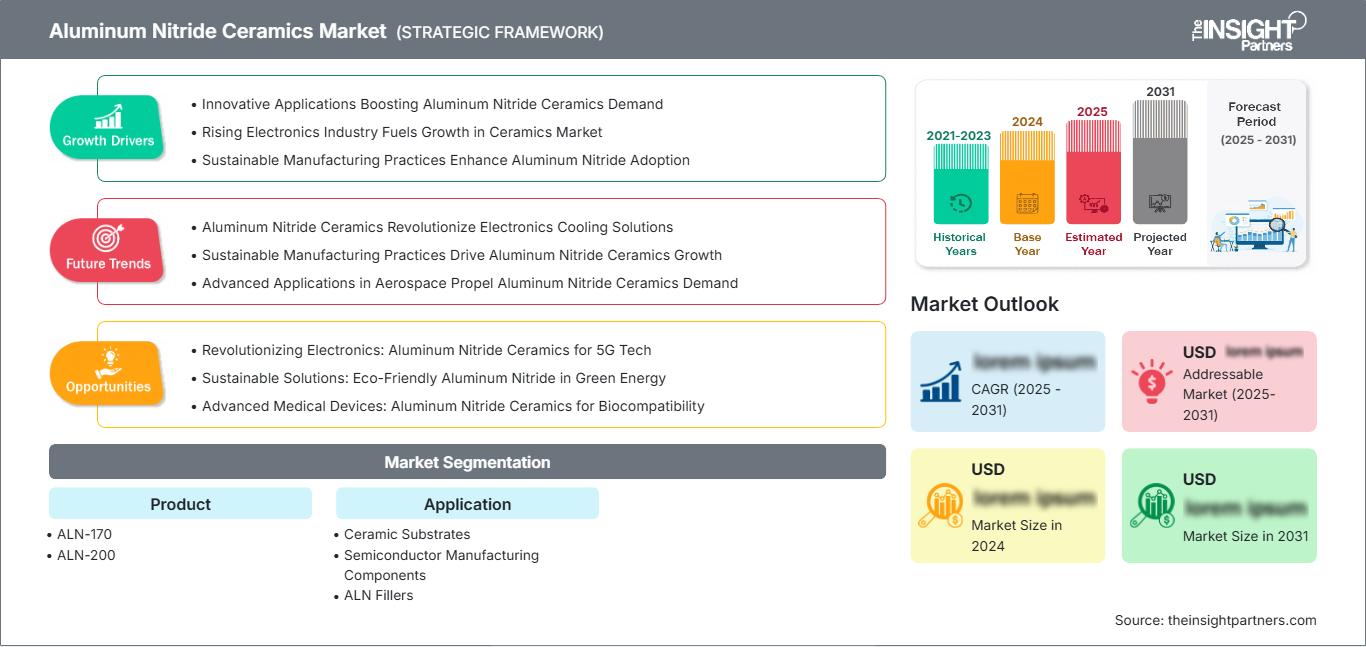
Aluminum Nitride Ceramics Market: Strategic Insights
Regional Insights
North America Aluminum Nitride Ceramics Market
North America accounted for 29–32% of the aluminum nitride ceramics market share in 2025 and is projected to expand at a CAGR of 5.3–5.8% during 2026–2034. Growth is supported by increasing investments in domestic semiconductor fabrication, expanding electric vehicle manufacturing, and rising demand for high-performance thermal management materials across aerospace, defense, and industrial automation. Government initiatives promoting semiconductor supply chain resilience are further strengthening regional demand for advanced ceramic substrates and semiconductor manufacturing components.
The application of aluminum nitride ceramics continues to gain momentum in the United States and Canada, especially within sectors such as power electronics, 5G networks, and semiconductor equipment manufacturing. With an increase in the use of silicon carbide and gallium nitride power devices, there is a need for the use of ceramics that provide better thermal conductivity and electrical insulation. Increased investment in manufacturing technology, research, and development of semiconductor manufacturing capabilities will drive growth in the region.
U.S. Aluminum Nitride Ceramics Market
The United States represented 80–83% of the North American market in 2025 and is anticipated to register a CAGR of 5.4–5.9% through 2034. Federal initiatives supporting semiconductor manufacturing, including investments under domestic chip manufacturing programs, are increasing demand for advanced ceramic components used in wafer processing equipment, power modules, and high-performance electronic systems. The country's strong ecosystem of semiconductor manufacturers, aerospace companies, and electronics OEMs continues to support market expansion.
Major manufacturers and technology developers maintain significant research, manufacturing, and engineering operations across the United States, enabling continuous innovation in advanced ceramic materials. Increasing adoption of electric vehicles, renewable energy systems, medical electronics, and industrial automation equipment is further driving the consumption of ceramic substrates and thermal management solutions. Continued investment in precision manufacturing and advanced materials research is expected to reinforce the country's leadership within the regional market.
Europe Aluminum Nitride Ceramics Market
Europe held 23–26% market share in 2025 and is projected to record a CAGR of 5.0–5.5% between 2026 and 2034. Germany remains the leading regional market owing to its strong semiconductor equipment manufacturing capabilities, automotive electronics industry, and industrial automation sector. The country also benefits from extensive research in advanced ceramics and continued investment in power electronics supporting electric mobility and renewable energy applications.
The United Kingdom continues to strengthen demand through investments in semiconductor research, aerospace technologies, and advanced manufacturing capabilities. Germany remains the regional leader with strong production of automotive electronics, industrial machinery, and precision engineering components requiring thermally conductive ceramic materials. France, Italy, and Spain are witnessing steady adoption driven by industrial automation, renewable energy equipment, and expanding electronics manufacturing, supporting gradual regional market expansion across multiple high-value applications.
APAC Aluminum Nitride Ceramics Market
Asia Pacific accounted for 37–40% share in 2025 and is expected to register the fastest CAGR of 6.4–6.9% through 2034. China, Japan, South Korea, and Taiwan dominate semiconductor manufacturing, while India is emerging as a growing electronics manufacturing destination supported by government incentive programs and expanding industrial investments.
Japan continues to lead advanced ceramic innovation, whereas China rapidly expands semiconductor production capacity. South Korea remains a major hub for memory chip manufacturing, and Australia supports demand through mining, defense, and industrial applications. Strong electronics manufacturing ecosystems and favorable industrial policies continue to position Asia Pacific as the largest regional market.
Middle East & Africa Aluminum Nitride Ceramics Market
The Middle East & Africa market is anticipated to grow at a CAGR of 4.7–5.2% during 2026–2034. Saudi Arabia and the UAE are increasing investments in industrial diversification, electronics manufacturing, and renewable energy infrastructure, creating new opportunities for advanced ceramic materials across high-performance industrial applications.
South Africa remains the leading manufacturing base within Sub-Saharan Africa, supported by mining, industrial processing, and engineering industries. The Rest of the Middle East & Africa is gradually adopting advanced ceramic technologies as governments promote localization of manufacturing, infrastructure modernization, and technology-driven industrial development, supporting steady long-term demand growth.
Segmentation Analysis
Product
The Product segment defines the performance characteristics of aluminum nitride ceramics used across thermal management and semiconductor applications. The aluminum nitride ceramics market scope continues to expand as manufacturers develop higher thermal conductivity grades with improved purity and mechanical strength to support advanced electronic devices. The segment is expected to register a CAGR of 5.8–6.3% during 2026–2034, driven by increasing demand for high-reliability ceramic materials in semiconductor fabrication, electric vehicles, and industrial electronics.
- ALN-170: Primarily utilized in applications requiring balanced thermal conductivity, electrical insulation, and cost efficiency. The grade is widely adopted for ceramic substrates, industrial electronics, and general thermal management components where consistent performance and manufacturing scalability are essential.
- ALN-200: Offers superior thermal conductivity and enhanced material purity, making it suitable for advanced semiconductor manufacturing equipment, high-power electronic modules, aerospace electronics, and other applications demanding exceptional heat dissipation and long-term operational reliability.
Application
Application remains the primary demand-generating segment as aluminum nitride ceramics become increasingly critical for thermal management, electrical insulation, and precision manufacturing. Continuous expansion of semiconductor fabrication, power electronics, and advanced packaging technologies is accelerating adoption across multiple high-value industries. The application segment is projected to grow at a CAGR of 6.0–6.5% during 2026–2034, supported by technological advancements and increasing investments in electronics manufacturing infrastructure.
- Ceramic Substrates: The largest application owing to widespread use in power semiconductor modules, LED packages, RF devices, and electronic circuits requiring excellent thermal conductivity, dimensional stability, and electrical insulation under demanding operating environments.
- Semiconductor Manufacturing Components: Demand continues to increase as wafer fabrication facilities require highly durable ceramic parts capable of withstanding corrosive process environments, elevated temperatures, and stringent dimensional tolerances throughout advanced semiconductor manufacturing operations.
- ALN Fillers: Increasingly incorporated into thermal interface materials, encapsulants, engineering polymers, and composite materials to improve heat dissipation while maintaining electrical insulation for electric vehicles, consumer electronics, telecommunications equipment, and industrial systems.
Opportunity Snapshot
| Application | Revenue Contribution | Trend Tag | Adoption Stage |
|---|---|---|---|
| Ceramic Substrates | High | Power Modules | Mature |
| Semiconductor Manufacturing Components | High | Chip Fabrication | Scaling |
| ALN Fillers | Medium | Thermal Compounds | Emerging |
Aluminum Nitride Ceramics Market Growth Drivers and Impact Analysis
Increasing semiconductor manufacturing investments worldwide
The growing pace of development of the production of semiconductors worldwide has led to an increase in the demand for aluminum nitride ceramics for use in wafers, substrates, electrostatic chucks, and thermal components. Countries such as those of the United States, Europe, Japan, South Korea, and China have been actively investing in their local semiconductor manufacturing industry due to its importance for the safety of supply chains. Therefore, there is constant demand for high-quality ceramic materials able to withstand the conditions of high temperature and corrosive environment and strict dimensional specifications. Aluminum nitride ceramics can boast of their high thermal conductivity, excellent electrical insulation properties, and high chemical resistance, making them crucial for manufacturing semiconductors. The more advanced the technology of semiconductor manufacturing becomes, the more premium ceramic materials will be needed.
Growing adoption of electric vehicles and power electronics
Increasing electrification of both the transport and industrial industries is resulting in increased demand for efficient thermal management materials that can manage the heat generated from powerful electronic systems. Electric vehicles come equipped with power modules, inverters, onboard chargers, and battery management systems that create a considerable amount of heat when in use. Aluminum nitride ceramics have good thermal conductivity with good electrical insulating properties that make these essential parts reliable and more efficient. The increasing use of silicon carbide and gallium nitride power semiconductor devices is adding more to the demand, owing to their requirement for efficient ceramic substrates to manage thermal load.
Expansion of advanced electronics and telecommunications infrastructure
The rise in the number of 5G network installations, AI chips, data center operations, aerospace electronics, and industrial automation systems will further augment the demand for highly efficient ceramics. Contemporary electronic products need small-sized products that are better in thermal management to make them reliable and efficient. Aluminum Nitride Ceramics offer a perfect solution due to their superior thermal conductivity, reduced dielectric loss, and robustness. Many manufacturers are incorporating such ceramics in their RF products, lasers, optical communications equipment, and high-frequency electronic components. As the investments made in digital infrastructures keep growing around the world, the demand for such ceramics is also likely to increase.
Aluminum Nitride Ceramics Market Future Trends
Development of advanced thermal management materials for next-generation electronics
The aluminum nitride ceramics market trends are increasingly shaped by continuous innovation in high thermal conductivity ceramic materials supporting next-generation semiconductor devices, artificial intelligence hardware, electric vehicles, and high-density power electronics. There is significant investment being made by manufacturers in better synthesis of powders, superior sintering methods, and machining processes to ensure higher levels of thermal performance coupled with low manufacturing variability. This has resulted in aluminum nitride ceramics being able to meet more stringent requirements for applications like advanced packaging, high-power devices, RF communication, and industrial electronics.
Increasing adoption of automation and digital manufacturing technologies
Automation, artificial intelligence, digital inspection, and advanced process controls are increasingly being incorporated into the manufacturing of ceramic components to increase consistency and quality in the manufacturing process. The use of automated powder handling, robotic machining, and monitoring of the manufacturing process assists in minimizing defects while increasing production efficiency and yields. Digital manufacturing also allows for increased tolerance levels required for semiconductor manufacturing equipment and electronic components. With an increase in production volumes, Industry 4.0 will assist in increasing efficiency and lowering costs in the aluminum nitride ceramics industry.
Aluminum Nitride Ceramics Market Opportunities
Expanding semiconductor fabrication capacity across emerging economies
Government incentive programs encouraging domestic semiconductor manufacturing are creating significant opportunities for advanced ceramic suppliers across Asia Pacific, the Middle East, and selected European markets. Aluminum nitride ceramics market Forecasts indicate sustained investments in wafer fabrication plants, advanced packaging facilities, and semiconductor equipment manufacturing over the coming decade. These developments are expected to increase demand for ceramic substrates, electrostatic chucks, chamber components, and thermal management materials. Manufacturers capable of expanding production capacity, improving material purity, and establishing localized supply chains will be well-positioned to capture long-term growth opportunities while supporting rapidly evolving semiconductor manufacturing ecosystems.
Growing utilization in renewable energy and aerospace applications
Increasing deployment of renewable energy systems, satellite technologies, defense electronics, and aerospace platforms is creating additional demand for high-performance ceramic materials. Aluminum nitride ceramics are increasingly utilized in power conversion equipment, radar systems, avionics, and high-frequency communication devices due to their excellent thermal conductivity and electrical insulation characteristics. Continuous advancements in power electronics, energy storage technologies, and space exploration programs are expected to expand commercial opportunities beyond traditional semiconductor applications. Strategic partnerships between ceramic manufacturers, aerospace suppliers, and energy technology companies will further accelerate product innovation and market penetration.
Recent Developments
- April 2026: Kyocera International, Inc. expanded its fine ceramics manufacturing facility in Hendersonville, North Carolina, by installing a 30,000-psi Cold Isostatic Press (CIP) and expanding production space. The investment strengthens manufacturing capabilities for larger, high-purity ceramic components serving semiconductor, aerospace, medical, energy, and industrial applications while enhancing production efficiency and material consistency.
- November 2025: CeramTec GmbH participated in SEMICON Europa 2025, presenting advanced technical ceramic solutions for semiconductor manufacturing, including high-performance ceramic components designed for wafer processing equipment and demanding semiconductor production environments. The showcase reinforces the company's strategic focus on semiconductor manufacturing technologies.
Frequently Asked Questions

- Comprehensive Market Sizing and Forecast Analysis
- Detailed Segmentation Analysis
- In-Depth Market Dynamics Assessment
- Regional and Country-Level Insights
- Competitive Landscape and Company Benchmarking
- Strategic Business Intelligence
Recent Reports
Testimonials

The Insight Partners' SCADA System Market report is comprehensive, with valuable insights on current trends and future forecasts. The team was highly professional, responsive, and supportive throughout. We are very satisfied and highly recommend their services.
RAN KEDEM Partner, Reali Technologies LTDs
I requested a report on a very specific software market and the team produced the report in a few days. The information was very relevant and well presented. I then requested some changes and additions to the report. The team was again very responsive and I got the final report in less than a week.
JEAN-HERVE JENN Chairman, Future Analytica
We worked with The Insight Partners for an important market study and forecast. They gave us clear insights into opportunities and risks, which helped shape our plans. Their research was easy to use and based on solid data. It helped us make smart, confident decisions. We highly recommend them.
PIYUSH NAGPAL Sr. Vice President, High Beam Global
The Insight Partners delivered insightful, well-structured market research with strong domain expertise. Their team was professional and responsive throughout. The user-friendly website made accessing industry reports seamless. We highly recommend them for reliable, high-quality research services
YUKIHIKO ADACHI CEO, Deep Blue, LLC.
This is the first time I have purchased a market report from The Insight Partners.While I was unsure at first, I visited their web site and felt more comfortable to take the risk and purchase a market report.I am completely satisfied with the quality of the report and customer service. I had several questions and comments with the initial report, but after a couple of dialogs over email with their analyst I believe I have a report that I can use as input to our strategic planning process.Thank you so much for taking the extra time and making this a positive experience.I will definitely recommend your service to others and you will be my first call when we need further market data.
JOHN SUZUKI President and Chief Executive Officer, Board Director, BK Technologies
I wish to appreciate your support and the professionalism you displayed in the course of attending to my request for information regarding to infectious disease IVD market in Nigeria. I appreciate your patience, your guidance, and the fact that you were willing to offer a discount, which eventually made it possible for us to close a deal. I look forward to engaging The Insight Partners in the future, all thanks to the impression you have created in me as a result of this first encounter.
DR CHIJIOKE ONYIA MANAGING DIRECTOR, PineCrest Healthcare Ltd.Reason to Buy
- Informed Decision-Making
- Understanding Market Dynamics
- Competitive Analysis
- Identifying Emerging Markets
- Customer Insights
- Market Forecasts
- Risk Mitigation
- Boosting Operational Efficiency
- Strategic Planning
- Investment Justification
- Tracking Industry Innovations
- Aligning with Regulatory Trends





 Get Free Sample for