
Amniotic Fluid Detection Market Size, Share & Demand by 2034
Coverage: by Product Type (Test Kits and Reagents & Consumables); End User (Diagnostics Laboratories, Gynecology Clinics and Hospitals) , and Geography (North America, Europe, Asia Pacific, and South and Central America)
- Status : Data Released
- Report Code : TIPRE00008195
- Category : Life Sciences
- No. of Pages : 150
- Available Report Formats :


- Last update date : July 22, 2026


2025 Market Size
US$ 345.94 Mn
Base year value
2034 Forecast
US$ 910.8 Mn
Projected by 2034
CAGR 2026-2034
11.36 %
Growth rate
Addressable Market
US$ 5,540.11 Mn
(2026-2034)
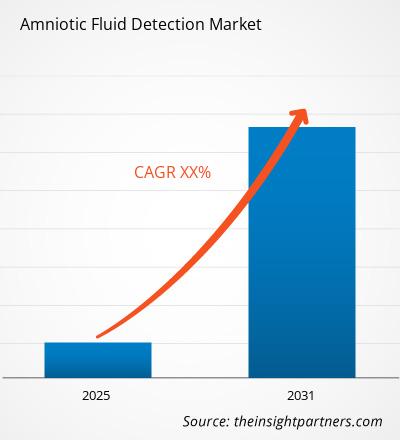
The Amniotic Fluid Detection Market is projected to grow from US$ 345.94 Million in 2025 to US$ 910.8 Million by 2034, registering a CAGR of 11.36% during 2026–2034. Market dynamics indicate the growing need for timely assessment of the rupture of membranes in connection with an increasing need for prenatal diagnosis and screening.
Geographically, North America will be a lucrative revenue source for the market, owing to more frequent institutional tests, developed obstetrics practice, and greater adoption of disposable rapid test formats. In the period between 2026 and 2034, North America is forecast to grow in the 10.8-11.4% CAGR range due to late pregnancy cases, hospital triage processes, and better understanding of reimbursement for prenatal diagnosis.
Amniotic Fluid Detection Market Assessment and Insights
- North America accounted for 38–42% of the Amniotic Fluid Detection Market share in 2025 and is projected to grow at a CAGR between 2026–2034 of 10.8–11.4%, driven by structured prenatal care pathways, rapid diagnostic procurement, and strong use of sterile swab-based PROM tests.
- US represented 78–82% of North America in 2025 and is expected to grow at a CAGR between 2026–2034 of 10.9–11.5%, supported by high hospital maternity throughput and lab consolidation.
- Europe held 25–29% share in 2025 and is projected to grow at a CAGR between 2026–2034 of 10.2–10.9%, led by Germany, the UK, France, Italy, and Spain through protocol-driven obstetric diagnostics.
- Asia Pacific captured 22–26% share in 2025 and is forecast to grow at a CAGR between 2026–2034 of 12.1–12.8%, led by China, India, Japan, South Korea, and Australia amid higher private maternity care investment.
- Largest Segment Test Kits held 63–67% market share in 2025 and is expected to grow at a CAGR range of 10.8–11.4%, reflecting preference for fast, interpretable, procedure-light PROM detection.
- High Growth Segment Diagnostics Laboratories held 47–51% market share in 2025 and is projected to grow at a CAGR range of 11.8–12.4%, driven by centralized prenatal testing volumes.
- Key companies analyzed in detail: Cook Medical LLC, ELITechGroup SAS, Fullife Healthcare Pvt. Ltd., IQ Products B.V., Medix Biochemica Group Oy, Medical Wire & Equipment Co. (Bath) Ltd., Pro Lab Diagnostics Inc., QIAGEN N.V., RIDACOM s.r.o., Thermo Fisher Scientific Inc.
Source: The Insight Partners' analysis based on proprietary research, government publications, company annual reports, investor presentations, industry databases, and expert interviews.
Application has advanced from subjective analysis of leaks to standardized swab, biomarker, and reagent-assisted methods. Test kits have taken the dominant share of sales due to their applicability for emergency obstetric triage, low equipment requirements, and less reliance on delayed microscopy. Product development trends include increased focus of suppliers on sterilized packages, room-temperature storage, extended shelf life, and consistent product quality by lots. Amniotic Fluid Detection Market growth is consequently determined by reliable products and clinician trust, as well as consumable manufacturing scalability.
In the future, the market will extend its boundaries from high-end maternity wards to private practices and diagnostics networks in India, China, Southeast Asia, and the Gulf countries. Increased regulatory scrutiny of in vitro diagnostic quality, along with investments made by hospitals in maternal-fetal medicine, create procurement criteria. Manufacturers who will manage to localize distribution and training of obstetricians, as well as supply stable amount of reagents, will benefit from this process.
Amniotic Fluid Detection Market Report Scope
| Report Attribute | Details |
|---|---|
| Market size in 2025 | US$ 345.94 Million |
| Market Size by 2034 | US$ 910.8 Million |
| Global CAGR (2026 - 2034) | 11.36% |
| Historical Data | 2021-2024 |
| Forecast period | 2026-2034 |
Amniotic Fluid Detection Market Analysis
The demand is generated by the clinical need for fast detection of membrane rupture, which, if undetected, could increase chances of infections, pre-term labour, and neonatal complications. According to the WHO, in 2020 there were 13.4 million premature births worldwide, which makes prenatal complication management a crucial factor in maternal healthcare planning. Fast detection is used by hospitals in order to facilitate admission, observation, selection of antibiotics, and referral. The value chain consists of the substrates or indicator, antibodies or reagents, sterile swabs, suppliers of packaging, distributors, obstetric department, and reference laboratory.
The supply-side forces are in favor of manufacturers, which would be able to integrate high performance, easy-to-understand result reading, and robust distribution channels. From the analysis of Amniotic Fluid Detection Market, one can conclude that purchasers put emphasis on tests with low probability of error in triage. Also, procurement officers consider storage period, storing requirements, ease of using, and compatibility with current prenatal program when selecting a test.
Fragmentation in the Amniotic Fluid Detection Market Report characterizes the competitive landscape to some extent with worldwide diagnostic firms and specialized obstetric firms competing in separate purchase streams. Although QIAGEN N.V. and Thermo Fisher Scientific Inc. contribute to the overall laboratory process, Medical Wire & Equipment Co. (Bath) Ltd., Pro Lab Diagnostics Inc., IQ Products B.V., and Fullife Healthcare Pvt. Ltd. offer competition through product formulation specialization. Cook Medical LLC fits in the reproductive health purchase stream, while ELITechGroup SAS offers competition through molecular diagnostics adjacency.
The trend in investments is towards workflow integration, quality documentation, and geographic distribution presence, and not large capital equipment. Medix Biochemica Group Oy and RIDACOM s.r.o. operate in the area of reagents and immunodiagnostic kits, both of which are critical for the development of assays. Clinical credibility, consistency, and readiness for registration in various regions are increasingly key strategic positions. Small companies can play competitively if they offer reliable and uncomplicated test formats for obstetrics applications.
● REPORT CUSTOMIZATION
Tailor This Report To Align With Your Specific Business Requirements
This report can be customized to align precisely with your business objectives, scope, and target markets. Customization options include tailored segmentation, geography, competitive analysis, and strategic insights to support informed decision-making.
Customize This Report →WHAT YOU CAN ADJUST
- ● Segmentations
- ● Geography
- ● Competitive Analysis
- ● Language Preferences
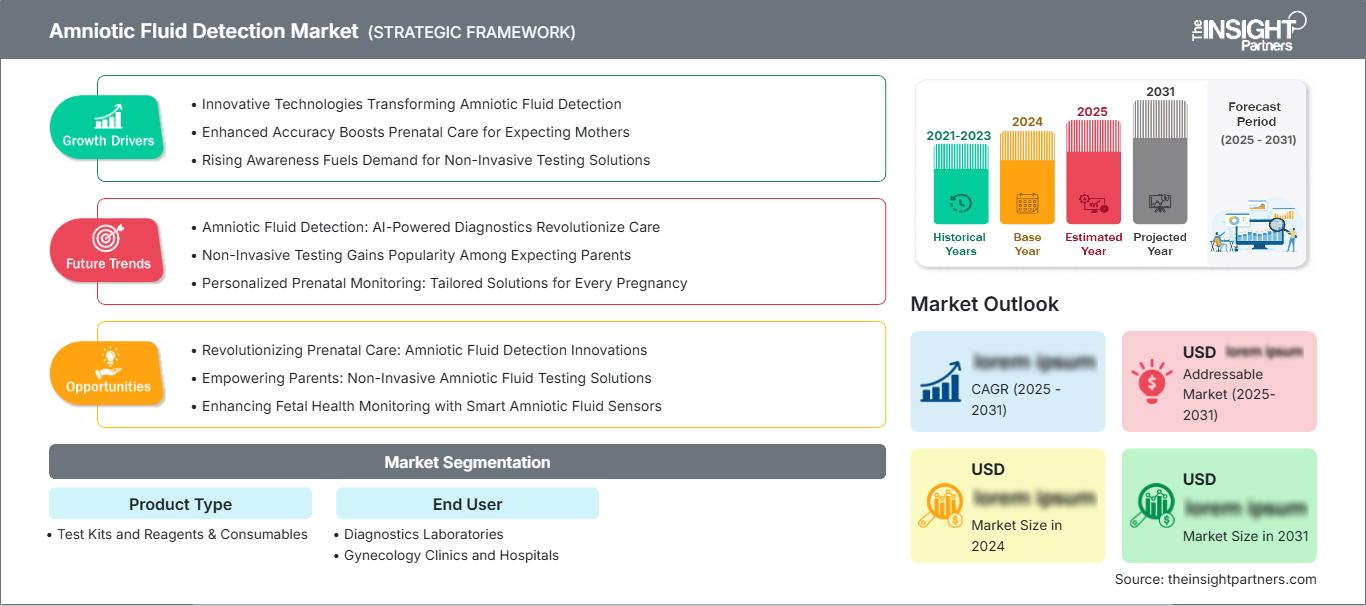
Amniotic Fluid Detection Market: Strategic Insights
Regional Insights
North America Amniotic Fluid Detection Market
North America accounted for 38–42% share in 2025 and is expected to grow at a CAGR of 10.8–11.4% through 2034. Amniotic Fluid Test market share is driven by existing triage protocols in obstetrics, robust hospital buying capabilities, and abundant laboratories capable of processing antenatal specimens. CDC data on a 10.41% preterm delivery rate in the U.S. in 2024 bolsters the clinical demand for accurate testing of amniotic membranes' rupture.
Product use is centered around hospitals, maternal-fetal medicine specialists, and diagnostic labs employing one-time swabs and reagents to test patients. User preference includes visual interpretation, sterility, and ease of use. Suppliers take advantage of existing product distribution, clinician training, and adoption by emergency maternity screening programs, while regulation requirements prompt documentation, label accuracy, and manufacturing control.
U.S. Amniotic Fluid Detection Market
The U.S. represented 78–82% of North America in 2025 and is projected to grow at a CAGR of 10.9–11.5% during 2026–2034. The market structure is driven by large maternity centers, private obstetrics centers, and laboratories, which process large numbers of prenatal diagnostic samples. For 2024, births in the United States were recorded at 3,628,934, thereby maintaining consistent institutional demand for triage of complications.
Vendor presence is varied, and the vendors include QIAGEN N.V., Thermo Fisher Scientific Inc., Cook Medical LLC, among others who cover various segments of the testing value chain. Hospitals often favor test kits that suit nurse-based triage processes, while labs favor consistency of reagents and processing of samples. Testing adoption is further driven by advanced maternal age, cesarean monitoring pathway, and accountable care needs to reduce unnecessary admission.
Europe Amniotic Fluid Detection Market
Europe held 25–29% share in 2025 and is expected to expand at a CAGR of 10.2–10.9%, with Germany leading. UK has the advantage of having standard maternity pathways and National Health Service procurement practices, encouraging demand for reliable and user-friendly diagnostics in obstetric assessment units. Providers need to show that the test is reliable, has training support, and is cost-effective in using in centralized healthcare systems.
Germany continues to be the leader among European countries because of its well-developed diagnostic capabilities, purchasing power in hospitals, and increased use of IVD products. Countries such as France, Italy, and Spain participate thanks to well-developed maternity programs, private clinics' willingness to adopt IVD products, and increased interest in high-risk pregnant mothers. According to Eurostat, in 2024, there were 3.55 million EU births with an average first birth age of 29.9 years.
APAC Amniotic Fluid Detection Market
APAC accounted for 22–26% share in 2025 and is forecast to grow at a CAGR of 12.1–12.8%, with China leading. Growth is supported by expanding private maternity hospitals, urban diagnostic chains, and policy attention to maternal and newborn outcomes. Japan, South Korea, and Australia emphasize quality systems, while India shows rapid expansion in clinic-based prenatal testing.
Industrial drivers include local packaging capacity, broader reagent sourcing, and expanding medical device distribution. China’s scale and hospital modernization reinforce leadership, while India adds volume upside through private obstetric care. Australia and South Korea support premium diagnostic formats through regulated clinical pathways and higher awareness of maternal-fetal risk screening.
Middle East & Africa Amniotic Fluid Detection Market
The Middle East & Africa is projected to grow at a CAGR of 9.8–10.5%, with Saudi Arabia leading regional adoption. Hospital infrastructure investment, women’s health modernization, and private maternity services support wider use of rapid obstetric diagnostics. The UAE follows with premium hospital procurement, while South Africa anchors demand in sub-Saharan clinical networks.
Energy-funded healthcare investment indirectly supports procurement in Gulf countries through new hospitals, specialty clinics, and diagnostic laboratories. Rest of MEA remains uneven because access varies by infrastructure, clinician training, and supply continuity. Suppliers that offer room-temperature products and distributor education can address gaps in secondary cities and emerging maternity-care networks..
Segmentation Analysis
Product Type
Product Type is projected to grow at a CAGR range of 11.0–11.6% during 2026–2034. Product demand is driven by the need for quick, sterile, and reliable detection tools in emergency obstetric evaluation. The Amniotic Fluid Detection Market scope is broadening as hospitals combine rapid kits with supporting reagents and consumables to improve diagnostic confidence and workflow efficiency.
- Test Kits dominate due to simple use, visual or assay-based interpretation, and strong fit with triage settings where fast membrane rupture assessment affects admission and clinical decision-making.
- Reagents & Consumables remain strategically important because recurring use supports assay performance, quality control, and laboratory continuity, especially where centralized testing complements bedside evaluation.
End User
End User is expected to grow at a CAGR range of 11.2–11.8% during 2026–2034. Adoption is shaped by the location of clinical decision-making, with hospitals managing urgent obstetric cases and diagnostic laboratories supporting standardized testing. Gynecology clinics increasingly use rapid formats to support early referral, reduce uncertainty, and improve patient management before escalation.
- Diagnostics Laboratories are gaining share as prenatal testing consolidates into higher-throughput networks that prioritize validated reagents, standardized quality systems, and consistent reporting for obstetric decision support.
- Gynecology Clinics and Hospitals remain core users because membrane rupture suspicion often presents first in maternity units, emergency rooms, and outpatient obstetric settings requiring rapid assessment.
Opportunity Snapshot
| Segment Name | Revenue Contribution | Trend Tag | Adoption Stage |
| Diagnostics Laboratories | High | Central Testing | Scaling |
| Gynecology Clinics and Hospitals | High | Obstetric Triage | Mature |
Amniotic Fluid Detection Market Growth Drivers and Impact Analysis
Rising Need for Rapid PROM Triage
Prompt assessment of premature membrane rupture is essential since it affects admission criteria, fetal monitoring, antibiotics, and delivery strategy. The fact that according to WHO, there were 13.4 million cases of premature birth in 2020 proves the ongoing problem associated with pregnancy complications in the world. In this regard, rapid diagnostics allows differentiating the amniotic fluid leak from urine or vaginal discharge, which helps overcome uncertainties in a busy environment. The market of amniotic fluid detection benefits in situations when hospitals have clear standards for testing using rapid tests with easy interpretation and minimal complexity.
Shift Toward Disposable, Low-Complexity Diagnostic Formats
The adoption of the disposables test kits by hospitals and clinics is motivated by the need to minimize contamination, make training easier, and fit into a decentralized health setting. Sterilized swabs and reagents make the process less complicated than using microscopy which is both complicated and time-consuming. Moreover, this innovation fits well in the developing countries where laboratory equipment and staffing is not consistent from facility to facility. The manufacturers enjoy continuous sales of the disposables while the consumers enjoy a predictable cost structure for their consumption. In effect, there is an increasing number of customers from various maternity hospitals and gynecological clinics.
Growth in Advanced Maternal-Age Pregnancy Monitoring
Pregnancy delay is altering prenatal risk factors in developed and urbanizing economies. According to Eurostat, the average EU first-time motherhood age was 29.9 years in 2024, while US figures pointed to increasing birth rates amongst women in the 40–44-year age range in 2024. An older pregnancy age may result in increased levels of monitoring, specialist consultation, and need for prompt evaluation in case of any potential problems. While amniotic fluid testing is age agnostic, it stands to benefit from overall heightened levels of prenatal monitoring and more organized pathways of obstetrics.
Amniotic Fluid Detection Market Future Trends
Integration of PROM Testing into Digital Maternity Workflows
The Amniotic Fluid Detection Market trends point toward closer linkage between rapid test results, electronic maternity records, and triage decision tools. Hospitals are moving from isolated bedside observations to documented, auditable workflows that support clinical governance. Future products may not need complex hardware, but they will need clearer reporting formats, lot traceability, and compatibility with standardized care pathways. Vendors that provide training material, QR-linked instructions, and digital documentation support can reduce user error and strengthen adoption. This trend will be most visible in high-acuity maternity units and private hospital networks where quality metrics and patient throughput are closely monitored.
Greater Use of Biomarker-Supported Confirmation
The future demand will be more oriented towards products that ensure greater specificity in situations where there are ambiguities in results because of infection, hemorrhage, or mixed flow. The biomarker-based tests can serve as a supplement to pH test kits in order to have better assurance regarding membrane rupture. The low cost visual tests are still there but there is a hierarchy of testing options, wherein the clinics carry out screening and the laboratories conduct confirmation. It offers greater value for companies having capability of developing reagents and assays.
Amniotic Fluid Detection Market Opportunities
Expansion Through Diagnostic Laboratory Networks
Large diagnostic chains and hospital-affiliated laboratories offer a scalable channel for manufacturers because they aggregate prenatal testing demand across many clinics. Amniotic Fluid Detection Market Forecasts indicate stronger opportunity where laboratories can standardize reagent purchasing, quality control, and reporting. Vendors should focus on long-term supply contracts, training modules, and kit-reagent bundles that support predictable turnaround. In emerging markets, partnerships with regional laboratories can also improve access beyond tertiary hospitals. Companies that combine distributor reach with clinical education can build durable volume growth without depending solely on direct hospital sales.
Localized Manufacturing and Distributor-Led Access
Localized manufacturing, packaging, or reagent procurement can help in reducing the chances of stockouts and gaining pricing advantage in APAC, the Middle East, and some African regions. Maternity centers are more concerned about reliability than technology; therefore, logistics can become the key competitive advantage. Local registration, multi-language instructions, and distribution-based clinician training can help to win customers in second-tier cities. This strategy is especially important for the test kits that have ambient storage capacity and can be used in the ambulatory environment. Companies that will manage to combine affordability with quality certification may win from premium imports.
Recent Developments
- April 2026: QIAGEN N.V. — launched the CE-IVDR-certified QIAstat-Dx BCID GPF Plus AMR Panel for bloodstream infection syndromic testing, identifying 20 pathogen targets and 10 antimicrobial resistance markers in about one hour. While not specific to amniotic fluid, the launch strengthens QIAGEN’s rapid diagnostic workflow capabilities relevant to hospital laboratory procurement.
- April 2025: Medical Wire & Equipment Co. (Bath) Ltd. — released an updated product leaflet for Amnicator and SIGMA GBS, highlighting visible PROM detection in 30 seconds and swab-based collection for obstetric use. The update supports clinician education and reinforces the company’s specialist positioning in rapid pregnancy-related diagnostic consumables.
- May 2024: ELITechGroup SAS — became part of Bruker Corporation after Bruker completed its acquisition of ELITech for EUR 870 million, excluding the carved-out clinical chemistry business. The transaction expanded Bruker’s molecular diagnostics footprint and increased ELITech’s access to scale, systems capability, and commercial reach across Europe and the Americas.
Frequently Asked Questions

- Comprehensive Market Sizing and Forecast Analysis
- Detailed Segmentation Analysis
- In-Depth Market Dynamics Assessment
- Regional and Country-Level Insights
- Competitive Landscape and Company Benchmarking
- Strategic Business Intelligence
Recent Reports
Testimonials

The Insight Partners' SCADA System Market report is comprehensive, with valuable insights on current trends and future forecasts. The team was highly professional, responsive, and supportive throughout. We are very satisfied and highly recommend their services.
RAN KEDEM Partner, Reali Technologies LTDs
I requested a report on a very specific software market and the team produced the report in a few days. The information was very relevant and well presented. I then requested some changes and additions to the report. The team was again very responsive and I got the final report in less than a week.
JEAN-HERVE JENN Chairman, Future Analytica
We worked with The Insight Partners for an important market study and forecast. They gave us clear insights into opportunities and risks, which helped shape our plans. Their research was easy to use and based on solid data. It helped us make smart, confident decisions. We highly recommend them.
PIYUSH NAGPAL Sr. Vice President, High Beam Global
The Insight Partners delivered insightful, well-structured market research with strong domain expertise. Their team was professional and responsive throughout. The user-friendly website made accessing industry reports seamless. We highly recommend them for reliable, high-quality research services
YUKIHIKO ADACHI CEO, Deep Blue, LLC.
This is the first time I have purchased a market report from The Insight Partners.While I was unsure at first, I visited their web site and felt more comfortable to take the risk and purchase a market report.I am completely satisfied with the quality of the report and customer service. I had several questions and comments with the initial report, but after a couple of dialogs over email with their analyst I believe I have a report that I can use as input to our strategic planning process.Thank you so much for taking the extra time and making this a positive experience.I will definitely recommend your service to others and you will be my first call when we need further market data.
JOHN SUZUKI President and Chief Executive Officer, Board Director, BK Technologies
I wish to appreciate your support and the professionalism you displayed in the course of attending to my request for information regarding to infectious disease IVD market in Nigeria. I appreciate your patience, your guidance, and the fact that you were willing to offer a discount, which eventually made it possible for us to close a deal. I look forward to engaging The Insight Partners in the future, all thanks to the impression you have created in me as a result of this first encounter.
DR CHIJIOKE ONYIA MANAGING DIRECTOR, PineCrest Healthcare Ltd.Reason to Buy
- Informed Decision-Making
- Understanding Market Dynamics
- Competitive Analysis
- Identifying Emerging Markets
- Customer Insights
- Market Forecasts
- Risk Mitigation
- Boosting Operational Efficiency
- Strategic Planning
- Investment Justification
- Tracking Industry Innovations
- Aligning with Regulatory Trends





 Get Free Sample for