
Anal Cancer Market Demand, Trends & Forecast by 2034
Coverage: By Type (Carcinoma in Situ, Squamous Cell Carcinoma, Adenocarcinoma, Basal Cell Carcinoma, Melanoma, Others); Treatment Type (Chemotherapy, Surgery, Radiation Therapy, Immunotherapy); End User (Hospitals and Clinics, Research and Academic Institutes, Ambulatory Surgical Centers, Others) , and Geography (North America, Europe, Asia Pacific, and South and Central America)
- Status : Data Released
- Report Code : TIPRE00017614
- Category : Life Sciences
- No. of Pages : 150
- Available Report Formats :


- Last update date : July 30, 2026


2025 Market Size
US$ 687.06 Mn
Base year value
2034 Forecast
US$ 1,104.75 Mn
Projected by 2034
CAGR 2026-2034
5.42 %
Growth rate
Addressable Market
US$ 8,126.02 Mn
(2026-2034)
The anal cancer market was valued at US$ 687.06 Million in 2025 and is projected to reach US$ 1,104.75 Million by 2034, registering a CAGR of 5.42% during 2026–2034. The market is shaped by rising diagnoses of HPV-associated malignancies, increasing use of chemoradiation, expanding immunotherapy access, and stronger surveillance of high-risk populations in oncology and colorectal care settings.
Across North America, adoption is expected to grow at a CAGR of 6.9–7.9% through 2034, supported by oncology infrastructure, HPV vaccination awareness, screening in high-risk groups, and availability of advanced radiation and immunotherapy regimens. The anal cancer market size is influenced by earlier lesion detection, referral pathways, multidisciplinary tumor boards, and payer coverage for systemic oncology medicines.
Anal Cancer Market Assessment and Insights
- North America accounted for 38–41% share in 2025 and is projected to grow at a CAGR between 6.9–7.9% during 2026–2034, supported by high oncology spending, screening awareness, HPV prevention programs, and immunotherapy access.
- US represented 84–88% of North America in 2025 and is forecast to grow at a CAGR between 7.0–8.0% during 2026–2034, led by specialty oncology care.
- Europe held 27–30% share in 2025 and is projected to grow at a CAGR between 6.4–7.4% during 2026–2034, with Germany, the UK, France, Italy, and Spain leading adoption.
- Asia Pacific captured 19–22% share in 2025 and is expected to grow at a CAGR between 8.0–9.0% during 2026–2034, led by China, Japan, India, South Korea, and Australia.
- Largest Segment Squamous Cell Carcinoma held 72–76% market share in 2025 and is projected to grow at a CAGR between 7.2–8.2% during 2026–2034.
- High Growth Segment Immunotherapy held 12–15% market share in 2025 and is projected to grow at a CAGR between 10.5–12.0% during 2026–2034.
- Key companies analyzed in detail: Advaxis, Inc., ORYX GmbH & Co. KG, Eli Lilly and Company, Genticel S.A., Merck & Co., Inc., F. Hoffmann-La Roche Ltd., GSK plc, Onconova Therapeutics Inc., BioMimetix JV, LLC, Bayer AG.
Source: The Insight Partners' analysis based on proprietary research, government publications, company annual reports, investor presentations, industry databases, and expert interviews.
Therapy options have moved from surgical therapy to chemoradiation therapy that preserves organs, image guidance, pathology diagnosis, and immunotherapy checkpoints in case of recurrence or metastasis. Squamous cell carcinoma leads in terms of treatment requests due to the fact that almost all cases are associated with HPV infection. Production activities are centered on oncology therapies, radiation planning, diagnostics, vaccine-based prevention, and clinical trials connecting rare tumors specialists within colorectal, gynecological, infectious diseases, and medical oncology.
Prospects are oriented toward early diagnostics, biomarker-based therapy, and more effective prevention with HPV vaccination. Emerging markets are developing in terms of accessibility of oncology centers and radiation therapy machines, whereas mature markets are developing in terms of immunotherapy sequencing and survivorship care. The regulatory environment has the most dynamics if rare cancer trials show any progression-free survival benefits, hence allowing new systemic treatments to enter the arena without any evidence-based data.
Anal Cancer Market Report Scope
| Report Attribute | Details |
|---|---|
| Market size in 2025 | US$ 687.06 Million |
| Market Size by 2034 | US$ 1,104.75 Million |
| Global CAGR (2026 - 2034) | 5.42% |
| Historical Data | 2021-2024 |
| Forecast period | 2026-2034 |
Anal Cancer Market Analysis
Demand is supported by HPV-associated cancer burden, aging populations, and increased recognition of anal intraepithelial neoplasia among high-risk groups. The anal cancer market growth is also linked to cancer control programs, as WHO and national oncology bodies continue to emphasize HPV vaccination, screening, and treatment access for cancers associated with high-risk HPV types.
The care ecosystem includes gastroenterologists, colorectal surgeons, radiation oncologists, medical oncologists, pathologists, infectious disease specialists, vaccine providers, hospitals, laboratories, and academic trial groups. Supply dynamics depend on radiotherapy capacity, infusion access, diagnostic turnaround, biopsy volume, drug reimbursement, and referral coordination. Smaller patient pools make organized clinical networks essential for evidence generation and consistent treatment adoption.
Competition is increasingly shaped by immune oncology relevance, HPV-directed research, and gastrointestinal cancer capabilities. The anal cancer market analysis indicates that Merck & Co., Inc., F. Hoffmann-La Roche Ltd., GSK plc, Bayer AG, Eli Lilly and Company, and Onconova Therapeutics Inc. retain strategic relevance through checkpoint inhibitors, oncology pipelines, and clinical development infrastructure.
Specialists, including Advaxis, Inc., ORYX GmbH & Co. KG, Genticel S.A., and BioMimetix JV, LLC. strengthen the research landscape through vaccine, immune, or tumor biology perspectives. Strategic investment is shifting toward combination immunotherapy, viral or vaccine-based approaches, biomarker testing, and rare tumor trial designs that can produce actionable evidence despite limited incidence.
● REPORT CUSTOMIZATION
Tailor This Report To Align With Your Specific Business Requirements
This report can be customized to align precisely with your business objectives, scope, and target markets. Customization options include tailored segmentation, geography, competitive analysis, and strategic insights to support informed decision-making.
Customize This Report →WHAT YOU CAN ADJUST
- ● Segmentations
- ● Geography
- ● Competitive Analysis
- ● Language Preferences
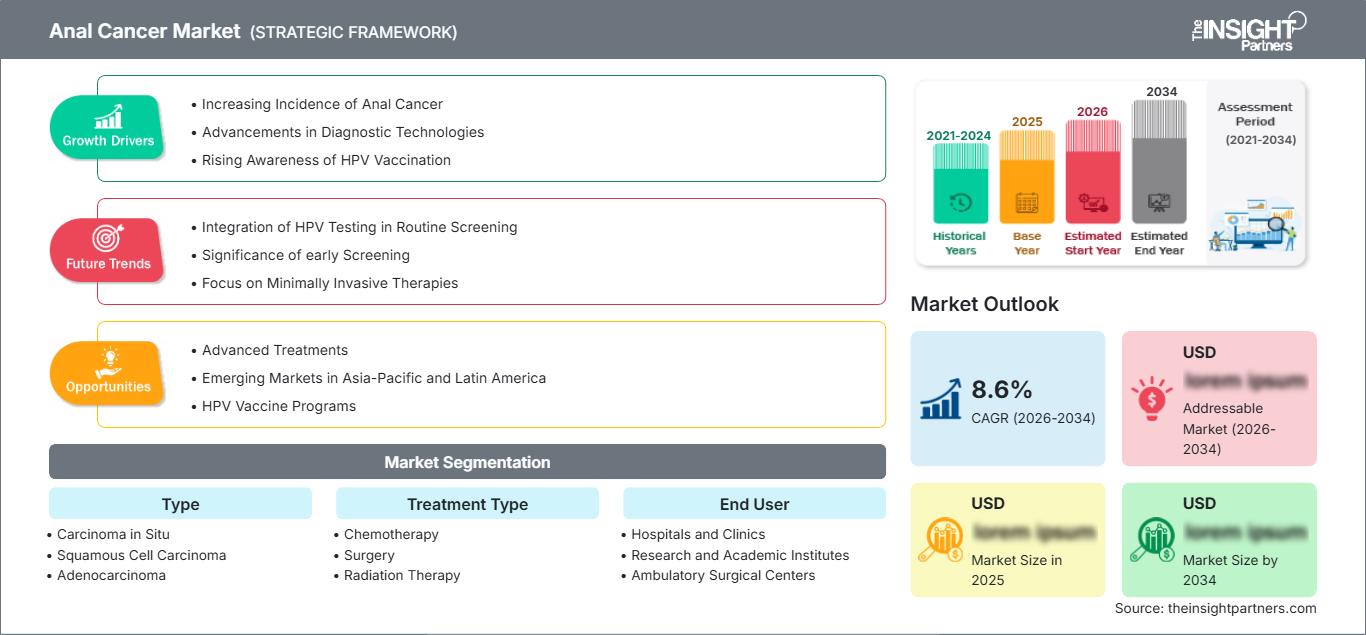
Anal Cancer Market: Strategic Insights
Regional Insights
North America anal cancer market
North America accounted for 38–41% share in 2025 and is projected to grow at a CAGR between 6.9–7.9% during 2026–2034. The region benefits from advanced radiation oncology, HPV vaccination programs, infectious disease referral networks, and early access to immune checkpoint therapies. The anal cancer market share is concentrated in hospitals, oncology clinics, radiation centers, and academic cancer institutes.
The demand is driven by high-risk surveillance of those with immunodeficiency, HIV, and chronic HPV infection. The multidisciplinary tumor board contributes to effective care sequencing from chemoradiotherapy to surgery to systemic therapy. In addition, North American buyers are concerned about biomarker tests, participation in clinical trials, as well as treatment that lowers the chances of recurrence without affecting continence.
U.S. Anal Cancer Market
The U.S. represented 84–88% of North America in 2025 and is projected to grow at a CAGR between 7.0–8.0% during 2026–2034. Market depth reflects broad oncology reimbursement, National Cancer Institute-designated centers, HPV-related cancer awareness, and availability of advanced radiotherapy and immunotherapy.
Application trends include anal cytology referral, high-resolution anoscopy in selected populations, concurrent chemoradiation, checkpoint inhibitor use in advanced disease, and survivorship services for bowel, sexual, and functional complications. Merck & Co., Inc., F. Hoffmann-La Roche Ltd., GSK plc, Eli Lilly and Company, and Bayer AG maintain visibility through oncology portfolios, immunotherapy research, and gastrointestinal cancer capabilities.
Europe Anal Cancer Market
Europe held 27–30% share in 2025 and is expected to grow at a CAGR between 6.4–7.4% during 2026–2034. The UK is increasing HPV vaccination and referrals in case of suspicious symptoms, while expert centers are dealing with chemoradiotherapy and late toxicity follow-ups. Public health care is focused on evidence-based implementation and affordability.
Germany leads due to oncological care, availability of radiation treatment, and extensive clinical trial involvement. France, Italy, and Spain support demand via colorectal surgery networks, cancer research institutes, and HPV programs. The growth in Europe will be determined by the time of reimbursement, rare cancer evidence, and the inclusion of new immunotherapy combination guidelines for advanced squamous cell carcinoma.
APAC Anal Cancer Market
APAC captured 19–22% share in 2025 and is forecast to grow at a CAGR between 8.0–9.0% during 2026–2034. China is the dominant nation, with Japan, India, South Korea, and Australia next in line through cancer center development, HPV immunization campaigns, and better pathology facilities.
Japan and Australia have more access to oncology procedures, while China and India have developed radiotherapy treatment and specialty referral systems. Growth is enabled by urban hospitals, oncology chains, and increased awareness of HPV-related cancers despite inconsistent screening.
Middle East & Africa Anal Cancer Market
The Middle East & Africa is projected to grow at a CAGR between 5.8–6.8% during 2026–2034. Leadership of Saudi Arabia and the UAE is through tertiary oncology hospitals, medical tourism, and radiation therapy investments. Discussions regarding HPV vaccination are increasingly becoming relevant for cancer prevention in the long run.
South Africa continues to be the most developed African market in terms of demand based on increased cancer risk due to HIV, public oncology services, and private cancer centers. The rest of MEA adoption is gradual due to a lack of screening and late diagnosis, in addition to poor radiotherapy access.
Segmentation Analysis
Type
Type is projected to grow at a CAGR between 7.1–8.1% during 2026–2034. Disease classification determines clinical pathway, treatment intensity, and prognosis. The anal cancer market scope is shaped by the dominance of squamous cell carcinoma, while rarer histologies require differentiated surgical, systemic, or dermatologic oncology approaches. Accurate pathology is therefore central to therapy selection and trial eligibility.
- Carcinoma in Situ represents early-stage disease where surveillance, local treatment, and progression prevention are strategically important, particularly in high-risk populations with persistent HPV-related lesions.
- Squamous Cell Carcinoma dominates demand because most anal cancers arise from squamous epithelium and are commonly treated with combined chemotherapy and radiation before systemic escalation.
- Adenocarcinoma is less common but clinically important because management may resemble lower rectal cancer pathways, requiring careful staging, surgical evaluation, and systemic treatment planning.
- Basal Cell Carcinoma is rare in the anal region and typically requires specialist differentiation from perianal skin tumors, influencing local excision and dermatologic oncology involvement.
- Melanoma is uncommon but aggressive, often requiring immunotherapy assessment, molecular testing, and referral to melanoma specialists due to poorer outcomes and distinct biology.
Treatment Type
Treatment Type is projected to grow at a CAGR between 7.4–8.4% during 2026–2034. Treatment demand reflects stage, histology, recurrence status, performance score, and immune profile. Chemoradiation remains foundational for localized squamous cell carcinoma, while immunotherapy is gaining importance in advanced disease. Surgery continues to serve selected early lesions, salvage situations, and non-squamous histologies.
- Chemotherapy remains central in combination with radiation for localized disease and with systemic regimens for advanced cases, supporting demand for infusion services and toxicity management.
- Surgery is used selectively for local excision, persistent disease, recurrence, or salvage abdominoperineal resection, making surgical expertise important despite organ-preserving treatment preference.
- Radiation Therapy is a core modality because precise pelvic radiation combined with chemotherapy can preserve sphincter function while controlling localized squamous cell carcinoma.
- Immunotherapy is the fastest-moving treatment class, supported by checkpoint inhibitor activity in locally recurrent or metastatic disease and expanding combination strategies.
End User
End User is projected to grow at a CAGR between 7.0–8.0% during 2026–2034. Care delivery depends on diagnosis stage, procedure complexity, radiotherapy access, and systemic treatment availability. Hospitals and clinics manage most commercial demand because they coordinate biopsy, staging, chemoradiation, surgery evaluation, infusion therapy, and follow-up, while research institutes drive rare cancer trial participation.
- Hospitals and Clinics dominate demand because patients require multidisciplinary care involving oncology, colorectal surgery, radiation therapy, pathology, pain management, and survivorship services.
- Research and Academic Institutes are strategically important because rare cancer trials, HPV biology studies, immune biomarker research, and registries depend on concentrated expert networks.
- Ambulatory Surgical Centers support selected biopsy, local excision, and follow-up procedures where patient risk is appropriate and coordination with oncology teams is maintained.
Opportunity Snapshot
| Treatment | Revenue Contribution | Trend Tag | Adoption Stage |
| Chemotherapy | High | ChemoRT Backbone | Mature |
| Surgery | Medium | Salvage Care | Mature |
| Radiation Therapy | High | Pelvic Precision | Mature |
| Immunotherapy | Medium | PD-1 Expansion | Scaling |
Anal Cancer Market Growth Drivers and Impact Analysis
HPV-Associated Disease Burden Sustains Clinical Demand
The persistence of high-risk HPV infection is the key factor driving the epidemiology of anal squamous cell carcinoma, as it causes the majority of these cancer cases. There will be a continuous demand for prevention, screening, treatment, and monitoring of such cancer cases. Prevention through HPV vaccination might decrease the rate of this cancer, but there is still a demand for clinical patients due to the fact that it takes a few years from the time of infection before cancer forms. The actual effect is the continuous need for lesion detection, pathological confirmation, chemoradiotherapy, and systemic treatment.
Immunotherapy Expands Options in Advanced Disease
Immune checkpoint blockade is transforming the paradigm of systemic therapy for recurrent and metastatic anal squamous cell carcinoma. Traditionally, there have been limited systemic treatment options beyond platinum-based therapy, and patient outcomes were poor. With the advent of new immunotherapy combinations, new lines of therapy are available, and biomarker assessment is possible in more advanced stages. Market implications of this include increased spending on oncology drugs, increased utilization of infusion centers, and increased interest in clinical studies on checkpoint inhibitors combined with chemotherapy, anti-VEGF drugs, or vaccines.
Multidisciplinary Care Improves Treatment Pathway Efficiency
This approach represents an efficient catalyst for growth since anal cancer treatment involves coordination between staging, pathology review, chemoradiation treatment plan, surgical evaluation, and survivorship care. Fragmented care may result in treatment delays, toxicity risks, and missed recurrences. Tumor boards determine whether a patient needs chemoradiation treatment, local resection, salvage surgery, or systemic therapy. The business benefits from the above approach will be greater use of oncology services, radiation planning, supportive care, and imaging follow-up. Hospitals with multidisciplinary teams of colorectal surgeons, radiation oncologists, medical oncologists, infectious disease doctors, and nurse navigators will be able to handle complicated cases and act as referral centers.
Anal Cancer Market Future Trends
Biomarker-Led Immunotherapy Sequencing
The most important anal cancer market trends will involve biomarker-led immunotherapy sequencing in advanced squamous cell carcinoma. Future treatment decisions are expected to rely more on PD-L1 expression, HPV-derived circulating tumor DNA, immune microenvironment markers, prior platinum exposure, and response durability. These tools may help identify patients likely to benefit from checkpoint inhibitors or combination regimens. As rare cancer trials mature, biomarker enrichment can improve study efficiency and payer confidence. Oncology centers that connect molecular testing, serial monitoring, and clinical trial referral will be better positioned to manage advanced cases with precision.
HPV Prevention and High-Risk Surveillance Converge
Prevention and surveillance will continue to merge as health care systems link HPV vaccinations, HIV care, cervical cancer screening, and anal dysplasia surveillance. Younger generations that receive vaccinations could have reduced rates of infection over time; however, older or at-risk adults will require ongoing monitoring. In future programs, risk assessment, high-definition anoscopy, cytology, HPV testing, and referral to specialists will allow lesions to be detected before cancer is present. As a result, some resources will be diverted from treating the condition and into diagnostic procedures and prevention.
Anal Cancer Market Opportunities
Rare Tumor Immunotherapy Trial Networks
A clear opportunity lies in developing rare tumor trial networks that can evaluate immunotherapy combinations efficiently. The anal cancer market Forecasts indicate that growth will depend on better evidence for advanced and recurrent disease, where patient numbers are limited but the unmet need is high. Sponsors can partner with academic cancer centers, HIV clinics, and colorectal oncology groups to accelerate recruitment. Trial designs should include biomarker sampling, quality-of-life outcomes, and crossover rules that reflect ethical treatment expectations. Networks that standardize data capture and referral can reduce development risk and support faster guideline adoption.
Integrated HPV-Linked Cancer Care Pathways
HPV-related integrated care pathways provide an excellent opportunity for hospitals and diagnostics companies working together with public health partners. These programs may integrate vaccine counseling, high-risk screening, referral to anal dysplasia specialists, pathologic examination, oncologic treatment, and survivorship care. This strategy is commercially relevant due to its provision of earlier diagnoses, improved patient retention rates, and clear referral processes. Funding must be directed towards training, anoscopy capability, molecular diagnostics, and cooperation between infectious disease, gynecological, colorectal surgery, and oncology departments. The best opportunities will arise in urban cancer networks dealing with HIV-positive patients and HPV prevention in other regions.
Recent Developments
- July 2026: Oncolytics Biotech Inc. received FDA Fast Track designation for pelareorep in combination with a checkpoint inhibitor for advanced squamous cell carcinoma of the anal canal after prior systemic therapy. The designation followed FDA alignment on a randomized pivotal study design for patients with limited post-immunotherapy options.
- January 2026: F. Hoffmann-La Roche Ltd. supported published evidence from a Phase II trial evaluating atezolizumab and bevacizumab in HPV-positive unresectable or metastatic squamous cell carcinoma of the anal canal. The study reported an 11% overall response rate and identified translational biomarkers associated with survival.
- May 2025: Incyte Corporation received FDA approval for retifanlimab-dlwr with carboplatin and paclitaxel for first-line treatment of adults with inoperable locally recurrent or metastatic squamous cell carcinoma of the anal canal. The approval was based on POD1UM-303/InterAACT 2 progression-free survival results.
Frequently Asked Questions

- Comprehensive Market Sizing and Forecast Analysis
- Detailed Segmentation Analysis
- In-Depth Market Dynamics Assessment
- Regional and Country-Level Insights
- Competitive Landscape and Company Benchmarking
- Strategic Business Intelligence
Recent Reports
Testimonials

The Insight Partners' SCADA System Market report is comprehensive, with valuable insights on current trends and future forecasts. The team was highly professional, responsive, and supportive throughout. We are very satisfied and highly recommend their services.
RAN KEDEM Partner, Reali Technologies LTDs
I requested a report on a very specific software market and the team produced the report in a few days. The information was very relevant and well presented. I then requested some changes and additions to the report. The team was again very responsive and I got the final report in less than a week.
JEAN-HERVE JENN Chairman, Future Analytica
We worked with The Insight Partners for an important market study and forecast. They gave us clear insights into opportunities and risks, which helped shape our plans. Their research was easy to use and based on solid data. It helped us make smart, confident decisions. We highly recommend them.
PIYUSH NAGPAL Sr. Vice President, High Beam Global
The Insight Partners delivered insightful, well-structured market research with strong domain expertise. Their team was professional and responsive throughout. The user-friendly website made accessing industry reports seamless. We highly recommend them for reliable, high-quality research services
YUKIHIKO ADACHI CEO, Deep Blue, LLC.
This is the first time I have purchased a market report from The Insight Partners.While I was unsure at first, I visited their web site and felt more comfortable to take the risk and purchase a market report.I am completely satisfied with the quality of the report and customer service. I had several questions and comments with the initial report, but after a couple of dialogs over email with their analyst I believe I have a report that I can use as input to our strategic planning process.Thank you so much for taking the extra time and making this a positive experience.I will definitely recommend your service to others and you will be my first call when we need further market data.
JOHN SUZUKI President and Chief Executive Officer, Board Director, BK Technologies
I wish to appreciate your support and the professionalism you displayed in the course of attending to my request for information regarding to infectious disease IVD market in Nigeria. I appreciate your patience, your guidance, and the fact that you were willing to offer a discount, which eventually made it possible for us to close a deal. I look forward to engaging The Insight Partners in the future, all thanks to the impression you have created in me as a result of this first encounter.
DR CHIJIOKE ONYIA MANAGING DIRECTOR, PineCrest Healthcare Ltd.Reason to Buy
- Informed Decision-Making
- Understanding Market Dynamics
- Competitive Analysis
- Identifying Emerging Markets
- Customer Insights
- Market Forecasts
- Risk Mitigation
- Boosting Operational Efficiency
- Strategic Planning
- Investment Justification
- Tracking Industry Innovations
- Aligning with Regulatory Trends





 Get Free Sample for