
Anesthesia Gas Scavenging System Market Trends, Share & Demand by 2034
Coverage: By Product Type (Active Scavenging Systems, Passive Scavenging Systems); End User (Hospitals, Specialty Clinics, Other End Users), and Geography (North America, Europe, Asia Pacific, and South and Central America)
- Status : Data Released
- Report Code : TIPRE00009089
- Category : Life Sciences
- No. of Pages : 150
- Available Report Formats :


- Last update date : July 31, 2026


2025 Market Size
US$ 692.27 Mn
Base year value
2034 Forecast
US$ 1,175.66 Mn
Projected by 2034
CAGR 2026-2034
6.06 %
Growth rate
Addressable Market
US$ 8,458.15 Mn
(2026-2034)
The anesthesia gas scavenging system market is projected to grow from US$ 692.27 Million in 2025 to US$ 1,175.66 Million by 2034, registering a CAGR of 6.06% during 2026–2034. Demand is supported by rising surgical volumes, stricter occupational exposure control, wider use of inhalation anesthesia, and hospital investment in waste anesthetic gas removal systems across operating rooms, recovery areas, dental suites, and veterinary procedure environments.
North America remains a major revenue contributor because hospitals and specialty care facilities prioritize staff safety, ventilation compliance, and operating room infrastructure upgrades. The anesthesia gas scavenging system market size in the region is supported by developed medical gas pipeline networks, active adoption in veterinary practices, and replacement of older passive systems. Regional growth is expected to remain within a 5.3–5.9% CAGR range through 2034.
Anesthesia Gas Scavenging System Market Assessment and Insights
- North America: North America accounted for 36–40% share in 2025 and is projected to grow at 5.3–5.9% CAGR between 2026–2034, supported by operating room upgrades, veterinary anesthesia use, and occupational exposure control.
- US: The US represented 83–87% of North America in 2025 and is expected to grow at 5.2–5.8% CAGR between 2026–2034, driven by hospitals, specialty clinics, dental surgery centers, and veterinary facilities.
- Europe: Europe held 27–31% share in 2025 and is forecast to grow at 5.1–5.7% CAGR between 2026–2034, led by Germany, the UK, France, Italy, and Spain.
- Asia Pacific: Asia Pacific captured 22–26% share in 2025 and is projected to expand at 7.0–7.7% CAGR between 2026–2034, with China, Japan, India, South Korea, and Australia leading adoption.
- Largest Segment: Active Scavenging Systems held 68–73% market share in 2025 and is expected to grow at 6.2–6.8% CAGR between 2026–2034, because centralized suction improves waste gas removal.
- High Growth Segment: Specialty Clinics accounted for 18–23% market share in 2025 and is projected to grow at 6.8–7.5% CAGR between 2026–2034, supported by outpatient anesthesia expansion.
- Key companies analyzed in detail: Midmark Corporation, Megasan Medikal, Pneumatech Medical Gas Solutions, MIM Medical, Atlas Copco AB, Millennium Medical Products Ltd., BGS General S.r.l., Hugo Sachs Elektronik, Smiths Medical, and STM Tecnologie Medicali S.r.l.
Source: The Insight Partners' analysis based on proprietary research, government publications, company annual reports, investor presentations, industry databases, and expert interviews.
Clinical gas infrastructure has moved from basic exhaust approaches toward engineered scavenging systems that actively collect, transfer, and discharge waste anesthetic gases. Hospitals increasingly evaluate flow stability, vacuum control, system alarms, terminal units, and compatibility with medical gas pipeline networks. Production dynamics are also changing as suppliers combine pumps, blowers, valves, hoses, and monitoring components into modular packages that can serve new facilities and retrofit projects.
Future demand will be shaped by operating room modernization, veterinary anesthesia expansion, and stronger workplace safety expectations. Asia Pacific and the Middle East will add new installation demand through hospital construction, while North America and Europe will generate replacement and compliance-led procurement. Buyers will increasingly favor scalable systems that support multiple anesthesia points, reduce room clutter, and improve environmental control.
Anesthesia Gas Scavenging System Market Report Scope
| Report Attribute | Details |
|---|---|
| Market size in 2025 | US$ 692.27 Million |
| Market Size by 2034 | US$ 1,175.66 Million |
| Global CAGR (2026 - 2034) | 6.06% |
| Historical Data | 2021-2024 |
| Forecast period | 2026-2034 |
Anesthesia Gas Scavenging System Market Analysis
The anesthesia gas scavenging system market growth is driven by the rising use of inhaled anesthetics in human medicine, veterinary surgery, dental sedation, and research procedures. Anesthetic gases may be produced in a poorly-controlled environment, which makes a scavenging system absolutely necessary for protecting staff. There is the highest demand for this product in places such as operating rooms and specialty suites, which need to ensure the evacuation of anesthetic gases from the breathing circuit and ventilation systems of patients.
The value chain consists of collection points, tubes, receivers, active pumps, exhaust systems, terminal points, controls, filters, and maintenance services. The supply side factors include construction cycles of hospitals, medical gas requirements, installer capacity, and biomedical engineering facilities. Reliability, noise generation, suction stability, and flow rates are some of the criteria considered by buyers.
The anesthesia gas scavenging system market analysis indicates a specialized competitive structure involving medical gas infrastructure suppliers, veterinary equipment companies, and hospital engineering vendors. While Atlas Copco AB and Pneumatech Medical Gas Solutions have a wider scope in providing services related to medical gases, Midmark Corporation has a prominent place in veterinary anesthesia scavenging, especially at the clinic level.
Installation capabilities and regional reach are also key factors in competitive positioning. Megasan Medikal, MIM Medical, BGS General S.r.l., Millennium Medical Products Ltd., and STM Tecnologie Medicali S.r.l. cater to infrastructure development at hospitals where the integration of medical gases plays an important role. On the other hand, Hugo Sachs Elektronik caters to the needs of research facilities and Smiths Medical through anesthesia and respiratory care channels.
● REPORT CUSTOMIZATION
Tailor This Report To Align With Your Specific Business Requirements
This report can be customized to align precisely with your business objectives, scope, and target markets. Customization options include tailored segmentation, geography, competitive analysis, and strategic insights to support informed decision-making.
Customize This Report →WHAT YOU CAN ADJUST
- ● Segmentations
- ● Geography
- ● Competitive Analysis
- ● Language Preferences
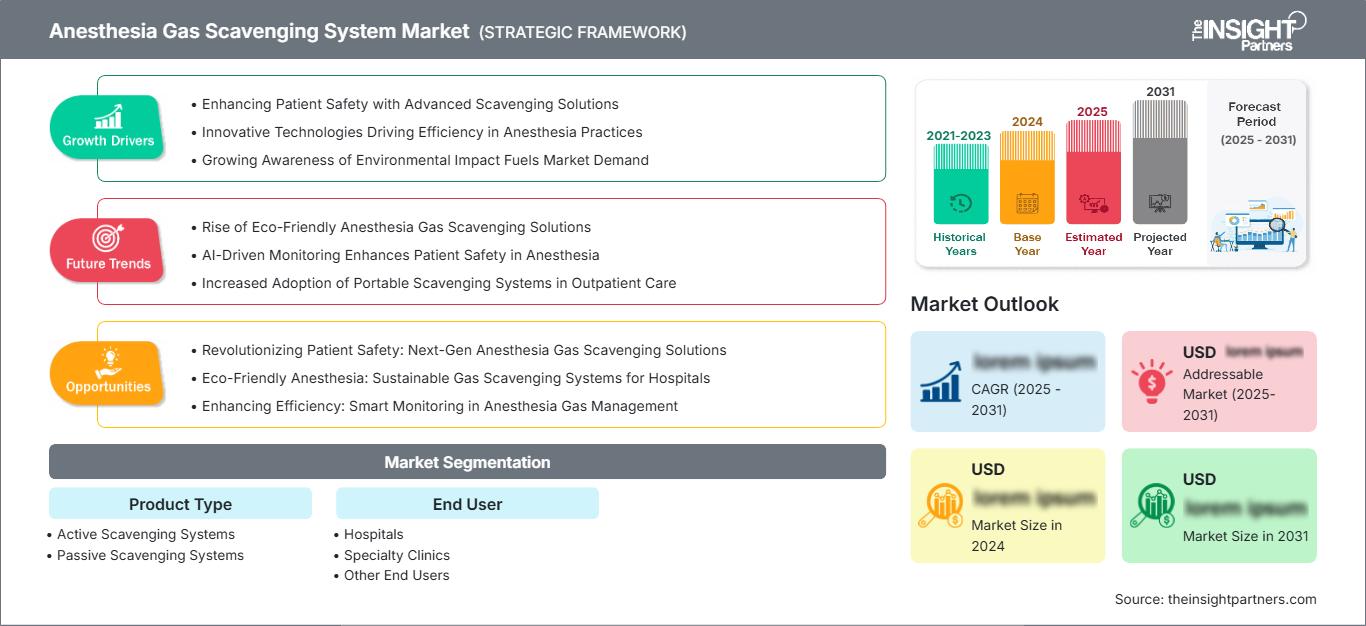
Anesthesia Gas Scavenging System Market: Strategic Insights
Regional Insights
North America anesthesia gas scavenging system market
North America accounted for 36–40% share in 2025 and is projected to grow at 5.3–5.9% CAGR during 2026–2034. The demand for the product is driven by hospitals, ambulatory procedure centers, veterinary hospitals, dental surgical units, and research institutions. The presence of mature infrastructure and awareness regarding occupational exposures drives the demand for engineered solutions compared to makeshift exhaust systems.
Market Share for Anesthesia Gas Scavenging Systems in North America
The North American market for anesthesia gas scavenging systems is being driven by the need for replacement of old systems, installation of new procedure rooms, and increased adoption in veterinary clinics. Purchasing of systems is done on the basis of an active system that eliminates the waste gas from several anesthesia machines using suction.
U.S. anesthesia gas scavenging system Market
The US represented 83–87% of North America in 2025 and is expected to grow at 5.2–5.8% CAGR during 2026–2034. The demand is prompted by the surgical departments in hospitals, outpatient surgical centers, dental anesthesia services, veterinary chains, and research laboratories at universities. There is increased adoption where there is daily usage of anesthetic gases, and minimizing staff exposure is a priority.
There is widespread distribution via companies dealing with direct medical gases, veterinary wholesalers, and equipment manufacturers. Companies like Midmark Corporation, Atlas Copco AB, Pneumatech Medical Gas Solutions, Smiths Medical, and Hugo Sachs Elektronik are in favor of established routes to clinical and research facilities. In the U.S., the buyers focus on system capacity, expandability, maintenance, and ventilation compatibility.
Europe anesthesia gas scavenging system Market
Europe held 27–31% share in 2025 and is forecast to grow at 5.1–5.7% CAGR during 2026–2034. The UK supports demand through hospital refurbishment, surgical suite upgrades, and workplace safety practices related to anesthetic gas exposure. Specialty clinics and veterinary hospitals are adding compact scavenging units as procedure volumes rise.
The country leading in Europe is Germany, because of its high quality of hospital engineering, good standards of medical gases, and many operating theaters. The procurement process is usually related to the operating theater refurbishment, the improvement of the central plant and medical gas pipeline system integration with ventilation and monitoring infrastructure.
France, Italy, and Spain take part by means of hospital refurbishment, private clinic investments, and dental and veterinary anesthesia services development. European clients generally evaluate safety integrity, CE marking, blower redundancy, low noise and maintainability of products. Anesthetic gases' sustainability issues drive improved anesthesia gases capture and exhaust management.
APAC anesthesia gas scavenging system Market
Asia Pacific accounted for 22–26% share in 2025 and is expected to grow at 7.0–7.7% CAGR during 2026–2034. China leads regional demand through hospital construction, operating room expansion, and the modernization of medical gas infrastructure. Japan and South Korea maintain demand for high-quality engineered systems in advanced hospitals and research facilities.
India and Australia add momentum through private hospital investment, surgical capacity growth, veterinary care development, and accreditation-led safety improvements. Distributor and installer networks remain important because effective scavenging requires correct sizing, terminal placement, pipeline routing, and post-installation checks. Local service capability strongly influences adoption outside major metropolitan hospitals.
Middle East & Africa anesthesia gas scavenging system Market
The Middle East & Africa is expected to grow at 6.1–6.8% CAGR during 2026–2034. Saudi Arabia and the UAE lead regional demand through new hospital projects, specialty surgery centers, and medical city developments. These facilities increasingly specify integrated medical gas systems that include anesthetic gas scavenging from the planning stage.
South Africa remains the most developed regional market, supported by private hospitals, academic facilities, and veterinary procedure demand. The rest of MEA adoption is emerging through hospital refurbishment, international healthcare partnerships, and expansion of surgical services. Procurement is often shaped by tenders, installer availability, training needs, and preference for robust systems that perform reliably under variable facility conditions.
Segmentation Analysis
Product Type
Product Type is projected to grow at 5.8–6.4% CAGR during 2026–2034 as healthcare facilities choose systems based on procedure volume, room layout, and infrastructure maturity. The anesthesia gas scavenging system market scope across product types is led by active systems because they provide controlled removal through suction or blower-based disposal. Passive systems remain relevant where facility design allows safe exhaust without mechanical assistance.
- Active Scavenging Systems: Active Scavenging Systems are preferred in hospitals and high-volume procedure rooms because they use vacuum or blower mechanisms to remove waste anesthetic gas consistently from multiple care points.
- Passive Scavenging Systems: Passive Scavenging Systems remain suitable for lower-volume settings where room design, duct routing, and pressure conditions permit safe gas discharge without powered suction equipment.
End User
End User is expected to grow at 6.0–6.6% CAGR during 2026–2034 as adoption expands across hospitals, specialty clinics, and other care environments. Hospitals remain the largest buyers because multiple operating rooms require centralized systems. Specialty clinics are growing faster as dental sedation, ophthalmology, endoscopy, veterinary surgery, and office-based procedures increase the need for compact scavenging solutions.
- Hospitals: Hospitals generate the highest demand because central operating rooms, recovery areas, and procedural suites require engineered systems that support multiple anesthesia machines and continuous safety protocols.
- Specialty Clinics: Specialty Clinics are expanding adoption as outpatient sedation, dental anesthesia, veterinary surgery, and specialty procedures require waste gas removal without full hospital-scale infrastructure.
Opportunity Snapshot
| Segment Name | Revenue Contribution | Trend Tag | Adoption Stage |
| Hospitals | High | OR Infrastructure | Mature |
| Specialty Clinics | Medium | Outpatient Sedation | Scaling |
| Other End Users | Low | Research Rooms | Emerging |
Anesthesia Gas Scavenging System Market Growth Drivers and Impact Analysis
Workplace Exposure Control in Anesthesia Environments
The control of waste anesthetic gases by healthcare facilities has become stronger due to the exposure of operating room, dental, veterinary, and research personnel during inhalation anesthesia administration. The scavenging system minimizes the build-up of gases from the breathing circuit, induction chamber, mask, and recovery process. The effect is noticeable in hospitals and specialist clinics due to repetitive exposure risks, which would encourage the purchase of scavenging systems. Healthcare facilities view the scavenging system as essential infrastructure for occupational health and safety rather than as equipment that can be done without.
Expansion of Outpatient and Specialty Procedure Sites
Migration of procedures to ambulatory and specialty care facilities is creating more locations requiring inhalational agents and sedation assistance. Dental facilities, animal hospitals, ophthalmic facilities, and small operating rooms frequently have space needs and requirements for the removal of waste gases that do not allow for elaborate central plant installations. This factor drives the need for scalable active systems and practical passive solutions where applicable. The market effects include diversification of customers outside of typical hospitals. Manufacturers with modular product lines, training of distributors, and easy-to-install packages may reach small facilities that require compliance-driven solutions but do not have big biomedical engineering staff.
Hospital Construction and Medical Gas Pipeline Modernization
The new hospital projects of construction and renovation are an important source of demand for scavenging systems because the scavenging systems are usually considered simultaneously with the installations of oxygen, vacuum, compressed air, and medical gas pipelines. Active systems with blowers, control panels, terminal units, and redundancy capability are designed to be part of the planning of operating rooms for safe discharge of waste gases. This market effect will be felt especially in Asia Pacific, the Gulf region, and major replacements in developed markets. Early interaction with architects, medical gas installers, and facility engineers helps vendors to position better.
Anesthesia Gas Scavenging System Market Future Trends
Integrated Monitoring and Alarmed Scavenging Networks
Integrated monitoring will become one of the key anesthesia gas scavenging system market trends as hospitals seek better visibility into suction performance, flow continuity, and system faults. Future networks will include control panels, remote indicators, automated alerts, and maintenance logs that support biomedical teams. This shift will be strongest in large hospitals where multiple operating rooms depend on central scavenging. Buyers will increasingly ask for systems that verify performance instead of simply removing gas. Suppliers able to combine mechanical reliability with digital status feedback will gain an advantage in new construction and high-acuity replacement projects.
Clinic-Level Systems Become Simpler and More Scalable
Specialty clinics will increasingly adopt compact scavenging systems designed for lower room counts and limited engineering support. Products will emphasize quiet operation, simple tubing layouts, easy expansion, minimal maintenance, and compatibility with common anesthesia machines. Veterinary and dental settings will be especially important because many facilities are moving away from charcoal-only disposal or improvised exhaust arrangements. Scalable systems that start with one or two procedure rooms and expand later will match buyer budgets better than hospital-scale installations. Distributors will play a larger role in education, installation coordination, and ongoing parts availability.
Anesthesia Gas Scavenging System Market Opportunities
Retrofitting Older Operating Rooms and Procedure Suites
Retrofit projects offer a significant opportunity because many facilities use aging gas disposal arrangements that no longer meet current expectations for safety, documentation, or workflow efficiency. The anesthesia gas scavenging system market Forecasts indicate that replacement demand will favor suppliers offering compact active units, flexible piping options, low-noise performance, and installation guidance. Hospitals and specialty clinics can upgrade without complete reconstruction if systems are designed for practical integration. Vendors should target biomedical departments, facility managers, and clinical leaders with assessment packages that identify room-level requirements, equipment compatibility, and maintenance planning before procurement decisions are finalized.
Veterinary and Dental Facility Expansion
Veterinary hospitals and dental anesthesia providers represent a focused opportunity because inhaled agents are common, but facility layouts vary widely. These buyers need reliable scavenging that protects staff while fitting compact rooms, mobile tables, and multiple procedure points. Suppliers can grow by offering starter systems, expansion kits, staff training, and distributor-supported installation. Demand is especially attractive in North America, Europe, and urban Asia Pacific, where pet care spending, dental sedation, and clinic consolidation are rising. Practical features such as quiet operation, multi-machine capacity, and low maintenance demands will determine commercial success.
Recent Developments
- May 2025: Pneumatech Medical Gas Solutions advanced its integration with BeaconMedaes under the Atlas Copco medical gas platform, consolidating product channels and support resources. The move was positioned to simplify go-to-market processes, accelerate production and response times, and provide customers access to an expanded medical gas portfolio through a single established brand.
- January 2025: Midmark Corporation continued to position its Central Scavenger for veterinary anesthesia environments, emphasizing active waste gas removal from up to four anesthesia machines and expansion capability to cover up to twelve machines. The system replaces charcoal canister handling and supports clinics seeking cleaner, centralized waste anesthetic gas control.
- January 2025: STM Tecnologie Medicali S.r.l. maintained availability of its 21400 series anesthetic gas scavenging system, an active centralized unit using side-channel blowers, automatic alternation, pump failure backup, filters, vacuum gauge, and electrical control panel. The system is designed for operating theaters and preparation or recovery units requiring centralized gas evacuation.
Frequently Asked Questions

- Comprehensive Market Sizing and Forecast Analysis
- Detailed Segmentation Analysis
- In-Depth Market Dynamics Assessment
- Regional and Country-Level Insights
- Competitive Landscape and Company Benchmarking
- Strategic Business Intelligence
Recent Reports
Testimonials

The Insight Partners' SCADA System Market report is comprehensive, with valuable insights on current trends and future forecasts. The team was highly professional, responsive, and supportive throughout. We are very satisfied and highly recommend their services.
RAN KEDEM Partner, Reali Technologies LTDs
I requested a report on a very specific software market and the team produced the report in a few days. The information was very relevant and well presented. I then requested some changes and additions to the report. The team was again very responsive and I got the final report in less than a week.
JEAN-HERVE JENN Chairman, Future Analytica
We worked with The Insight Partners for an important market study and forecast. They gave us clear insights into opportunities and risks, which helped shape our plans. Their research was easy to use and based on solid data. It helped us make smart, confident decisions. We highly recommend them.
PIYUSH NAGPAL Sr. Vice President, High Beam Global
The Insight Partners delivered insightful, well-structured market research with strong domain expertise. Their team was professional and responsive throughout. The user-friendly website made accessing industry reports seamless. We highly recommend them for reliable, high-quality research services
YUKIHIKO ADACHI CEO, Deep Blue, LLC.
This is the first time I have purchased a market report from The Insight Partners.While I was unsure at first, I visited their web site and felt more comfortable to take the risk and purchase a market report.I am completely satisfied with the quality of the report and customer service. I had several questions and comments with the initial report, but after a couple of dialogs over email with their analyst I believe I have a report that I can use as input to our strategic planning process.Thank you so much for taking the extra time and making this a positive experience.I will definitely recommend your service to others and you will be my first call when we need further market data.
JOHN SUZUKI President and Chief Executive Officer, Board Director, BK Technologies
I wish to appreciate your support and the professionalism you displayed in the course of attending to my request for information regarding to infectious disease IVD market in Nigeria. I appreciate your patience, your guidance, and the fact that you were willing to offer a discount, which eventually made it possible for us to close a deal. I look forward to engaging The Insight Partners in the future, all thanks to the impression you have created in me as a result of this first encounter.
DR CHIJIOKE ONYIA MANAGING DIRECTOR, PineCrest Healthcare Ltd.Reason to Buy
- Informed Decision-Making
- Understanding Market Dynamics
- Competitive Analysis
- Identifying Emerging Markets
- Customer Insights
- Market Forecasts
- Risk Mitigation
- Boosting Operational Efficiency
- Strategic Planning
- Investment Justification
- Tracking Industry Innovations
- Aligning with Regulatory Trends





 Get Free Sample for