
Aniline Market Size, Share & Growth by 2034
Coverage: By Type (Salts, Sulfur Derivatives of Aniline, N-Alkyl Aniline Derivatives, C-Alkyl Aniline Derivatives, Chloroanilines and Nitroanilines Anilines, Diazo and Azo Compounds, Other Aniline Derivatives); Application (Methyl Diphenyl Diisocyanate, Dyes and Pigments, Rubber Chemical, Plant Protecting Products, Pharmaceuticals, Others) , and Geography (North America, Europe, Asia Pacific, and South and Central America)
- Status : Data Released
- Report Code : TIPRE00005616
- Category : Chemicals and Materials
- No. of Pages : 150
- Available Report Formats :


- Last update date : August 24, 2026


2025 Market Size
US$ 10.82 Bn
Base year value
2034 Forecast
US$ 16.37 Bn
Projected by 2034
CAGR 2026-2034
4.71 %
Growth rate
Addressable Market
US$ 123.44 Bn
(2026-2034)
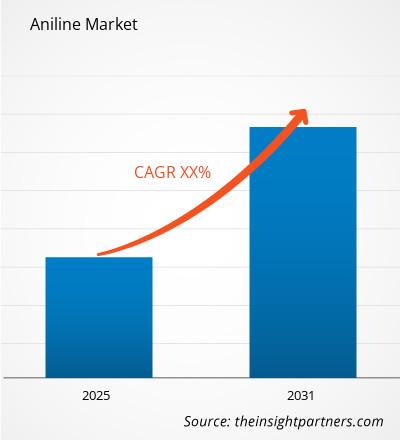
The aniline market is valued at US$ 10.82 Billion in 2025 and is projected to reach US$ 16.37 Billion by 2034, expanding at a CAGR of 4.71% during 2026–2034. The market is supported by aniline consumption across polyurethane, rubber chemicals, dyes, pigments, agrochemicals, and pharmaceutical value chains, with MDI remaining a central downstream application because of its extensive use in insulation, automotive, appliances, and furniture.
North America is expected to record an estimated CAGR of 4.1–4.6% through 2034, supported by polyurethane demand, energy-efficient building materials, automotive manufacturing, and established chemical production infrastructure. The region benefits from integrated aniline-to-MDI supply chains and continued investment in higher-value polyurethane applications. The aniline market size in North America is also influenced by replacement of conventional materials with MDI-based insulation and engineered polyurethane systems.
Aniline Market Assessment and Insights
- North America: North America is estimated to represent a 18–22% share in 2025 and grow at a CAGR of 4.1–4.6% between 2026–2034, supported by polyurethane insulation, automotive production, and integrated chemical manufacturing.
- US: The US represents approximately 68–73% of North American demand in 2025 and is expected to expand at a CAGR of 3.9–4.4%, supported by MDI, construction insulation, automotive, and furniture applications.
- Europe: Europe accounts for an estimated 19–23% share in 2025 and is projected to grow at a CAGR of 3.6–4.1%, with Germany, Belgium, France, Italy, and Spain supported by polyurethane manufacturing and industrial chemical production.
- Asia Pacific: Asia Pacific holds an estimated 48–53% share in 2025 and is expected to register a CAGR of 5.1–5.7%, led by China, Japan, South Korea, and India, where MDI, automotive, construction, textiles, and agrochemicals generate demand.
- Largest Segment: Methyl Diphenyl Diisocyanate accounts for an estimated 55–60% market share in 2025 and is expected to grow at a CAGR of 4.9–5.4%, maintaining its leading application position.
- High Growth Segment: Plant Protecting Products represents an estimated 7–10% market share in 2025 and is projected to grow at a CAGR of 5.4–5.9%, supported by agrochemical intermediate requirements.
- Key companies analyzed in detail: BASF Corporation, BorsodChem MCHZ, a.s., Covestro AG, DuPont de Nemours, Inc., Huntsman International LLC, Mitsubishi Chemical Corporation, Mitsui Chemicals, Inc., Sumika Bayer Urethane Co., Ltd., Sumitomo Chemical Co., Ltd., Tosoh Corporation, Wanhua Chemical Group Co., Ltd., Kumho Mitsui Chemicals Inc., and Aarti Industries Limited.
Source: The Insight Partners' analysis based on proprietary research, government publications, company annual reports, investor presentations, industry databases, and expert interviews.
The aniline industry will develop within highly integrated aromatic chemistry chains where benzene is transformed by nitration and hydrogenation to yield aniline followed by further conversion into MDI and specialty derivatives. Manufacturers will focus on energy savings, process integration, capacity expansion, and downstream integration. There will be bio-based processes as well, with continuous-production schemes designed to displace petrochemical feedstocks without compromising performance properties in polyurethanes.
Future capacity expansion will occur mainly in the Asia Pacific region as well as certain regions of North America and Europe. Capacity expansion and process improvements will favor MDI, debottlenecking, low-carbon production processes, and derivatives for particular applications. Environmental regulations concerning emissions and energy consumption may spur use of polyurethane foam insulation, providing an indirect boost to aniline demand. The manufacturers with integrated access to feedstocks and conversion processes will be better able to address feedstock volatility issues.
Aniline Market Report Scope
| Report Attribute | Details |
|---|---|
| Market size in 2025 | US$ 10.82 Billion |
| Market Size by 2034 | US$ 16.37 Billion |
| Global CAGR (2026 - 2034) | 4.71% |
| Historical Data | 2021-2024 |
| Forecast period | 2026-2034 |
Aniline Market Analysis
The market demand for aniline is linked to the MDI supply chain since aniline is one of the main precursors in the preparation of MDI. The construction of insulation, refrigeration, automobiles, furniture, footwear, adhesives, sealants, and elastomers affect the use of aniline. The ecosystem starts with benzene and nitric acid, continues to nitrobenzene and hydrogenation and continues through MDI, specialty derivatives, rubber chemicals, dyes, pigments, agrochemical intermediates, and pharmaceuticals. Integrated manufacturers are advantaged by synchronized procurement, utilities, and logistics.
The supply structure is different based on geography. The Asia Pacific has large capacity production of aniline and subsequent polyurethane products, while Europe and North America have existing integrated chemical facilities. Feedstock benzene costs, hydrogen, energy costs, plant capacities, and MDI production rates affect the financial performance of aniline producers. Aniline producers now prefer flexibility in operations since downstream demand varies due to construction cycles, automotive and industrial manufacturing cycles.
Positioning based on competition in the Aniline Market Report for aniline is increasingly moving towards integration and away from independent commodities. BASF Corporation, Covestro AG, and Huntsman International LLC have well-established positions along polyurethane value chain, while BorsodChem MCHZ, a.s. and Tosoh Corporation are engaged in integrated chemical manufacturing. In China, Wanhua Chemical Group Co., Ltd. has developed its MDI platform and improved regional linkages between intermediates and polyurethane materials.
Investments are increasingly focused on capacity expansion, regional security of supply, and carbon reduction. In South Korea, Mitsui Chemicals, Inc. and Kumho Mitsui Chemicals Inc. are expanding capacity for MDI production, while BASF is making significant investments in MDI capacity in the US. Aarti Industries Limited is developing specialty aniline derivatives in India. This shows how suppliers are balancing size, geographic diversity, specialty chemistry, and downstream integration.
● REPORT CUSTOMIZATION
Tailor This Report To Align With Your Specific Business Requirements
This report can be customized to align precisely with your business objectives, scope, and target markets. Customization options include tailored segmentation, geography, competitive analysis, and strategic insights to support informed decision-making.
Customize This Report →WHAT YOU CAN ADJUST
- ● Segmentations
- ● Geography
- ● Competitive Analysis
- ● Language Preferences
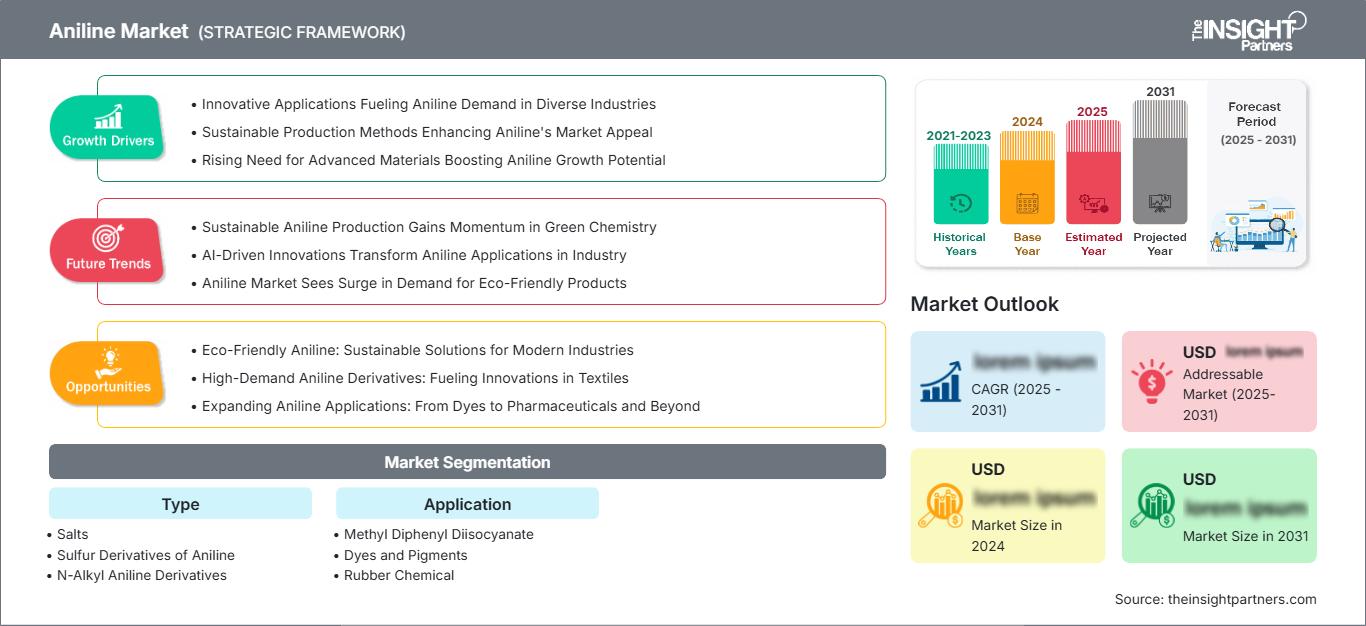
Aniline Market: Strategic Insights
Regional Insights
North America aniline market
North America is estimated to hold an 18–22% of the Aniline Market share of the global market in 2025 and record a 4.1–4.6% CAGR through 2034. The US dominates regional consumption because of its established polyurethane, automotive, appliance, construction, and furniture industries. Demand is particularly linked to MDI-based rigid polyurethane foam used in insulation and refrigeration.
Canada will contribute through construction supplies, industrial chemicals, and automobiles industry supply chain, while Mexico will contribute to the market demand through manufacturing of vehicles and other manufacturing facilities. The producers in the region will take advantage of the integration of the chemical infrastructure and access to benzene and other raw materials. Rising demand for energy-efficient buildings is set to bolster the use of polyurethane insulation, while automobile weight reduction will help the polyurethane systems.
U.S. aniline Market
The US will account for about 68-73% of the North American demand in 2025 and is forecasted to grow at a CAGR of 3.9-4.4%. This is due to high MDI consumption and diversity of the downstream manufacturing base such as construction insulation, automotive components, appliances, furniture, coatings, adhesives, and sealants. The integrated facilities have the advantage of feedstock availability and economics of operations.
The major manufacturers are involved in the inter-linked aniline and MDI value chains, ensuring consistent supply of raw materials for the polyurethane manufacturers. Energy efficiency considerations in building and refrigeration applications drive the demand. Production of the automobile drives consistent demand for cushioning polyurethanes, coatings, and elastomerics. Development of the local capacity of MDI will enhance feedstock availability, but operations will be dependent on economic cycles in construction, manufacturing, and energy prices.
Europe aniline Market
Europe accounts for 19-23% of world demand in 2025 and will see a CAGR growth of 3.6-4.1%. Germany is one of the key countries due to presence of large-scale chemical industry, automobile manufacturing, construction materials and polyurethane industry. Belgium holds strategic significance due to integration of chemical cluster of Antwerp along with logistics and feedstock availability.
UK, Germany, France, Italy, and Spain contribute through automotive industry, construction chemicals, industrial coatings, agriculture chemicals, and pharmaceuticals. Importance of Germany lies in the chemical and polyurethane industry, whereas that of Belgium is in the integrated European MDI supplies. France and Italy contribute via downstream demand from automotive, construction and specialty chemicals. Spain benefits from its industrial manufacturing and polyurethane usage, while UK contributes via specialty chemicals and pharmaceuticals.
APAC aniline Market
Demand from APAC accounts for about 48–53% of the worldwide demand in 2025 and is expected to grow at a CAGR of 5.1–5.7%. China is the largest country due to its huge MDI manufacturing, construction industry, auto sector, appliances industry, textiles, rubber and agrochemicals industries. Japan and South Korea have well-developed chemical manufacturing facilities along with polyurethanes manufacturing.
India is growing in importance due to domestic chemical manufacturing industry, agrochemicals, pharmaceuticals and automotive industry. The Australian market is a smaller one with demands driven mainly by industrial chemical applications and construction applications. Growth in industries, urbanization, infrastructure development and promotion of energy-efficient buildings drive polyurethane consumption in this region. Integrated manufacturing and debottlenecking are key strategies for suppliers to meet demands.
Middle East & Africa aniline Market
Middle East and Africa demand is smaller but is expected to grow at approximately 4.0–4.6% through 2034. Saudi Arabia and the UAE benefit from petrochemical infrastructure, construction activity, and industrial diversification, while South Africa contributes through automotive, mining-related manufacturing, construction, and chemicals.
The other sectors of MEA have opportunities in terms of infrastructure development, housing developments, refrigeration, and industrialization. The demand for regional chemicals is strongly associated with imported aniline and polyurethane chemicals since the level of locally integrated chemicals is relatively low. There may be some opportunities in terms of energy and infrastructure investments that can be used in construction insulations and industrial processes.
Segmentation Analysis
Type
The Type segment in the Aniline Market is expected to expand at a CAGR of 4.4–5.0% during 2026–2034. Demand varies substantially by derivative chemistry, with downstream requirements from polyurethane, agrochemicals, dyes, pharmaceuticals, and rubber processing determining individual product economics. Specialty derivatives generally offer greater application differentiation than high-volume intermediates.
- Salts: Aniline salts serve specialty chemical and pharmaceutical applications where controlled reactivity and formulation characteristics are important. Demand is influenced by pharmaceutical intermediates and chemical synthesis requirements requiring stable salt forms.
- Sulfur Derivatives of Aniline: These derivatives support rubber chemical and specialty chemical applications. Their strategic importance comes from performance requirements in elastomer processing, particularly where controlled curing and formulation stability are required.
- N-Alkyl Aniline Derivatives: N-alkyl derivatives are used across specialty chemical applications and selected industrial intermediates. Their commercial relevance reflects the ability to modify molecular properties for targeted downstream synthesis.
- C-Alkyl Aniline Derivatives: C-alkyl derivatives support agrochemical, pharmaceutical, and specialty chemical synthesis. Demand depends on downstream molecule development and manufacturing requirements rather than broad commodity consumption.
- Chloroanilines and Nitroanilines Anilines: These derivatives are important intermediates for dyes, pigments, agrochemicals, and pharmaceuticals. Their strategic value is linked to increasingly specialized synthesis routes and application-specific purity requirements.
- Diazo and Azo Compounds: These compounds are strongly associated with color chemistry, particularly dyes and pigments. Their demand follows textile, coatings, printing, and specialty coloration applications requiring defined optical characteristics.
- Other Aniline Derivatives: Other derivatives encompass application-specific molecules used across pharmaceuticals, agriculture, rubber chemicals, and specialty synthesis. Their importance increases where customers require customized chemistry, purity, or performance characteristics.
Application
The Application segment is projected to grow at a CAGR of 4.5–5.1% from 2026 to 2034. The aniline market scope is particularly influenced by polyurethane and MDI consumption, although dyes, rubber chemicals, agrochemicals, and pharmaceutical applications provide diversification and reduce dependence on a single downstream industry.
- Methyl Diphenyl Diisocyanate: MDI is the dominant application because aniline is a major precursor. Consumption is supported by polyurethane insulation, automotive components, appliances, furniture, footwear, coatings, adhesives, and sealants.
- Dyes and Pigments: Aniline derivatives provide important intermediates for colorants used in textiles, coatings, printing, plastics, and specialty formulations. Demand follows textile production and industrial coating activity.
- Rubber Chemical: Aniline-based chemistry supports rubber processing chemicals used in tires and industrial rubber products. Automotive production, tire replacement demand, and industrial manufacturing therefore influence this application.
- Plant Protecting Products: Aniline derivatives are used in agrochemical intermediates, making demand sensitive to crop protection requirements, agricultural output, formulation development, and regulatory approvals across major farming regions.
- Pharmaceuticals: Pharmaceutical applications use aniline and derivatives as synthesis intermediates. Demand is influenced by active pharmaceutical ingredient production, generic drug manufacturing, specialty medicines, and regional pharmaceutical investment.
Opportunity Snapshot
| Application | Revenue Contribution (High/Medium/Low) | Trend Tag | Adoption Stage |
|---|---|---|---|
| Methyl Diphenyl Diisocyanate | High | PU Insulation | Mature |
| Dyes and Pigments | Medium | Color Chemistry | Mature |
| Rubber Chemical | Medium | Tire Demand | Mature |
| Plant Protecting Products | Medium | Crop Protection | Scaling |
| Pharmaceuticals | Medium | API Synthesis | Scaling |
Aniline Market Growth Drivers and Impact Analysis
Rising demand for methylene diphenyl diisocyanate production
MDI-based polyurethane insulation remains the strongest structural demand driver because aniline is a critical precursor within the MDI production chain. Buildings, refrigeration systems, cold-chain equipment, automotive components, and furniture increasingly use polyurethane materials where thermal performance, durability, and weight reduction are important. Energy-efficiency requirements can reinforce this trend by increasing the value of high-performance insulation materials. The impact on aniline producers is transmitted through MDI plant utilization and expansion decisions rather than directly through final construction demand. Integrated suppliers can benefit most because they can coordinate aniline production with MDI output, optimize intermediates, and reduce external procurement exposure. Increasing MDI capacity in North America and Asia Pacific therefore creates incremental upstream demand while reinforcing the strategic importance of reliable aniline supply.
Expansion of pharmaceutical and agrochemical manufacturing
Aniline derivatives serve as intermediates in multiple agrochemical and pharmaceutical synthesis routes, creating demand that is less directly correlated with polyurethane cycles. Agricultural productivity requirements encourage development and production of crop-protection products, while pharmaceutical manufacturing supports continued consumption of specialty aromatic amines. The impact is particularly significant for producers capable of manufacturing substituted anilines, chloroanilines, nitroanilines, and other customized derivatives. These products generally require more specialized process control than commodity aniline and can create higher-value opportunities. Growth in India and other Asian manufacturing centers is especially relevant because domestic chemical producers are increasing capabilities across specialty intermediates. This diversification can improve portfolio resilience by balancing large-volume MDI exposure with smaller but technically differentiated applications.
Growing consumption of aniline-based rubber chemicals
Vertical integration is becoming increasingly important as producers seek greater control over feedstocks, intermediate conversion, capacity utilization, and product quality. Integrated facilities can connect benzene, nitrobenzene, aniline, and MDI operations while sharing utilities, logistics infrastructure, and technical resources. This configuration can reduce exposure to external intermediate purchases and provide greater flexibility during changes in market conditions. The impact extends beyond cost management because integrated production also supports coordinated capacity planning and product development. Producers can respond more quickly to shifts between commodity MDI and specialty derivatives. As chemical markets become more exposed to energy volatility and geopolitical supply risks, integration can improve supply continuity and strengthen the competitive position of companies operating large-scale aromatic and polyurethane value chains.
Aniline Market Future Trends
Increasing focus on low-emission aniline manufacturing technologies
The aniline market trends are increasingly moving toward production technologies that reduce fossil feedstock dependence and process emissions. Bio-based aniline is receiving attention because it could function as a drop-in alternative within established downstream value chains without requiring major changes to MDI chemistry. Pilot-scale development is expected to progress toward continuous and semi-industrial production, with process economics remaining a key commercialization criterion. Producers will likely evaluate renewable feedstocks, energy consumption, hydrogen sourcing, catalyst efficiency, and lifecycle emissions together rather than treating feedstock substitution independently. If technical performance and economics become competitive, lower-carbon aniline could create differentiated supply categories for customers with measurable carbon-reduction objectives. Certification and traceability will become increasingly relevant to premium applications.
Shift toward integrated aniline and downstream chemical production
Derivative portfolios are likely to become more specialized as producers seek growth beyond conventional MDI-linked volumes. Customized chloroanilines, nitroanilines, alkyl derivatives, and pharmaceutical or agrochemical intermediates can provide opportunities where customers value technical consistency and supply reliability. Manufacturers may increasingly use multipurpose production assets that can shift between related molecules according to market conditions. This flexibility can reduce exposure to individual downstream cycles while improving utilization of specialized equipment. Application-specific grades could also become more important in rubber chemicals, dyes, and pharmaceutical synthesis. Over the longer term, producers combining flexible manufacturing with strong regulatory capabilities and customer development programs should be better positioned to capture specialty demand without abandoning scale advantages in core aniline production.
Aniline Market Opportunities
Expansion of aniline production capacity in emerging economies
India offers an attractive opportunity for expansion of specialty aniline derivative production because its pharmaceutical, agrochemical, dyes, and specialty chemical industries are increasingly integrated with domestic intermediate manufacturing. Producers can target substituted anilines and application-specific derivatives where customers require reliable supply and consistent quality. Investment can focus on multipurpose hydrogenation, nitration, chlorination, and amination capabilities that allow manufacturing flexibility across related product families. Such assets can serve both domestic and export markets while reducing dependence on imported specialty intermediates. Companies can further improve competitiveness through backward integration, renewable power sourcing, and long-term raw-material agreements. The opportunity is strongest for producers able to combine technical development with regulatory compliance and customer qualification capabilities.
Development of higher-value aniline derivatives and specialty chemicals
The aniline market Forecasts indicate an opportunity for producers to connect low-carbon aniline initiatives with expanding MDI and polyurethane portfolios. Rather than commercializing lower-carbon aniline as an isolated specialty product, integrated producers can incorporate it into polyurethane value chains serving construction, automotive, refrigeration, and furniture customers. This approach can create a clearer route to monetizing carbon reductions because customers increasingly evaluate complete material systems rather than individual intermediates. Investment priorities include renewable electricity, efficient hydrogenation, heat integration, renewable or bio-based feedstocks, and process optimization. Producers can also use established MDI customer relationships to accelerate qualification of lower-carbon materials. Successful commercialization will depend on achieving credible lifecycle improvements without creating a substantial cost premium that limits adoption.
Recent Developments
- June 16, 2026: Covestro AG launched the Bio4PURConti project, a 10-partner initiative spanning seven countries to develop the first continuous production process for bio-based aniline. The project targets semi-industrial-scale production and aims to create a lower-carbon drop-in alternative for conventional aniline used in polyurethane value chains. Pilot plants are planned in Ghent and Leverkusen.
- February 27, 2026: BASF Corporation confirmed that its Geismar, Louisiana MDI expansion was on track for startup in the third quarter of 2026. The approximately US$1 billion project is designed to double MDI capacity at the site to around 600,000 metric tons annually, strengthening the North American polyurethane chain and associated demand for upstream intermediates.
Frequently Asked Questions

- Comprehensive Market Sizing and Forecast Analysis
- Detailed Segmentation Analysis
- In-Depth Market Dynamics Assessment
- Regional and Country-Level Insights
- Competitive Landscape and Company Benchmarking
- Strategic Business Intelligence
Recent Reports
Testimonials

The Insight Partners provided valuable market intelligence that supported our global go-to-market strategy. Their team was professional, responsive, and attentive to our feedback, providing thoughtful analysis and helpful methodological clarifications throughout the project.
Junmo Kim Chief Financial Officer (CFO), Enertech Co., Ltd.
The Insight Partners' SCADA System Market report is comprehensive, with valuable insights on current trends and future forecasts. The team was highly professional, responsive, and supportive throughout. We are very satisfied and highly recommend their services.
RAN KEDEM Partner, Reali Technologies LTDs
I requested a report on a very specific software market and the team produced the report in a few days. The information was very relevant and well presented. I then requested some changes and additions to the report. The team was again very responsive and I got the final report in less than a week.
JEAN-HERVE JENN Chairman, Future Analytica
We worked with The Insight Partners for an important market study and forecast. They gave us clear insights into opportunities and risks, which helped shape our plans. Their research was easy to use and based on solid data. It helped us make smart, confident decisions. We highly recommend them.
PIYUSH NAGPAL Sr. Vice President, High Beam Global
The Insight Partners delivered insightful, well-structured market research with strong domain expertise. Their team was professional and responsive throughout. The user-friendly website made accessing industry reports seamless. We highly recommend them for reliable, high-quality research services
YUKIHIKO ADACHI CEO, Deep Blue, LLC.
This is the first time I have purchased a market report from The Insight Partners.While I was unsure at first, I visited their web site and felt more comfortable to take the risk and purchase a market report.I am completely satisfied with the quality of the report and customer service. I had several questions and comments with the initial report, but after a couple of dialogs over email with their analyst I believe I have a report that I can use as input to our strategic planning process.Thank you so much for taking the extra time and making this a positive experience.I will definitely recommend your service to others and you will be my first call when we need further market data.
JOHN SUZUKI President and Chief Executive Officer, Board Director, BK Technologies
I wish to appreciate your support and the professionalism you displayed in the course of attending to my request for information regarding to infectious disease IVD market in Nigeria. I appreciate your patience, your guidance, and the fact that you were willing to offer a discount, which eventually made it possible for us to close a deal. I look forward to engaging The Insight Partners in the future, all thanks to the impression you have created in me as a result of this first encounter.
DR CHIJIOKE ONYIA MANAGING DIRECTOR, PineCrest Healthcare Ltd.Reason to Buy
- Informed Decision-Making
- Understanding Market Dynamics
- Competitive Analysis
- Identifying Emerging Markets
- Customer Insights
- Market Forecasts
- Risk Mitigation
- Boosting Operational Efficiency
- Strategic Planning
- Investment Justification
- Tracking Industry Innovations
- Aligning with Regulatory Trends





 Get Free Sample for