
Animal and Plant Fibers Market Size, Demand & Growth by 2034
Coverage: By Type (Plant Fibers, Animal Fibers); Application (Textiles, Paper Processing, Composite Materials), and Geography (North America, Europe, Asia Pacific, and South and Central America)
- Status : Data Released
- Report Code : TIPRE00014774
- Category : Chemicals and Materials
- No. of Pages : 150
- Available Report Formats :


- Last update date : September 17, 2026


2025 Market Size
US$ 22.49 Bn
Base year value
2034 Forecast
US$ 32.58 Bn
Projected by 2034
CAGR 2026-2034
4.21 %
Growth rate
Addressable Market
US$ 250.17 Bn
(2026-2034)
The animal and plant fibers market is positioned as a growing materials category spanning textile reinforcement, paper processing, and composite applications. The market is valued at US$ 22.49 Billion in 2025 and is projected to reach US$ 32.58 Billion by 2034, advancing at a CAGR of 4.21% from 2026 to 2034. Demand is being shaped by renewable feedstocks, lightweight material requirements, fiber-based packaging, and substitution of selected petroleum-intensive materials.
North America presents a diversified demand base supported by automotive lightweighting, sustainable packaging, premium textiles, and construction materials. The regional animal and plant fibers market size is estimated to expand at a 3.7–4.3% CAGR during 2026–2034. Increasing use of hemp, flax, cotton, wool, and other bio-based reinforcements, together with corporate carbon-reduction programs, is strengthening procurement interest in traceable natural fibers and engineered fiber systems.
Animal and Plant Fibers Market Assessment and Insights
- North America: North America is estimated to account for a 19–23% animal and plant fibers market share in 2025 and expand at a 3.7–4.3% CAGR between 2026–2034, supported by advanced textiles, composites, packaging, and automotive lightweighting applications.
- US: The US represents approximately 72–77% of North American demand in 2025 and is expected to grow at a 3.8–4.4% CAGR through 2034, led by composites and sustainable material adoption.
- Europe: Europe holds an estimated 28–32% share in 2025 and is projected to grow at a 4.0–4.6% CAGR, with Germany, France, Italy, and the UK benefiting from bio-based materials and circularity initiatives.
- Asia Pacific: Asia Pacific represents an estimated 39–43% share in 2025 and is expected to register a 4.5–5.1% CAGR, with China, India, Japan, South Korea, and Southeast Asia providing broad textile and paper demand.
- Largest Segment: Plant Fibers is the largest segment, representing an estimated 70–74% market share in 2025 and expanding at a 4.3–4.8% CAGR through 2034.
- High Growth Segment: Composite Materials is the high-growth application, representing an estimated 17–21% share in 2025 and advancing at a 5.0–5.6% CAGR during 2026–2034.
- Key companies analyzed in detail: Bast Fibre Technologies Inc.; Natural Fibre Products; S.L. Bally Ribbon Mills; Wacker Chemie AG; UPM-Kymmene Corporation; Procotex Corporation SA; HempFlax Group B.V.; JELU-WERK Josef Ehrler GmbH & Co. KG; Tecnaro GmbH; and Bcomp Ltd.
Source: The Insight Partners' analysis based on proprietary research, government publications, company annual reports, investor presentations, industry databases, and expert interviews.
In terms of trends, the animal and plant fibers market is moving from commodity fiber use to engineered natural fibers with tailored morphological characteristics, moisture properties, surface treatment capabilities, and composite integration. In the textile industry, there is a trend towards incorporating established fibers along with hemp, flax, bamboo, and regenerated fibers, whereas the composites industry is working towards enhancing fiber dispersion and bonding. Non-wood fibers can be used by paper producers as alternative cellulose.
The animal and plant fibers market report shows that for the upcoming period, investments are likely to be made in process improvements, traceable agriculture supply chain, fiber treatments, and scalable composite production. Upcoming suppliers can take advantage of availability of agricultural feedstock in Eastern Europe, India, Southeast Asia, and Latin America, whereas established suppliers will emphasize on certifications and downstream integrations. Regulations related to recyclability, renewable content, and carbon emissions are expected to favor such fibers.
Animal and Plant Fibers Market Report Scope
| Report Attribute | Details |
|---|---|
| Market size in 2025 | US$ 22.49 Billion |
| Market Size by 2034 | US$ 32.58 Billion |
| Global CAGR (2026 - 2034) | 4.21% |
| Historical Data | 2021-2024 |
| Forecast period | 2026-2034 |
Animal and Plant Fibers Market Analysis
Increasing demand in textile, packaging, and lightweight materials is driving growth in the markets for animal and plant fibers. The supply chain starts from agricultural and livestock raw materials through harvesting, retting, decortication, scouring, cleaning, carding, spinning, weaving, forming of nonwovens, or reinforcement of composites. Therefore, fiber producers continue being subject to the risk of crop yield fluctuations, weather conditions, labor costs, transportation, and local processing capacity.
The share of plant fibers is higher due to multiple applications of cotton, flax, hemp, jute, sisal, bamboo, and other materials in various industries. Meanwhile, animal fibers such as wool and silk remain significant in the field of high-quality textiles. Supply issues become more favorable for vertically integrated companies that can ensure high-quality control of fiber moisture, contamination, traceability, and certification.
Positioning has become more based on specialization than mere fiber volume. Bast Fibre Technologies is specialized in technical natural fibers while Natural Fiber Products caters to the needs of engineered fibers. S.L. Bally Ribbon Mills is specialized in narrow weaving technology including natural-fiber products while Wacker Chemie AG is indirectly involved in the process via material technology for composite and fiber manufacture.
Other players in the competitive landscape include UPM-Kymmene Corporation, Procotex Corporation, HempFlax Group, JELU-WERK Josef Ehrler, Tecnaro, and Bcomp. Investment trends are increasingly being channeled towards fiber pre-processing, composite ready products, specialty fabrics, and downstream solutions. Collaboration between fiber manufacturers, resin makers, fabric makers, auto parts providers, and packaging converters is becoming more critical since consistency is dependent on more than raw fiber manufacturing.
● REPORT CUSTOMIZATION
Tailor This Report To Align With Your Specific Business Requirements
This report can be customized to align precisely with your business objectives, scope, and target markets. Customization options include tailored segmentation, geography, competitive analysis, and strategic insights to support informed decision-making.
Customize This Report →WHAT YOU CAN ADJUST
- ● Segmentations
- ● Geography
- ● Competitive Analysis
- ● Language Preferences
Animal and Plant Fibers Market: Strategic Insights
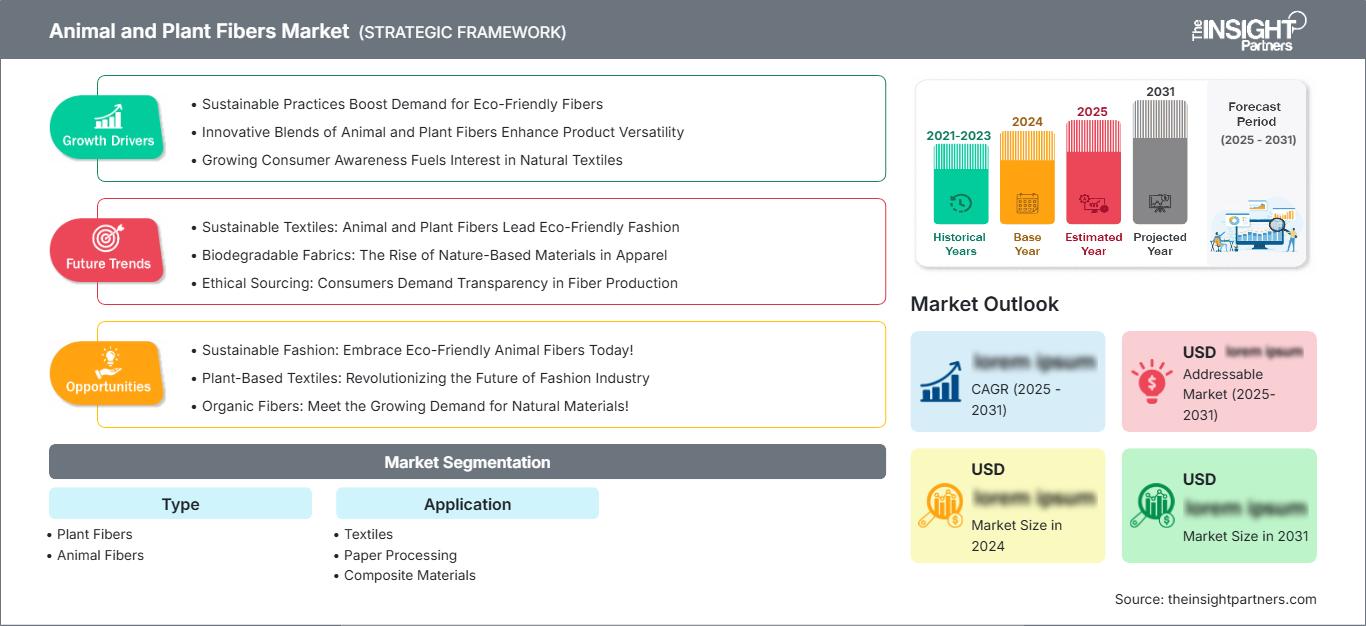
Regional Insights
North America Animal and Plant Fibers Market
North America is estimated to represent 19–23% of the global animal and plant fibers market in 2025, with a 3.7–4.3% CAGR through 2034. There is dominance of consumption in the region due to existing textile converters, packaging makers, automobile suppliers and composite makers. The focus on hemp and flax as renewable reinforcement materials and cotton as the key plant-based fiber for textile use is currently being seen.
The contribution from Canada involves fiber technologies that are related to forestry, specialty textiles and bio-materials. The regional consumers are increasingly looking at uniform fiber dimensions, moisture management, traceability and environmental impact documentation. Lightweighting for automobiles is especially pertinent as natural fiber composites can reduce density in certain interior parts. In the field of packaging, agricultural fibers are being considered as secondary raw materials.
US Animal and Plant Fibers Market
The US accounts for approximately 72–77% of North American demand in 2025 and is expected to grow at a 3.8–4.4% CAGR through 2034. Requirement is present in the sectors such as apparels, technical textiles, paper, construction materials, auto parts, and biomaterials for the composites. There are structural advantages in cotton fiber, but there is rising attraction for hemp and flax in engineered products.
Moreover, the nation boasts of a well-developed environment comprising fiber processing industries, specialized textile manufacturing units, chemical firms, and composite producers. S.L. Bally Ribbon Mills reflects the contribution of textile conversion process while the technologies of natural fiber composite from BASF indicate the increasing interconnection between fibers and binders.
Europe Animal and Plant Fibers Market
Europe represents an estimated 28–32% share in 2025 and is forecast to grow at a 4.0–4.6% CAGR through 2034, with Germany serving as a leading market. The UK, Germany, France, Italy, and Spain together represent a diverse portfolio including textiles, automotive fibers, packaging materials, and industrial composites.
The UK offers already developed textile expertise and also investigates fibers that could reduce the impact on the environment, along with developing circular approaches to sourcing fibers. There is high demand for natural-fiber composite materials in Germany due to the automotive and industrial manufacturing sector in this country. France provides support to flax and other bast fiber value chain, while Italy creates demands for natural fibers due to textile clusters there.
Asia Pacific Animal and Plant Fibers Market
APAC holds approximately 39–43% of global demand in 2025 and is expected to register a 4.5–5.1% CAGR. China leads regional consumption, followed by India, Japan, South Korea, and Australia. Large textile manufacturing bases provide structural demand for cotton, wool, silk, and other fibers.
China and India benefit from extensive processing infrastructure, while Japan and South Korea emphasize higher-value technical materials. Australia contributes through wool and agricultural fiber resources. Industrial policy supporting domestic textiles, bio-based materials, and manufacturing modernization should encourage investment in processing efficiency and higher-value applications.
Middle East and Africa Animal and Plant Fibers Market
Middle East and Africa represent a smaller but developing demand base, with Saudi Arabia, the UAE, South Africa, Egypt, and other markets supporting textiles, packaging, construction materials, and agricultural fiber processing. Regional growth is estimated at 3.2–3.9% through 2034, with Saudi Arabia and the UAE emphasizing industrial diversification.
South Africa and Egypt offer agricultural and textile-processing capabilities, while the Gulf markets increasingly import specialized fibers and finished materials. Infrastructure investment, manufacturing localization, and diversification away from hydrocarbon-dependent economic structures can create opportunities for fiber-based products. Water availability and agricultural productivity remain important constraints for local feedstock expansion.
Segmentation Analysis
Type
Plant Fibers dominate the animal and plant fibers market because of their extensive availability, established textile infrastructure, and increasing use in paper and composite applications. The segment is expected to expand at a 4.3–4.8% CAGR from 2026–2034, while animal fibers retain importance in premium and performance textiles.
- Plant Fibers: Cotton, flax, hemp, jute, bamboo, sisal, and other plant-derived fibers serve textile, paper, packaging, and reinforcement requirements. Their renewable origin and broad agricultural availability support diversified industrial adoption.
- Animal Fibers: Wool, silk, cashmere, alpaca, and other animal-derived fibers remain concentrated in premium apparel, home textiles, and specialized fabrics. Their tactile properties, insulation characteristics, and brand positioning sustain demand despite higher costs.
Application
Textiles remain the principal application because natural fibers have established spinning, weaving, knitting, and finishing infrastructure. The application segment is expected to grow at a 4.0–4.5% CAGR through 2034, while composite materials offer the fastest expansion potential.
- Textiles: Apparel, home furnishings, technical fabrics, and specialty woven products represent the largest consumption base. Fiber quality, softness, strength, dyeability, and certification determine purchasing decisions across conventional and premium textile markets.
- Paper Processing: Non-wood fibers are increasingly evaluated as supplementary cellulose resources for specialty papers, packaging, and molded fiber products. Adoption depends on pulp yield, processing economics, fiber availability, and compatibility with existing equipment.
- Composite Materials: Hemp, flax, jute, kenaf, and other fibers are increasingly incorporated into lightweight composite structures. Automotive interiors, furniture, construction products, and consumer goods offer opportunities where renewable content and weight reduction provide measurable value.
Opportunity Snapshot
| Application | Revenue Contribution | Trend Tag | Adoption Stage |
|---|---|---|---|
| Textiles | High | Premium Fibers | Mature |
| Paper Processing | Medium | Fiber Packaging | Scaling |
| Composite Materials | Medium | Lightweight Composites | Scaling |
Animal and Plant Fibers Market Growth Drivers and Impact Analysis
Rising Adoption of Renewable Fibers in Sustainable Industrial Applications
Manufacturers are increasingly incorporating renewable fibers into products where petroleum-derived or mineral-based materials can be partially replaced without sacrificing required performance. Hemp, flax, kenaf, jute, bamboo, and other fibers provide reinforcement while reducing dependence on virgin fossil resources. The commercial impact is strongest in composites, packaging, furniture, and selected automotive components. Producers able to provide stable fiber geometry and documented sourcing can command stronger positions than suppliers focused only on raw volume. This driver also encourages chemical companies to develop binders, coatings, and surface treatments compatible with natural fibers. As buyers introduce renewable-content targets, the addressable customer base expands beyond traditional textile producers toward industrial manufacturers seeking lower-impact material formulations.
Increasing Demand for Lightweight Natural Fiber Composites in Automotive and Transportation
Automotive and transportation manufacturers are seeking material combinations that reduce weight while maintaining dimensional stability, stiffness, acoustic performance, and processing efficiency. Natural fibers can provide useful reinforcement at relatively low density, particularly in interior panels, door structures, package trays, and other semi-structural components. The resulting opportunity extends through fiber suppliers, nonwoven producers, resin formulators, compounders, and component manufacturers. Increased electric vehicle production strengthens the relevance of lightweighting because reducing vehicle mass can support efficiency and range objectives. Commercial adoption nevertheless depends on moisture management, fire performance, cycle time, durability, and consistent fiber quality. Suppliers investing in engineered fiber formats and application-specific treatment can therefore move from commodity markets toward higher-value automotive programs.
Growing Use of Non-Wood Fibers in Paper and Sustainable Packaging
Paper and packaging manufacturers are responding to pressure for recyclable, renewable, and fiber-based alternatives to selected multilayer structures. Non-wood fibers can supplement conventional wood-based cellulose in applications where supply availability, processing compatibility, and barrier performance are acceptable. Agricultural residues and rapidly renewable crops also create opportunities to diversify feedstock sources and reduce dependence on forest resources. The market impact extends to pulping technologies, fiber pretreatment, barrier coatings, and converting equipment. Producers that integrate alternative fibers into established paper processes can target food packaging, specialty papers, molded products, and consumer packaging. Commercial success will depend on fiber consistency, pulping yield, water consumption, energy intensity, and end-of-life compatibility rather than renewable origin alone.
Animal and Plant Fibers Market Future Trends
Increasing Traceability and Standardization of Engineered Natural Fiber Formats
animal and plant fibers market trends are moving toward greater traceability, standardized performance, and engineered fiber formats. Buyers increasingly require information covering cultivation, processing, chemical treatment, and environmental characteristics rather than purchasing fibers solely by origin or grade. Digital traceability systems can connect agricultural production with processors and downstream manufacturers, helping identify quality variation and improve inventory planning. Fiber suppliers are also expected to develop customized lengths, surface treatments, blends, and reinforcement architectures for specific applications. This shift should gradually separate technical natural fibers from commodity agricultural fibers. Producers with integrated testing, quality assurance, and application-development capabilities will be better positioned to address automotive, industrial, packaging, and specialty textile requirements.
Development of Functionalized and Hybrid Natural Fiber Materials
The animal and plant fibers market forecast shows that future development will increasingly focus on fibers that provide more than basic reinforcement or textile functionality. Surface modification, hybridization, chemical treatment, and controlled fiber architecture can improve moisture resistance, adhesion, thermal stability, acoustic behavior, or processability. Such developments may allow natural fibers to enter applications previously dominated by glass fibers or conventional plastics. Composite manufacturers are likely to use combinations of natural and synthetic reinforcements where performance requirements are demanding. At the same time, textile processors may incorporate functional treatments that improve durability and resource efficiency. These developments will increase the technical value of fibers and encourage closer collaboration among agricultural producers, fiber processors, chemical companies, composite manufacturers, and end users.
Animal and Plant Fibers Market Opportunities
Expansion of Localized Fiber Processing and Integrated Agricultural Supply Chains
Investment opportunities exist in regions where agricultural production can support localized fiber processing rather than exporting low-value raw biomass. Establishing decortication, cleaning, grading, spinning, and reinforcement-preparation facilities near cultivation areas can reduce transportation requirements while improving producer access to higher-value markets. India, Southeast Asia, Eastern Europe, and parts of Latin America offer potential because of established agricultural and textile ecosystems. Investors can target integrated facilities capable of handling multiple feedstocks, reducing exposure to crop-specific variability. Partnerships with textile mills, paper producers, and composite manufacturers can improve capacity utilization. The strongest projects are likely to combine reliable feedstock contracts, efficient preprocessing, quality laboratories, and downstream customer agreements.
Development of Application-Specific Natural Fiber Composite Systems
The growing use of lightweight components creates an opportunity for suppliers to develop application-specific natural fiber composite systems rather than selling untreated reinforcement. Automotive interior components can provide an attractive entry point because manufacturers value weight reduction, acoustic performance, renewable content, and design flexibility. Suppliers can differentiate through optimized fiber length, nonwoven architecture, binder compatibility, moisture control, and fire-performance treatment. Collaboration with automotive Tier 1 suppliers can shorten qualification cycles and provide access to vehicle platforms. Companies that establish repeatable material specifications and automated processing compatibility may achieve stronger margins than commodity fiber suppliers. The opportunity also extends to electric vehicles, where lightweight interior structures can contribute to overall vehicle efficiency.
Recent Developments
- February 27, 2026: Ibex incorporated Nuyarn’s performance yarn technology into its Nautilus Fisherman Sweater, combining a 70% merino wool and 30% nylon blend with bespoke 3D knitting. The development extends advanced merino applications beyond traditional performance base layers into lifestyle apparel while leveraging 3D construction to reduce material waste. The launch highlights innovation in animal-fiber processing and higher-value apparel applications.
- February 3, 2025: Spiber announced more than 20 newly developed woven suiting fabrics created with Takisada-Nagoya, incorporating Brewed Protein fiber at varying blend levels with materials including wool and polyester. Spiber also presented 40 additional blended fabrics developed with A-girls, expanding applications for fermentation-derived protein fibers across suits, jackets, and other textiles. The development demonstrates growing material innovation around next-generation protein-based fibers.
Frequently Asked Questions

- Comprehensive Market Sizing and Forecast Analysis
- Detailed Segmentation Analysis
- In-Depth Market Dynamics Assessment
- Regional and Country-Level Insights
- Competitive Landscape and Company Benchmarking
- Strategic Business Intelligence
Recent Reports
Testimonials

The Insight Partners' SCADA System Market report is comprehensive, with valuable insights on current trends and future forecasts. The team was highly professional, responsive, and supportive throughout. We are very satisfied and highly recommend their services.
RAN KEDEM Partner, Reali Technologies LTDs
I requested a report on a very specific software market and the team produced the report in a few days. The information was very relevant and well presented. I then requested some changes and additions to the report. The team was again very responsive and I got the final report in less than a week.
JEAN-HERVE JENN Chairman, Future Analytica
We worked with The Insight Partners for an important market study and forecast. They gave us clear insights into opportunities and risks, which helped shape our plans. Their research was easy to use and based on solid data. It helped us make smart, confident decisions. We highly recommend them.
PIYUSH NAGPAL Sr. Vice President, High Beam Global
The Insight Partners delivered insightful, well-structured market research with strong domain expertise. Their team was professional and responsive throughout. The user-friendly website made accessing industry reports seamless. We highly recommend them for reliable, high-quality research services
YUKIHIKO ADACHI CEO, Deep Blue, LLC.
This is the first time I have purchased a market report from The Insight Partners.While I was unsure at first, I visited their web site and felt more comfortable to take the risk and purchase a market report.I am completely satisfied with the quality of the report and customer service. I had several questions and comments with the initial report, but after a couple of dialogs over email with their analyst I believe I have a report that I can use as input to our strategic planning process.Thank you so much for taking the extra time and making this a positive experience.I will definitely recommend your service to others and you will be my first call when we need further market data.
JOHN SUZUKI President and Chief Executive Officer, Board Director, BK Technologies
I wish to appreciate your support and the professionalism you displayed in the course of attending to my request for information regarding to infectious disease IVD market in Nigeria. I appreciate your patience, your guidance, and the fact that you were willing to offer a discount, which eventually made it possible for us to close a deal. I look forward to engaging The Insight Partners in the future, all thanks to the impression you have created in me as a result of this first encounter.
DR CHIJIOKE ONYIA MANAGING DIRECTOR, PineCrest Healthcare Ltd.Reason to Buy
- Informed Decision-Making
- Understanding Market Dynamics
- Competitive Analysis
- Identifying Emerging Markets
- Customer Insights
- Market Forecasts
- Risk Mitigation
- Boosting Operational Efficiency
- Strategic Planning
- Investment Justification
- Tracking Industry Innovations
- Aligning with Regulatory Trends





 Get Free Sample for