
Anoxia Market Growth, Trends & Forecast by 2034
Coverage: by Type (Anemic Anoxia, Toxic Anoxia, Stagnant Anoxia, Anoxic Anoxia); Diagnosis (MRI (Magnetic Resonance Imaging), CAT scan (Computerized Axial Tomography), Evoked Potential Tests, EEG (Electroencephalogram)); Treatment (Cardiopulmonary Resuscitation (CPR), Rehabilitation Therapies, Medication); End-User (Hospital and Clinics, Diagnostic Centers, Research Institutes, Rehabilitation Centers, Others), and Geography (North America, Europe, Asia Pacific, and South and Central America)
- Status : Data Released
- Report Code : TIPRE00007552
- Category : Life Sciences
- No. of Pages : 150
- Available Report Formats :


- Last update date : August 13, 2026


2025 Market Size
US$ 3.02 Bn
Base year value
2034 Forecast
US$ 4.76 Bn
Projected by 2034
CAGR 2026-2034
5.17 %
Growth rate
Addressable Market
US$ 35.27 Bn
(2026-2034)
The anoxia market was valued at US$ 3.02 Billion in 2025 and is projected to reach US$ 4.76 Billion by 2034, registering a CAGR of 5.17% during 2026–2034. Demand is tied to emergency medicine, neurological assessment, rehabilitation, cardiopulmonary resuscitation, and oxygen-deprivation injury management across acute care and post-acute settings.
Across North America, the anoxia market size is supported by advanced emergency response systems, high MRI and CT availability, and mature neurological rehabilitation networks. The region is estimated to grow at a CAGR range of 4.7–5.1% during 2026–2034, driven by hospital protocol standardization and broader use of EEG-based monitoring after cardiac arrest.
Anoxia Market Assessment and Insights
- North America held 41–44% share in 2025 and is expected to grow at a CAGR between 2026–2034 of 4.7–5.1%, supported by tertiary hospitals, EMS response networks, and advanced neuroimaging capacity.
- US accounted for 78–82% of North America in 2025 and is projected to grow at a CAGR between 2026–2034 of 4.6–5.0%, led by post-cardiac-arrest care pathways.
- Europe held 25–28% share in 2025 and is expected to grow at a CAGR between 2026–2034 of 4.4–4.8%, with Germany, the UK, and France leading adoption.
- Asia Pacific represented 20–23% share in 2025 and is expected to grow at a CAGR between 2026–2034 of 6.0–6.4%, led by China, Japan, India, South Korea, and Australia.
- Largest Segment Treatment held 43–47% market share in 2025 and is expected to grow at a CAGR range of 5.0–5.4% during 2026–2034, led by resuscitation and rehabilitation demand.
- High Growth Segment End-User recorded 24–28% market share in 2025 and is projected to grow at a CAGR range of 5.6–6.0% during 2026–2034 as rehabilitation centers scale capacity.
- Key companies analyzed in detail: Pfizer Inc., Abbott Laboratories, Smith & Nephew plc, Novartis AG, GSK plc, Teva Pharmaceutical Industries Ltd. (Cephalon legacy portfolio), Takeda Pharmaceutical Company Limited (Shire legacy portfolio), UCB S.A., Intertek Group plc, ICON plc.
Source: The Insight Partners' analysis based on proprietary research, government publications, company annual reports, investor presentations, industry databases, and expert interviews.
Current medical practices have moved away from delay in the recognition of oxygen deprivation damage to comprehensive diagnosis, immediate resuscitation, and planned neurological recovery. The anoxia industry gains from the development of more accurate MRI, CAT scanning, EEG, and evoked potentials procedures that enable doctors to evaluate the extent of brain injury. The dynamics of production processes become contingent upon the accessibility of monitoring equipment, neurorehabilitation aids, important drugs, and clinical research facilities that provide services for treatment evaluation.
During the forecast period, growth in new geographical markets is expected through the development of trauma centers, stroke units, heart-related care, and neurorehabilitation facilities. Regulatory focus on readiness for emergencies, reduction of neurological disabilities, and recovery after intensive care stimulates investment motivation. The anoxia industry also becomes affected by brain health policies, as WHO finds out neurological disorders impact one-third of the global population and are among leading causes of disability.
Anoxia Market Report Scope
| Report Attribute | Details |
|---|---|
| Market size in 2025 | US$ 3.02 Billion |
| Market Size by 2034 | US$ 4.76 Billion |
| Global CAGR (2026 - 2034) | 5.17% |
| Historical Data | 2021-2024 |
| Forecast period | 2026-2034 |
Anoxia Market Analysis
Urgent need for oxygen-restoration therapies, diagnostics, and recovery management drives the development. Hospitals are at the heart of the demand since patients typically have suffered from cardiorespiratory arrest, poisoning, stroke-like symptoms, or perioperative anoxia. Value chain actors include pharmaceutical manufacturers, imaging equipment producers, providers of EEG testing, clinical research companies, rehabilitation facilities, and quality control personnel.
In the case of supply, the dynamics are quite diverse. High-income countries take advantage of the density of MRI, the presence of intensive care, and neurorehabilitation, but many low- and middle-income countries lack appropriate manpower. Hence, the ecosystem evolves towards uniform triage, portable neurological monitoring, and referral to rehabilitation early on.
According to the anoxia market analysis, there is a moderate level of fragmentation in competition in terms of drugs, diagnostic, clinical, rehabilitation, and clinical trials support. There are companies such as Pfizer Inc., Novartis AG, GSK plc, UCB S.A., Teva Pharmaceutical Industries Ltd., and Takeda Pharmaceutical Company Limited which offer neurology or supportive care products, and Abbott Laboratories and Smith & Nephew plc provide diagnostic and recovery-related services.
In terms of strategic positioning, generating evidence and post-acute outcomes as well as partnering with hospital systems has been crucial. ICON plc helps in providing clinical development and real-world evidence services, and Intertek Group plc provides testing, assurance, and regulatory services.
● REPORT CUSTOMIZATION
Tailor This Report To Align With Your Specific Business Requirements
This report can be customized to align precisely with your business objectives, scope, and target markets. Customization options include tailored segmentation, geography, competitive analysis, and strategic insights to support informed decision-making.
Customize This Report →WHAT YOU CAN ADJUST
- ● Segmentations
- ● Geography
- ● Competitive Analysis
- ● Language Preferences
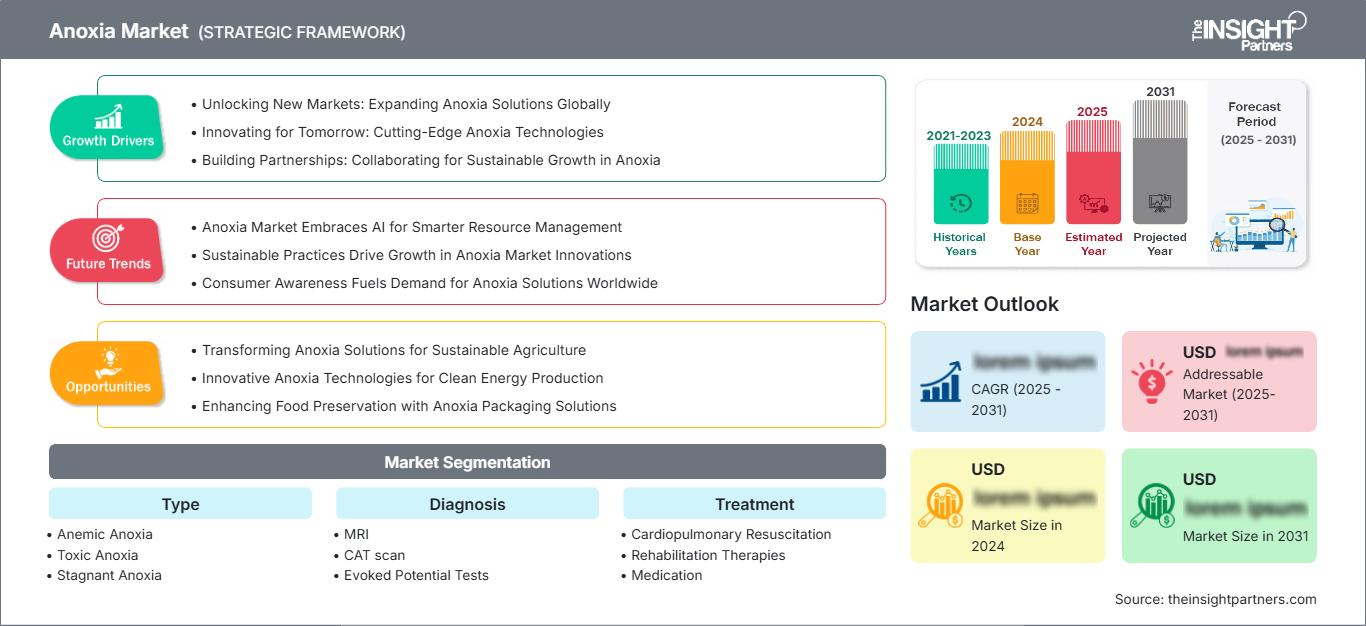
Anoxia Market: Strategic Insights
Regional Insights
North America anoxia market
North America held 41–44% share in 2025, reflecting advanced emergency response, intensive care networks, and strong neurodiagnostic infrastructure. The region is projected to grow at a CAGR range of 4.7–5.1% during 2026–2034. The anoxia market share in North America is supported by structured cardiac arrest protocols, growing post-ICU clinics, and wider MRI, CAT scan, and EEG access.
The US dominates regional demand, while Canada contributes through universal care pathways and rehabilitation referrals. CDC-reported cardiac arrest burden highlights the need for CPR, defibrillation, and neurological follow-up. Hospitals increasingly connect emergency medicine, neurology, cardiology, and rehabilitation teams to reduce disability after oxygen deprivation.
U.S. anoxia Market
The U.S. made up for 78-82% of the North American share in 2025 and is expected to have a compound annual growth rate of 4.6-5.0% from 2026-2034. The application is driven by high usage in major hospitals, specialized care units, trauma centers, diagnostic centers, and rehabilitation centers. Market players include Abbott Laboratories, Pfizer Inc., UCB S.A., and ICON plc.
EEG application post resuscitation, imaging tests to assess hypoxic-ischemic brain injury, and multidisciplinary rehabilitation plans are the anoxia market trends. The anoxia market is also affected by the focus of payers on the outcome of the procedure, such as status at discharge, neuro-recovery, and reduction in readmissions post acute oxygen-deprivation.
Europe anoxia Market
Europe represented 25–28% share in 2025 and is projected to grow at a CAGR range of 4.4–4.8% during 2026–2034. Germany is the leading country, supported by hospital density, neurocritical care capability, and diagnostic imaging access. The UK contributes through NHS emergency pathways and post-acute rehabilitation programs.
France, Italy, and Spain add steady demand through public hospital modernization, stroke and cardiac care networks, and broader neurorehabilitation availability. The market in Europe is shaped by reimbursement discipline, medical device regulation, and increasing focus on long-term disability reduction after neurological injury.
APAC anoxia Market
APAC held 20–23% share in 2025 and is projected to grow at a CAGR range of 6.0–6.4% during 2026–2034. China is the leading country because of hospital expansion, critical care investment, and rising diagnostic imaging installation. Japan and South Korea add high technology adoption, while India and Australia support growth through emergency care and rehabilitation capacity.
Policy priorities favor critical care expansion, emergency systems, and domestic healthcare infrastructure. Industrial growth in medical devices, diagnostics, and clinical research supports wider evaluation of oxygen-deprivation injury across urban hospitals.
Middle East & Africa anoxia Market
The Middle East & Africa is projected to grow at a CAGR range of 4.9–5.3% during 2026–2034. Saudi Arabia leads regional adoption through hospital modernization, emergency care capacity, and rehabilitation investment, while the UAE supports premium diagnostic and specialty-care services.
South Africa remains the key sub-Saharan contributor, supported by tertiary hospitals and diagnostic centers. Energy-sector economies continue to invest in infrastructure resilience, trauma care, and specialist hospitals, although rural access and neurology workforce limitations remain constraints.
Segmentation Analysis
Type
The Type segment is projected to grow at a CAGR range of 4.8–5.2% during 2026–2034. The market scope across type categories is shaped by causality, treatment urgency, and neurological risk severity. Differentiating anemic, toxic, stagnant, and anoxic forms helps clinicians align diagnostics with oxygen delivery, toxin exposure, circulation failure, or environmental oxygen depletion.
- Anemic Anoxia is associated with inadequate oxygen-carrying capacity, making blood testing, clinical history, and rapid supportive care central to diagnosis and treatment planning.
- Toxic Anoxia requires urgent identification of poisoning or metabolic interference, creating demand for emergency medicine, toxicology support, and neurological monitoring.
- Stagnant Anoxia is linked to impaired circulation, with cardiac arrest, shock, and vascular compromise driving demand for CPR, imaging, and rehabilitation.
- Anoxic Anoxia reflects insufficient oxygen availability, supporting use in respiratory failure, suffocation, altitude exposure, and perioperative monitoring contexts.
Diagnosis
The Diagnosis segment is projected to grow at a CAGR range of 5.1–5.5% during 2026–2034. Growth is driven by earlier neurological assessment, post-resuscitation monitoring, and imaging-led severity classification. Diagnostic centers gain relevance as hospitals outsource non-emergency imaging and neurophysiology evaluation, while tertiary hospitals retain complex acute cases.
- MRI remains strategically important for detecting hypoxic-ischemic brain injury, lesion distribution, and prognosis after acute oxygen-deprivation events.
- CAT scan provides rapid emergency assessment, particularly where hemorrhage, trauma, stroke mimicry, or intracranial swelling must be excluded quickly.
- Evoked Potential Tests support neurological pathway assessment, especially when consciousness is impaired and prognosis requires objective neurophysiological data.
- EEG is increasingly used after cardiac arrest and coma to assess seizures, electrical activity, and neurological recovery potential.
Treatment
The Treatment segment is projected to grow at a CAGR range of 5.0–5.4% during 2026–2034. Treatment remains the largest revenue contributor because intervention spans emergency resuscitation, stabilization, drug therapy, and long rehabilitation cycles. Demand is strongest where hospitals can connect ICU care with cognitive, physical, occupational, and speech rehabilitation services.
- Cardiopulmonary Resuscitation is the first-line emergency intervention, influencing survival, neurological outcomes, and downstream demand for ICU monitoring and recovery services.
- Rehabilitation Therapies are strategically important because survivors may require long-term cognitive, motor, behavioral, and functional recovery support after brain injury.
- Medication supports seizure control, cardiovascular stabilization, infection management, and symptom treatment, depending on the underlying cause and recovery stage.
End-User
The End-User segment is projected to grow at a CAGR range of 5.6–6.0% during 2026–2034. Hospitals lead acute case management, but rehabilitation centers are expanding as survival improves and disability management becomes a priority. Research institutes support evidence generation, while diagnostic centers improve access to imaging and neurophysiology testing.
- Hospital and Clinics dominate acute management, integrating emergency response, ICU care, imaging, EEG, medication, and referral to post-acute recovery pathways.
- Diagnostic Centers support imaging and neurophysiology access, especially for follow-up evaluation and outpatient assessment after hospital discharge.
- Research Institutes contribute to clinical protocols, biomarker studies, device evaluation, and evidence on long-term neurological outcomes.
- Rehabilitation Centers are increasingly important as care shifts from survival alone to functional recovery, independence, and quality-of-life improvement.
Opportunity Snapshot
| Segment Name | Revenue Contribution | Trend Tag | Adoption Stage |
|---|---|---|---|
| Hospital and Clinics | High | ICU Pathways | Mature |
| Diagnostic Centers | Medium | Neuro Imaging | Scaling |
| Research Institutes | Medium | Evidence Trials | Scaling |
| Rehabilitation Centers | High | Recovery Care | Scaling |
Anoxia Market Growth Drivers and Impact Analysis
Expansion of post-cardiac-arrest neurological care
The problem of oxygen-deprivation injuries continues to be one of the leading causes of cardiac arrest, which increases the dependence on the quality of an emergency response system. According to the report of the CDC, there are more than 356,000 out-of-hospital cardiac arrests in the US each year, during which many people die before being taken to a hospital. With the development of the skills of performing CPR, using a defibrillator, and surviving intensive care, more people need additional treatment such as EEG, MRI, drugs, and rehabilitation.
Rising burden of neurological disability
More than a third of the world’s population is affected by neurological disorders, according to evidence linked to WHO's global burden studies, giving rise to policy attention on brain health and disability prevention. Oxygen deprivation-related damage leads to cognitive, motor impairments, seizures, and dependency, especially following respiratory problems, toxin ingestion, and circulation failure. It means that health care systems are focused on early identification and systematic rehabilitation programs. This driver positively influences the market through higher use of neuroimaging techniques, EEG, evoked potentials, pharmacotherapy, and rehabilitation services.
Growth in diagnostic imaging and monitoring capacity
MRI, CAT scans, and EEG technologies play a key role in diagnosing suspected cases of hypoxic injury. The availability of medical technology databases compiled by OECD and WHO reveals considerable disparities in MRI penetration that create challenges and provide chances for development. Better imaging facilities will allow categorizing the severity of injuries, assisting in making prognosis and deciding on the level of rehabilitation needed. The expansion of medical technology acquisitions and diagnostic services will boost the market.
Anoxia Market Future Trends
AI-enabled neurological prognosis
The use of AI for the analysis of electroencephalogram (EEG), imaging, and other medical data is likely to be among the major trends in the market of anoxia due to hospitals' needs to make earlier and more accurate diagnosis after the incidents of oxygen deficiency. Algorithms are able to detect certain patterns of seizures, brain images, and patient recovery that might not be easy to standardize without the help of technology. Initially, it will gain its popularity in tertiary hospitals via cloud-based diagnostics.
Integrated recovery pathways after ICU discharge
Future care models will increasingly connect emergency departments, ICUs, neurology teams, and rehabilitation centers into coordinated recovery pathways. This shift responds to growing recognition that survival after oxygen deprivation is not the endpoint; functional recovery and cognitive outcomes matter for patients, payers, and providers. Digital follow-up tools, outpatient EEG, neuropsychological screening, and home-based therapy support will become more common. Providers that coordinate acute and post-acute services will capture stronger long-term value.
Anoxia Market Opportunities
Rehabilitation center partnerships
Hospital systems and specialist rehabilitation providers can create high-value partnerships around step-down care, cognitive therapy, mobility restoration, and caregiver training. anoxia market Forecasts indicate that recovery-oriented care will gain importance as survival improves and payers demand measurable outcomes after ICU discharge. Investment opportunities include standardized assessment bundles, therapy capacity expansion, and digital progress tracking. Providers that demonstrate reduced readmissions, better functional scores, and shorter institutional stays can improve commercial positioning while addressing unmet recovery needs.
Evidence generation for targeted protocols
Companies can invest in clinical evidence that clarifies which diagnostic and treatment combinations improve outcomes by anoxia type, severity, age group, and recovery stage. Current practice varies across hospitals, creating demand for real-world datasets, registry studies, and pragmatic trials. Clinical research organizations, diagnostic firms, and drug developers can collaborate on protocols linking CPR quality, EEG findings, imaging markers, medication use, and rehabilitation intensity. Stronger evidence would support guideline adoption, reimbursement confidence, and differentiated service models.
Recent Developments
- August 2026: Smith & Nephew plc reported second-quarter and first-half 2026 results, noting multiple product platforms delivering double-digit or higher growth and new product launches, expansions, and approvals including TESSA Spatial Surgery System. These updates reinforce the company’s orthopedic and recovery-adjacent technology position relevant to rehabilitation-focused care environments.
- May 2026: Abbott Laboratories announced that it would present 11 abstracts across its cancer diagnostics portfolio at ASCO 2026, highlighting screening, treatment guidance, and recurrence monitoring capabilities. The development is relevant to broader diagnostic infrastructure, evidence generation, and hospital decision-support models used in complex patient evaluation.
- February 2026: Novartis AG completed its acquisition of Avidity Biosciences, adding a muscle-directed antibody oligonucleotide conjugate platform and three late-stage neuromuscular programs. The transaction strengthens Novartis’ neuroscience pipeline and supports broader investment momentum in neurological and neuromuscular disease innovation.
Frequently Asked Questions

- Comprehensive Market Sizing and Forecast Analysis
- Detailed Segmentation Analysis
- In-Depth Market Dynamics Assessment
- Regional and Country-Level Insights
- Competitive Landscape and Company Benchmarking
- Strategic Business Intelligence
Recent Reports
Testimonials

The Insight Partners' SCADA System Market report is comprehensive, with valuable insights on current trends and future forecasts. The team was highly professional, responsive, and supportive throughout. We are very satisfied and highly recommend their services.
RAN KEDEM Partner, Reali Technologies LTDs
I requested a report on a very specific software market and the team produced the report in a few days. The information was very relevant and well presented. I then requested some changes and additions to the report. The team was again very responsive and I got the final report in less than a week.
JEAN-HERVE JENN Chairman, Future Analytica
We worked with The Insight Partners for an important market study and forecast. They gave us clear insights into opportunities and risks, which helped shape our plans. Their research was easy to use and based on solid data. It helped us make smart, confident decisions. We highly recommend them.
PIYUSH NAGPAL Sr. Vice President, High Beam Global
The Insight Partners delivered insightful, well-structured market research with strong domain expertise. Their team was professional and responsive throughout. The user-friendly website made accessing industry reports seamless. We highly recommend them for reliable, high-quality research services
YUKIHIKO ADACHI CEO, Deep Blue, LLC.
This is the first time I have purchased a market report from The Insight Partners.While I was unsure at first, I visited their web site and felt more comfortable to take the risk and purchase a market report.I am completely satisfied with the quality of the report and customer service. I had several questions and comments with the initial report, but after a couple of dialogs over email with their analyst I believe I have a report that I can use as input to our strategic planning process.Thank you so much for taking the extra time and making this a positive experience.I will definitely recommend your service to others and you will be my first call when we need further market data.
JOHN SUZUKI President and Chief Executive Officer, Board Director, BK Technologies
I wish to appreciate your support and the professionalism you displayed in the course of attending to my request for information regarding to infectious disease IVD market in Nigeria. I appreciate your patience, your guidance, and the fact that you were willing to offer a discount, which eventually made it possible for us to close a deal. I look forward to engaging The Insight Partners in the future, all thanks to the impression you have created in me as a result of this first encounter.
DR CHIJIOKE ONYIA MANAGING DIRECTOR, PineCrest Healthcare Ltd.Reason to Buy
- Informed Decision-Making
- Understanding Market Dynamics
- Competitive Analysis
- Identifying Emerging Markets
- Customer Insights
- Market Forecasts
- Risk Mitigation
- Boosting Operational Efficiency
- Strategic Planning
- Investment Justification
- Tracking Industry Innovations
- Aligning with Regulatory Trends





 Get Free Sample for