
Anti-Aging Market Growth, Demand & Size by 2034
Coverage: By Product (UV Absorbers, Anti-Wrinkle Products, Dermal Fillers, Botox, Anti-Stretch Mark Products); Devices (Anti-Cellulite Treatment, Laser Aesthetic Devices, Microdermabrasion Devices, Radio Frequency Devices, Others); End User (Hospitals, Clinics, Home Healthcare), and Geography (North America, Europe, Asia Pacific, and South and Central America)
- Status : Data Released
- Report Code : TIPRE00005523
- Category : Consumer Goods
- No. of Pages : 150
- Available Report Formats :


- Last update date : August 26, 2026


2025 Market Size
US$ 81.07 Bn
Base year value
2034 Forecast
US$ 156.74 Bn
Projected by 2034
CAGR 2026-2034
7.60 %
Growth rate
Addressable Market
US$ 1,071.28 Bn
(2026-2034)
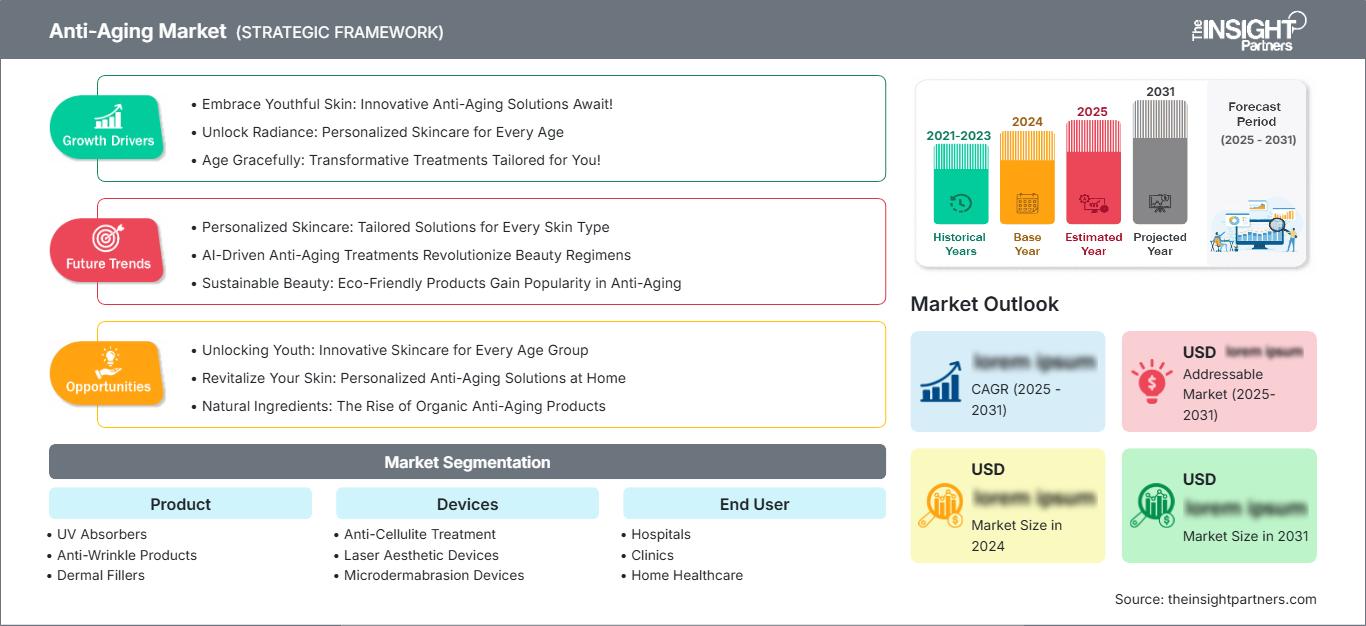
The Anti-aging market was valued at US$ 81.07 Billion in 2025 and is projected to reach US$ 156.74 Billion by 2034, expanding at a CAGR of 7.60% during 2026–2034. The market continues to benefit from rising consumer expenditure on aesthetic enhancement, increasing life expectancy, and growing acceptance of minimally invasive cosmetic procedures across developed and emerging economies. Product innovation, dermatological research, and broader accessibility of aesthetic services remain central factors shaping industry expansion.
Across North America, demand remains supported by high awareness of cosmetic dermatology, strong reimbursement support for selected procedures, and an established network of specialty clinics. The anti-aging market size in the region continues to expand at an estimated CAGR range of 6.8–7.4%, supported by increasing procedure volumes, technological advancements in aesthetic devices, and a rapidly aging yet appearance-conscious population.
Anti-Aging Market Assessment and Insights
- North America: Accounted for an estimated 36–40% Share in 2025 and is expected to grow at a CAGR between 6.8–7.4% during 2026–2034. Strong physician adoption, premium consumer spending, and widespread availability of advanced aesthetic procedures support regional leadership.
- US: Represented approximately 78–82% of North America in 2025 and is projected to expand at a CAGR between 6.9–7.5% during 2026–2034. Demand remains concentrated in cosmetic injectables, laser treatments, and anti-aging skincare solutions.
- Europe: Held an estimated 28–32% Share in 2025 and is forecast to grow at a CAGR between 6.5–7.1% during 2026–2034. Germany, the UK, France, Italy, and Spain remain leading markets supported by mature aesthetic care infrastructure.
- Asia Pacific: Accounted for approximately 24–28% Share in 2025 and is expected to register a CAGR between 8.5–9.3% during 2026–2034. China, Japan, South Korea, and India are driving adoption across devices and injectable treatments.
- Largest Segment: Product segment captured an estimated 58–62% market share in 2025 and is projected to grow at a CAGR between 7.0–7.8% during 2026–2034, supported by strong consumer demand for preventive and corrective solutions.
- High Growth Segment: Devices segment accounted for approximately 24–28% market share in 2025 and is anticipated to grow at a CAGR between 8.8–9.6% during 2026–2034, driven by technological innovation and non-invasive treatment preferences.
- Key companies analyzed in detail: Allergan Aesthetics, Zimmer Biomet Holdings, Inc., Calico Life Sciences LLC, VEBELLE, Exopharm Limited, Alma Lasers Ltd., Cynosure, LLC, PMD Beauty, Lumenis Be Ltd., Photomedex, Inc.
Source: The Insight Partners' analysis based on proprietary research, government publications, company annual reports, investor presentations, industry databases, and expert interviews.
From topical cosmetics, the market has transformed into a more sophisticated approach that uses injections and energy devices as well as regenerative techniques and personalized skin care products. The advancements made in the field of laser precision, radiofrequency devices, and biologically active substances have increased the number of treatments available at various ages. Consumers' increasing inclination towards non-invasive aesthetic treatments has forced the market players to create such treatment modalities that ensure quick recovery and predictable results.
In terms of future outlook, there would be more investments coming into the market through the Asia Pacific, the Gulf region, and certain economies of Latin America because of improved healthcare infrastructure and increased wellness expenditure among consumers. The regulatory landscape focusing on the safety of devices, efficacy of the products, and qualifications of practitioners would contribute positively to the market.
Anti-Aging Market Report Scope
| Report Attribute | Details |
|---|---|
| Market size in 2025 | US$ 81.07 Billion |
| Market Size by 2034 | US$ 156.74 Billion |
| Global CAGR (2026 - 2034) | 7.60% |
| Historical Data | 2021-2024 |
| Forecast period | 2026-2034 |
Anti-Aging Market Analysis
This growth pattern of the market will be backed by demographic changes, higher life expectancy rates, and more focus on preventive health. The rise of consumers above 50 years of age who are constantly looking for treatments that can offer relief from wrinkles, uneven tone, skin slackness, and volume loss is only one of the factors contributing to increased demand. Consumers want more than a cosmetically improved appearance – they look for confidence, professional image, and improved health status.
The ecosystem of the industry involves ingredient suppliers, device makers, drugmakers, dermatology clinics, aesthetics centers, and home health care services providers. In terms of supply, the market becomes more inclined towards products with technological differentiation and the ability to achieve visible results with no downtime.
The market analysis reveals an intensifying competition among medical aesthetics companies and innovative startups involved in regenerative medicine and biotechnology. While Allergan Aesthetics continues to retain its leadership in injectables, Alma Lasers, Cynosure, and Lumenis operate through their diverse range of energy-based therapy lines. New product development is gradually focusing on the safety, convenience, and customized treatment paths.
Investment efforts continue to be directed at clinical research, geographical expansion, education of physicians, and engagement via digital platforms. Partnerships with dermatology clinics and aesthetic practices are being sought for better commercial penetration. Simultaneously, organizations like Exopharm and Calico Life Sciences pursue more advanced biological strategies for future treatments. Competitive advantage is gaining importance through clinical evidence, branding, and treatment outcomes beyond price.
● REPORT CUSTOMIZATION
Tailor This Report To Align With Your Specific Business Requirements
This report can be customized to align precisely with your business objectives, scope, and target markets. Customization options include tailored segmentation, geography, competitive analysis, and strategic insights to support informed decision-making.
Customize This Report →WHAT YOU CAN ADJUST
- ● Segmentations
- ● Geography
- ● Competitive Analysis
- ● Language Preferences
Anti-Aging Market: Strategic Insights
Regional Insights
North America Anti-aging market
North America represented approximately 36–40% of the global market in 2025 and continues to maintain leadership through advanced healthcare infrastructure, strong consumer purchasing power, and widespread acceptance of minimally invasive cosmetic procedures. The region is expected to expand at a CAGR of 6.8–7.4% through 2034. High volumes of Botox, dermal fillers, laser resurfacing, and radiofrequency treatments contribute significantly to market revenues.
The region also holds the largest anti-aging market share, supported by extensive physician networks, favorable consumer awareness, and ongoing technology adoption. Regulatory oversight enhances confidence in approved products and devices. Growth remains strongest within injectable aesthetics and non-invasive rejuvenation technologies, while home-use anti-aging solutions continue to gain traction among consumers seeking convenience and cost efficiency.
U.S. Anti-aging Market
The United States accounted for 78–82% of North American demand in 2025 and is projected to record a CAGR of 6.9–7.5% during the forecast period. The procedure volume, wide availability of board-certified specialists, and penetration of premium aesthetic solutions have made the country the biggest national market in the world. Patients are showing increasing interest in procedures that do not involve a long recovery time.
The key companies operating in the sector have well-developed commercial activities within the country. The firms like Allergan Aesthetics, Cynosure, Alma Lasers, and Lumenis are benefiting from huge clinical acceptance within dermatology and cosmetic surgery practices. Rising need for preventive anti-aging solutions in young patients has also contributed in the continuous market growth.
Europe Anti-aging Market
Europe accounted for approximately 28–32% of the global market in 2025 and is expected to grow at a CAGR of 6.5–7.1%. Germany retains the position of the leader in the region owing to high levels of health care spending, easy availability of dermatology services, and high awareness among consumers about medical aesthetics. Innovation and the presence of clinics further fuel regional demand for both products and devices.
In the UK, there is a high degree of adoption of minimally invasive aesthetics and premium skincare services, fueled by increased spending on private health care. In Germany, technology and procedural skills help it retain the top position in Europe. The combined efforts of France, Italy, and Spain account for significant revenues generated from increased acceptance of cosmetic treatments and wellness spending.
APAC Anti-aging Market
Asia Pacific represented approximately 24–28% of global revenue in 2025 and is forecast to register the fastest regional CAGR of 8.5–9.3% through 2034. China leads regional expansion through large consumer populations and increasing aesthetic treatment penetration, while Japan and South Korea remain technologically advanced markets.
India and Australia continue to experience rising demand for both clinical and home-based anti-aging solutions. Expanding disposable incomes, growing medical tourism activity, and increasing awareness of aesthetic treatments support regional momentum. Regulatory improvements and investment in specialty healthcare infrastructure further strengthen long-term growth prospects.
Middle East & Africa Anti-aging Market
The Middle East & Africa market is developing steadily, supported by premium healthcare investments and rising cosmetic treatment adoption. Saudi Arabia and the UAE account for the majority of regional demand, benefiting from expanding private healthcare infrastructure and growing wellness-oriented consumer behavior.
South Africa remains a key African market, while the broader region is expected to grow at a CAGR of 7.2–7.8% through 2034. Economic diversification initiatives, medical tourism investments, and increasing availability of advanced aesthetic services are gradually expanding market opportunities across major metropolitan centers.
Segmentation Analysis
Product
The Product segment remains the leading contributor and defines a broad portion of the anti-aging market scope. Estimated to grow at a CAGR of 7.0–7.8%, demand is supported by accessibility, recurring consumption patterns, and consumer preference for visible aesthetic improvements without major procedures. Product innovation and brand differentiation remain important competitive factors.
- UV Absorbers: Widely used for preventive skincare approaches, these products address photoaging concerns and remain strategically important due to growing awareness of sun-induced skin damage.
- Anti-Wrinkle Products: Strong consumer adoption and recurring purchasing cycles support demand. Manufacturers continue introducing advanced formulations incorporating peptides, antioxidants, and bioactive compounds.
- Dermal Fillers: Frequently used for facial volume restoration and contour enhancement, fillers remain an important component of minimally invasive aesthetic treatment portfolios.
- Botox: High physician acceptance and growing consumer familiarity support continued utilization across wrinkle reduction and cosmetic enhancement applications.
- Anti-Stretch Mark Products: Increasing demand from post-pregnancy and wellness-focused consumers sustains market relevance, particularly in premium skincare categories.
Devices
The Devices segment is expected to record the highest growth, expanding at a CAGR of 8.8–9.6% during 2026–2034. Rising preference for non-invasive procedures, improvements in treatment precision, and stronger clinical outcomes are supporting adoption across hospitals and specialty clinics.
- Anti-Cellulite Treatment: Demand is supported by increasing interest in body contouring procedures and non-surgical aesthetic enhancement among diverse age groups.
- Laser Aesthetic Devices: These systems remain central to skin resurfacing and rejuvenation procedures, offering versatility across multiple treatment indications.
- Microdermabrasion Devices: Consistent utilization within professional skincare services and growing availability of consumer versions support long-term demand.
- Radio Frequency Devices: Increasing acceptance for skin tightening and collagen stimulation applications positions these devices among the fastest-growing technology categories.
End User
The End User segment is projected to grow at a CAGR of 7.4–8.0%, reflecting expanding treatment accessibility across different care settings. Healthcare providers continue investing in advanced technologies to improve patient outcomes and service portfolios.
- Hospitals: Large facilities increasingly incorporate aesthetic offerings within broader dermatology and plastic surgery departments to diversify revenue opportunities.
- Clinics: Specialty aesthetic and dermatology clinics represent the leading service channel due to focused expertise, procedure availability, and strong patient engagement.
- Home Healthcare: Adoption is rising as consumers seek convenient self-care solutions supported by smart beauty devices and personalized skincare regimens.
Opportunity Snapshot
| Segment Name | Revenue Contribution | Trend Tag | Adoption Stage |
| Hospitals | Medium | Integrated Care | Mature |
| Clinics | High | Injectables Hub | Mature |
| Home Healthcare | Medium | Smart Beauty | Scaling |
Anti-Aging Market Growth Drivers and Impact Analysis
Expansion of Minimally Invasive Aesthetic Procedures
The increasing trend towards minimally invasive treatments has changed patient behavior in both developed and developing economies. Patients have become more inclined towards minimally invasive treatments that offer visual results and also do not cause any pain or require long recovery periods. Minimally invasive treatments such as dermal fillers, Botox injections, laser therapy, and radiofrequency treatments continue to gain popularity amongst new demographics. These changes are favorable for companies since procedure volume increases along with the need for repeat treatments. Higher levels of safety, expertise, and technology further aid in their commercial viability.
Growing Aging Population and Longevity Trends
The phenomenon of increased longevity has been continuously affecting health care spending trends around the world. There is a growing number of people in this group who are looking for ways to fight the visual manifestations of aging, such as wrinkles, pigmentation, and loss of elasticity. There is a trend toward prevention among consumers, thus expanding the target market to younger populations. The combination of these two factors ensures consistent consumer demand for the entire range of products, devices, and professional procedures.
Technology Integration Across Aesthetic Platforms
The continual innovations in aesthetic technology have helped enhance the effectiveness, precision, and satisfaction levels of the treatments. The advanced lasers, radiofrequency, imaging technologies, and skin assessment technologies are helping differentiate by opening up new possibilities. The healthcare professionals are using the innovations to add treatments and improve patient retention. There is increased emphasis on multifunction devices by the device makers, which can be used for multiple indications on one system. The advancements in technology have helped make procedures more efficient and have expanded access to treatments for enhanced market development.
Anti-Aging Market Future Trends
Growth of Personalized Longevity Solutions
The most influential of all emerging anti-aging market trends is the transition toward personalized treatment pathways. Increasingly, businesses are using information about genetics, the condition of the skin, lifestyle, and artificial intelligence in the process of product development and treatment planning. For future success in the market, personalized results will be crucial, not generalized ones. Personalization is supposed to lead to greater client loyalty, better efficacy of therapy, and higher pricing strategy. With decreasing expenses for technologies, anti-aging services will become available to more consumers worldwide.
Convergence of Beauty, Wellness, and Preventive Healthcare
Market evolution is likely to erase conventional distinctions between cosmetic enhancement and health prevention strategies. Consumers look for products that offer both aesthetic appeal and wellness effects. The phenomenon is consistent with growing interest in nutraceuticals, regenerative medicine, skin care technologies, and comprehensive treatment plans. Market players need to cultivate skills across dermatology, biotechnology, digital health, and wellness sectors. The phenomenon may result in new business models and a wider addressable market.
Anti-Aging Market Opportunities
Expansion Through Home-Based Aesthetic Technologies
The increasing sophistication of consumer beauty technology creates significant commercial opportunities. Companies can expand addressable markets through portable devices offering convenience, affordability, and routine usage. Demand is strongest among consumers seeking preventive maintenance between clinical visits. Product ecosystems combining connected devices, digital monitoring, and subscription-based skincare offerings may generate recurring revenues. Emerging markets in particular present meaningful opportunities for scalable home-healthcare solutions where specialist access remains limited. According to long-term anti-aging market Forecasts, the shift toward consumer-managed aesthetic care is expected to accelerate investment activity across device categories.
Investment in Regenerative and Cell-Based Therapies
Regenerative medicine emerges as a promising innovation route for market players to distinguish themselves. Studies on stem cell-based treatments, extracellular vesicles, and biological rejuvenation processes have gained increasing scientific and business attention. Companies able to prove efficacy and adherence to regulations can establish a competitive advantage. Collaboration among biotech companies, medical facilities, and cosmetic firms can help speed up the process of commercialization. Regenerative anti-aging technologies are increasingly seen by investors as a long-term prospect that can change the treatment paradigm and generate valuable intellectual property.
Frequently Asked Questions

- Comprehensive Market Sizing and Forecast Analysis
- Detailed Segmentation Analysis
- In-Depth Market Dynamics Assessment
- Regional and Country-Level Insights
- Competitive Landscape and Company Benchmarking
- Strategic Business Intelligence
Recent Reports
Testimonials

The Insight Partners provided valuable market intelligence that supported our global go-to-market strategy. Their team was professional, responsive, and attentive to our feedback, providing thoughtful analysis and helpful methodological clarifications throughout the project.
Junmo Kim Chief Financial Officer (CFO), Enertech Co., Ltd.
The Insight Partners' SCADA System Market report is comprehensive, with valuable insights on current trends and future forecasts. The team was highly professional, responsive, and supportive throughout. We are very satisfied and highly recommend their services.
RAN KEDEM Partner, Reali Technologies LTDs
I requested a report on a very specific software market and the team produced the report in a few days. The information was very relevant and well presented. I then requested some changes and additions to the report. The team was again very responsive and I got the final report in less than a week.
JEAN-HERVE JENN Chairman, Future Analytica
We worked with The Insight Partners for an important market study and forecast. They gave us clear insights into opportunities and risks, which helped shape our plans. Their research was easy to use and based on solid data. It helped us make smart, confident decisions. We highly recommend them.
PIYUSH NAGPAL Sr. Vice President, High Beam Global
The Insight Partners delivered insightful, well-structured market research with strong domain expertise. Their team was professional and responsive throughout. The user-friendly website made accessing industry reports seamless. We highly recommend them for reliable, high-quality research services
YUKIHIKO ADACHI CEO, Deep Blue, LLC.
This is the first time I have purchased a market report from The Insight Partners.While I was unsure at first, I visited their web site and felt more comfortable to take the risk and purchase a market report.I am completely satisfied with the quality of the report and customer service. I had several questions and comments with the initial report, but after a couple of dialogs over email with their analyst I believe I have a report that I can use as input to our strategic planning process.Thank you so much for taking the extra time and making this a positive experience.I will definitely recommend your service to others and you will be my first call when we need further market data.
JOHN SUZUKI President and Chief Executive Officer, Board Director, BK Technologies
I wish to appreciate your support and the professionalism you displayed in the course of attending to my request for information regarding to infectious disease IVD market in Nigeria. I appreciate your patience, your guidance, and the fact that you were willing to offer a discount, which eventually made it possible for us to close a deal. I look forward to engaging The Insight Partners in the future, all thanks to the impression you have created in me as a result of this first encounter.
DR CHIJIOKE ONYIA MANAGING DIRECTOR, PineCrest Healthcare Ltd.Reason to Buy
- Informed Decision-Making
- Understanding Market Dynamics
- Competitive Analysis
- Identifying Emerging Markets
- Customer Insights
- Market Forecasts
- Risk Mitigation
- Boosting Operational Efficiency
- Strategic Planning
- Investment Justification
- Tracking Industry Innovations
- Aligning with Regulatory Trends





 Get Free Sample for