
Anti-Decubitus Dynamic Mattresses Market Share, Growth & Forecast by 2034
Coverage: By Product (Foam Mattresses, Air Cushion Mattresses, Others); End User (Hospitals, Nursing Home, Others) , and Geography (North America, Europe, Asia Pacific, and South and Central America)
- Status : Data Released
- Report Code : TIPRE00018289
- Category : Life Sciences
- No. of Pages : 150
- Available Report Formats :


- Last update date : August 13, 2026


2025 Market Size
US$ 2.26 Bn
Base year value
2034 Forecast
US$ 3.98 Bn
Projected by 2034
CAGR 2026-2034
6.50 %
Growth rate
Addressable Market
US$ 28.24 Bn
(2026-2034)
The anti-decubitus dynamic mattresses market is projected to grow from US$ 2.26 Billion in 2025 to US$ 3.98 Billion by 2034, registering a CAGR of 6.50% during 2026–2034. Demand is shaped by the clinical need to prevent pressure injuries among immobile, elderly, post-surgical, and critical-care patients, particularly where hospitals and nursing homes are standardizing pressure redistribution protocols.
Within North America, advanced hospital infrastructure and long-term care capacity support steady adoption of dynamic support surfaces. The anti-decubitus dynamic mattresses market size in the region is supported by replacement cycles, pressure injury prevention programs, and procurement linked to patient safety metrics. Regional growth is estimated at 5.8–6.3% during 2026–2034, reflecting mature but consistent demand from acute-care and skilled-nursing settings.
Anti-Decubitus Dynamic Mattresses Market Assessment and Insights
- North America held 34–37% share in 2025 and is growing at a CAGR of 5.8–6.3% between 2026–2034, supported by pressure injury prevention protocols, high ICU bed density, and structured long-term care procurement.
- US represented 84–88% share of North America in 2025 and is growing at a CAGR of 5.7–6.2% between 2026–2034, driven by hospital replacement cycles and skilled nursing demand.
- Europe accounted for 28–31% share in 2025 and is growing at a CAGR of 5.4–5.9% between 2026–2034, led by Germany, the UK, France, Italy, and Spain.
- Asia Pacific captured 22–25% share in 2025 and is growing at a CAGR of 7.2–7.8% between 2026–2034, led by China, Japan, India, South Korea, and Australia.
- Largest Segment air cushion mattresses held 58–63% market share in 2025, growing at a CAGR of 6.8–7.4% between 2026–2034, due to alternating-pressure and microclimate benefits.
- High Growth Segment nursing homes held 34–39% market share in 2025, growing at a CAGR of 7.0–7.6% between 2026–2034, supported by ageing populations and residential care expansion.
- Key companies analyzed in detail: Trulife Limited, EHOB, Inc., Permobil AB, Stryker Corporation, Malvestio S.p.A., Drive DeVilbiss Sidhil Ltd., Hill-Rom Services, Inc., Apex Medical Corp., LINET spol. s r.o., and Hirtz & Co. KG.
Source: The Insight Partners' analysis based on proprietary research, government publications, company annual reports, investor presentations, industry databases, and expert interviews.
Technological evolution has moved pressure relief from foam static protection towards air dynamics, low air loss surfaces, weight adjustment through sensors and covers that are easy to use for infection control. Production dynamics include modular pumps, weld cell durability, greater weight capacity and surfaces that can be used in acute care beds. There is also a focus by manufacturers on delivering quieter operations, ease of maintenance and cost of ownership for overworked nursing staff.
Future demand will be driven by infrastructure development of healthcare facilities in Asia Pacific and the Middle East, increased use of risk scoring models and procurement focus on prevention of harm. Quality and regulatory environments are pushing towards traceability, cleaning validation and scientific claims of devices. Suppliers who provide training, rentals and lifecycle management of devices will find themselves well placed as caregivers upgrade their surfaces.
Anti-Decubitus Dynamic Mattresses Market Report Scope
| Report Attribute | Details |
|---|---|
| Market size in 2025 | US$ 2.26 Billion |
| Market Size by 2034 | US$ 3.98 Billion |
| Global CAGR (2026 - 2034) | 6.50% |
| Historical Data | 2021-2024 |
| Forecast period | 2026-2034 |
Anti-Decubitus Dynamic Mattresses Market Analysis
Anti-decubitus dynamic mattresses have grown on account of the proven pressure injury burden in hospitals and long-term care facilities. In one large meta-analysis, there was a pooled prevalence of 12.8% among hospitalized adult patients and a hospital-acquired rate of 8.4%, underscoring why prevention surfaces have become key to nursing practice. The demand for the products will increase due to frailty, immobility, incontinence, ICU care, orthopedic rehabilitation, and bariatric needs.
Value chains include polyurethane foam, air bladders, compressors, pressure sensors, covers, valves, and bed frame integration. Hospitals are evaluating vendors based on their clinical support, replacement schedules, washability, and responsiveness. Rentals continue to be necessary since healthcare providers require high-acuity surfaces amid census spikes, while nursing homes seek systems that minimize repositioning of patients without maintenance complexities.
The anti-decubitus dynamic mattresses market report depicts competition amongst global medtech companies, specialty pressure care mattress makers, and regional bed manufacturers. Competition from Stryker Corporation and Hill-Rom Services, Inc. arises from bed and surface ecosystems. LINET spol. s r.o., Malvestio S.p.A., Apex Medical Corp., and Drive DeVilbiss Sidhil Ltd. compete based on institutional portfolio.
Competitors like EHOB, Inc., Trulife Limited, Permobil AB, and Hirtz & Co. KG have significance through focused support surfaces, seating, positioning and via home care or long term care sales route. Competitive positioning will increasingly be influenced by evidence building, local service reach, and capacity for offering foam, hybrid and powered air surfaces in one purchasing relationship.
● REPORT CUSTOMIZATION
Tailor This Report To Align With Your Specific Business Requirements
This report can be customized to align precisely with your business objectives, scope, and target markets. Customization options include tailored segmentation, geography, competitive analysis, and strategic insights to support informed decision-making.
Customize This Report →WHAT YOU CAN ADJUST
- ● Segmentations
- ● Geography
- ● Competitive Analysis
- ● Language Preferences
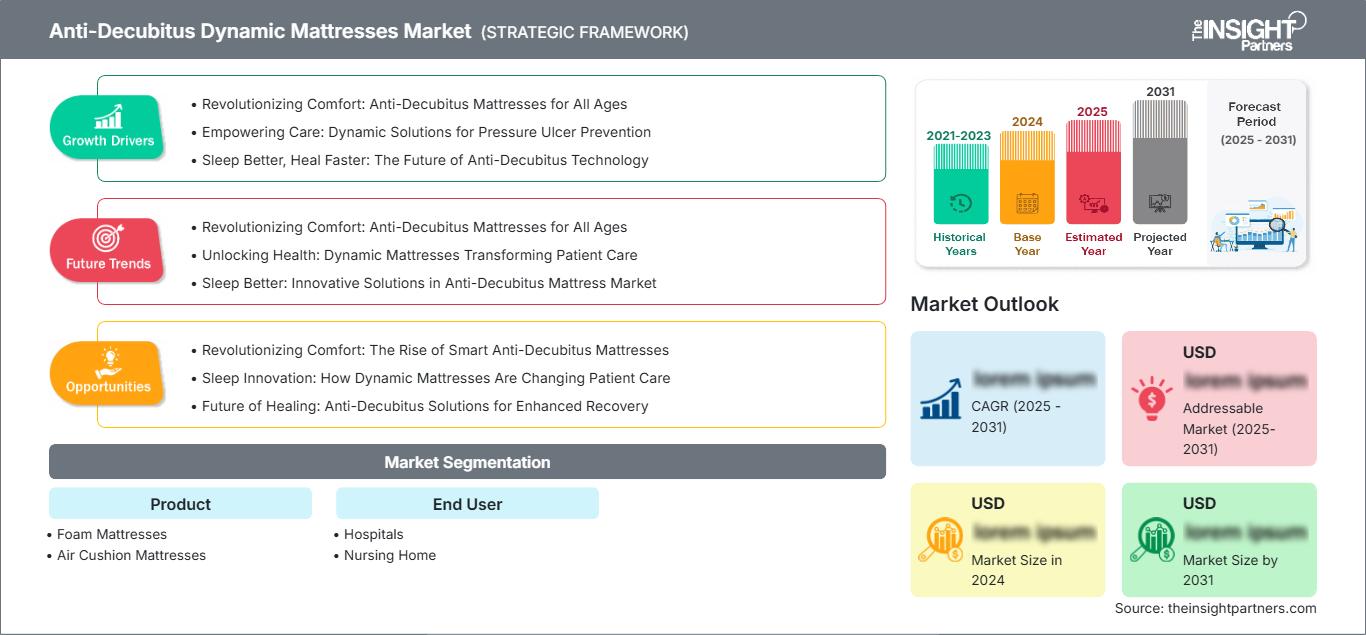
Anti-Decubitus Dynamic Mattresses Market: Strategic Insights
Regional Insights
North America anti-decubitus dynamic mattresses market
North America accounted for 34–37% share in 2025, giving the region the largest anti-decubitus dynamic mattresses market share globally. The region is growing at a CAGR of 5.8–6.3% during 2026–2034, supported by pressure injury quality metrics, sophisticated ICU infrastructure, and mature procurement channels for replacement surfaces, rental fleets, and high-acuity therapeutic mattresses.
Demand is strongest in the US, while Canada contributes steady purchases through public hospital networks and long-term care facilities. Structural drivers include ageing demographics, nursing workload reduction, and standardized skin-integrity programs. Device selection increasingly prioritizes microclimate control, heel offloading, CPR deflation, transport stability, cleaning resistance, and compatibility with powered hospital bed platforms.
U.S. anti-decubitus dynamic mattresses Market
The US represented 84–88% of North America in 2025 and is expanding at a CAGR of 5.7–6.2% during 2026–2034. Adoption is concentrated across acute-care hospitals, ICUs, rehabilitation units, and skilled nursing facilities where pressure injuries can increase patient length of stay, litigation exposure, and care complexity.
Company presence is broad, with Stryker Corporation, Hill-Rom Services, Inc., EHOB, Inc., Permobil AB, and Drive DeVilbiss Sidhil Ltd. serving institutional buyers through direct sales, distributors, and rental support. Applications are moving beyond very high-risk patients toward step-down units, bariatric care, post-operative recovery, and nursing home prevention programs where staff ratios make automated pressure redistribution valuable.
Europe anti-decubitus dynamic mattresses Market
Europe held 28–31% share in 2025 and is growing at a CAGR of 5.4–5.9% during 2026–2034. The UK shows strong demand from National Health Service trusts and private care homes, where pressure ulcer prevention is linked to clinical governance, nursing audits, and equipment standardization across wards and residential facilities.
Germany represents the strongest market, backed by advanced hospitals, rehabilitation facilities, and local medical technology capabilities. Purchasers require tough surfaces, protection against infection, and bed adjustability compatibility. LINET spol. s r.o., Malvestio S.p.A., Hirtz & Co. KG, and Drive DeVilbiss Sidhil Ltd. can leverage their regional servicing networks and existing connections.
France, Italy, and Spain contribute valuable sales volume through public hospital buying, private rehabilitation facilities, and elderly resident care facilities. France places a heavy emphasis on quality standards adherence, Italy capitalizes on regional hospitals modernization, and Spain sees increasing demand in nursing homes. Across Europe, replacement purchases are frequently related to pressure injury audit and accreditation processes.
APAC anti-decubitus dynamic mattresses Market
APAC accounted for 22–25% share in 2025 and is growing at a CAGR of 7.2–7.8% during 2026–2034. China is the leading country by scale, while Japan leads in elderly-care intensity and South Korea supports premium hospital equipment adoption.
India and Australia add growth through private hospital expansion, rehabilitation demand, and long-term care development. Industrial drivers include regional medical device manufacturing and cost-optimized air systems. Policy attention to hospital quality, elderly care infrastructure, and infection prevention is increasing demand for dynamic mattresses in both tertiary hospitals and nursing facilities.
Middle East & Africa anti-decubitus dynamic mattresses Market
Middle East & Africa is growing at a CAGR of 6.4–7.0% during 2026–2034, with Saudi Arabia as the leading country. The UAE is a premium hospital hub, supported by medical tourism, private healthcare investment, and adoption of international patient safety standards.
South Africa and the Rest of MEA remain more cost-sensitive, with demand concentrated in tertiary hospitals and select private care providers. Energy-linked healthcare infrastructure investment in Gulf countries supports procurement of ICU beds, powered air surfaces, and infection-control mattresses, while wider regional adoption depends on distributor coverage and biomedical maintenance capability.

Segmentation Analysis
Product
The Product segment is growing at a CAGR of 6.2–6.8% during 2026–2034. The anti-decubitus dynamic mattresses market scope across product types is defined by risk level, setting, staff capacity, and clinical acuity. Foam mattresses remain important for moderate-risk patients and cost-controlled environments, while powered air cushion mattresses support high-risk, immobile, ICU, and long-term care patients requiring dynamic pressure redistribution.
- Foam Mattresses maintain relevance where facilities need affordable prevention, simple cleaning, and lower maintenance. They are commonly used in wards, nursing homes, and moderate-risk patients requiring basic redistribution.
- Air Cushion Mattresses dominate higher-acuity demand because alternating pressure, low-air-loss functions, and adjustable zones support pressure relief, microclimate control, and care plans for immobile patients.
End User
The End User segment is growing at a CAGR of 6.5–7.1% during 2026–2034. Hospitals remain the primary buyers because acute immobility, ICU stays, surgery, and comorbidity create high pressure injury risk. Nursing homes are gaining strategic importance as residents live longer with frailty, dementia, incontinence, and mobility limitations that require continuous preventive support surfaces.
- Hospitals generate high revenue contribution through ICU surfaces, step-down units, bariatric care, rental contracts, and replacement demand tied to patient safety audits and biomedical equipment policies.
- Nursing Home demand is expanding as operators standardize prevention protocols, reduce manual repositioning pressure on staff, and invest in durable dynamic systems for residents with chronic immobility.
Opportunity Snapshot
| Segment Name | Revenue Contribution | Trend Tag | Adoption Stage |
|---|---|---|---|
| Hospitals | High | ICU Surfaces | Mature |
| Nursing Home | Medium | Resident Care | Scaling |
Anti-Decubitus Dynamic Mattresses Market Growth Drivers and Impact Analysis
Rising Clinical Burden of Pressure Injuries
Pressure injuries continue to be an ongoing safety issue because they have been found to be related to immobility, advanced age, malnutrition, perfusion, moisture, and extended stay in the hospital. The World Health Organization lists pressure ulcers as one of the adverse events leading to unnecessary patient injury, whereas clinical evidence shows the significance of this condition among hospitalized adults. As a result of this problem, there is an actual procurement challenge with respect to surfaces designed to minimize interface pressure and control skin microclimate. The effect is especially apparent in ICUs, surgery wards, and long-term facilities where even one serious injury prolongs treatment and nursing care, and providers are liable for quality.
Expansion of Elderly and Long-Term Care Capacity
Population ageing is increasing the number of patients who require prolonged bed rest, assisted mobility, and residential care. Nursing homes and rehabilitation centers face higher exposure to frailty, dementia, stroke recovery, orthopedic recovery, and chronic illness, all of which increase pressure injury risk. The commercial driver is a transition from a demand that only exists at hospitals to a need for prevention programs across the entire facility in long-term care facilities. Facilities are considering surfaces in terms of their durability, cleanability, usability by staff, and load-bearing capacity. The commercial driver supports recurring demand, since mattresses need to be replaced periodically and pumps need to be maintained.
Need to Reduce Nursing Workload and Care Variability
Dynamic mattresses help facilities reduce dependence on manual repositioning alone, especially when nursing shortages make strict turning schedules difficult to maintain. Alternating-pressure systems, zoned support, transport modes, and microclimate management offer more consistent protection for high-risk patients. The operational impact is significant because easier setup, alarms, rapid CPR deflation, and washable covers reduce caregiver burden during routine care. Procurement teams increasingly connect these features with staff safety, patient comfort, and workflow efficiency. Products that integrate clearly with bed frames and training programs stand out because they reduce misuse, shorten onboarding time, and support more standardized pressure injury prevention across shifts.
Anti-Decubitus Dynamic Mattresses Market Future Trends
Smart Surface Monitoring
The next phase of anti-decubitus dynamic mattresses market trends will involve sensors that monitor patient weight distribution, bed exit status, moisture, and surface performance. These systems may connect to nurse call platforms or hospital dashboards, enabling earlier intervention when patients remain in one position too long or when microclimate risk rises. Smart monitoring will also help biomedical teams track pump performance and replacement needs. The trend is expected to reshape procurement criteria because hospitals will evaluate outcome data, interoperability, cybersecurity, and maintenance analytics alongside traditional pressure redistribution capability. Suppliers with connected bed ecosystems are likely to gain an advantage.
Hybrid Foam-Air Platforms
Hybrid foam-air platforms are expected to gain traction as facilities seek clinical performance without excessive complexity. These systems combine stable foam support, transfer-edge safety, and powered or adjustable air zones for higher-risk patients. The model can reduce the need to move patients between surfaces as acuity changes, improving continuity of care and lowering handling risk. Future product development will focus on quieter pumps, modular replaceable cells, antimicrobial covers, and broader bariatric sizing. Hybrid platforms will be attractive for hospitals and nursing homes that need flexible surfaces across mixed-acuity rooms rather than separate inventories for every risk category.
Anti-Decubitus Dynamic Mattresses Market Opportunities
Lifecycle Service and Rental Models
Lifecycle service models offer a strong investment opportunity because many care facilities lack staff capacity for pump checks, cover inspection, cell replacement, and surface utilization tracking. The anti-decubitus dynamic mattresses market Forecasts support greater demand for bundled equipment, maintenance, training, and rental programs that align spending with patient acuity. Suppliers can create value by offering rapid delivery for high-risk patients, documented cleaning protocols, preventive maintenance schedules, and usage analytics. Hospitals benefit from lower capital intensity during census peaks, while nursing homes gain predictable costs. This opportunity favors companies with regional depots, field service teams, and broad portfolios across foam and air systems.
Cost-Optimized Products for Emerging Care Networks
Emerging care networks need dynamic mattresses that balance clinical protection with affordability, easy repair, and distributor-supported maintenance. Asia Pacific, the Middle East, and selected African markets are expanding hospitals and long-term care capacity, but procurement budgets remain uneven. Manufacturers can address this gap with modular pumps, replaceable air cells, durable covers, and simplified controls. Local partnerships can reduce downtime and improve training consistency. The opportunity is not limited to low-cost products; it involves fit-for-purpose systems that meet infection-control expectations, support higher patient weights, and operate reliably in facilities with constrained biomedical engineering resources.
Recent Developments
- April 2026: Permobil AB appointed Ana Lopez as Chief Operating Officer, creating a global COO role to strengthen end-to-end supply chain, quality, manufacturing performance, and service delivery across its assistive mobility, seating, positioning, beds, and therapeutic surface operations. The move supports faster product availability and operational consistency for care providers using advanced support surfaces.
- June 2025: Stryker Corporation introduced the APAISER X1 ICU air mattress in India during ANEiCON 2025, positioning the system for critical-care environments with independent low-air-loss technology, a TrueCare alternating pressure system, adaptive care modes, auto Fowler detection, low-noise pump operation, and transport pressure retention for uninterrupted patient support.
- February 2025: Permobil AB released its updated beds, therapeutic surfaces, and mattresses guide, highlighting expanded powered active air surfaces, alternating pressure and pulsation therapy systems, low-air-loss options, modular mattress configurations, bariatric sizing, pediatric options, and ROHO and Vicair inlay compatibility for long-term care and home-care environments.
Frequently Asked Questions

- Comprehensive Market Sizing and Forecast Analysis
- Detailed Segmentation Analysis
- In-Depth Market Dynamics Assessment
- Regional and Country-Level Insights
- Competitive Landscape and Company Benchmarking
- Strategic Business Intelligence
Recent Reports
Testimonials

The Insight Partners provided valuable market intelligence that supported our global go-to-market strategy. Their team was professional, responsive, and attentive to our feedback, providing thoughtful analysis and helpful methodological clarifications throughout the project.
Junmo Kim Chief Financial Officer (CFO), Enertech Co., Ltd.
The Insight Partners' SCADA System Market report is comprehensive, with valuable insights on current trends and future forecasts. The team was highly professional, responsive, and supportive throughout. We are very satisfied and highly recommend their services.
RAN KEDEM Partner, Reali Technologies LTDs
I requested a report on a very specific software market and the team produced the report in a few days. The information was very relevant and well presented. I then requested some changes and additions to the report. The team was again very responsive and I got the final report in less than a week.
JEAN-HERVE JENN Chairman, Future Analytica
We worked with The Insight Partners for an important market study and forecast. They gave us clear insights into opportunities and risks, which helped shape our plans. Their research was easy to use and based on solid data. It helped us make smart, confident decisions. We highly recommend them.
PIYUSH NAGPAL Sr. Vice President, High Beam Global
The Insight Partners delivered insightful, well-structured market research with strong domain expertise. Their team was professional and responsive throughout. The user-friendly website made accessing industry reports seamless. We highly recommend them for reliable, high-quality research services
YUKIHIKO ADACHI CEO, Deep Blue, LLC.
This is the first time I have purchased a market report from The Insight Partners.While I was unsure at first, I visited their web site and felt more comfortable to take the risk and purchase a market report.I am completely satisfied with the quality of the report and customer service. I had several questions and comments with the initial report, but after a couple of dialogs over email with their analyst I believe I have a report that I can use as input to our strategic planning process.Thank you so much for taking the extra time and making this a positive experience.I will definitely recommend your service to others and you will be my first call when we need further market data.
JOHN SUZUKI President and Chief Executive Officer, Board Director, BK Technologies
I wish to appreciate your support and the professionalism you displayed in the course of attending to my request for information regarding to infectious disease IVD market in Nigeria. I appreciate your patience, your guidance, and the fact that you were willing to offer a discount, which eventually made it possible for us to close a deal. I look forward to engaging The Insight Partners in the future, all thanks to the impression you have created in me as a result of this first encounter.
DR CHIJIOKE ONYIA MANAGING DIRECTOR, PineCrest Healthcare Ltd.Reason to Buy
- Informed Decision-Making
- Understanding Market Dynamics
- Competitive Analysis
- Identifying Emerging Markets
- Customer Insights
- Market Forecasts
- Risk Mitigation
- Boosting Operational Efficiency
- Strategic Planning
- Investment Justification
- Tracking Industry Innovations
- Aligning with Regulatory Trends





 Get Free Sample for