
Anti-lock Braking System Market Size, Share & Forecast by 2034
Coverage: By Components (Sensors, Electronic Control Unit (ECU), Hydraulic Unit, Others); Type (Four-Channel Four-Sensor ABS, Three-Channel Three-Sensor ABS, One-Channel One-Sensor ABS); Vehicle Type (Passenger Cars, HCV, LCV) , and Geography (North America, Europe, Asia Pacific, and South and Central America)
- Status : Data Released
- Report Code : TIPRE00006120
- Category : Automotive and Transportation
- No. of Pages : 150
- Available Report Formats :


- Last update date : August 26, 2026


2025 Market Size
US$ 56.81 Bn
Base year value
2034 Forecast
US$ 105.27 Bn
Projected by 2034
CAGR 2026-2034
7.09 %
Growth rate
Addressable Market
US$ 731.45 Bn
(2026-2034)
The anti-lock braking system market was valued at US$ 56.81 Billion in 2025 and is projected to reach US$ 105.27 Billion by 2034, registering a CAGR of 7.09%. The increasing integration of active vehicle safety technologies, regulatory mandates for braking performance, and rising production of passenger and commercial vehicles continue to support long-term industry expansion across developed and emerging economies.
Across North America, safety regulations, advanced vehicle penetration, and increasing adoption of electronic braking architectures are supporting steady demand. The anti-lock braking system market size in the region benefits from strong OEM investments, high vehicle ownership rates, and growing deployment of advanced driver-assistance systems. The region is anticipated to expand at a CAGR range of 6.2%–7.0% through 2034, supported by continued innovation in braking electronics and sensor technologies.
Anti-lock Braking System Market Assessment and Insights
- North America: Accounted for 30%–34% share in 2025 and is projected to grow at a 6.2%–7.0% CAGR during 2026–2034, supported by stringent vehicle safety requirements, premium vehicle adoption, and strong OEM investment in braking technologies.
- US: Represented 74%–78% of North America in 2025 and is anticipated to register a 6.3%–7.1% CAGR during 2026–2034, driven by automotive innovation, fleet modernization, and widespread integration of safety systems.
- Europe: Held 24%–28% share in 2025 and is forecast to advance at a 5.8%–6.6% CAGR during 2026–2034, led by Germany, the UK, and France, where safety regulations and vehicle electrification are accelerating system deployment.
- Asia Pacific: Accounted for 34%–38% share in 2025 and is expected to achieve a 7.2%–8.0% CAGR during 2026–2034, supported by automotive manufacturing growth in China, Japan, India, and South Korea.
- Largest Segment: Four-Channel Four-Sensor ABS held a 52%–56% market share in 2025 and is projected to expand at a 6.8%–7.6% CAGR during 2026–2034 due to superior braking control and widespread passenger vehicle adoption.
- High Growth Segment: Sensors are anticipated to record a 20%–24% market share in 2025 and a 7.8%–8.6% CAGR during 2026–2034, supported by growing electronic content per vehicle.
- Key companies analyzed in detail: AISIN Corporation, Aptiv PLC, Continental AG, DENSO CORPORATION, Hitachi Astemo, Ltd., Hyundai Mobis Co., Ltd., Nissin Kogyo Co., Ltd., Robert Bosch GmbH, ZF Friedrichshafen AG, and ZF CV Systems (WABCO).
Source: The Insight Partners' analysis based on proprietary research, government publications, company annual reports, investor presentations, industry databases, and expert interviews.
Vehicle safety requirements have changed dramatically owing to the incorporation of electronics, software, and sensor technologies into brake systems. Car makers today use complex wheel speed sensors, electronic control modules, and hydraulic modules to work with traction control and stability systems. Increasing manufacture of SUVs, electric cars, and premium passenger cars has also fueled the adoption of advanced anti-lock brake systems across different types of vehicles.
In terms of the future market outlook, it is believed that the anti-lock brake system market will benefit from increasing production of vehicles in the Asia Pacific region, localized manufacturing, and stringent safety requirements in emerging countries. Increasing adoption of intelligent brake systems, along with growing adoption of autonomous drive technology, will drive the demand for anti-lock brakes going forward.
Anti-lock Braking System Market Report Scope
| Report Attribute | Details |
|---|---|
| Market size in 2025 | US$ 56.81 Billion |
| Market Size by 2034 | US$ 105.27 Billion |
| Global CAGR (2026 - 2034) | 7.09% |
| Historical Data | 2021-2024 |
| Forecast period | 2026-2034 |
Anti-lock Braking System Market Analysis
The anti-lock braking system market growth trajectory is strongly linked to vehicle safety regulations and consumer demand for accident prevention technologies. New braking systems help enhance vehicle stability by reducing wheel lock during emergency braking. Value chain participants include semiconductor providers, sensor makers, control unit developers, hydraulic system providers, automotive original equipment manufacturers (OEMs), and aftermarket service companies. The growing presence of electronics in vehicles increases the role of software-based braking control.
There have been significant changes on the supply side as well. Automotive OEMs will keep focusing on using lighter components, building electronic brake systems, and adopting platform designs that allow for scalability. Reduced operating risks and higher reliability will be achieved via the miniaturization of sensors, enhanced data processing capacity, and increased diagnostics. Simultaneously, electrification trends motivate system modification to accommodate regenerative braking and future vehicle control systems.
The competitive environment remains concentrated among established automotive technology companies. The anti-lock braking system market analysis indicates that Robert Bosch GmbH, Continental AG, AISIN Corporation, DENSO CORPORATION, Aptiv PLC, Hyundai Mobis Co., Ltd., Hitachi Astemo, Ltd., and ZF Friedrichshafen AG continue strengthening their market positions through product innovation, manufacturing expansion, and strategic partnerships. Their diverse product portfolio allows them to integrate their brake technology systems into stability control and driver assistance systems.
In recent times, investments have been focused on software-driven vehicle architectures, intelligent sensing abilities, and brake-by-wire innovation pathways. The OEMs require suppliers that can provide scalable safety platforms for their vehicles running on internal combustion engines as well as their electric vehicles. The focus of competitive differentiation has also moved from hardware to software innovations.
● REPORT CUSTOMIZATION
Tailor This Report To Align With Your Specific Business Requirements
This report can be customized to align precisely with your business objectives, scope, and target markets. Customization options include tailored segmentation, geography, competitive analysis, and strategic insights to support informed decision-making.
Customize This Report →WHAT YOU CAN ADJUST
- ● Segmentations
- ● Geography
- ● Competitive Analysis
- ● Language Preferences
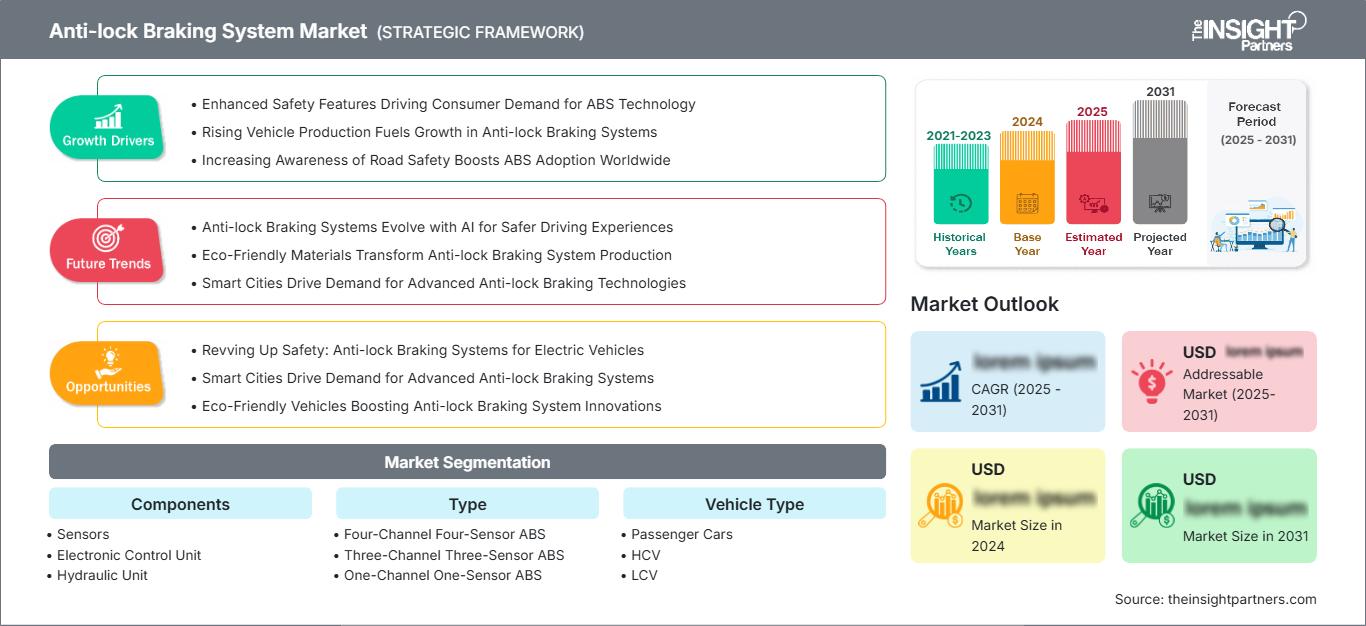
Anti-lock Braking System Market: Strategic Insights
Regional Insights
North America anti-lock braking system market
North America accounted for approximately 30%–34% of the anti-lock braking system market share in 2025 and is forecast to expand at a CAGR of 6.2%–7.0% between 2026 and 2034. The factors such as efficient safety compliance programs, high usage of passenger cars, and rising need for driver-assistive systems will continue driving the market.
Automotive producers in the US, Canada, and Mexico have been focusing on adding advanced brake system electronics to the existing platforms. The growth is being driven by the increasing use of SUVs, pickup trucks, and EVs. Investment in the manufacturing of automobiles and intelligent mobility will continue driving the market for advanced braking systems.
U.S. anti-lock braking system Market
The US represented approximately 74%–78% of North American demand in 2025 and is projected to expand at a CAGR of 6.3%–7.1% through 2034. Strong automotive manufacturing capabilities, substantial technology investments, and early adoption of advanced safety technologies contribute to stable market development across diverse vehicle categories.
The presence of leading technology providers, OEMs, and engineering centers supports continuous innovation in braking solutions. Rising deployment of connected vehicles, electric mobility platforms, and advanced safety packages is increasing demand for sensors, hydraulic modules, and electronic control units. Fleet operators are also prioritizing safety-driven upgrades, creating additional opportunities across commercial transportation applications.
Europe anti-lock braking system Market
Europe accounted for 24%–28% of the global market in 2025 and is anticipated to grow at a CAGR of 5.8%–6.6% through 2034. Germany still ranks first because of its robust automotive manufacturing environment, existing brand cars, and focus on engineering expertise. The safety standards and vehicle electrification projects keep encouraging the adoption of technology.
The UK enjoys the benefits of investment in automotive research, high-end vehicle manufacturing, and the incorporation of safety features. France, Italy, and Spain together offer significant demand through the manufacture of passenger vehicles and commercial transport. There is increasing adoption of electric vehicles, which encourages the development of superior braking architecture for efficiency and safety.
APAC anti-lock braking system Market
Asia Pacific held 34%–38% share in 2025 and is projected to register the fastest growth, at a CAGR of 7.2%–8.0%. China remains the leading market, supported by vehicle production scale and the accelerating adoption of safety technologies.
Japan, South Korea, India, and Australia continue contributing through vehicle manufacturing investments, rising safety awareness, and regulatory developments. Favorable industrial policies and expanding automotive production capacities support long-term demand for advanced braking systems.
Middle East & Africa anti-lock braking system Market
The Middle East & Africa market is expected to expand at a CAGR of 5.4%–6.2% through 2034. Saudi Arabia and the UAE are benefiting from transportation modernization programs, while South Africa maintains a significant automotive manufacturing base.
Infrastructure investment, commercial fleet expansion, and growing vehicle safety awareness are supporting technology adoption. Increasing logistics activity and long-term mobility initiatives are expected to strengthen demand across the broader regional market.
Segmentation Analysis
Components
The Components segment is expected to grow at a CAGR of 7.0%–7.8% during 2026–2034. The anti-lock braking system market scope continues to expand through increasing integration of advanced electronic and sensing technologies. Greater vehicle connectivity, safety compliance requirements, and software-based control functions are improving demand for high-performance components that enhance braking precision and operational reliability.
- Sensors: Sensors play a critical role in wheel-speed monitoring and data transmission. Increasing electronic vehicle content and higher safety requirements continue driving demand across passenger and commercial vehicle categories.
- Electronic Control Unit: Electronic control units process sensor data and coordinate braking responses. Their strategic importance is rising as manufacturers adopt integrated safety architectures and intelligent vehicle control platforms.
- Hydraulic Unit: Hydraulic units regulate brake pressure distribution and support system responsiveness. Continuous improvements in durability, efficiency, and compact design strengthen their position within modern braking assemblies.
Type
The Type segment is projected to expand at a CAGR of 6.5%–7.3% during 2026–2034. Growing requirements for stability, braking control, and safety performance are increasing the adoption of advanced configurations. Manufacturers are prioritizing systems capable of providing greater precision and vehicle control during challenging road and weather conditions.
- Four-Channel Four-Sensor ABS: The most widely adopted configuration due to superior wheel-by-wheel control, improved braking efficiency, and strong compatibility with modern passenger vehicle safety systems.
- Three-Channel Three-Sensor ABS: Commonly utilized in selected vehicle categories requiring balanced performance and cost efficiency. It remains relevant where moderate braking control characteristics satisfy operational requirements.
- One-Channel One-Sensor ABS: Primarily used in certain entry-level and specialized vehicle applications where cost considerations remain important, and braking system complexity is comparatively lower.
Opportunity Snapshot
| Type | Revenue Contribution | Trend Tag | Adoption Stage |
| Four-Channel Four-Sensor ABS | High | Vehicle Safety | Mature |
| Three-Channel Three-Sensor ABS | Medium | Cost Efficiency | Scaling |
| One-Channel One-Sensor ABS | Low | Basic Mobility | Mature |
Anti-lock Braking System Market Growth Drivers and Impact Analysis
Expansion of Vehicle Safety Regulations Worldwide
Continual enhancement in safety standards by government bodies and transportation departments will lead to higher demand for dependable anti-lock braking systems, as advanced braking technology is increasingly mandated across many jurisdictions. Accident prevention, stability, and safety considerations will be more prevalent in current regulations as manufacturers would be encouraged to install advanced braking systems as a standard feature in their products. Such factors would not only drive the recurring demand for anti-lock braking systems from new vehicle manufacturing processes but also generate demand from the aftermarket replacement activities. Greater public understanding about the importance of road safety and accident prevention would add further impetus.
Rising Adoption of Electric and Connected Vehicles
Advanced braking system technology is necessary in electric vehicles to function efficiently together with the regenerative systems and intelligent vehicle control systems. With the rise of connected and software-based vehicles in the market, brake systems are more likely to be integrated into an entire safety ecosystem. This implies that the significance of sensors, electronic control units, and complex algorithms becomes greater in these types of brake systems. More efficient, safe, and compatible platforms for the next generation of mobility solutions are now being developed by manufacturers.
Growth in Automotive Production Across Emerging Economies
Developing nations continue to enhance automotive production capacity through industrial investments, infrastructure development, and favorable policies by their governments. Urbanization, increased incomes, and vehicle ownership rates are leading to positive situations that promote demand for the products. Production of the parts and the assembly of the automobiles locally leads to efficient supply chain processes as well as low-cost structures. The manufacturers are also incorporating more safety measures in their entry-level automobiles, leading to a bigger market potential. This is promoting growth prospects for the company in the future.
Anti-lock Braking System Market Future Trends
Software-Integrated Braking Platforms
The anti-lock braking system market trends increasingly reflect the transition toward software-centric vehicle architectures. Future braking systems will be built with increased functionality for diagnostic and predictive maintenance, as well as optimized performance in real time. Increased software functionality will enable interconnectivity with autonomous driving systems, connected car technology, and other safety applications. With the continued development of vehicle electronics, suppliers who can provide combined hardware-software solutions are poised to win.
Evolution Toward Brake-by-Wire Technologies
The sector is progressively moving towards brake-by-wire technology that will help to decrease mechanical complexity while enhancing reaction and vehicle control. These kinds of systems are envisaged to contribute to innovations in both the electrification and automation sectors. Further improvements in terms of electronics redundancy, cybersecurity, and functional safety will facilitate greater acceptance of the brake-by-wire technology. With time, the sector may start incorporating ABS into motion control systems.
Anti-lock Braking System Market Opportunities
Expansion in Emerging Automotive Manufacturing Hubs
Emerging production centers across Asia, the Middle East, and selected Latin American markets present significant investment opportunities. Vehicle manufacturers increasingly seek localized sourcing strategies to improve operational efficiency and supply chain resilience. Suppliers able to establish regional manufacturing capabilities, technical support infrastructure, and strategic partnerships may gain substantial advantages. Rising safety requirements in developing economies also create favorable conditions for broader technology adoption. According to long-term anti-lock braking system market Forecasts, demand growth in these regions is expected to outpace mature markets, supporting capacity expansion and product localization initiatives.
Integration with Advanced Driver Assistance Systems
Braking technologies are becoming increasingly interconnected with collision avoidance, stability management, and autonomous driving functions. This evolution creates opportunities for suppliers offering advanced sensing, software, and control capabilities. Companies capable of delivering integrated safety platforms can strengthen their value proposition to OEM customers. Growing investment in vehicle intelligence and connected mobility is expected to stimulate demand for sophisticated braking technologies that support higher levels of automation and enhanced road safety outcomes.
Frequently Asked Questions

- Comprehensive Market Sizing and Forecast Analysis
- Detailed Segmentation Analysis
- In-Depth Market Dynamics Assessment
- Regional and Country-Level Insights
- Competitive Landscape and Company Benchmarking
- Strategic Business Intelligence
Recent Reports
Testimonials

The Insight Partners' SCADA System Market report is comprehensive, with valuable insights on current trends and future forecasts. The team was highly professional, responsive, and supportive throughout. We are very satisfied and highly recommend their services.
RAN KEDEM Partner, Reali Technologies LTDs
I requested a report on a very specific software market and the team produced the report in a few days. The information was very relevant and well presented. I then requested some changes and additions to the report. The team was again very responsive and I got the final report in less than a week.
JEAN-HERVE JENN Chairman, Future Analytica
We worked with The Insight Partners for an important market study and forecast. They gave us clear insights into opportunities and risks, which helped shape our plans. Their research was easy to use and based on solid data. It helped us make smart, confident decisions. We highly recommend them.
PIYUSH NAGPAL Sr. Vice President, High Beam Global
The Insight Partners delivered insightful, well-structured market research with strong domain expertise. Their team was professional and responsive throughout. The user-friendly website made accessing industry reports seamless. We highly recommend them for reliable, high-quality research services
YUKIHIKO ADACHI CEO, Deep Blue, LLC.
This is the first time I have purchased a market report from The Insight Partners.While I was unsure at first, I visited their web site and felt more comfortable to take the risk and purchase a market report.I am completely satisfied with the quality of the report and customer service. I had several questions and comments with the initial report, but after a couple of dialogs over email with their analyst I believe I have a report that I can use as input to our strategic planning process.Thank you so much for taking the extra time and making this a positive experience.I will definitely recommend your service to others and you will be my first call when we need further market data.
JOHN SUZUKI President and Chief Executive Officer, Board Director, BK Technologies
I wish to appreciate your support and the professionalism you displayed in the course of attending to my request for information regarding to infectious disease IVD market in Nigeria. I appreciate your patience, your guidance, and the fact that you were willing to offer a discount, which eventually made it possible for us to close a deal. I look forward to engaging The Insight Partners in the future, all thanks to the impression you have created in me as a result of this first encounter.
DR CHIJIOKE ONYIA MANAGING DIRECTOR, PineCrest Healthcare Ltd.Reason to Buy
- Informed Decision-Making
- Understanding Market Dynamics
- Competitive Analysis
- Identifying Emerging Markets
- Customer Insights
- Market Forecasts
- Risk Mitigation
- Boosting Operational Efficiency
- Strategic Planning
- Investment Justification
- Tracking Industry Innovations
- Aligning with Regulatory Trends





 Get Free Sample for