
Antibody Isotyping Kit Market Size, Share & Growth by 2034
Coverage: By Product type (ELISA antibody isotyping kits, Dipstick style rapid antibody isotyping kits, Cassette style rapid antibody isotyping kits); Applications (Infectious diseases, Cardiology, Oncology, Others); End User (Hospital, Clinical laboratories, Blood banks, Academic research centers, Biotechnology companies), and Geography (North America, Europe, Asia Pacific, and South and Central America)
- Status : Data Released
- Report Code : TIPRE00008553
- Category : Life Sciences
- No. of Pages : 150
- Available Report Formats :


- Last update date : August 24, 2026


2025 Market Size
US$ 1.99 Bn
Base year value
2034 Forecast
US$ 3.71 Bn
Projected by 2034
CAGR 2026-2034
7.19 %
Growth rate
Addressable Market
US$ 25.75 Bn
(2026-2034)
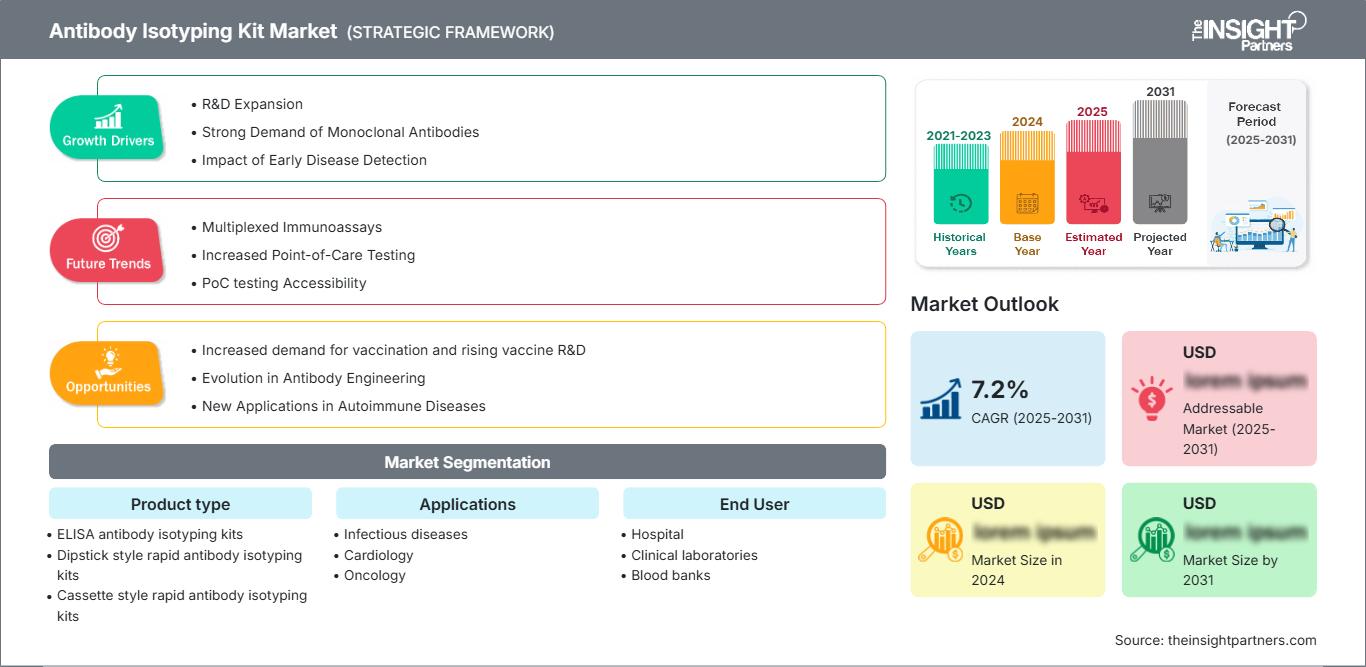
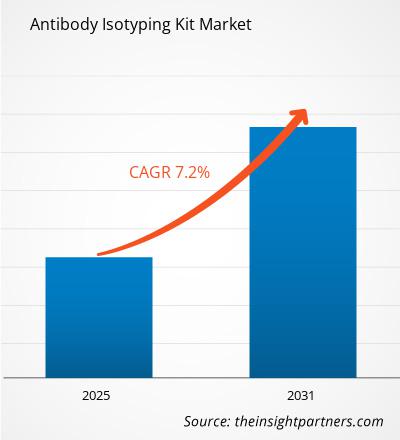
The Antibody Isotyping Kits Market operates at the crossroad of antibody typing, assay development, translational research, and testing laboratories. The Antibody Isotyping Kit market is valued at US$ 1.99 Billion in 2025 and is expected to grow to US$ 3.71 Billion by 2034, growing at a CAGR of 7.19% from 2026 to 2034. Growth drivers include growth in the development of monoclonal antibodies, increased immunoglobulin typing, and use of rapid and multiplex testing methods.
North America continues to maintain a significant antibody isotyping kit market size, with a forecast CAGR of 7.6-8.2% during 2026 to 2034. The market size in North America is driven by high biotechnology research intensity, presence of developed clinical laboratories and adoption of automation technologies in immunoassays. The USA in particular gets benefited through R&D spending by pharmaceuticals and academic institutions and need for rapid identification of antibodies.
Antibody Isotyping Kit Market Assessment and Insights
- North America: North America is expected to account for a 39–43% antibody isotyping kit market share in 2025 and grow at a CAGR of 7.6–8.2% during 2026–2034, supported by biotechnology concentration, advanced laboratories, and established antibody research workflows.
- US: The US is estimated to represent 84–88% of North America's 2025 value and expand at a CAGR of 7.7–8.3% during 2026–2034, led by pharmaceutical and academic research demand.
- Europe: Europe is projected to hold a 25–29% share in 2025 and register a CAGR of 6.9–7.6% during 2026–2034. Germany, the UK, France, and Italy provide strong research and laboratory bases.
- Asia Pacific: Asia Pacific is estimated at a 20–24% share in 2025, with a CAGR of 8.0–8.8% through 2034. China, Japan, South Korea, and India are increasing laboratory capacity and biotechnology investment.
- Largest Segment: ELISA antibody isotyping kits are estimated to command a 48–53% market share in 2025, with a 6.6–7.3% CAGR during 2026–2034 due to quantitative, scalable workflows.
- High Growth Segment: Dipstick style rapid antibody isotyping kits are estimated at a 15–19% market share in 2025 and a 8.8–9.6% CAGR through 2034, driven by speed and workflow simplicity.
- Key companies analyzed in detail: Thermo Fisher Scientific, Bio-Rad Laboratories, Becton, Dickinson and Company, Abbott Laboratories, Roche Diagnostics, Danaher Corporation, bioMérieux, Sysmex Corporation, Quidel Corporation, Creative Diagnostics.
Source: The Insight Partners' analysis based on proprietary research, government publications, company annual reports, investor presentations, industry databases, and expert interviews.
According to the antibody isotyping kit market report, these kits have seen a shift from traditional plate-based testing to fast, lateral flow testing and multiplexed bead-based analysis in recent times. Traditional ELISA is still vital for cases requiring high throughput quantitation, whereas fast techniques are used for urgent screening purposes. The current offerings of products include mouse, rat, and human antibody characterization; multiplexing technology allows multiple isotyping of multiple immunoglobulins in the small amount of sample material.
During the forecast period, usage of these products should become more prevalent in growing biotechnology clusters and in less centralized research setups. Increased focus on reproducibility and assay standardization should benefit manufacturers of products that can be integrated into such workflows. Expectations of regulatory authorities concerning laboratory quality should also contribute to the growing popularity of standard kits. Result management should become more digitized with immunoassay instrumentation.
Antibody Isotyping Kit Market Report Scope
| Report Attribute | Details |
|---|---|
| Market size in 2025 | US$ 1.99 Billion |
| Market Size by 2034 | US$ 3.71 Billion |
| Global CAGR (2026 - 2034) | 7.19% |
| Historical Data | 2021-2024 |
| Forecast period | 2026-2034 |
Antibody Isotyping Kit Market Analysis
Growth in antibody isotyping kit market will be linked with discoveries in monoclonal antibodies, hybridoma screening, vaccines, immune response studies, and humanized antibodies. Thermo Fisher Scientific has recognized isotyping as an important test to screen during the process of developing antibodies, with ELISA, multiplex, dipstick, and cassette systems catering to various throughput needs.
The ecosystem includes antibody developers, antibody manufacturers, assay developers, lab equipment providers, distributors, academia labs, biotech companies, hospitals, and clinical diagnostic facilities. Differentiation in supply is increasingly driven by availability of validated antibodies, stability of reagents, number of species that can be analyzed, assay sensitivity, and compatibility with standard readers. Multiplex systems are valuable in reducing sample usage and integration of multiple tests in one process.
From the competitive landscape of the antibody isotyping kit market analysis, the market appears to be diversified, with a combination of general laboratory suppliers and suppliers specializing in antibodies. The offerings from Thermo Fisher Scientific include ELISA, dipstick, cassette, and multiplex tests, whereas Bio-Rad provides multiplex immunoglobulin profiling kits. Danaher Corporation enjoys an extensive network of diagnostics and life sciences solutions, whereas Abbott Laboratories, Roche Diagnostics, Becton, Dickinson and Company, and bioMérieux have strong laboratory networks.
Strategic positioning seems to rely more on product portfolios than on products per se. Suppliers are developing solutions such as multiplex testing, automated workflows, quality control measures, and automated assays to enhance laboratory efficiency. Creative Diagnostics specializes in research involving antibodies, whereas Sysmex Corporation and Quidel Corporation offer well-developed diagnostic networks. Integration into laboratory information systems may prove crucial in differentiating the competition.
● REPORT CUSTOMIZATION
Tailor This Report To Align With Your Specific Business Requirements
This report can be customized to align precisely with your business objectives, scope, and target markets. Customization options include tailored segmentation, geography, competitive analysis, and strategic insights to support informed decision-making.
Customize This Report →WHAT YOU CAN ADJUST
- ● Segmentations
- ● Geography
- ● Competitive Analysis
- ● Language Preferences
Antibody Isotyping Kit Market: Strategic Insights
Regional Insights
North America antibody isotyping kit market
North America is estimated to represent 39–43% of the global market in 2025 and is projected to grow at a 7.6–8.2% CAGR through 2034. The region benefits from a dense concentration of pharmaceutical companies, biotechnology firms, universities, contract research organizations, and specialized laboratories. The US remains the principal contributor because antibody discovery and translational research require extensive characterization and screening capabilities.
Biotech initiatives, university labs, and clinical research studies also serve as research grounds for Canada. There is increasing demand for multiplexing and rapid testing as there is a need for high throughput despite the limited manpower in laboratories. Well-established distribution networks and procurement systems make it possible to access these specialized kits. This implies that the regional market is marked by high product penetration, repetitive reagent usage, and adoption of standardized and automated immunoassays.
U.S. antibody isotyping kit Market
The US represents approximately 84–88% of North America's 2025 value and is expected to grow at a 7.7–8.3% CAGR during 2026–2034. The country's pharmaceutical R&D infrastructure, academic antibody research, and biotechnology investment provide a broad customer base. Thermo Fisher Scientific, Bio-Rad Laboratories, Danaher Corporation, Abbott Laboratories, and Becton, Dickinson and Company have substantial laboratory market presence.
The uses cover a range of fields such as infectious disease, cancer, cardiovascular research, vaccines, and antibodies. The ELISA is still useful for quantitation purposes, while rapid ELISAs can be used for screening purposes and where speed is an issue. The multiplex format becomes more relevant in immune profiling since several immunoglobulin types can be analyzed from a small volume of samples. Research laboratories can gain from procurement networks and equipment that work on microplates and multiplexes.
Europe antibody isotyping kit Market
Estimated share of Europe will be 25-29% in 2025 and will grow at a CAGR of 6.9-7.6% till 2034. Both the United Kingdom and Germany represent prominent centers of demand that are driven by pharmaceutical research, university laboratories, biotech clusters, and clinical laboratory networks. France, Italy, and Spain will provide additional demand due to translational research and hospital laboratory testing.
Biomedical research and antibody discovery programs drive demand in the United Kingdom, while Germany represents the combination of pharmaceutical manufacturing and intensive academic research capacities. Biomedical research and clinical laboratory networks generate demand in France. Increasingly, Italy and Spain become promising markets due to workflow modernization and expanding research capacities in laboratories. Overall in Europe, there is an increased demand for purchase of assays due to emphasis on reproducibility, documentation, and integration into existing laboratory platforms.
APAC antibody isotyping kit Market
The APAC region is projected to hold 20%-24% of the 2025 market share with an 8.0%-8.8% CAGR growth rate. The dominant country is China, followed by Japan, South Korea, India, and Australia. Investments in biotechnology, expansion of laboratories, and research will fuel the adoption in the academia and industry sector.
The biologics market of China will drive the adoption of antibody characterization, and Japan and South Korea are equipped with advanced pharmaceutical and research laboratories. Biotechnology and diagnostic facilities are growing in India, and the contribution from Australia comes through biomedical research in universities. The government-sponsored life science research and localization of laboratories will favor adoption, especially with scalable formats available from suppliers.
Middle East & Africa antibody isotyping kit Market
Middle East and Africa represents a smaller but developing opportunity, supported by healthcare infrastructure investment and laboratory modernization. Saudi Arabia and the UAE are leading regional markets, while South Africa provides an established research and diagnostic base. The region is expected to expand at a 6.5–7.3% CAGR during 2026–2034.
Saudi Arabia's healthcare transformation initiatives and the UAE's laboratory investments support advanced testing adoption. South Africa contributes through academic and infectious disease research. Rest of MEA remains constrained by procurement budgets, specialist workforce availability, and uneven laboratory infrastructure. Nevertheless, improved hospital capacity, biotechnology initiatives, and regional research programs can create demand for reliable antibody characterization tools, particularly rapid formats that require limited instrumentation.
Segmentation Analysis
Product type
The product type segment is expected to grow at a 6.7–7.5% CAGR from 2026–2034. ELISA maintains the largest position because it provides quantitative measurements and supports batch testing, while rapid formats address laboratories prioritizing speed, convenience, and limited equipment requirements. Multiplex capability increasingly influences purchasing decisions where sample conservation and broader immune profiling are important.
- ELISA antibody isotyping kits: These kits remain central to quantitative antibody characterization because microplate workflows support multiple samples, standardized controls, and reproducible measurement across antibody development and immune-response studies.
- Dipstick style rapid antibody isotyping kits: Dipstick formats provide simple, instrument-light testing and rapid visual interpretation, making them strategically relevant for preliminary screening and laboratories seeking shorter characterization workflows.
- Cassette style rapid antibody isotyping kits: Cassette formats offer enclosed, easy-to-handle testing with rapid visual results. Their workflow simplicity supports decentralized research environments and situations where conventional plate readers are unavailable.
Applications
The applications segment is projected to expand at a 7.0–7.8% CAGR during 2026–2034. Infectious disease research generates recurring demand for immune-response characterization, while oncology and cardiology applications benefit from increasing biomarker research and antibody-based therapeutic development. Application diversification reduces dependence on any single disease area and supports recurring kit consumption.
- Infectious diseases: Infectious disease laboratories use immunoglobulin characterization to study immune responses, vaccine performance, pathogen exposure, and disease progression, supporting sustained demand for reliable antibody profiling methods.
- Cardiology: Cardiology research uses immunological characterization alongside biomarker studies and inflammatory investigations, creating a specialized demand base for quantitative and multiplex antibody measurement workflows.
- Oncology: Oncology represents an important application because antibody engineering, tumor immunology, immune-response studies, and therapeutic development require detailed characterization of antibody classes and subclasses.
End User
The end user segment is expected to register a 7.1–7.9% CAGR during 2026–2034. Biotechnology companies and academic research centers increasingly use antibody characterization during discovery and development, while hospitals, clinical laboratories, and blood banks provide additional demand from immunological testing and research-oriented applications.
- Hospital: Hospitals use antibody characterization capabilities mainly within specialized laboratory, research, immunology, and translational settings where sample profiling supports disease investigation and clinical research.
- Clinical laboratories: Clinical laboratories favor reproducible workflows, standardized reagents, and compatible instrumentation, particularly where antibody measurements contribute to specialized immunological investigations.
- Blood banks: Blood banks can use immunoglobulin characterization within specialized research and serological workflows, although purchasing priorities emphasize validated performance, traceability, and operational reliability.
- Academic research centers: Academic centers represent an important recurring customer group because antibody screening, hybridoma development, immunology, and vaccine studies require flexible characterization tools across diverse experimental programs.
- Biotechnology companies: Biotechnology companies increasingly require scalable antibody characterization during discovery and engineering, creating demand for rapid screening, quantitative assays, and multiplex formats that shorten development cycles.
Opportunity Snapshot
| Segment Name | Revenue Contribution (High/Medium/Low) | Trend Tag | Adoption Stage |
|---|---|---|---|
| Hospital | Medium | Specialized Testing | Scaling |
| Clinical laboratories | High | Workflow Automation | Mature |
| Blood banks | Low | Serology Profiling | Scaling |
| Academic research centers | High | Multiplex Profiling | Mature |
| Biotechnology companies | High | Antibody Screening | Scaling |
Antibody Isotyping Kit Market Growth Drivers and Impact Analysis
Expansion of monoclonal antibody research pipelines
Monoclonal antibody development requires characterization at several stages, creating recurring demand for isotyping rather than one-time testing. Screening laboratories use class and subclass information to select candidates, understand antibody behavior, and determine suitable downstream assay conditions. This relationship makes antibody characterization closely tied to the broader biologics research ecosystem. As biotechnology companies expand discovery programs, kit suppliers can benefit from higher testing frequency across hybridoma screening, recombinant expression, and antibody engineering. The commercial impact is strongest for suppliers offering species-specific panels, rapid formats, and quantitative assays. Multiplex products can further increase value per laboratory account by consolidating several immunoglobulin measurements. Consequently, sustained biologics research activity supports recurring reagent consumption and creates opportunities for vendors to build long-term relationships with development laboratories.
Increasing preference for multiplex immune profiling
Multiplex testing is changing laboratory economics by allowing several immunoglobulin classes or subclasses to be evaluated from a single sample. Bio-Rad's Bio-Plex Pro human isotyping platform, for example, supports simultaneous measurement of multiple immunoglobulin targets, illustrating the movement toward consolidated immune profiling. This approach can reduce sample handling, improve experimental efficiency, and provide broader biological interpretation than isolated assays. Its impact is particularly relevant in academic research, vaccine studies, oncology investigations, and translational programs where sample availability can be limited. Suppliers capable of integrating multiplex reagents with established readers can strengthen laboratory retention. The driver also favors higher-value products because customers may evaluate performance based on information generated per sample rather than simply the price per test.
Growth of rapid and instrument-light laboratory workflows
Rapid formats address an important operational constraint: the time and infrastructure required for conventional plate-based testing. Thermo Fisher Scientific's Pro-Detect formats illustrate this shift, with dipstick testing designed to provide visual antibody class and subclass identification within minutes and cassette formats offering similarly rapid interpretation. The commercial impact is strongest in laboratories conducting preliminary screening, high-frequency characterization, or research where immediate decisions are more important than extensive quantitative profiling. Rapid formats can also reduce dependence on microplate readers and simplify training requirements. Although their qualitative nature limits replacement of quantitative ELISA in some applications, they can expand the addressable customer base by making antibody characterization practical in smaller laboratories and decentralized research environments.
Antibody Isotyping Kit Market Future Trends
Integration of isotyping with digital laboratory workflows
Future antibody characterization workflows are likely to connect assay results with digital sample tracking, laboratory information systems, electronic notebooks, and automated data interpretation. Such integration can reduce transcription errors and make antibody development records easier to compare across experiments. Suppliers may increasingly differentiate through software compatibility, barcode-based sample identification, and standardized output rather than reagent performance alone. Multiplex instruments can provide a foundation for automated data capture because several measurements are already generated in a single run. As laboratories pursue higher throughput without equivalent increases in staffing, integrated workflows should become increasingly attractive. The antibody isotyping kit market trends will therefore include a gradual shift from standalone consumables toward connected characterization ecosystems that combine reagents, instruments, quality controls, and digital reporting.
Expansion of human antibody characterization formats
Human antibody research is expected to become a more prominent product-development focus as therapeutic antibodies, vaccine candidates, immune monitoring programs, and translational studies expand. Suppliers are likely to broaden panels covering human immunoglobulin subclasses and light-chain identities while improving compatibility with small sample volumes. Rapid lateral-flow products may complement rather than replace quantitative multiplex systems, creating tiered workflows in which rapid screening precedes detailed characterization. Standardized reference materials and stronger quality-control practices can further improve comparability between laboratories. Product developers that combine broad species coverage with simple workflows may gain share in biotechnology and academic environments. These changes should also encourage manufacturers to design kits around specific research decisions rather than only around individual immunoglobulin targets.
Antibody Isotyping Kit Market Opportunities
Localized distribution and technical support in emerging markets
Emerging biotechnology markets provide an opportunity for suppliers to expand through localized distribution, technical support, application training, and smaller pack configurations. India, China, South Korea, and selected Middle Eastern markets are increasing laboratory capacity, but purchasing decisions can be influenced by import lead times, technical assistance, and budget constraints. Vendors can address these barriers through regional inventory, multilingual protocols, application specialists, and flexible packaging. The antibody isotyping kit market Forecasts should therefore consider channel strategy as an important commercial variable rather than treating geographic expansion solely as a sales function. Partnerships with universities, biotechnology incubators, and laboratory distributors can establish early product familiarity and support recurring purchases as research programs mature.
Development of application-specific multiplex panels
Application-specific multiplex panels could create higher-value opportunities by combining antibody isotyping with disease-focused immune profiling. Rather than selling generic characterization alone, suppliers can develop panels aligned with infectious disease, oncology, vaccine, or inflammatory research workflows. Such products can reduce experimental complexity when laboratories need several related measurements simultaneously. The commercial opportunity extends beyond reagent sales because validated protocols, controls, data analysis templates, and technical services can strengthen customer retention. Manufacturers should prioritize panels where sample scarcity and multiplex information provide clear economic benefits. The resulting antibody isotyping kit market Forecasts are likely to favor vendors that translate assay capabilities into application-specific workflows, particularly for translational laboratories and biotechnology companies with repeat testing requirements.
Recent Developments
- April 2026: QuidelOrtho Corporation completed the acquisition of LEX Diagnostics for approximately US$100 million, adding an ultra-fast molecular testing platform and strengthening its broader diagnostics portfolio spanning immunoassay, clinical chemistry, immunohematology, and molecular testing. The transaction demonstrates continued portfolio expansion around integrated diagnostic workflows and decentralized testing capabilities.
- January 2026: Danaher Corporation reported its 2025 results and highlighted multiple life sciences and diagnostics innovations, including expansion of the Beckman Coulter Diagnostics DxI 9000 immunoassay menu. The company also expanded Cytiva's Xcellerex bioreactor platform, reinforcing investment across research, biologics manufacturing, and diagnostic workflows.
- November 2025: Bio-Rad Laboratories published validation work for a multiplex immunoglobulin isotyping assay using magnetic microspheres. The study evaluated seven immunoglobulin isotypes and compared performance with WHO reference standards, demonstrating continued development and validation of multiplex approaches for quantitative immune profiling.
Frequently Asked Questions

- Comprehensive Market Sizing and Forecast Analysis
- Detailed Segmentation Analysis
- In-Depth Market Dynamics Assessment
- Regional and Country-Level Insights
- Competitive Landscape and Company Benchmarking
- Strategic Business Intelligence
Recent Reports
Testimonials

The Insight Partners' SCADA System Market report is comprehensive, with valuable insights on current trends and future forecasts. The team was highly professional, responsive, and supportive throughout. We are very satisfied and highly recommend their services.
RAN KEDEM Partner, Reali Technologies LTDs
I requested a report on a very specific software market and the team produced the report in a few days. The information was very relevant and well presented. I then requested some changes and additions to the report. The team was again very responsive and I got the final report in less than a week.
JEAN-HERVE JENN Chairman, Future Analytica
We worked with The Insight Partners for an important market study and forecast. They gave us clear insights into opportunities and risks, which helped shape our plans. Their research was easy to use and based on solid data. It helped us make smart, confident decisions. We highly recommend them.
PIYUSH NAGPAL Sr. Vice President, High Beam Global
The Insight Partners delivered insightful, well-structured market research with strong domain expertise. Their team was professional and responsive throughout. The user-friendly website made accessing industry reports seamless. We highly recommend them for reliable, high-quality research services
YUKIHIKO ADACHI CEO, Deep Blue, LLC.
This is the first time I have purchased a market report from The Insight Partners.While I was unsure at first, I visited their web site and felt more comfortable to take the risk and purchase a market report.I am completely satisfied with the quality of the report and customer service. I had several questions and comments with the initial report, but after a couple of dialogs over email with their analyst I believe I have a report that I can use as input to our strategic planning process.Thank you so much for taking the extra time and making this a positive experience.I will definitely recommend your service to others and you will be my first call when we need further market data.
JOHN SUZUKI President and Chief Executive Officer, Board Director, BK Technologies
I wish to appreciate your support and the professionalism you displayed in the course of attending to my request for information regarding to infectious disease IVD market in Nigeria. I appreciate your patience, your guidance, and the fact that you were willing to offer a discount, which eventually made it possible for us to close a deal. I look forward to engaging The Insight Partners in the future, all thanks to the impression you have created in me as a result of this first encounter.
DR CHIJIOKE ONYIA MANAGING DIRECTOR, PineCrest Healthcare Ltd.Reason to Buy
- Informed Decision-Making
- Understanding Market Dynamics
- Competitive Analysis
- Identifying Emerging Markets
- Customer Insights
- Market Forecasts
- Risk Mitigation
- Boosting Operational Efficiency
- Strategic Planning
- Investment Justification
- Tracking Industry Innovations
- Aligning with Regulatory Trends





 Get Free Sample for