
Antibody Production Market Share, Growth & Forecast by 2034
Coverage: By Type (Monoclonal, Polyclonal); Device (Bioreactors, Chromatography, Consumables); End User (Biopharmaceutical/Pharmaceutical Companies, Research & Academic Institutes, Diagnostic Laboratories) , and Geography (North America, Europe, Asia Pacific, and South and Central America)
- Status : Data Released
- Report Code : TIPHE100001114
- Category : Life Sciences
- No. of Pages : 150
- Available Report Formats :


- Last update date : August 24, 2026


2025 Market Size
US$ 18.03 Bn
Base year value
2034 Forecast
US$ 44.93 Bn
Projected by 2034
CAGR 2026-2034
10.68 %
Growth rate
Addressable Market
US$ 278.86 Bn
(2026-2034)
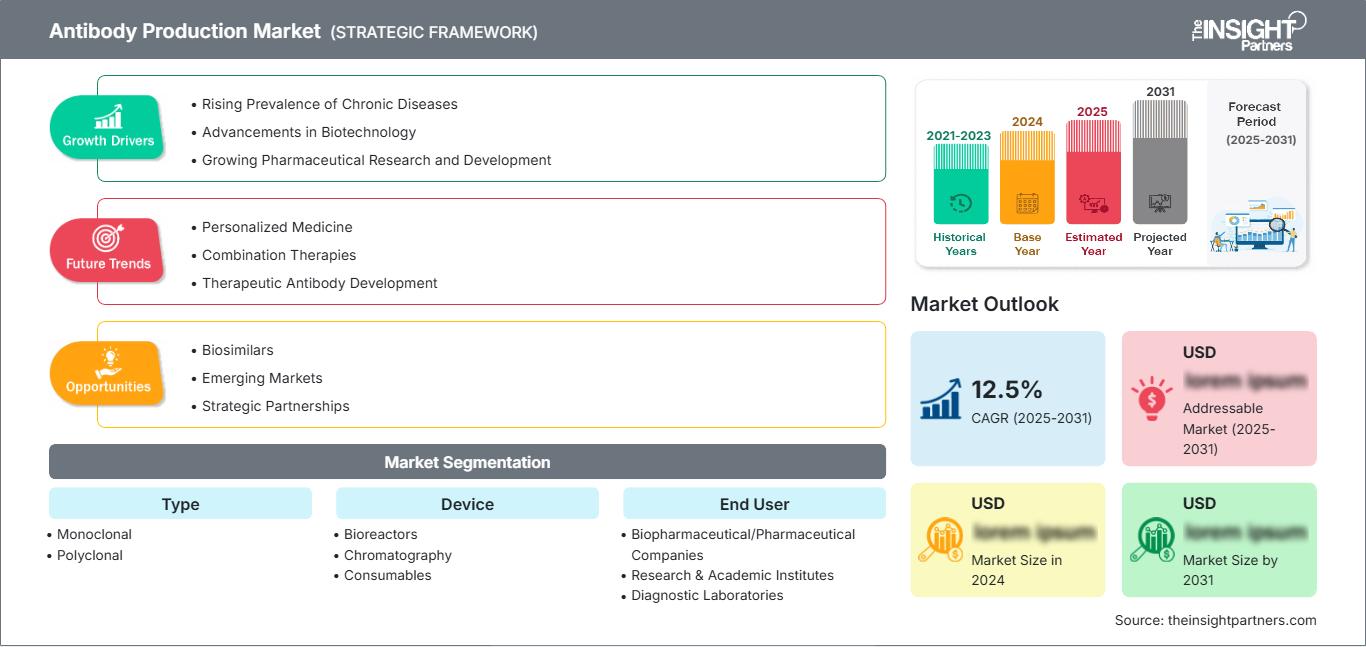
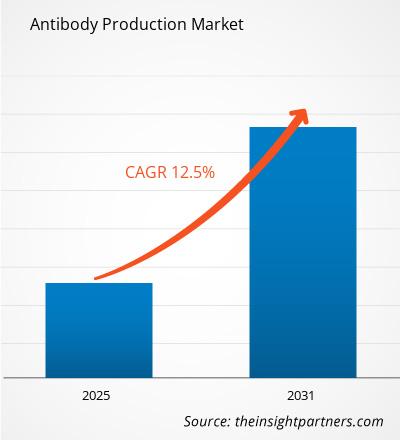
The antibody production market has been estimated at US$ 18.03 billion in 2025 and is expected to achieve US$ 44.93 billion by 2034, growing with a CAGR of 10.68% from 2026 to 2034. Growth factors include increase in antibody-based research, diagnostics, biopharmaceutical pipeline, and investments in expression and purification technologies. This market involves antibody production, upstream culture, downstream purification, analytical operations, and production instrumentation.
North America continues to be a structurally attractive manufacturing and research area, due to presence of biopharmaceutical companies, laboratory facilities, and continuous biologics development. The antibody production market size in North America is forecasted to grow with a CAGR of approximately 9.7–10.6% between 2026 and 2034, owing to growing demand for antibody production using recombinant expression and automation systems.
Antibody Production Market Assessment and Insights
- North America: North America is estimated to hold 38–42% antibody production Market share in 2025, supported by mature biopharmaceutical manufacturing and research infrastructure, and is projected to grow at a 9.7–10.6% CAGR between 2026–2034 as production platforms become increasingly automated.
- US: The US represents approximately 82–86% of North America's 2025 share, with a projected 9.8–10.7% CAGR between 2026–2034, supported by pharmaceutical R&D, biologics manufacturing, and advanced laboratory investment.
- Europe: Europe accounts for approximately 25–29% share in 2025 and is expected to expand at a 9.1–10.0% CAGR between 2026–2034, led by Germany, the UK, France, Switzerland, and Italy through biopharmaceutical manufacturing and academic research.
- Asia Pacific: Asia Pacific represents approximately 20–24% share in 2025, with a 10.8–12.0% CAGR between 2026–2034, led by China, Japan, South Korea, India, and Australia as regional biologics capacity expands.
- Largest Segment: Monoclonal antibodies represent the largest segment, with a 62–68% market share in 2025 and a 10.5–11.4% CAGR between 2026–2034, reflecting stronger reproducibility and therapeutic adoption.
- High Growth Segment: Biopharmaceutical and pharmaceutical companies form the high-growth end-user segment, representing 55–61% share in 2025 and a 11.2–12.1% CAGR between 2026–2034.
- Key companies analyzed in detail: Thermo Fisher Scientific Inc., Merck KGaA, General Electric Company, Eppendorf AG, Abcam plc, F. Hoffmann-La Roche Ltd., Enzo Life Sciences, Inc., Proteintech Group, Inc., Bio-Rad Laboratories, Inc., Novus Biologicals.
Source: The Insight Partners' analysis based on proprietary research, government publications, company annual reports, investor presentations, industry databases, and expert interviews.
Antibody production process technologies have shifted from traditional animal-derived and hybridoma systems to recombinant expression, cell-line engineering, single B-cell technologies, phage display, and increasingly automated screening technologies. Upstream production processes are becoming more controlled through use of mammalian-cell bioreactor production, while downstream production processes are becoming more complex involving Protein A capture, ion-exchange, polishing, filtration, and analytics. Intensified processing such as continuous processing and fed-batch intensification is becoming increasingly important because of its potential advantages in terms of improving facility utilization and minimizing processing disruptions.
The antibody production Market indicates that future expansion will go beyond traditional US and Europe-based manufacturing clusters. Biologics manufacturing capabilities are being strengthened by the following countries: China, South Korea, India, Singapore, and Australia. Biomanufacturing skill training programs being run by WHO in developing nations emphasize the importance of skills training programs. Identity, purity, potency, aggregation, glycosylation, and batch-to-batch consistency regulatory requirements will increasingly favor the use of advanced production technologies.
Antibody Production Market Report Scope
| Report Attribute | Details |
|---|---|
| Market size in 2025 | US$ 18.03 Billion |
| Market Size by 2034 | US$ 44.93 Billion |
| Global CAGR (2026 - 2034) | 10.68% |
| Historical Data | 2021-2024 |
| Forecast period | 2026-2034 |
Antibody Production Market Analysis
Demand is closely linked with the expanding use of antibodies in therapeutics, diagnostics, immunology, oncology, infectious disease research, and life-science workflows. The antibody production market growth is therefore influenced by both clinical pipeline activity and laboratory demand. The value chain begins with antigen preparation and antibody discovery, followed by cell-line development, expression, harvesting, purification, formulation, characterization, and quality control.
The biopharmaceutical industry is seeking more scalable solutions that can seamlessly transition from R&D scale to commercial scale without any modifications to the processes being used. As such, bioreactors, chromatography systems, filtration systems, media, resins, and analytical consumables become components of one linked chain. Competitive advantage no longer lies in the capacity of equipment but in yields, process reproducibility, automation compatibility, and capability to support complex recombinant structures.
Competitive advantage is based both on a wide range of products and expertise in antibodies production. Thermo Fisher Scientific Inc. offers products for production, purification, and laboratories, while Merck KGaA works on bioprocessing, filtration, and chromatography. Bioprocessing background of General Electric Company via its Cytiva division is crucial strategically, while Eppendorf AG has strong competitive positions in laboratories and bioprocess equipment. Abcam plc and Proteintech Group, Inc. focus on antibodies.
F. Hoffmann-La Roche Ltd., Bio-Rad Laboratories, Inc., Enzo Life Sciences, Inc., and Novus Biologicals strengthen the competitive environment through antibody portfolios, analytical solutions, research applications, or specialized production capabilities. Investment is increasingly directed toward automation, single-use systems, process analytical technology, and digital manufacturing. Suppliers able to connect discovery-scale workflows with reproducible production and characterization can capture greater value across the development lifecycle.
● REPORT CUSTOMIZATION
Tailor This Report To Align With Your Specific Business Requirements
This report can be customized to align precisely with your business objectives, scope, and target markets. Customization options include tailored segmentation, geography, competitive analysis, and strategic insights to support informed decision-making.
Customize This Report →WHAT YOU CAN ADJUST
- ● Segmentations
- ● Geography
- ● Competitive Analysis
- ● Language Preferences
Antibody Production Market: Strategic Insights
Regional Insights
North America antibody production market
North America holds 38–42% share in 2025 and is projected to grow at a 9.7–10.6% CAGR through 2034. The US dominates regional activity because of its concentration of pharmaceutical companies, biotechnology firms, academic institutions, and specialized suppliers. Demand is supported by antibody therapeutics, translational research, diagnostics, and contract development activity.
Canadian participation includes academics working on research, biotechnology clusters, and bio-manufacturing projects, although its commercial level is not as high as that of the US. Local consumers are also becoming more demanding with respect to automation of cell culture, capacity of chromatography, single-use bioreactors, and digital monitoring. Good regulations for biologics manufacturing also drive investment in reproducibility of analytics.
U.S. antibody production Market
The US represents 82–86% of North America's 2025 share and is projected to grow at a 9.8–10.7% CAGR through 2034. Its position reflects extensive biopharmaceutical R&D, a large clinical development pipeline, advanced manufacturing infrastructure, and established suppliers including Thermo Fisher Scientific Inc., Merck KGaA, Bio-Rad Laboratories, Inc., and F. Hoffmann-La Roche Ltd.
Therapeutic antibodies account for substantial commercial demand, while research antibodies support proteomics, immunology, oncology, and translational studies. Government and industry efforts to strengthen domestic pharmaceutical manufacturing are also encouraging investment in local production capacity. The application mix increasingly favors recombinant monoclonal platforms, automated screening, intensified culture, and higher-throughput purification.
Europe antibody production Market
Europe represents a 25-29% market share in 2025, and is projected to experience growth at a 9.1-10.0% CAGR from 2026 to 2034, with Germany being the leading national market. Other countries such as the United Kingdom and Switzerland are key players in research and manufacturing, due to the well-developed ecosystem of the pharmaceutical industry and biotechnology.
Germany features advanced manufacturing capacities, research institutes and industrial bioprocessing facilities. The United Kingdom offers innovation in biotechnology along with research and contract development. France, Italy and Spain provide contributions in pharmaceutical manufacturing, diagnostic, clinical research, and university-based antibody initiatives. Increasing emphasis in Europe on reproducibility, compliance, automation and facility utilization can be observed.
APAC antibody production Market
APAC represents 20–24% share in 2025 and is expected to grow at a 10.8–12.0% CAGR through 2034. China is the leading regional market, followed by Japan and South Korea, while India and Australia provide expanding research and manufacturing opportunities. Regional growth reflects increasing biologics investment and infrastructure development.
Chinese firms are ramping up their domestic antibodies production, while South Korea is increasing its bio manufacturing facilities. Japanese organizations have excellent pharmaceutical and academic infrastructure. India has gained through increased investments in biopharmaceutical research and manufacturing, and Australia through translational research.
Middle East & Africa antibody production Market
MEA represents an up-and-coming production location, with Saudi Arabia being the focus for regional investments. The MEA region is expected to experience a growth rate of 8.2%-9.4% CAGR until 2034, driven by healthcare localization, biotech programs, and infrastructure development.
The UAE is building its life sciences capacity via advanced healthcare and research facilities, and South Africa continues to be an important research and diagnostic center. The RoMEA market will be stimulated by healthcare upgrades and aspirations for local manufacturing. Availability of energy and investments into specialized laboratory infrastructure offer production platform potential despite labor depth and regulatory issues.
Segmentation Analysis
Type
Type segmentation is led by Monoclonal antibodies and is projected to grow at a 10.5–11.4% CAGR between 2026–2034. Recombinant expression, defined specificity, stronger batch consistency, and extensive therapeutic and diagnostic applications support continued investment. Polyclonal antibodies remain important where multi-epitope recognition, robust signal generation, or research-specific requirements create advantages.
- Monoclonal: Monoclonal antibodies hold the dominant position because recombinant production enables reproducible characteristics, scalable manufacturing, engineered formats, and broad therapeutic, diagnostic, and research applications across major disease areas.
- Polyclonal: Polyclonal antibodies retain demand in research and diagnostic workflows where recognition of multiple epitopes can improve sensitivity, particularly when target variability or low-abundance proteins complicate single-epitope detection.
Device
Device is expected to expand at a 10.1–11.0% CAGR between 2026–2034, supported by production-scale requirements and increasing process automation. Bioreactors form the upstream foundation, while chromatography platforms and consumables support purification, process intensification, and reproducible downstream processing. Increasing use of single-use technologies is reshaping procurement priorities.
- Bioreactors: Bioreactors provide controlled environments for cell growth and antibody expression, with demand shifting toward scalable single-use and intensified systems that reduce cleaning requirements and support flexible production.
- Chromatography: Chromatography remains essential for antibody capture and polishing, with buyers emphasizing high binding capacity, selectivity, process consistency, and compatibility with increasingly continuous purification workflows.
- Consumables: Consumables support recurring production requirements across culture, filtration, purification, and analytical workflows, creating predictable replacement demand and encouraging suppliers to develop integrated product portfolios.
End User
End User is forecast to grow at a 10.7–11.6% CAGR between 2026–2034. Biopharmaceutical and pharmaceutical companies represent the largest demand center because therapeutic antibodies require scalable, validated manufacturing systems. Research institutes and diagnostic laboratories provide additional demand through discovery and testing, while technology suppliers increasingly tailor systems to different production scales.
- Biopharmaceutical/Pharmaceutical Companies: These organizations generate the strongest demand for scalable production platforms, purification systems, analytical technologies, and consumables because antibody pipelines require reproducible processes from development through commercial manufacturing.
- Research & Academic Institutes: Academic laboratories prioritize flexible, smaller-scale systems for antibody discovery, recombinant expression, screening, and characterization, making modular equipment and research-grade consumables particularly important.
- Diagnostic Laboratories: Diagnostic laboratories use antibodies across immunoassays, pathology, infectious-disease testing, and biomarker workflows, supporting continued demand for reliable antibody reagents and standardized production.
Opportunity Snapshot
| Segment Name | Revenue Contribution (High/Medium/Low) | Trend Tag | Adoption Stage |
|---|---|---|---|
| Biopharmaceutical/Pharmaceutical Companies | High | Process Scale-up | Mature |
| Research & Academic Institutes | Medium | Recombinant Screening | Scaling |
| Diagnostic Laboratories | Medium | Assay Expansion | Mature |
Antibody Production Market Growth Drivers and Impact Analysis
Expansion of recombinant and engineered antibody platforms
Recombinant antibody technology is changing production economics by improving sequence control, batch consistency, and scalability. Compared with traditional polyclonal approaches, recombinant monoclonal production enables manufacturers to preserve defined molecular characteristics while supporting engineering into humanized, bispecific, multispecific, and fragment formats. This expands the addressable production requirement beyond conventional antibody molecules. The commercial impact is strongest for suppliers of expression systems, cell-culture media, bioreactors, purification technologies, and analytical tools. Production organizations also benefit from better continuity because sequence-defined products are less exposed to biological variability. As engineered formats become more complex, manufacturers require tighter control of aggregation, glycosylation, charge variants, and potency, increasing demand for integrated upstream, downstream, and characterization technologies.
Rising biopharmaceutical manufacturing intensity
Increasing investment in biologics pipelines is raising the need for flexible production capacity and process-development infrastructure. Antibody programs generate demand across discovery, preclinical studies, clinical manufacturing, technology transfer, scale-up, and commercial production rather than at a single manufacturing stage. This broadens revenue opportunities for equipment and consumable suppliers because each development phase requires different production scales and analytical specifications. Manufacturers are consequently investing in modular facilities, single-use systems, intensified processes, and automation to reduce changeover requirements. The market impact is particularly relevant for suppliers that can serve both laboratory-scale development and larger production environments. Greater manufacturing intensity also increases the importance of process standardization, data integrity, equipment interoperability, and quality systems throughout the production lifecycle.
Need for higher productivity and process reproducibility
Manufacturers face pressure to increase antibody yield while controlling cost, variability, and facility utilization. Process optimization is therefore becoming a central purchasing criterion for bioreactors, chromatography systems, sensors, filtration platforms, and associated consumables. Fed-batch optimization, continuous processing, high-throughput experimentation, and process analytical technologies can reduce bottlenecks and improve consistency when appropriately integrated. Higher productivity also allows organizations to use existing facilities more efficiently rather than relying exclusively on additional physical capacity. For suppliers, this shifts competition from individual equipment specifications toward complete workflow performance. Companies capable of connecting upstream control, downstream purification, automation, and analytics can provide measurable operational benefits, particularly for manufacturers managing multiple antibody programs with different titers, batch sizes, product characteristics, and regulatory requirements.
Antibody Production Market Future Trends
AI-enabled antibody design and production optimization
AI is expected to increasingly influence antibody development by linking sequence design, developability assessment, expression prediction, and process optimization. Computational models can prioritize candidates before extensive laboratory testing, reducing the number of experimental iterations required during discovery. In production, machine-learning systems can analyze culture parameters, metabolite profiles, and historical batches to identify relationships affecting yield and product quality. The antibody production market trends will therefore increasingly connect discovery data with manufacturing data rather than treating them as separate workflows. Over time, digital twins, predictive maintenance, automated experimentation, and adaptive process control could enable production systems to adjust operating parameters more rapidly. Commercial adoption will depend on data quality, model validation, cybersecurity, interoperability, and regulatory acceptance.
Greater adoption of continuous and intensified manufacturing
Continuous and intensified manufacturing is expected to gain traction as producers seek better facility utilization and shorter processing cycles. Rather than relying exclusively on traditional batch operations, manufacturers can combine intensified upstream culture with continuous clarification, chromatography, filtration, and real-time monitoring. Such architectures can reduce intermediate holding requirements and potentially improve consistency when process controls are sufficiently mature. The shift is particularly relevant for smaller biotechnology companies seeking flexible manufacturing footprints and for established producers managing multiple products within the same facility. Equipment suppliers will increasingly compete on modularity, automation, process integration, and data connectivity. Adoption is likely to remain gradual because validation, regulatory strategy, workforce capabilities, and integration with existing batch infrastructure must be addressed before continuous approaches become standard.
Antibody Production Market Opportunities
Localized biomanufacturing capacity in emerging economies
Emerging economies present an opportunity for suppliers to establish localized antibody production ecosystems combining equipment, training, technical services, and process-development capabilities. India, China, South Korea, and selected Middle Eastern markets are increasing investment in biotechnology infrastructure, while workforce development programs are addressing shortages in specialized manufacturing skills. The antibody production market Forecasts therefore point toward a more geographically diversified production base. Suppliers can pursue growth through modular bioreactors, chromatography systems, single-use assemblies, and laboratory-scale development platforms that can be expanded as production demand increases. Partnerships with universities, pharmaceutical manufacturers, government-supported biotechnology centers, and contract organizations can improve market access. The strongest opportunity lies in integrated solutions that combine technology deployment with workforce training and process-transfer support.
Integrated platforms for discovery-to-production workflows
An additional opportunity exists in connecting antibody discovery, screening, expression, purification, and characterization within integrated workflows. Many organizations still operate these stages through separate instruments, software environments, and suppliers, creating data-transfer and reproducibility challenges. Vendors can differentiate by combining automated liquid handling, cell culture, chromatography, analytical characterization, and laboratory information management into connected workflows. Such integration can shorten development cycles and reduce manual intervention while improving traceability. The opportunity is particularly relevant to biotechnology companies with limited internal infrastructure and academic centers seeking translational capabilities. Strategic investment should focus on interoperability, scalable architecture, standardized data structures, and validated automation rather than isolated instruments. Suppliers that demonstrate measurable reductions in hands-on time and process variability can strengthen long-term customer relationships.
Recent Developments
- August 2026: Thermo Fisher Scientific Inc. indicated plans to expand its India customer base by 15–20% over the next five years, supported by increasing biopharmaceutical research and manufacturing activity. The company reported more than 5,000 employees in India and identified the country as an important Asia Pacific growth market for laboratory and manufacturing solutions.
- June 2025: Merck KGaA received US FDA approval for clesrovimab, an extended-use monoclonal antibody for prevention of RSV disease in infants. The approval expanded the commercial application of antibody-based preventive medicine and reinforced the importance of scalable antibody development, characterization, and manufacturing capabilities for infectious-disease applications.
- July 2025: World Health Organization announced a hands-on antibody manufacturing training program through its Global Training Hub for Biomanufacturing in the Republic of Korea. The program covers antibody development, manufacturing, quality management, and regulatory activities, demonstrating continued international emphasis on expanding skilled biomanufacturing capacity.
Frequently Asked Questions

- Comprehensive Market Sizing and Forecast Analysis
- Detailed Segmentation Analysis
- In-Depth Market Dynamics Assessment
- Regional and Country-Level Insights
- Competitive Landscape and Company Benchmarking
- Strategic Business Intelligence
Recent Reports
Testimonials

The Insight Partners provided valuable market intelligence that supported our global go-to-market strategy. Their team was professional, responsive, and attentive to our feedback, providing thoughtful analysis and helpful methodological clarifications throughout the project.
Junmo Kim Chief Financial Officer (CFO), Enertech Co., Ltd.
The Insight Partners' SCADA System Market report is comprehensive, with valuable insights on current trends and future forecasts. The team was highly professional, responsive, and supportive throughout. We are very satisfied and highly recommend their services.
RAN KEDEM Partner, Reali Technologies LTDs
I requested a report on a very specific software market and the team produced the report in a few days. The information was very relevant and well presented. I then requested some changes and additions to the report. The team was again very responsive and I got the final report in less than a week.
JEAN-HERVE JENN Chairman, Future Analytica
We worked with The Insight Partners for an important market study and forecast. They gave us clear insights into opportunities and risks, which helped shape our plans. Their research was easy to use and based on solid data. It helped us make smart, confident decisions. We highly recommend them.
PIYUSH NAGPAL Sr. Vice President, High Beam Global
The Insight Partners delivered insightful, well-structured market research with strong domain expertise. Their team was professional and responsive throughout. The user-friendly website made accessing industry reports seamless. We highly recommend them for reliable, high-quality research services
YUKIHIKO ADACHI CEO, Deep Blue, LLC.
This is the first time I have purchased a market report from The Insight Partners.While I was unsure at first, I visited their web site and felt more comfortable to take the risk and purchase a market report.I am completely satisfied with the quality of the report and customer service. I had several questions and comments with the initial report, but after a couple of dialogs over email with their analyst I believe I have a report that I can use as input to our strategic planning process.Thank you so much for taking the extra time and making this a positive experience.I will definitely recommend your service to others and you will be my first call when we need further market data.
JOHN SUZUKI President and Chief Executive Officer, Board Director, BK Technologies
I wish to appreciate your support and the professionalism you displayed in the course of attending to my request for information regarding to infectious disease IVD market in Nigeria. I appreciate your patience, your guidance, and the fact that you were willing to offer a discount, which eventually made it possible for us to close a deal. I look forward to engaging The Insight Partners in the future, all thanks to the impression you have created in me as a result of this first encounter.
DR CHIJIOKE ONYIA MANAGING DIRECTOR, PineCrest Healthcare Ltd.Reason to Buy
- Informed Decision-Making
- Understanding Market Dynamics
- Competitive Analysis
- Identifying Emerging Markets
- Customer Insights
- Market Forecasts
- Risk Mitigation
- Boosting Operational Efficiency
- Strategic Planning
- Investment Justification
- Tracking Industry Innovations
- Aligning with Regulatory Trends





 Get Free Sample for