
Antiseptic And Disinfectant Market Size, Trends & Growth by 2034
Antiseptic And Disinfectant Market Size and Forecasts (2021–2034), Global and Regional Share, Trends, and Growth Opportunity Analysis Report Coverage : by Type (Quaternary Ammonium Compounds); Product (Enzymatic Cleaners); Sales Channel (Fmcg, B2B); End User (Hospitals, Clinics); and Geography (North America, Europe, Asia Pacific, and South and Central America)
- Status : Data Released
- Report Code : TIPRE00040689
- Category : Life Sciences
- No. of Pages : 150
- Available Report Formats :


- Last update date : August 21, 2026


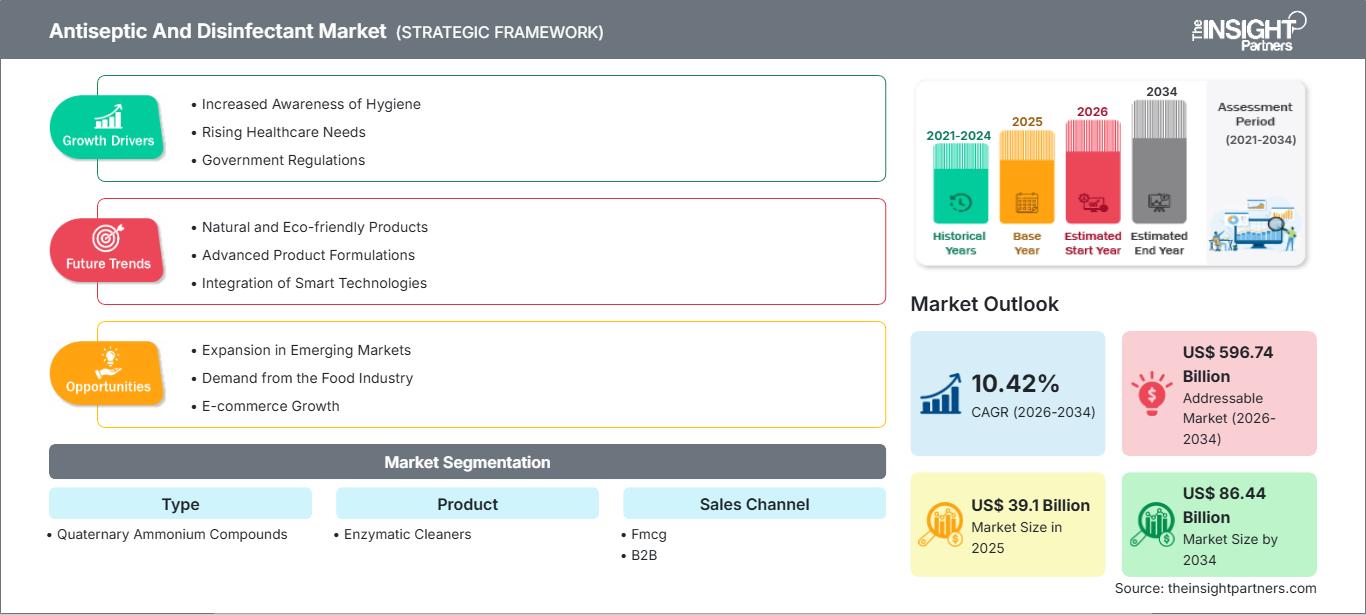
2025 Market Size
US$ 39.1 Bn
Base year value
2034 Forecast
US$ 86.44 Bn
Projected by 2034
CAGR 2026-2034
10.42 %
Growth rate
Addressable Market
US$ 596.74 Bn
(2026-2034)
The antiseptic and disinfectant market is placed at the crossroads of infection control in the healthcare industry, household hygiene, institutional sanitation, and surface decontamination. The market size is expected to be US$ 39.1 billion in 2025 and will grow to US$ 86.44 billion by 2034, growing at a CAGR of 10.42% between 2026 and 2034.
North America is predicted to have a structurally robust position with an anticipated CAGR of 9.6-10.6% in 2026-2034. Antiseptics are widely used in hospital-based infection prevention programs, and there are regulatory mandates for using antimicrobial products and the need for replacement of ready-to-use wipes, sprays, and surface cleaners. In North America, there is also an efficient procurement system and high institutional expenditure on environmental hygiene. Quaternary ammonium compounds are known to be used in healthcare facilities as disinfectants according to CDC guidelines, and product registration also helps formulate antiseptic products.
Antiseptic And Disinfectant Market Assessment and Insights
- North America: North America is estimated to account for a 31–35% antiseptic and disinfectant Market share in 2025 and grow at a CAGR of 9.6–10.6% between 2026–2034, supported by hospital infection-control programs, regulatory oversight, and established institutional procurement.
- US: The US represents approximately 78–82% of North America's 2025 share and is expected to expand at a 9.5–10.5% CAGR during 2026–2034, led by healthcare and institutional consumption.
- Europe: Europe is estimated to hold a 26–30% share in 2025 and grow at a CAGR of 9.8–10.8% through 2034, with Germany, the UK, France, Italy, and Spain supporting demand through healthcare standards and hygiene procurement.
- Asia Pacific: Asia Pacific is estimated at a 28–32% share in 2025 and is projected to grow at a CAGR of 11.2–12.2%, led by China, India, Japan, South Korea, and Australia as healthcare capacity and consumer hygiene adoption expand.
- Largest Segment: Quaternary Ammonium Compounds is estimated to command a 32–36% market share in 2025 and grow at a CAGR of 9.8–10.8%, reflecting broad surface-disinfection use.
- High Growth Segment: B2B is estimated to represent a 47–51% share in 2025 and expand at a CAGR of 10.6–11.6%, supported by institutional procurement and recurring professional consumption.
- Key companies analyzed in detail: Reckitt Benckiser Group plc, The Procter & Gamble Company, Unilever PLC, Johnson & Johnson, SC Johnson & Son, Inc., Kimberly-Clark Corporation, Diversey Holdings, Ltd., Henkel AG & Co. KGaA, The Clorox Company, 3M Company.
Source: The Insight Partners' analysis based on proprietary research, government publications, company annual reports, investor presentations, industry databases, and expert interviews.
The development of the antiseptic and disinfectant market involves the transition from standard liquid products to concentrated solutions, spray disinfectants, pre-saturated wipes, foam, and other formulations. The importance of quaternary ammonium compounds is determined by their compatibility with cleaning and wide application to non-critical surfaces, whereas hydrogen peroxide, alcohols, chlorine compounds, and peracetic acid are used for different needs of microbe control. CDC recommends selecting and using the products according to their labels since disinfectants are intended for certain purposes.
In the next stage, the key priorities will include safety, sustainability, convenience, and efficacy of the formulations for specific applications. Growing expenditures on hygiene among hospitals, clinics, food service providers, and households are expected to stimulate the development of emerging Asian markets. Increased regulatory interest in products with higher evidence of efficacy and responsibility of use is expected as well. Infection prevention and control remains the main issue of WHO, especially in areas with numerous healthcare associated infections.
Antiseptic And Disinfectant Market Report Scope
| Report Attribute | Details |
|---|---|
| Market size in 2025 | US$ 39.1 Billion |
| Market Size by 2034 | US$ 86.44 Billion |
| Global CAGR (2026 - 2034) | 10.42% |
| Historical Data | 2021-2024 |
| Forecast period | 2026-2034 |
Antiseptic And Disinfectant Market Analysis
Demand in the antiseptic and disinfectant Market is driven by continuous prevention of infection rather than sporadic outbreak consumption. The antiseptics and disinfectants market growth is driven by continuous need for hospitals, clinics, laboratories, food processing facilities, hospitality, office and household use. According to WHO, of 100 patients in acute care hospitals in high-income countries, seven have acquired at least one health care-associated infection, while in low- and middle-income countries 15 out of 100 do.
According to the antiseptic and disinfectant Market report, the value chain includes active ingredient suppliers, formulation suppliers, packagers, distributors, institutional buying agents, retail, and online distribution. Manufacturing companies compete on effectiveness, contact times, material compatibility, packaging convenience, and regulatory documentation. Market supply remains sensitive to the cost of chemicals used, availability of packaging, transportation fees, and regional manufacturing capability. Specialized formulations require more testing and registration than common household cleaning formulations.
Competitive landscape consists of global consumer health players as well as specialized institutional hygiene vendors. Reckitt Benckiser Group plc is using Dettol and Lysol hygiene expertise, while Unilever PLC is competing using brands and forms associated with surface hygiene. The Procter & Gamble Company has a robust consumer network, while Kimberly-Clark Corporation and 3M Company compete using healthcare and professional hygiene ecosystems. Diversey Holdings, Ltd. has a more institutional focus, especially in terms of professional cleaning and infection control.
Strategic positioning is increasingly based on premiumization, formulation for specific applications, and channel penetration, rather than on volumes only. 2025 reports of Reckitt include sustainability and innovation within Dettol brand, while 2026 brand strategy of Reckitt demonstrates growing interest to plant-based positioning and local consumer propositions. 2025 reports of Unilever also reveal the momentum in Home & Hygiene division due to innovations like Domestos and Cif.
● REPORT CUSTOMIZATION
Tailor This Report To Align With Your Specific Business Requirements
This report can be customized to align precisely with your business objectives, scope, and target markets. Customization options include tailored segmentation, geography, competitive analysis, and strategic insights to support informed decision-making.
Customize This Report →WHAT YOU CAN ADJUST
- ● Segmentations
- ● Geography
- ● Competitive Analysis
- ● Language Preferences
Antiseptic And Disinfectant Market: Strategic Insights
Regional Insights
North America antiseptic and disinfectant market
North America is projected to account for 31-35% of the worldwide market in 2025 and is set to experience a CAGR of 9.6-10.6% between 2025 and 2034. The region is characterized by an advanced system of hospitals' purchases, established infection control departments, and widespread utilization of disinfectants in healthcare, food service, hospitality and institutional sectors. Also, regulations in the US facilitate the registration and labeling process of the antimicrobial products. According to CDC recommendations, quaternary ammonium compounds, alcohols, and chlorine releasing agents are some of the common environmental disinfectants.
The preference of ready-to-use wipes, low residue products, and solutions that are compatible with medical devices and high contact surfaces is on the increase. In this regard, hospitals continue to be an important customer since environmental cleaning is part of the infection control measures. While Canada's contribution lies in its hospital and public health purchases, the US emerges as the major consumption center in North America.
U.S. antiseptic and disinfectant Market
The US constitutes about 78–82% of the North American 2025 market. The antiseptic and disinfectant Market size in this region is expected to grow at a CAGR of 9.5–10.5% over 2026–2034. Diversified demand comes from hospitals, clinics, laboratories, homes, food service, education, and commercial sectors. EPA registration is critical for surface antimicrobial products, whereas FDA regulation pertains to specific antiseptic and high-level disinfection segments.
Companies like Reckitt Benckiser Group plc, Johnson & Johnson, The Clorox Company, 3M Company, Kimberly-Clark Corporation, and SC Johnson & Son, Inc. already have experience within the pertinent consumer, healthcare, or professional hygiene segments. Trends for product applications are moving towards easy-to-use wipes, sprays, and pre-measured solutions that eliminate mistakes related to dilutions and facilitate environmental cleaning.
Europe antiseptic and disinfectant Market
Europe has been predicted to have a 26-30% share in 2025 and grow at a 9.8-10.8% CAGR until 2034. Germany, the United Kingdom, France, Italy, and Spain are the major markets within Europe. Maturity of health care system, strict hygiene standards, and professional cleaning distribution channels create solid demand base. There are also continuous expenses on healthcare associated infections in European hospitals, which makes environmental cleaning and control of infections crucial for their activities. WHO reports high HAI burden in European healthcare institutions.
In the UK, demand for cleaning products is maintained through healthcare procurement and professional cleaning. In Germany, there are well-developed healthcare infrastructure and professional cleaning practices. France, Italy, and Spain combine hospital demand and consumer hygiene products, while hospitality and food service segments create recurring commercial demand. In Europe, manufacturers tend to focus on concentrated formulas, reduced packaging, responsible choice of chemicals, and premium formulations. Compliance with regulations and proven efficacy become core buying criteria for professional customers.
APAC antiseptic and disinfectant Market
In 2025, Asia Pacific region is predicted to contribute 28%-32% to the global market and register a CAGR of 11.2%-12.2% till 2034. Leading the regional demand are China, Japan, South Korea, India, and Australia. Increasing healthcare infrastructure, urbanization, higher awareness of hygiene at homes, and growing sanitation demands at institutions will fuel the demand for hygiene products. WHO's India project will continue to focus on infection prevention and control capabilities of India.
While China is witnessing rising consumer demand along with increased preferences for differentiated formulations, India will continue to be highly promising in the long run due to its expanding healthcare sector and availability of branded hygiene products. Quality and performance of formulations would remain the key concerns in Japan and South Korea, whereas Australia's healthcare and institutional procurement infrastructure is quite mature.
Middle East & Africa antiseptic and disinfectant Market
It is anticipated that Middle East and Africa will witness an 8.8–9.8% CAGR till 2034, with Saudi Arabia accounting for one of the major markets in the region. Demand in UAE is bolstered by healthcare facilities, hospitality, aviation and other commercial infrastructures, whereas South Africa offers relatively developed healthcare facilities as well as retail environment. Markets from the Rest-of-MEA region are more fragmented but hold growth potential as the healthcare infrastructure develops.
Infrastructures for the energy sector, hotels, airports, schools and hospitals will require professional cleaning services on a recurring basis. Investments in healthcare and infrastructure in Saudi Arabia will help meet institutional demands, whereas procurement practices in UAE focus on quality and certification of the hygiene products. South Africa offers retail and professional channels both. In lower-income markets, affordability, availability and proper use become even more important than premium positioning.
Segmentation Analysis
Drug Class
Quaternary Ammonium Compounds are a major product category, with an estimated 9.8–10.8% CAGR during 2026–2034. Their broad use on noncritical surfaces, compatibility with routine environmental sanitation, and availability in wipes, sprays, and ready-to-use formulations support adoption. CDC identifies quaternary compounds as widely used disinfectants, while also noting limitations against certain organisms and the importance of correct formulation and application.
- Quaternary Ammonium Compounds: These formulations remain strategically important for routine environmental sanitation because they combine cleaning properties with antimicrobial activity and can be incorporated into multiple convenient professional and consumer formats.
Product
Enzymatic Cleaners are expected to expand at a 10.8–11.8% CAGR during 2026–2034. Their strategic relevance comes from cleaning before disinfection, especially where organic material can reduce disinfectant effectiveness. Hospitals and specialized facilities increasingly value products that support standardized cleaning workflows and reduce manual variability. CDC guidance explicitly states that disinfectants should generally follow cleaning and removal of organic material unless the formulation combines both functions.
- Enzymatic Cleaners: These products support pre-cleaning workflows by breaking down biological residues, making them relevant to healthcare, laboratory, dental, and specialized institutional environments where cleaning quality affects subsequent disinfection.
Sales Channel
FMCG and B2B channels are expected to grow at 9.7–10.7% and 10.6–11.6%, respectively, during 2026–2034. B2B purchasing benefits from recurring institutional consumption and contract-based procurement, while FMCG demand is driven by household penetration, brand familiarity, convenience, and retail accessibility. Channel strategy therefore requires different pack sizes, pricing structures, and product claims.
- FMCG: Retail-led consumption emphasizes brand trust, convenient pack formats, household applications, promotional visibility, and accessible pricing across supermarkets, convenience stores, and digital commerce.
- B2B: Institutional purchasing prioritizes efficacy documentation, cost per use, supply reliability, dispenser or equipment compatibility, training, and standardized procurement across hospitals and commercial facilities.
End User
Hospitals and Clinics are expected to grow at 9.9–10.9% and 10.0–11.0%, respectively, during 2026–2034. Hospitals generate high-frequency consumption because cleaning and disinfection are embedded across patient-care areas, operating rooms, laboratories, and shared equipment. Clinics represent a decentralized opportunity, particularly where outpatient procedures and infection-prevention requirements increase.
- Hospitals: Hospitals represent a strategically important end-user group because environmental cleaning affects patient safety, staff protection, equipment handling, and compliance with institutional infection-prevention protocols.
- Clinics: Clinics require compact, easy-to-use formulations for examination rooms, treatment areas, instruments, and high-touch surfaces, creating demand for convenient products with clear application instructions.
Opportunity Snapshot
| Segment Name | Revenue Contribution (High/Medium/Low) | Trend Tag (MAX 2 words) | Adoption Stage (Emerging/Scaling/Mature) |
| Hospitals | High | HAI Prevention | Mature |
| Clinics | Medium | Point Cleaning | Scaling |
Antiseptic And Disinfectant Market Growth Drivers and Impact Analysis
Persistent healthcare-associated infection prevention requirements
There continues to be an ongoing need for environmental sanitizing regardless of whether epidemic conditions are returned to normal due to HAI problems. According to WHO, seven out of every 100 patients in high-income countries and 15 out of 100 patients in low- and middle-income countries suffer from HAI in acute-care hospitals. As a result, there is consistent need for disinfectants, antiseptics, surface wipes, cleaning agents, and hand-hygiene products. The impact on the commercial environment is felt most strongly in hospitals that have programs to prevent infection, since procurement in such institutions depends on standardized procedure rather than discretionary household purchases. In addition, manufacturers who demonstrate the effectiveness of their products along with contact times and compatibility with medical surfaces can bolster their market position.
Expansion of institutional hygiene beyond acute-care hospitals
Cleaning requirements are spreading across clinics, long-term care facilities, laboratories, hospitality venues, food-service operations, schools, transportation facilities, and workplaces. This broadening creates multiple demand pools with different performance requirements, allowing suppliers to segment formulations by application rather than compete solely on price. Clinics increasingly need compact formats and rapid turnaround products, while hospitality and commercial facilities prioritize cost per treated surface and operational simplicity. Food-service customers emphasize approved applications and residue management. The resulting diversification reduces dependence on any single end-user segment and supports recurring professional sales. Companies with broad distribution networks can cross-sell products across institutional accounts, while specialized suppliers can compete through workflow design, training, dispensing systems, and technical support. WHO's IPC framework reinforces the importance of integrating hygiene practices throughout healthcare environments.
Consumerization of hygiene and premium formulation differentiation
Household consumers increasingly evaluate hygiene products through efficacy, convenience, scent, ingredients, packaging, and perceived safety rather than price alone. This supports premium formats such as ready-to-use sprays, wipes, foams, and formulations positioned around gentler or plant-derived ingredients. Reckitt's recent Dettol initiatives illustrate this shift, including localized innovation in China and renewed emphasis on botanical positioning. Such developments can expand category usage by connecting germ protection with broader wellbeing rather than restricting products to illness or cleaning events. Manufacturers therefore have an opportunity to increase value per household through differentiated claims, smaller trial packs, refill concepts, and digital education while retaining mass-market alternatives.
Antiseptic And Disinfectant Market Future Trends
Botanical and lower-impact formulation platforms
The antiseptic and disinfectant market trends are moving toward formulations that balance antimicrobial efficacy with consumer expectations around ingredient transparency, environmental impact, odor, residue, and skin compatibility. Future product development is likely to emphasize plant-derived adjuncts, concentrated formats, lower packaging intensity, and formulations that reduce unnecessary chemical exposure without compromising validated efficacy. Reckitt's Dettol innovation in China demonstrates how botanical positioning can create incremental relevance around established germ-protection brands. Similar strategies may emerge across household and institutional categories as retailers and procurement teams strengthen sustainability criteria. The commercial opportunity will depend on evidence rather than marketing language: suppliers must demonstrate microbial performance, material compatibility, stability, and regulatory compliance. This will favor companies capable of combining formulation science, testing infrastructure, packaging engineering, and consumer communication into commercially scalable platforms.
Digitized institutional cleaning and controlled-use systems
Future procurement models are likely to connect chemical products with dispensing, dosing, inventory, training, and usage-monitoring systems. Hospitals and large facilities can reduce waste and improve consistency when concentrates are automatically diluted or when ready-to-use products are supplied through controlled distribution. Digital purchasing platforms can further integrate consumption data with replenishment schedules, allowing suppliers to shift from transactional product sales toward managed hygiene programs. Such systems can also improve accountability because staff receive standardized products and instructions for specific surfaces or applications. Over time, data from procurement and usage systems may influence product design, packaging sizes, and contract structures. The transition will be strongest among large hospitals, hotel groups, food-service chains, and facility-management providers, where standardized operations make technology-enabled hygiene programs economically practical.
Antiseptic And Disinfectant Market Opportunities
Localized manufacturing and distribution in high-growth Asia Pacific markets
The antiseptic and disinfectant market Forecasts indicate attractive strategic potential in Asia Pacific, particularly where healthcare infrastructure, urbanization, and consumer hygiene adoption are expanding simultaneously. Manufacturers can establish local filling and packaging operations, regional distribution partnerships, or contract manufacturing arrangements to reduce logistics costs and improve availability. India and China offer particularly broad application pools across household, healthcare, institutional, and commercial users. Localized production can also support pack-size adaptation, regional pricing, language-specific labeling, and faster product launches. Companies entering these markets should prioritize regulatory mapping, domestic active-ingredient sourcing, and partnerships with hospital distributors and modern retail chains. The strongest strategy is likely to combine mass-market products with professional formulations, allowing manufacturers to capture volume while gradually developing higher-value institutional relationships.
Integrated hygiene contracts for hospitals and multi-site institutions
Suppliers can increase customer retention by combining disinfectants, antiseptics, cleaning products, dispensing equipment, training, inventory management, and technical support into multi-year institutional contracts. The approach creates an opportunity to move beyond individual product tenders and establish standardized hygiene protocols across hospital networks, clinics, laboratories, universities, and hospitality groups. Procurement managers benefit from consolidated ordering, consistent specifications, and improved supply visibility, while manufacturers gain recurring revenue and better demand forecasting. Companies with broad portfolios are particularly positioned to develop these models because they can cover multiple cleaning stages and applications. Strategic execution should focus on measurable service outcomes, including correct dilution, usage compliance, product availability, and reduction of avoidable waste. This model can also create defensible relationships in markets where standalone chemical products face significant price competition.
Recent Developments
- March 2026: Reckitt Benckiser Group plc launched a new report on Dettol's regional innovation strategy, highlighting Dettol Activ Botany and its positioning around botanical science and germ protection. The company reported that the product had exceeded forecasts and achieved a 44% share of the TikTok market in the referenced campaign, illustrating the growing role of localized digital innovation in hygiene categories.
- July 2025: The Procter & Gamble Company reported fiscal 2025 results, with net sales of US$84.3 billion and organic sales growth of 2%. Management reiterated its strategy of focused daily-use categories, product superiority, packaging, retail execution, and consumer value, providing a broader commercial context for household and hygiene product portfolio management.
- April 2025: Unilever PLC announced category innovation around Cif, including a cleaning approach using friendly bacteria to address household cleaning needs. The development illustrates continued investment in differentiated cleaning technologies and reflects the broader shift toward innovation-led hygiene propositions rather than reliance solely on conventional chemical formulations.
Frequently Asked Questions

- Comprehensive Market Sizing and Forecast Analysis
- Detailed Segmentation Analysis
- In-Depth Market Dynamics Assessment
- Regional and Country-Level Insights
- Competitive Landscape and Company Benchmarking
- Strategic Business Intelligence
Recent Reports
Testimonials

The Insight Partners' SCADA System Market report is comprehensive, with valuable insights on current trends and future forecasts. The team was highly professional, responsive, and supportive throughout. We are very satisfied and highly recommend their services.
RAN KEDEM Partner, Reali Technologies LTDs
I requested a report on a very specific software market and the team produced the report in a few days. The information was very relevant and well presented. I then requested some changes and additions to the report. The team was again very responsive and I got the final report in less than a week.
JEAN-HERVE JENN Chairman, Future Analytica
We worked with The Insight Partners for an important market study and forecast. They gave us clear insights into opportunities and risks, which helped shape our plans. Their research was easy to use and based on solid data. It helped us make smart, confident decisions. We highly recommend them.
PIYUSH NAGPAL Sr. Vice President, High Beam Global
The Insight Partners delivered insightful, well-structured market research with strong domain expertise. Their team was professional and responsive throughout. The user-friendly website made accessing industry reports seamless. We highly recommend them for reliable, high-quality research services
YUKIHIKO ADACHI CEO, Deep Blue, LLC.
This is the first time I have purchased a market report from The Insight Partners.While I was unsure at first, I visited their web site and felt more comfortable to take the risk and purchase a market report.I am completely satisfied with the quality of the report and customer service. I had several questions and comments with the initial report, but after a couple of dialogs over email with their analyst I believe I have a report that I can use as input to our strategic planning process.Thank you so much for taking the extra time and making this a positive experience.I will definitely recommend your service to others and you will be my first call when we need further market data.
JOHN SUZUKI President and Chief Executive Officer, Board Director, BK Technologies
I wish to appreciate your support and the professionalism you displayed in the course of attending to my request for information regarding to infectious disease IVD market in Nigeria. I appreciate your patience, your guidance, and the fact that you were willing to offer a discount, which eventually made it possible for us to close a deal. I look forward to engaging The Insight Partners in the future, all thanks to the impression you have created in me as a result of this first encounter.
DR CHIJIOKE ONYIA MANAGING DIRECTOR, PineCrest Healthcare Ltd.Reason to Buy
- Informed Decision-Making
- Understanding Market Dynamics
- Competitive Analysis
- Identifying Emerging Markets
- Customer Insights
- Market Forecasts
- Risk Mitigation
- Boosting Operational Efficiency
- Strategic Planning
- Investment Justification
- Tracking Industry Innovations
- Aligning with Regulatory Trends





 Get Free Sample for