
Application Containerization as a Service Market Analysis and Forecast by 2034
Coverage: by Type (Container Monitoring, Security, Data Management, Networking, Orchestration), Deployment Type (On-premise, Cloud), Vertical (BFSI, Telecommunications and IT, Retail, Healthcare, Media and Entertainment, and Others), and Geography (North America, Europe, Asia Pacific, and South and Central America)
- Status : Data Released
- Report Code : TIPRE00003179
- Category : Technology, Media and Telecommunications
- No. of Pages : 150
- Available Report Formats :


- Last update date : August 27, 2026


2025 Market Size
US$ 13.66 Bn
Base year value
2034 Forecast
US$ 78.76 Bn
Projected by 2034
CAGR 2026-2034
21.5 %
Growth rate
Addressable Market
US$ 368.23 Bn
(2026-2034)
The application containerization as a service market is projected to grow from US$ 13.66 Billion in 2025 to US$ 78.76 Billion by 2034, registering a CAGR of 21.5% during 2026–2034. The market reflects rising enterprise reliance on packaged, portable software environments that improve deployment consistency, application scalability, and infrastructure utilization across hybrid and cloud-native architectures.
Across North America, the application containerization as a service market size is supported by mature cloud spending, banking modernization, telecom cloudification, and regulated enterprise migration from virtual machines to Kubernetes-based platforms. The region is estimated to expand at a CAGR of 20–22% during 2026–2034, with demand concentrated around managed orchestration, container security, observability, and policy-driven deployment automation.
Application Containerization as a Service Market Assessment and Insights
- North America held 37–40% share in 2025 and is growing at a CAGR of 20–22% during 2026–2034, supported by hyperscale cloud adoption, regulated workload modernization, and mature DevSecOps programs across BFSI, healthcare, retail, and telecom enterprises.
- US accounted for 78–82% of North America in 2025 and is growing at a CAGR of 20–22% during 2026–2034, driven by public cloud leadership and enterprise platform engineering.
- Europe represented 24–27% share in 2025 and is growing at a CAGR of 19–21% during 2026–2034, led by the UK, Germany, France, Italy, and Spain through data-sovereign cloud and cybersecurity compliance programs.
- Asia Pacific captured 22–25% share in 2025 and is growing at a CAGR of 23–26% during 2026–2034, with China, Japan, South Korea, India, and Australia accelerating cloud-native deployment across telecom, banking, retail, and digital public infrastructure.
- Largest Segment: Orchestration held 30–34% market share in 2025, growing at a CAGR of 21–23% during 2026–2034 as Kubernetes automation became central to enterprise control planes.
- High Growth Segment: Security held 17–20% market share in 2025, growing at a CAGR of 24–27% during 2026–2034 as image scanning, runtime protection, and compliance controls moved into CI/CD pipelines.
- Key companies analyzed in detail: Amazon Web Services, Inc., Apcera, Cisco Systems, Inc., Docker, Inc., International Business Machines Corporation, Joyent, Inc., Microsoft Corporation, Rancher Labs, Inc., Red Hat, Inc., VMware LLC.
Source: The Insight Partners' analysis based on proprietary research, government publications, company annual reports, investor presentations, industry databases, and expert interviews.
Enterprise software delivery has shifted from isolated container experimentation to standardized platform operations, making application containerization as a service market growth closely tied to Kubernetes maturity, developer self-service, and automated release governance. Production patterns are increasingly geared towards managed services, certified images, policy-as-code, and monitoring since enterprises require control consistency between public cloud, private cloud, and edge, at the same time avoiding configuration drift and downtime in applications.
Going forward, adoption is likely to increase in the Asia Pacific, the Middle East, and vertical cloud environments due to the focus on digital infrastructure by governments, upgrades in core banking systems by financial organizations, and virtualization of network services by telecom service providers. Capital will be invested in secure software supply chains, sovereignty, and AI-enabled containers, whereas the increased need for audited container lifecycles will be driven by regulations on data privacy and resiliency.
Application Containerization as a Service Market Report Scope
| Report Attribute | Details |
|---|---|
| Market size in 2025 | US$ 13.66 Billion |
| Market Size by 2034 | US$ 78.76 Billion |
| Global CAGR (2026 - 2034) | 21.5% |
| Historical Data | 2021-2024 |
| Forecast period | 2026-2034 |
Application Containerization as a Service Market Analysis
Demand is expanding as enterprises replace monolithic release models with cloud-native, API-led, and microservices-based architectures. The ecosystem spans hyperscale cloud providers, Kubernetes distribution vendors, container registry operators, observability platforms, cybersecurity specialists, and system integrators. Supply dynamics are shaped by managed control planes, open-source compatibility, and enterprise support models that reduce operational burden while preserving deployment portability across infrastructure environments.
Container platforms now sit at the intersection of application modernization, DevSecOps, and infrastructure automation. The application containerization as a service market analysis indicates that buyers increasingly evaluate vendors on policy automation, workload isolation, cost optimization, and integration with existing CI/CD tooling. This is pushing providers to bundle orchestration, image governance, runtime telemetry, network policies, and compliance reporting into unified service offerings.
Competition is focused among cloud and enterprise software providers, although specialists still hold sway via development tools and Kubernetes lifecycles. Amazon Web Services, Inc., Microsoft Corporation, International Business Machines Corporation, Red Hat, Inc., VMware LLC, Cisco Systems, Inc., Docker, Inc., Rancher Labs, Inc., Joyent, Inc., and Apcera are competing with differentiating control planes, cloud integration, and security features.
Positioning now increasingly revolves around managed Kubernetes economics, hybrid cloud capabilities, and ecosystems. AWS and Microsoft are stressing cloud native offerings, Red Hat and IBM have hybrid enterprise platforms, VMware LLC is supporting private cloud transformation, while Docker, Inc. continues to be relevant to developer tooling. Other specialists have sway over platform choice when portability, governance, or simplicity trump cloud bundling.
● REPORT CUSTOMIZATION
Tailor This Report To Align With Your Specific Business Requirements
This report can be customized to align precisely with your business objectives, scope, and target markets. Customization options include tailored segmentation, geography, competitive analysis, and strategic insights to support informed decision-making.
Customize This Report →WHAT YOU CAN ADJUST
- ● Segmentations
- ● Geography
- ● Competitive Analysis
- ● Language Preferences
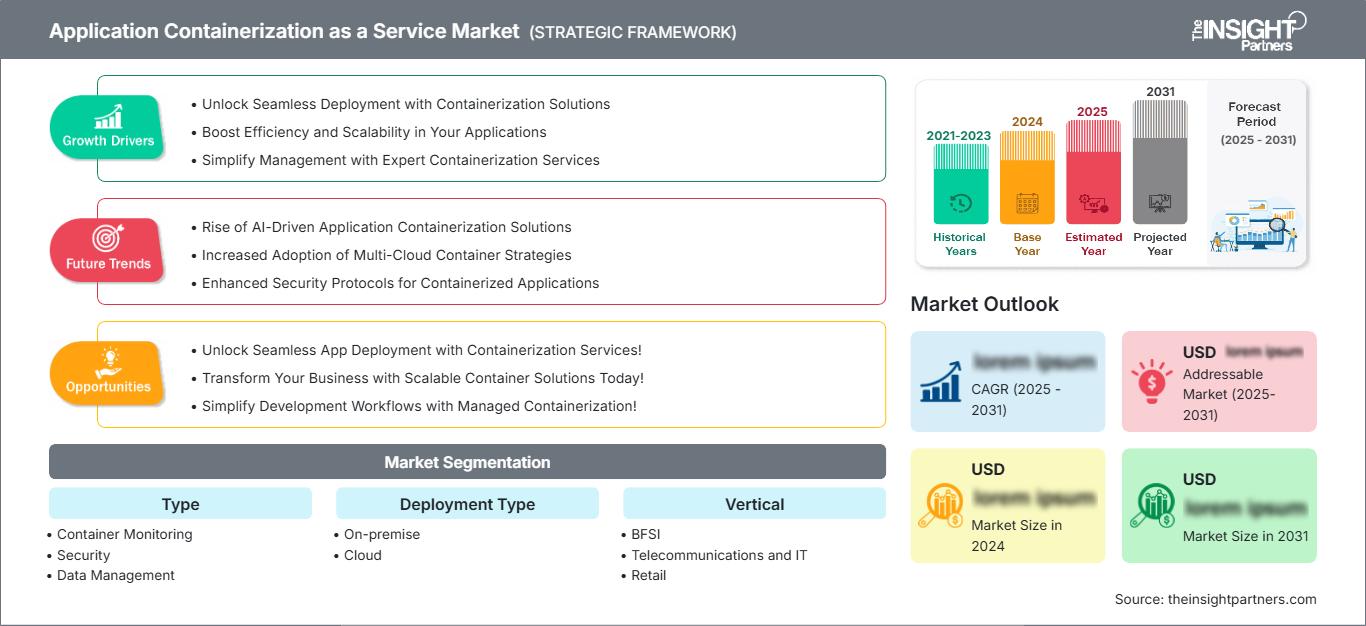
Application Containerization as a Service Market: Strategic Insights
Regional Insights
North America application containerization as a service market
North America held 37–40% share in 2025 and is projected to grow at a CAGR of 20–22% during 2026–2034. The regional application containerization as a service market share is reinforced by high cloud infrastructure penetration, a strong software vendor base, and enterprise spending on DevSecOps automation. BFSI and healthcare buyers prioritize hardened images, identity controls, and audit-ready runtime governance.
Cloud-native migration in the region is also supported by telecom 5G core modernization, retail digital commerce platforms, and media streaming workloads. Large organizations increasingly adopt managed orchestration to reduce Kubernetes skills gaps, while mid-market firms use cloud services to avoid building internal platform teams. Security, observability, and policy management remain the main purchase differentiators.
U.S. application containerization as a service Market
The U.S. accounted for 78–82% of North America application containerization as a service market in 2025 and is expected to grow at a CAGR of 20–22% during 2026–2034. Enterprise platform engineering, national cloud regions, and a deep hyperscaler footprint make the country the anchor market. AWS, Microsoft, IBM, Red Hat, Docker, and VMware have well-established customer-facing, partner, and engineering ecosystems in the country.
Application adoption is driven by finance services, healthcare software, e-commerce applications, and digital media, where speed of release and robustness of infrastructure impact revenue. U.S. customers are among the first users of signed container images, software bill of materials, and runtime detection technologies. This is increasing demand for service offerings, rather than just container hosting.
Europe application containerization as a service Market
Europe represented 24–27% share of the application containerization as a service market in 2025 and is forecast to grow at a CAGR of 19–21% during 2026–2034. The UK leads the pack, bolstered by the upgrade of its financial technology, cloud computing initiatives within the public sector, and the managed services distribution channel. The buyers care about portability and resiliency since cloud computing initiatives are usually cross-provider and involve regulated deployment environments.
In Germany, there is a high demand coming from manufacturing, automotive software, and industrial IoT platforms, where the use of containers ensures standardized workload deployment on the production floor, private cloud, and edge devices. There is development going on in France, Italy, and Spain, driven by modernization in telecommunications, healthcare, and public cloud purchasing initiatives.
APAC application containerization as a service Market
APAC held 22–25% share of the application containerization as a service market in 2025 and is projected to grow at a CAGR of 23–26% during 2026–2034, making it the fastest-growing major region. China dominates regional demand, while Japan, South Korea, India, and Australia gain momentum due to banking digitization, telecommunications clouds, digital governments, and enterprise SaaS.
Industrial and regulatory factors matter. India’s digital infrastructure, Japan’s cloud initiatives, South Korea’s 5G environment, and Australia’s focus on cybersecurity are driving the demand for container platforms. There is also the factor of rapidly growing developer communities and the adoption of managed Kubernetes.
Middle East & Africa application containerization as a market Market
The Middle East & Africa application containerization as a service market is expected to grow at a CAGR of 22–25% during 2026–2034, led by Saudi Arabia. UAE, South Africa, and the rest of MEA add to the growth story via cloud region expansion, digital banking, automation in the energy sector, smart cities, and data platforms for nations.
Use cases in energy and infrastructure are especially pertinent. Operators in oil and gas, utilities, and digital transformation initiatives funded by the governments need highly resilient application environments across centralized cloud and decentralized operational locations. Containers facilitate quicker deployments of monitoring, analytics, and customer-facing applications while enhancing workload mobility within new regional cloud ecosystems.
Segmentation Analysis
Type
Type segment of the application containerization as a service market is projected to grow at a CAGR of 21–23% during 2026–2034 as enterprises assemble integrated container stacks rather than procure isolated tools. The application containerization as a service market scope is broadening from deployment enablement to full lifecycle governance, including monitoring, data persistence, secure runtime controls, software-defined networking, and automated orchestration across hybrid estates.
- Container Monitoring supports telemetry, logs, metrics, and distributed tracing for containerized workloads, helping operations teams identify performance degradation, capacity strain, and service-level failures before user experience or compliance outcomes are affected.
- Security is gaining strategic importance as organizations embed vulnerability scanning, image signing, secrets management, policy enforcement, and runtime threat detection directly into container build, deploy, and operations workflows.
- Data Management addresses persistent storage, backup, replication, and recovery requirements for stateful containerized applications, enabling databases, analytics tools, and transactional workloads to operate reliably in modern environments.
- Networking supports service discovery, ingress control, micro-segmentation, and traffic management, making it essential for distributed applications that require secure east-west communication and predictable latency.
- Orchestration remains the largest capability area because enterprises need automated scheduling, scaling, health management, and configuration control across multi-cluster and multi-cloud container environments.
Deployment Type
Deployment Type is projected to grow at a CAGR of 20–22% during 2026–2034, reflecting enterprise efforts to balance cost, control, sovereignty, and operational simplicity. Cloud deployment is expanding rapidly through managed Kubernetes and container services, while on-premise platforms remain relevant for regulated workloads, latency-sensitive systems, and organizations with existing private cloud investments.
- On-premise remains important for banks, healthcare providers, telecom operators, and government-related users that require direct infrastructure control, strict data residency, customized networking, or integration with legacy systems.
- Cloud leads new deployments as enterprises use managed services to reduce Kubernetes administration, accelerate application releases, improve elasticity, and access integrated security, registry, and observability capabilities.
Vertical
Vertical is projected to grow at a CAGR of 21–24% during 2026–2034 as sector-specific modernization programs move from pilot workloads to production platforms. Regulated industries emphasize security and auditability, while digital-native sectors prioritize release speed, scalability, and resilience. Adoption patterns vary by application criticality, compliance exposure, and cloud operating model maturity.
- BFSI uses containerized platforms for digital banking, payments, fraud analytics, and customer-facing applications where resilience, auditability, rapid updates, and secure software supply chains are core operating requirements.
- Telecommunications and IT adopt containers for network functions, service orchestration, enterprise SaaS delivery, developer platforms, and 5G-related workloads that demand automation, scalability, and low-latency deployment models.
- Retail applies container services to e-commerce, inventory systems, personalization engines, and omnichannel applications where seasonal peaks, release speed, and customer experience consistency are commercially critical.
- Healthcare uses containerized applications for patient portals, analytics, interoperability layers, and secure data platforms, while prioritizing privacy, availability, and integration with legacy clinical environments.
- Media and entertainment rely on containerized workflows for streaming, content delivery, rendering pipelines, subscriber platforms, and analytics systems that require elastic capacity and rapid feature deployment.
Opportunity Snapshot
| Vertical | Revenue Contribution | Trend Tag | Adoption Stage |
| BFSI | High | Core Modernization | Scaling |
| Telecommunications and IT | High | Network Cloud | Scaling |
| Retail | Medium | Commerce Scale | Scaling |
| Healthcare | Medium | Secure Workloads | Emerging |
| Media and Entertainment | Medium | Streaming Ops | Scaling |
Application Containerization as a Service Market Growth Drivers and Impact Analysis
Enterprise Migration from Virtual Machines to Cloud-Native Platforms
Companies are moving from virtual machine (VM)-intensive architectures towards containerized solutions in order to optimize resource consumption, increase release frequency, and ensure uniform deployment. Container technology reduces conflicts related to dependencies by bundling application code and runtime together, which is essential for banking firms, retailers, telecom operators, and medical institutions that have various types of software on board. Market dynamics show that there is demand for container orchestration services, auto-scaling, image repositories, and platform engineering services. Purchasers perceive container technology as not just a developer solution but an operational paradigm, and this leads to spending on governance, observability, and training.
Security and Compliance Embedded into Software Delivery Pipelines
Security has moved from post-deployment scanning to continuous controls across build, registry, deployment, and runtime stages. Enterprises require container image provenance, vulnerability remediation, secrets protection, identity-based access, and policy enforcement to reduce software supply chain exposure. This shift directly increases demand for integrated security modules within application containerization as a service market offerings. Regulated buyers in BFSI, healthcare, and public services are particularly focused on audit trails and automated compliance evidence. Vendors that combine developer usability with enforceable governance gain stronger renewal prospects because security teams can standardize controls without slowing release velocity or fragmenting engineering workflows.
Hybrid Cloud and Multi-Cloud Workload Portability Requirements
Containers are becoming more valuable to businesses due to hybrid and multi-cloud approaches because companies seek portability of workloads but do not wish to redesign their applications from scratch. Containers offer a common way of packaging, whereas cloud services based on Kubernetes help deploy workloads across private data centers, hyperscale clouds, and edge environments. The practical effect is a higher importance of platform abstractions, service meshes, multi-cluster management, and cost transparency. Companies in telecoms, manufacturing, and financial services tend to use this approach to meet their latency, regulatory compliance, and resiliency requirements. Those that offer tools that allow interoperability, open APIs, and managed services are well-positioned to capture revenue from such customers.
Application Containerization as a Service Market Future Trends
AI Workload Orchestration on Container Platforms
AI inference and model-serving workloads will increasingly influence application containerization as a service market trends as enterprises move from experimentation to production-grade AI applications. Containers provide an easy way to package the model, dependencies, APIs, and the monitoring agent, whereas orchestration provides a means to schedule the compute power on GPUs, CPUs, and cluster environments. The future requirements will revolve around scheduling the workloads, integrating the life cycle of models, accessing data securely, and observability for AI services. The future will also promote the need to align the MLOps, DevOps, and platform engineering organizations.
Policy-Driven Platform Engineering and Developer Self-Service
As platform engineering evolves from internal tooling efforts to standard service catalogs, which developers leverage for deploying containerized workloads, the future model of operations will rely on preconfigured templates for networking, security, observability, and deployment pipelines instead of requiring manual setup of clusters. It will involve less friction for developers but retain central governance. Abstraction layers, golden paths, guardrails, and cost-based provisioning are the elements in demand now. Companies evaluate their success based on the frequency of deployments, recovery time of failures, and policy compliance.
Application Containerization as a Service Market Opportunities
Regulated Industry Platforms with Built-In Compliance Controls
Vendors have a strong opportunity to build container services tailored for regulated sectors that need preconfigured compliance, encryption, access control, and evidence capture. Banks, insurers, healthcare providers, and public-sector technology buyers prefer deployment models that reduce audit preparation effort while supporting rapid application delivery. The application containerization as a service market Forecasts point to sustained investment in secure lifecycle management, especially where organizations must document software provenance and infrastructure configuration. Providers can differentiate through sector-specific reference architectures, certified images, compliance dashboards, and managed policy updates. Partnerships with system integrators will be critical for converting complex legacy environments into compliant container platforms.
Edge-Native Container Services for Telecom and Industrial Users
Edge computing presents a tangible use case for lightweight container services that can be guaranteed to perform consistently within a distributed and resource-constrained environment. Telecommunications providers have an opportunity to deploy container services in their network functions and low-latency services, whereas industrial players can benefit from using analytics and monitoring services near their assets. The key will lie in lifecycle management that works well with minimal resources available at the edge, offline capabilities, remote update capability, and integration with the cloud-based control planes. The vendors who will adapt their technology to these constraints can cater to new demand beyond the data center footprint.
Frequently Asked Questions

- Comprehensive Market Sizing and Forecast Analysis
- Detailed Segmentation Analysis
- In-Depth Market Dynamics Assessment
- Regional and Country-Level Insights
- Competitive Landscape and Company Benchmarking
- Strategic Business Intelligence
Recent Reports
Testimonials

The Insight Partners provided valuable market intelligence that supported our global go-to-market strategy. Their team was professional, responsive, and attentive to our feedback, providing thoughtful analysis and helpful methodological clarifications throughout the project.
Junmo Kim Chief Financial Officer (CFO), Enertech Co., Ltd.
The Insight Partners' SCADA System Market report is comprehensive, with valuable insights on current trends and future forecasts. The team was highly professional, responsive, and supportive throughout. We are very satisfied and highly recommend their services.
RAN KEDEM Partner, Reali Technologies LTDs
I requested a report on a very specific software market and the team produced the report in a few days. The information was very relevant and well presented. I then requested some changes and additions to the report. The team was again very responsive and I got the final report in less than a week.
JEAN-HERVE JENN Chairman, Future Analytica
We worked with The Insight Partners for an important market study and forecast. They gave us clear insights into opportunities and risks, which helped shape our plans. Their research was easy to use and based on solid data. It helped us make smart, confident decisions. We highly recommend them.
PIYUSH NAGPAL Sr. Vice President, High Beam Global
The Insight Partners delivered insightful, well-structured market research with strong domain expertise. Their team was professional and responsive throughout. The user-friendly website made accessing industry reports seamless. We highly recommend them for reliable, high-quality research services
YUKIHIKO ADACHI CEO, Deep Blue, LLC.
This is the first time I have purchased a market report from The Insight Partners.While I was unsure at first, I visited their web site and felt more comfortable to take the risk and purchase a market report.I am completely satisfied with the quality of the report and customer service. I had several questions and comments with the initial report, but after a couple of dialogs over email with their analyst I believe I have a report that I can use as input to our strategic planning process.Thank you so much for taking the extra time and making this a positive experience.I will definitely recommend your service to others and you will be my first call when we need further market data.
JOHN SUZUKI President and Chief Executive Officer, Board Director, BK Technologies
I wish to appreciate your support and the professionalism you displayed in the course of attending to my request for information regarding to infectious disease IVD market in Nigeria. I appreciate your patience, your guidance, and the fact that you were willing to offer a discount, which eventually made it possible for us to close a deal. I look forward to engaging The Insight Partners in the future, all thanks to the impression you have created in me as a result of this first encounter.
DR CHIJIOKE ONYIA MANAGING DIRECTOR, PineCrest Healthcare Ltd.Reason to Buy
- Informed Decision-Making
- Understanding Market Dynamics
- Competitive Analysis
- Identifying Emerging Markets
- Customer Insights
- Market Forecasts
- Risk Mitigation
- Boosting Operational Efficiency
- Strategic Planning
- Investment Justification
- Tracking Industry Innovations
- Aligning with Regulatory Trends





 Get Free Sample for