
Application Testing Services Market Trends, Size & Growth by 2034
Application Testing Services Market Size and Forecasts (2021 - 2034), Global and Regional Share, Trends, and Growth Opportunity Analysis Report Coverage : By Testing Type (Functionality Testing, Usability Testing, Performance Testing, Compatibility Testing, Security Testing, Compliance Testing, Automation Testing, Others), End-user (BFSI, IT & Telecom, Government, Retail, Healthcare, Media & Entertainment, Others); Geography (North America, Europe, Asia-Pacific, Middle East & Africa, South and Central America)
- Status : Data Released
- Report Code : TIPRE00039725
- Category : Technology, Media and Telecommunications
- No. of Pages : 150
- Available Report Formats :


- Last update date : August 28, 2026


2025 Market Size
US$ 49.50 Bn
Base year value
2034 Forecast
US$ 125.40 Bn
Projected by 2034
CAGR 2026-2034
10.88 %
Growth rate
Addressable Market
US$ 773.47 Bn
(2026-2034)
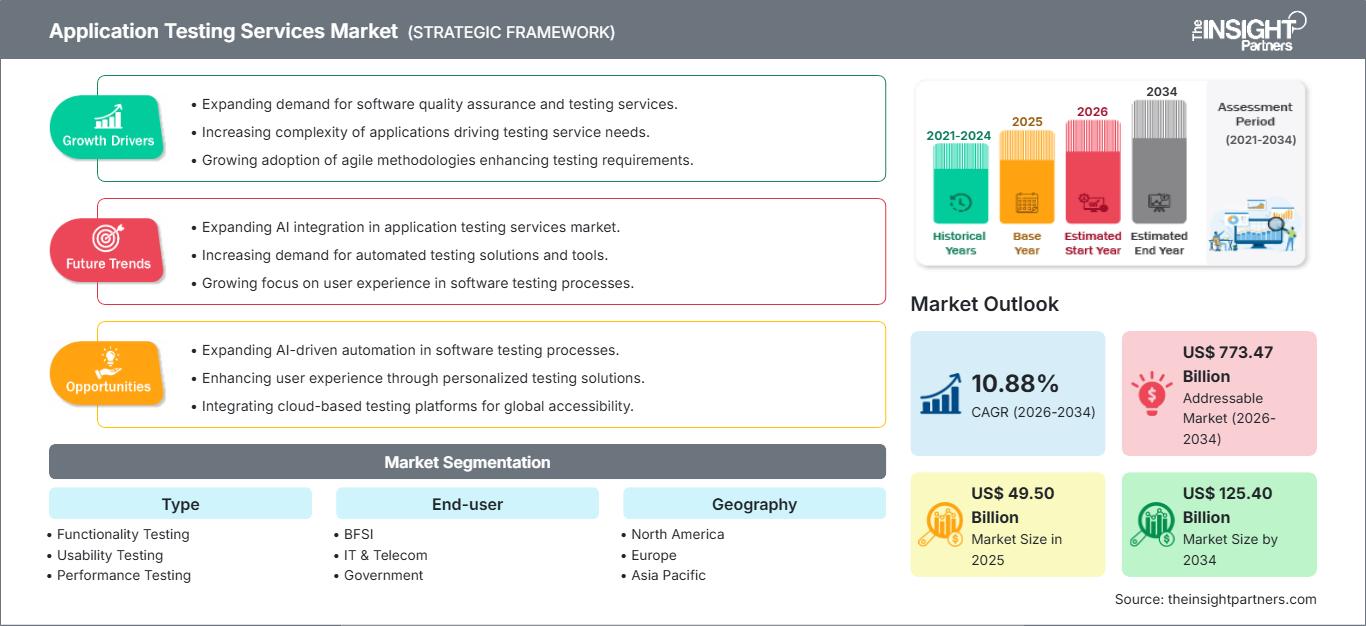
The application testing services market is projected to grow from US$ 49.50 Billion in 2025 to US$ 125.40 Billion by 2034, registering a CAGR of 10.88% during 2026–2034. Demand is being shaped by accelerated enterprise digitization, complex release cycles, and the need to verify cloud, mobile, API, security, and compliance performance before deployment. The market is moving from traditional quality assurance toward continuous quality engineering embedded across development pipelines.
North America remains a key demand center as large enterprises expand cloud-native applications, regulated digital platforms, and DevSecOps-led delivery models. The application testing services market size in the region is supported by high spending on automation, security validation, and managed testing programs. Regional growth is expected to remain in the 10.2–11.4% CAGR range during 2026–2034 as enterprises modernize legacy systems and scale AI-assisted testing.
Application Testing Services Market Assessment and Insights
- North America: North America is estimated to hold 38–42% share in 2025 and grow at a CAGR of 10.2–11.4% during 2026–2034, supported by cloud migration, regulatory testing, and strong DevOps adoption.
- US: The US accounts for 76–80% of North America revenue in 2025 and is expected to grow at 10.4–11.6% CAGR, driven by BFSI, healthcare, and digital commerce modernization.
- Europe: Europe is estimated at 24–28% share in 2025 and 9.4–10.6% CAGR through 2034, with the UK, Germany, and France leading demand for compliance, cybersecurity, and enterprise application validation.
- Asia Pacific: Asia Pacific represents 23–27% share in 2025 and is forecast to grow at 11.8–13.2% CAGR, led by India, China, Japan, South Korea, and Australia as outsourcing and digital platform investment increase.
- Largest Segment: Functionality Testing holds the largest segment position with 26–30% market share in 2025 and a 9.8–10.8% CAGR, reflecting its core role in release readiness.
- High Growth Segment: Automation Testing is the fastest-growing segment with 16–20% share in 2025 and a 13.0–14.6% CAGR, as AI-enabled frameworks reduce regression cycle time.
- Key companies analyzed in detail: Wipro Limited, Cognizant Technology Solutions Corporation, Xoriant Corporation, HCL Technologies Limited, Tata Consultancy Services Limited, Accenture plc, Capgemini SE, International Business Machines Corporation, Infosys Limited, and Aspire Systems Inc.
Source: The Insight Partners' analysis based on proprietary research, government publications, company annual reports, investor presentations, industry databases, and expert interviews.
Quality engineering has evolved from a late-stage defect detection activity into a continuous governance layer across software delivery. The application testing services market growth is tied to Agile, DevOps, API-led architectures, and cloud-native modernization. Enterprises now require functional, performance, compatibility, security, and compliance validation across distributed environments where release frequency, user experience, and resilience directly affect revenue continuity.
Forward investment is expected to concentrate on AI-assisted test design, autonomous regression, observability-driven quality analytics, and industry-specific testing accelerators. Emerging delivery hubs in India, Eastern Europe, and Southeast Asia are gaining strategic relevance as enterprises balance cost efficiency with domain expertise. Regulated sectors are also expanding the application testing services market analysis requirements to address auditability, privacy, and operational risk.
Application Testing Services Market Report Scope
| Report Attribute | Details |
|---|---|
| Market size in 2025 | US$ 49.50 Billion |
| Market Size by 2034 | US$ 125.40 Billion |
| Global CAGR (2026 - 2034) | 10.88% |
| Historical Data | 2021-2024 |
| Forecast period | 2026-2034 |
Application Testing Services Market Analysis
Enterprise demand is rising because applications now support real-time banking, digital healthcare, omnichannel retail, citizen services, and media platforms. Continuous software releases increase the probability of functional defects, integration failures, performance bottlenecks, and security vulnerabilities. This makes application testing services' growth closely linked to automated validation, reusable test assets, cloud-based test labs, and service providers capable of supporting production-like environments. Organizations are also demanding higher release frequency without compromising user experience, regulatory compliance, or operational stability, increasing reliance on specialized testing partners and quality engineering frameworks.
The demand side for these services is moving toward integrated quality engineering contracts rather than one-off testing assignments. Vendors are bundling consulting services, managed testing services, test-automation frameworks, AI-enabled defect predictions, test-data management, and industry-compliance knowledge in the context of larger digital transformation initiatives. BFSI and IT & telecommunications firms continue to be large customers since system downtime, transaction failures, and data leakage entail costs in dollars and reputation. But even healthcare providers, retailers, manufacturers, and government agencies are spending more on testing.
The competitive environment includes global systems integrators as well as digital assurance companies. The competition among Wipro Limited, Cognizant Technology Solutions Corporation, HCL Technologies Limited, Tata Consultancy Services Limited, Accenture plc, Capgemini SE, International Business Machines Corporation, Infosys Limited, Xoriant Corporation, and Aspire Systems Inc. will be based on the size of delivery, intellectual property for automation, partnership for cloud, domain knowledge, and verticalized accelerators. Increasing competitive advantage will be based on the use of AI for testing, continuous quality engineering, cybersecurity verification and support of multi-cloud/hybrid application environments.
Investment priorities are moving toward outcome-based quality metrics, defect leakage reduction, faster release certification, and security-by-design validation. Providers with AI-enabled test orchestration, performance engineering, accessibility testing, and sector-specific compliance capabilities are positioned to win larger managed-services contracts. The application testing services market analysis shows rising emphasis on platform engineering alignment, measurable business resilience, DevOps integration, and continuous quality monitoring. Future growth is expected to be supported by increasing adoption of cloud-native architectures, intelligent automation, generative AI applications, and stricter regulatory requirements governing software reliability and data protection.
● REPORT CUSTOMIZATION
Tailor This Report To Align With Your Specific Business Requirements
This report can be customized to align precisely with your business objectives, scope, and target markets. Customization options include tailored segmentation, geography, competitive analysis, and strategic insights to support informed decision-making.
Customize This Report →WHAT YOU CAN ADJUST
- ● Segmentations
- ● Geography
- ● Competitive Analysis
- ● Language Preferences
Application Testing Services Market: Strategic Insights
Regional Insights
North America Application Testing Services Market
North America is estimated to represent 38–42% application testing services market share in 2025 and grow at 10.2–11.4% CAGR during 2026–2034. The region benefits from high enterprise technology spending, early DevSecOps adoption, and strict expectations for application reliability in BFSI, healthcare, retail, and public-sector platforms.
Demand is strongest for security testing, performance engineering, API testing, and automation testing. Enterprises are also increasing third-party validation for cloud migrations and AI-enabled applications. Large outsourcing contracts increasingly include continuous quality dashboards, release risk scoring, and automated regression suites.
U.S. Application Testing Services Market
The US contributes 76–80% of North America's revenue in 2025 and is expected to grow at 10.4–11.6% CAGR. The need for demand is fueled by large ecosystems for digital banks, compliance for health care, expansion of products in the SaaS model, and advanced e-commerce platforms needing extensive testing in a production environment.
Top vendors are well entrenched in their US customers through transformation via consulting, offshore-nearshore delivery models, and cloud ecosystems partnerships. Demand for application testing has become more dependent on user experience analytics, cyber-resilience, mobile performance, and regulatory assurance of mission-critical enterprise applications.
Europe Application Testing Services Market
Europe is estimated to hold 24–28% share in 2025 and expand at a 9.4–10.6% CAGR, led by the UK, Germany, and France. Demand is driven by factors such as banking modernization, automotive software validation, telecom cloud transformation, data privacy, and public sector digitization initiatives.
The United Kingdom exhibits high uptake in areas like financial services and digital government, while Germany focuses on industrial software, automotive software, and enterprise resource planning modernization. France, Italy, and Spain are increasing managed test services as companies move from project-oriented QA to continuous validation.
APAC Application Testing Services Market
The Application Testing Services Market Trends indicate that APAC is estimated at 23–27% share in 2025 and is expected to record the highest CAGR of 11.8–13.2% during the forecast period. India remains a major delivery and demand hub, while China, Japan, South Korea, and Australia increase spending on cloud migration, digital banking, telecom platforms, and e-commerce applications.
Growth is supported by outsourcing maturity, large engineering talent pools, and government-backed digital infrastructure programs. Enterprises increasingly use regional testing centers for automation, compatibility testing, mobile performance, and multilingual user experience validation.
Middle East & Africa Application Testing Services Market
The Application Testing Services Market Forecast indicates that the Middle East & Africa is forecast to grow at an 8.8–10.2% CAGR during 2026–2034, with Saudi Arabia, the UAE, and South Africa leading adoption. Smart government services, banking transformation, energy-sector digitization, and national cloud programs are creating demand for reliable application validation.
The region is still smaller than North America, Europe, and APAC, but spending is rising as enterprises professionalize DevOps and cybersecurity processes. Managed testing providers are gaining traction where internal QA capacity is limited.
Segmentation Analysis
Type
The Type segment is expected to grow at a 10.6–11.8% CAGR during 2026–2034. The application testing services market scope covers functionality, usability, performance, compatibility, security, compliance, and automation testing, with enterprises combining multiple methods to validate reliability across complex architectures.
- Functionality Testing: This remains the largest service area because every enterprise release requires verification of workflows, integrations, business rules, and transaction accuracy before production deployment.
- Usability Testing: Demand is rising as customer-facing applications compete on journey quality, accessibility, navigation simplicity, and consistent experience across digital touchpoints.
- Performance Testing: Enterprises use performance validation to protect revenue during peak traffic, high transaction volumes, and latency-sensitive operations.
- Compatibility Testing: Compatibility testing is critical as users access applications through varied browsers, devices, operating systems, networks, and cloud environments.
- Security Testing: Security testing is gaining strategic priority because APIs, open-source components, cloud workloads, and digital identities expand the attack surface.
- Compliance Testing: Regulated industries use compliance testing to demonstrate adherence to privacy, accessibility, financial, healthcare, and government standards.
- Automation Testing: Automation testing scales regression coverage, shortens release cycles, and enables quality checks within CI/CD pipelines.
End-user
The Application Testing Services Market Report indicates that the End-user segment is expected to expand at a 10.2–11.4% CAGR during 2026–2034 as application testing becomes an enterprise-wide requirement. BFSI, IT and Telecom, Government, Retail, Healthcare, and Media & Entertainment rely on testing partners to protect uptime, data security, customer experience, and regulatory performance.
- BFSI: BFSI contributes high revenue because digital banking, payment platforms, insurance portals, and risk systems demand secure, accurate, and compliant application performance.
- IT & Telecom: IT and telecom organizations use testing services for network software, OSS/BSS modernization, enterprise SaaS, cloud platforms, and customer self-service applications.
- Government: Government demand is tied to citizen service portals, digital identity, tax systems, procurement platforms, and secure public infrastructure transformation.
- Retail: Retailers prioritize performance, compatibility, and usability testing for omnichannel commerce, loyalty platforms, mobile shopping, and inventory-linked customer experiences.
- Healthcare: Healthcare adoption is driven by patient portals, telehealth, electronic records, claims systems, and strict privacy expectations.
- Media & Entertainment: Media and entertainment companies use testing to validate streaming quality, subscription journeys, content delivery, device compatibility, and high-volume event traffic.
Opportunity Snapshot
| End User | Revenue Contribution | Trend Tag | Adoption Stage |
| BFSI | High | Digital Banking | Mature |
| IT & Telecom | High | Cloud Networks | Mature |
| Government | Medium | Citizen Platforms | Scaling |
| Retail | Medium | Omnichannel QA | Scaling |
| Healthcare | Medium | Patient Apps | Scaling |
| Media & Entertainment | Low | Streaming Quality | Emerging |
Application Testing Services Market Growth Drivers and Impact Analysis
Expansion of Agile, DevOps, and Continuous Delivery
The operating models of agile and DevOps are resulting in a higher frequency of releases, and hence there is less time left for testing. This results in increased demand for testing through automation, continuous integration tests, service virtualization, and release certification based on risk assessment. Providers that offer built-in quality gates within development pipelines enable businesses to minimize defects while not hindering the pace of deployment.
Rising Security and Compliance Requirements
Application development has seen more processing of sensitive information, such as finance, health, identity, and customers, in a decentralized cloud and API network environment. This leads to higher requirements of security testing, compliance testing, penetration testing, vulnerability assessment, and privacy-driven quality controls. Businesses are trying to conduct these tests early in the development cycle since remediation becomes expensive after entering the production phase.
Enterprise Migration to Cloud-Native Architectures
As cloud-based applications employ microservices, API, containers, and third-party integrations that need testing at a greater level, performance, compatibility, integration, and resilience tests are critical to ensure service continuity. With ERP, customer-facing applications, mobile applications, and analytics applications being updated and re-designed by companies, the need for scalable testing partners with cloud laboratories and automated tools arises.
Application Testing Services Market Future Trends
AI-Augmented Quality Engineering
AI-assisted test design, self-healing scripts, defect prediction, and intelligent prioritization are becoming central application testing services market trends. These tools help teams identify high-risk code changes, reduce repetitive scripting, and optimize regression suites. Over the forecast period, AI will shift testing from execution support toward predictive quality governance, where service providers advise clients on release risk, coverage gaps, and performance anomalies before production impact occurs.
Autonomous and Platform-Based Testing Models
The future test programs would involve unified platforms that integrate automation, service virtualization, synthetic monitoring, test data management, and reporting. The execution would be autonomous and thus minimize reliance on humans in performing routine validation tests while the human experts concentrate on planning and other aspects like compliance interpretation and user experience assessment. Such an approach will favor vendors whose platforms are easily customizable across various sectors without violating sectoral demands.
Application Testing Services Market Opportunities
Verticalized Testing Solutions for Regulated Industries
Regulated industries present great potential since test needs have to take into account functionality, security, resilience, privacy, accessibility, auditability, and cybersecurity all at once. BFSI, healthcare, government, and telecom customers are becoming increasingly interested in partners with out-of-the-box test solutions, compliance frameworks, and industry-focused accelerators. The differentiators for vendors are reusable assets for such verticals as payments, claims processing, patient experience, identity, and citizenship, minimizing the ramp-up period.
Managed Automation Services for Mid-Market Enterprises
Many medium-scale businesses seek to enjoy the benefits of automation but are unable to afford experienced engineers, proper tool management, and robust frameworks. There is an opportunity to provide managed automation services that will help companies implement testing strategies, develop scripts, maintain the process, report results, and improve constantly. This is especially important for companies that are developing e-commerce, ERP, CRM, and customer service systems.
Frequently Asked Questions

- Comprehensive Market Sizing and Forecast Analysis
- Detailed Segmentation Analysis
- In-Depth Market Dynamics Assessment
- Regional and Country-Level Insights
- Competitive Landscape and Company Benchmarking
- Strategic Business Intelligence
Recent Reports
Testimonials

The Insight Partners' SCADA System Market report is comprehensive, with valuable insights on current trends and future forecasts. The team was highly professional, responsive, and supportive throughout. We are very satisfied and highly recommend their services.
RAN KEDEM Partner, Reali Technologies LTDs
I requested a report on a very specific software market and the team produced the report in a few days. The information was very relevant and well presented. I then requested some changes and additions to the report. The team was again very responsive and I got the final report in less than a week.
JEAN-HERVE JENN Chairman, Future Analytica
We worked with The Insight Partners for an important market study and forecast. They gave us clear insights into opportunities and risks, which helped shape our plans. Their research was easy to use and based on solid data. It helped us make smart, confident decisions. We highly recommend them.
PIYUSH NAGPAL Sr. Vice President, High Beam Global
The Insight Partners delivered insightful, well-structured market research with strong domain expertise. Their team was professional and responsive throughout. The user-friendly website made accessing industry reports seamless. We highly recommend them for reliable, high-quality research services
YUKIHIKO ADACHI CEO, Deep Blue, LLC.
This is the first time I have purchased a market report from The Insight Partners.While I was unsure at first, I visited their web site and felt more comfortable to take the risk and purchase a market report.I am completely satisfied with the quality of the report and customer service. I had several questions and comments with the initial report, but after a couple of dialogs over email with their analyst I believe I have a report that I can use as input to our strategic planning process.Thank you so much for taking the extra time and making this a positive experience.I will definitely recommend your service to others and you will be my first call when we need further market data.
JOHN SUZUKI President and Chief Executive Officer, Board Director, BK Technologies
I wish to appreciate your support and the professionalism you displayed in the course of attending to my request for information regarding to infectious disease IVD market in Nigeria. I appreciate your patience, your guidance, and the fact that you were willing to offer a discount, which eventually made it possible for us to close a deal. I look forward to engaging The Insight Partners in the future, all thanks to the impression you have created in me as a result of this first encounter.
DR CHIJIOKE ONYIA MANAGING DIRECTOR, PineCrest Healthcare Ltd.Reason to Buy
- Informed Decision-Making
- Understanding Market Dynamics
- Competitive Analysis
- Identifying Emerging Markets
- Customer Insights
- Market Forecasts
- Risk Mitigation
- Boosting Operational Efficiency
- Strategic Planning
- Investment Justification
- Tracking Industry Innovations
- Aligning with Regulatory Trends





 Get Free Sample for