
Arbovirus Testing Market Share, Demand & Growth by 2034
Arbovirus Testing Market Size and Forecasts (2021–2034), Global and Regional Share, Trends, and Growth Opportunity Analysis Report Coverage : by Test Type (ELISA-based Tests, RT-PCR based Tests, Other Test Types); End User (Diagnostic Laboratories, Hospitals, Research Centers, and Other End Users); and Geography (North America, Europe, Asia Pacific, and South and Central America)
- Status : Data Released
- Report Code : TIPRE00040134
- Category : Life Sciences
- No. of Pages : 150
- Available Report Formats :


- Last update date : September 02, 2026


2025 Market Size
US$ 1.18 Bn
Base year value
2034 Forecast
US$ 1.65 Bn
Projected by 2034
CAGR 2026-2034
3.8 %
Growth rate
Addressable Market
US$ 12.86 Bn
(2026-2034)
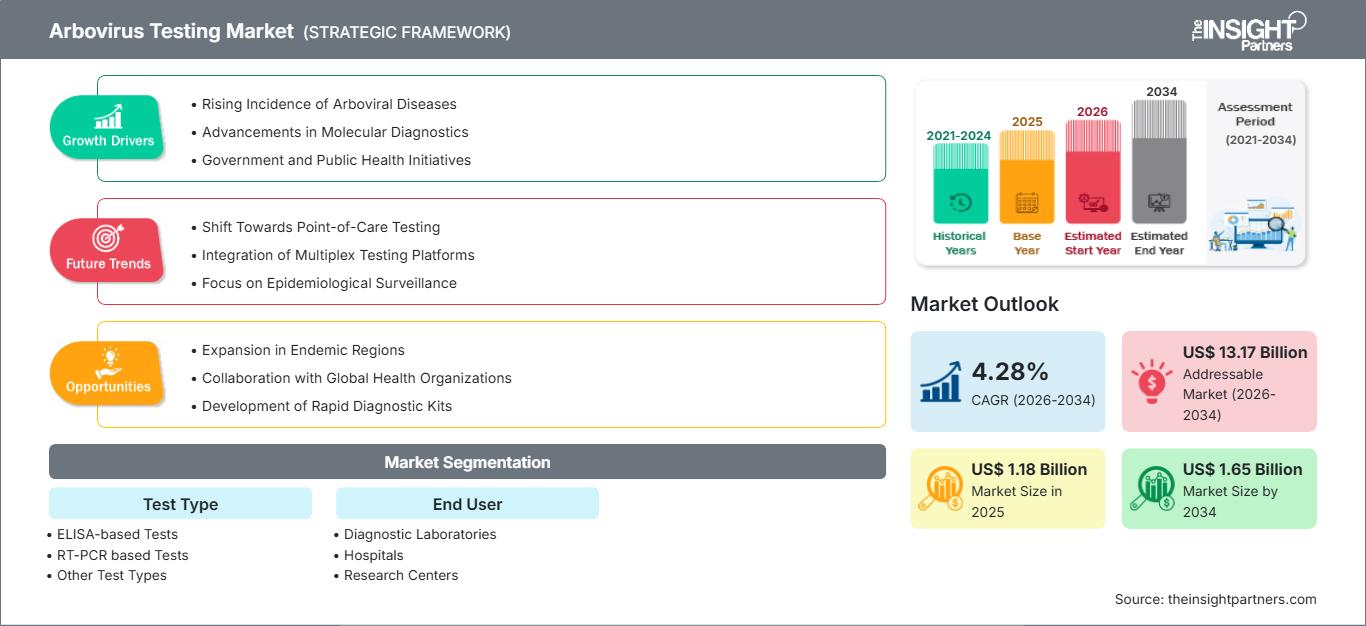
The Arbovirus Testing market was valued at US$ 1.18 billion in 2025 and is expected to reach US$ 1.65 billion by 2034; it is estimated to record a CAGR of 3.8% during 2026-2034.
Arbovirus Testing Market Assessment and Insights
- North America: North America is estimated to hold a 41–43% arbovirus testing market share in 2025, supported by mature laboratory infrastructure and surveillance networks, and is projected to grow at a 4.0–4.6% CAGR between 2026–2034.
- US: The US is estimated to represent 88–92% of North America's 2025 revenue, with established molecular testing infrastructure supporting a 4.0–4.6% CAGR between 2026–2034.
- Europe: Europe is estimated at a 24–27% share in 2025, led by Germany, France, Italy, Spain, and the UK, with expanding surveillance supporting a 4.2–4.8% CAGR during 2026–2034.
- Asia Pacific: Asia Pacific is estimated to account for a 20–23% share in 2025, led by China, Japan, India, and Australia, and is expected to register a 4.8–5.5% CAGR between 2026–2034.
- Largest Segment: ELISA-based Tests are expected to retain a 43–47% market share in 2025, supported by established serological workflows, with a 3.8–4.4% CAGR during 2026–2034.
- High Growth Segment: RT-PCR based Tests are expected to hold a 31–35% market share in 2025 and expand at a 5.0–5.8% CAGR during 2026–2034 as molecular confirmation gains importance.
- Key companies analyzed in detail: Thermo Fisher Scientific Inc., Roche Diagnostics, Abbott Laboratories, Bio-Rad Laboratories, Inc., QIAGEN N.V., Revvity, Inc., Cepheid, LLC, bioMérieux SA, Seegene Inc., and altona Diagnostics GmbH.
Source: The Insight Partners' analysis based on proprietary research, government publications, company annual reports, investor presentations, industry databases, and expert interviews.
Testing for arboviruses has shifted from the serology confirmation test to molecular and automated tests in the laboratory. Although the ELISA test still holds its significance since antibody and antigen tests can be used in diagnosis for various stages of a disease, RT-PCR will detect nucleic acids in the case of an acute disease. Automation, multiplexing, standardized reagents, and laboratory automation platforms have become key criteria influencing purchasing decisions.
Future growth will come from those regions where arbovirus testing is being incorporated into their national infectious disease programs. The public health organizations are focusing more on laboratory testing because of the possibility of confusion between various infections such as dengue, chikungunya, Zika, and other febrile diseases. Attention of regulatory bodies to the quality of diagnostics, external quality assessment, and procurement standards may push the laboratories towards the adoption of validated workflow systems.
Arbovirus Testing Market Report Scope
| Report Attribute | Details |
|---|---|
| Market size in 2025 | US$ 1.18 Billion |
| Market Size by 2034 | US$ 1.65 Billion |
| Global CAGR (2026 - 2034) | 3.8% |
| Historical Data | 2021-2024 |
| Forecast period | 2026-2034 |
Arbovirus Testing Market Analysis
Arbovirus testing market growth depends largely on increased lab confirmation needs, readiness to respond to outbreaks, and the expansion of testing capacity. The market value chain consists of developers of tests, producers of reagents and equipment, distributors, reference laboratories, hospitals, and health organizations. Dengue testing is still the primary driving factor, although chikungunya, Zika, West Nile, and yellow fever add to the need for differentiated or multiplex testing.
Requirements for tests differ depending on the stage of infection, available biological materials, lab capacities, and the epidemiological situation. Serologic tests are still valuable in the post-acute period, but molecular tests are especially necessary in early infection. This leads to a complementary, not purely substitutive, relation between ELISA and RT-PCR. Dynamics of supply depend on availability of reagents, platform compatibility, quality control, cold chain requirements, and capacity for high-volume testing during an outbreak.
The arbovirus testing market forecast shows a competitive landscape of diversified diagnostic players along with molecular testing specialists. Thermo Fisher Scientific Inc., Roche Diagnostics, Abbott Laboratories, Bio-Rad Laboratories, Inc., and QIAGEN N.V. have an advantage due to their presence across numerous laboratories, whereas Cepheid, Seegene Inc., altona Diagnostics GmbH, and bioMérieux SA offer unique molecular or immunology testing capabilities. Revvity, Inc. has added exposure to infectious diseases and laboratory technologies.
In the current scenario, competition is becoming based on assay range, automation, assay performance, processing time, and integration with existing laboratory facilities. The development of automated dengue antigen testing at Roche demonstrates an arbovirus testing market trend towards high throughput assays, while expansion of the digital PCR offering by QIAGEN caters to surveillance and research purposes. Consequently, investments are being made in multiplexing, automated results interpretation, decentralized testing capability, and multivariable assay development.
● REPORT CUSTOMIZATION
Tailor This Report To Align With Your Specific Business Requirements
This report can be customized to align precisely with your business objectives, scope, and target markets. Customization options include tailored segmentation, geography, competitive analysis, and strategic insights to support informed decision-making.
Customize This Report →WHAT YOU CAN ADJUST
- ● Segmentations
- ● Geography
- ● Competitive Analysis
- ● Language Preferences
Arbovirus Testing Market: Strategic Insights
Regional Insights
North America arbovirus testing market
North America is estimated to represent 41–43% Arbovirus testing market share in 2025 and is expected to expand at a 4.0–4.6% CAGR during 2026–2034. The US holds the dominant regional demand due to existing molecular diagnostics capabilities, federal surveillance, reference laboratories, and procurement processes for EIDs. Arbovirus tests are performed on imported cases of dengue and chikungunya, locally acquired infections, outbreaks investigation, and research purposes.
The regional market benefits from standard laboratory methods and access to high-throughput analyzers. The use of combination of molecular tests and serology by public health laboratories is growing since different approaches are needed at various stages of the disease. Canada accounts for a smaller portion but ensures its demand through travel-related testing, surveillance, and special laboratories. Sustained investment in preparedness, laboratory interoperability, and quick confirmation can guarantee moderate growth in the region and ensure North America’s leadership in geography terms.
U.S. arbovirus testing market
The US represents approximately 88–92% of North America's 2025 market, with a projected 4.0–4.6% CAGR during 2026–2034. Demand will be driven by the support of the Centers for Disease Control and Prevention, state public health laboratories, hospitals, commercial laboratories, and research institutions. The application of molecular diagnostics is especially critical when it comes to diagnosing acute infection and arbovirus surveillance cases related to either imported or locally acquired arboviruses.
Instruments, reagents, and molecular workflows used in the testing process include Thermo Fisher Scientific Inc., Roche Diagnostics, Abbott Laboratories, Bio-Rad Laboratories, Inc., QIAGEN N.V., Cepheid, LLC, and others. Clinical diagnostics, surveillance, and research are just a few among applications of the tests performed. Another aspect influencing the market includes the necessity of differential diagnosis of dengue fever and Zika virus diseases against other febrile illnesses.
Europe arbovirus testing market
Europe is estimated to account for a 24–27% share in 2025 and is projected to grow at a 4.2–4.8% CAGR through 2034, with Germany serving as a leading contributor. The region benefits from advanced hospital laboratories, cross-border surveillance, and increasing attention to locally acquired and travel-related arbovirus infections.
In the United Kingdom, the need is managed through specialized laboratories for infectious diseases as well as surveillance programs. In Germany, on the other hand, robust diagnosis systems and research capabilities co-exist. France, Italy, and Spain are among the significant markets since favorable weather, tourism, and the expansion of mosquito vectors make surveillance needs more necessary. Automated immunoassay testing, molecular confirmation, laboratory proficiency, and quick reporting have become critical considerations in regional purchasing.
APAC arbovirus testing market
APAC is estimated at a 20–23% share in 2025 and is expected to register a 4.8–5.5% CAGR during 2026–2034, with China and Japan among the leading contributors. India, South Korea, and Australia also support regional demand through surveillance and clinical testing.
The factors driving this market include high prevalence of dengue disease, development of healthcare facilities, urbanization, and vector control measures. China and India provide volume opportunities whereas Japan and Australia are focused on surveillance and import cases identification. Investments made in public health are resulting in increased laboratory confirmation and testing capacity in the region. Molecular technology is gaining more traction along with serology.
Middle East & Africa arbovirus testing market
Middle East and Africa represent a smaller but strategically important opportunity, with demand concentrated in Saudi Arabia, the UAE, South Africa, and selected tropical markets. The region is expected to expand at approximately 4.0–4.7% CAGR during 2026–2034, supported by infectious-disease surveillance and healthcare infrastructure development.
Saudi Arabia and the UAE benefit from advanced laboratory systems and international travel volumes, while South Africa provides a strong base for research and surveillance. Rest of MEA demand remains more variable because laboratory access differs substantially by country. Investments in centralized laboratories, outbreak preparedness, and regional reference networks should gradually improve diagnostic availability.
Segmentation Analysis
Test Type
The Test Type segment is projected to expand at a 4.2–4.8% CAGR during 2026–2034. ELISA-based testing remains strategically important because serological assays are established across routine laboratories, whereas molecular testing is increasingly selected when early confirmation, serotype identification, or outbreak investigation is required. The two approaches therefore address complementary diagnostic windows.
- ELISA-based Tests: ELISA-based testing maintains a strong routine position because antigen and antibody assays can be incorporated into established immunoassay workflows, supporting scalable testing across hospitals and diagnostic laboratories.
- RT-PCR based Tests: RT-PCR based Tests provide direct molecular confirmation during acute infection and are increasingly important for surveillance, outbreak investigation, reference laboratories, and settings requiring high analytical specificity.
End User
The End User segment in the arbovirus testing market is expected to register a 4.1–4.7% CAGR during 2026–2034. Diagnostic laboratories remain central because they process routine clinical samples at scale, while hospitals require rapid confirmation for patient management. Research centers contribute demand for assay validation, epidemiology, surveillance, and development of improved diagnostic methodologies.
- Diagnostic Laboratories: Diagnostic laboratories represent a core purchasing group because centralized workflows support standardized testing, quality control, batch processing, and broad access to specialized molecular and serological platforms.
- Hospitals: Hospitals use arboviral testing to support differential diagnosis, patient management, infection surveillance, and outbreak response, particularly where dengue or chikungunya symptoms overlap with other febrile diseases.
- Research Centers: Research centers require testing technologies for epidemiological studies, assay development, pathogen characterization, clinical investigations, and evaluation of emerging diagnostic approaches.
- Other End Users: Other end users include public-health programs and specialized testing facilities requiring targeted surveillance, confirmatory testing, and outbreak-response capabilities.
Application
The Application segment is expected to grow at a 4.3–4.9% CAGR during 2026–2034 as testing expands beyond routine diagnosis toward surveillance and epidemiological investigation. The arbovirus testing market scope is therefore shaped by clinical requirements as well as public-health and research priorities.
- Diagnostics: Diagnostics remain the largest application area, supported by routine testing of suspected infections and the need to distinguish arboviruses from clinically similar febrile diseases.
- Therapeutics: Therapeutics-related testing supports clinical development, patient stratification, endpoint evaluation, and investigation of treatment responses in arboviral disease studies.
- Research and Development: Research and Development activities use molecular and serological assays for epidemiology, assay validation, pathogen characterization, surveillance, and evaluation of emerging diagnostic technologies.
Opportunity Snapshot
| Segment Name | Revenue Contribution | Trend Tag | Adoption Stage |
|---|---|---|---|
| Diagnostic Laboratories | High | Centralized Testing | Mature |
| Hospitals | High | Acute Diagnosis | Mature |
| Research Centers | Medium | Surveillance Studies | Scaling |
| Other End Users | Low | Public Surveillance | Emerging |
Arbovirus Testing Market Growth Drivers and Impact Analysis
Rising Arboviral Disease Burden and Geographic Expansion
The rising incidence of dengue, chikungunya, Zika, and other mosquito-transmitted viruses is raising the need for accurate testing. Arboviruses have been declared a growing public health threat by WHO since billions of people live in the regions prone to transmission of Aedes transmitted viruses. This is a factor that will alter the priority in terms of lab purchases since testing facilities would be needed not only during outbreak times but also for surveillance purposes. Geographic spreading raises the demand for differentiation tests of infection with similar clinical presentations. Commercial implications will be strong for labs expanding their infectious diseases menu, for laboratories increasing throughput and for companies developing tests for compatibility with diagnostics platforms.
Greater Emphasis on Laboratory Confirmation
The increased focus by public health organizations on laboratory confirmation is due to the fact that clinical manifestations alone cannot adequately differentiate between dengue, chikungunya, Zika, malaria, and many other febrile diseases. As such, there will be an ongoing need for the use of complementary serology and molecular work flows, rather than the utilization of one diagnostic platform. Laboratory confirmation also helps improve epidemiological reporting, tracking of disease outbreaks, and resource allocations, making the testing process more valuable in the national surveillance system. The business impact goes beyond the number of test kits sold since labs could need instruments, quality control reagents, sample prep kits, data management software, and confirmatory testing. Manufacturers who are able to facilitate work flows in a standard fashion have the opportunity to enter into institutional purchasing programs.
Expansion of Automated and Molecular Diagnostic Infrastructure
Automation and molecular diagnostics are changing the economics of arboviral testing by improving throughput, standardization, traceability, and turnaround time. High-volume laboratories increasingly favor platforms that integrate sample processing, amplification, detection, and result interpretation within controlled workflows. Molecular testing also supports early infection detection, making it valuable when rapid confirmation influences clinical management or outbreak response. The impact is particularly relevant in reference laboratories and advanced hospital networks, where labor efficiency and reproducibility can justify investment in higher-value systems. At the same time, automated immunoassays remain important because serological testing is required at different stages of infection. Suppliers that connect molecular and immunoassay capabilities can address broader testing algorithms and reduce the operational complexity associated with managing multiple disease-specific workflows.
Arbovirus Testing Market Future Trends
Multiplex Arbovirus Panels Will Gain Strategic Importance
Future diagnostic development is likely to emphasize multiplex panels capable of distinguishing several arboviruses within a single workflow. This approach can improve clinical decision-making when dengue, chikungunya, Zika, and other infections circulate simultaneously and symptoms overlap. Multiplexing also provides laboratories with better instrument utilization because the same platform can support several surveillance targets. Manufacturers are expected to focus on assay design that balances broad pathogen coverage with analytical specificity, manageable interpretation, and compatibility with established instruments. Public-health laboratories may increasingly favor broader panels during outbreak investigations, while hospitals could use them selectively for patients with travel exposure or clinically ambiguous fever. As vector-borne disease patterns become less geographically predictable, flexible assay menus should become increasingly valuable for both routine and emergency testing.
Digital and Automated Workflows Will Reshape Surveillance Testing
Digital PCR, automated immunoassays, and connected laboratory information systems are expected to become more important in surveillance-oriented testing. Digital approaches can provide sensitive quantification for research and specialized applications, while automated immunoassays can support repeatable processing of larger sample volumes. Integration with laboratory information systems should improve traceability, quality monitoring, and transmission of results to public-health authorities. The long-term direction is toward connected testing ecosystems rather than isolated assays, allowing laboratories to combine molecular, serological, and epidemiological information. Manufacturers with strong instrument ecosystems may therefore have an advantage when customers prioritize workflow standardization. Smaller suppliers can compete by offering specialized assays, flexible multiplexing, or compatibility with widely deployed platforms rather than developing complete laboratory systems independently.
Arbovirus Testing Market Opportunities
Developing Integrated Testing Solutions for Endemic Markets
An important opportunity exists in developing integrated diagnostic packages tailored to dengue and chikungunya endemic markets. These solutions can combine antigen, antibody, and molecular testing according to disease stage, enabling laboratories to follow practical diagnostic algorithms rather than relying on one assay. Manufacturers can strengthen market access by combining reagents with training, quality controls, interpretation support, and service capabilities. The approach is particularly relevant in countries where laboratory resources vary significantly between urban hospitals, regional laboratories, and peripheral facilities. Procurement models that bundle consumables with equipment and technical support can also reduce operational barriers. Companies entering these markets should prioritize affordability, reagent stability, workflow simplicity, and compatibility with existing laboratory infrastructure while maintaining analytical performance required for public-health and clinical applications.
Expanding Surveillance and Reference-Laboratory Partnerships
Another opportunity lies in partnerships with national surveillance networks, reference laboratories, universities, and public-health agencies. Such collaborations can support assay validation, disease monitoring, epidemiological studies, and localized diagnostic development. Companies can use these partnerships to understand pathogen prevalence, serotype distribution, co-circulation patterns, and laboratory workflow requirements before commercial expansion. Reference-laboratory relationships can also strengthen credibility when new assays enter markets where procurement requires demonstrated performance under local conditions. Strategic partnerships may be particularly valuable for emerging arboviruses because commercial demand can initially be uncertain while surveillance needs are increasing. Suppliers that establish flexible development and manufacturing arrangements can respond more efficiently when outbreaks create sudden requirements for specialized assays, confirmatory testing, or expanded laboratory capacity.
Recent Developments
- October 2025: Roche Diagnostics received the CE mark for its Elecsys Dengue Ag test, an automated high-throughput immunoassay designed to aid diagnosis of acute dengue infection across all four dengue virus serotypes. The assay provides results in approximately 18 minutes and is designed to improve laboratory workflow efficiency and traceability during dengue testing.
- July 2025: Centers for Disease Control and Prevention updated information on its DENV-1-4 Real-Time RT-PCR Assay, an FDA-approved nucleic acid amplification test for detecting and typing dengue virus serotypes 1 through 4 in symptomatic patients. The assay is intended for use during the early illness period when molecular detection is particularly relevant.
- May 2025: World Health Organization activated its Dengue Expert Review Panel for Diagnostics in response to the 2024–2025 dengue emergency. The panel evaluates candidate in vitro diagnostic products against defined quality and performance criteria, supporting evidence-based procurement and improving access to appropriate dengue diagnostic tools.
Frequently Asked Questions

- Comprehensive Market Sizing and Forecast Analysis
- Detailed Segmentation Analysis
- In-Depth Market Dynamics Assessment
- Regional and Country-Level Insights
- Competitive Landscape and Company Benchmarking
- Strategic Business Intelligence
Recent Reports
Testimonials

The Insight Partners provided valuable market intelligence that supported our global go-to-market strategy. Their team was professional, responsive, and attentive to our feedback, providing thoughtful analysis and helpful methodological clarifications throughout the project.
Junmo Kim Chief Financial Officer (CFO), Enertech Co., Ltd.
The Insight Partners' SCADA System Market report is comprehensive, with valuable insights on current trends and future forecasts. The team was highly professional, responsive, and supportive throughout. We are very satisfied and highly recommend their services.
RAN KEDEM Partner, Reali Technologies LTDs
I requested a report on a very specific software market and the team produced the report in a few days. The information was very relevant and well presented. I then requested some changes and additions to the report. The team was again very responsive and I got the final report in less than a week.
JEAN-HERVE JENN Chairman, Future Analytica
We worked with The Insight Partners for an important market study and forecast. They gave us clear insights into opportunities and risks, which helped shape our plans. Their research was easy to use and based on solid data. It helped us make smart, confident decisions. We highly recommend them.
PIYUSH NAGPAL Sr. Vice President, High Beam Global
The Insight Partners delivered insightful, well-structured market research with strong domain expertise. Their team was professional and responsive throughout. The user-friendly website made accessing industry reports seamless. We highly recommend them for reliable, high-quality research services
YUKIHIKO ADACHI CEO, Deep Blue, LLC.
This is the first time I have purchased a market report from The Insight Partners.While I was unsure at first, I visited their web site and felt more comfortable to take the risk and purchase a market report.I am completely satisfied with the quality of the report and customer service. I had several questions and comments with the initial report, but after a couple of dialogs over email with their analyst I believe I have a report that I can use as input to our strategic planning process.Thank you so much for taking the extra time and making this a positive experience.I will definitely recommend your service to others and you will be my first call when we need further market data.
JOHN SUZUKI President and Chief Executive Officer, Board Director, BK Technologies
I wish to appreciate your support and the professionalism you displayed in the course of attending to my request for information regarding to infectious disease IVD market in Nigeria. I appreciate your patience, your guidance, and the fact that you were willing to offer a discount, which eventually made it possible for us to close a deal. I look forward to engaging The Insight Partners in the future, all thanks to the impression you have created in me as a result of this first encounter.
DR CHIJIOKE ONYIA MANAGING DIRECTOR, PineCrest Healthcare Ltd.Reason to Buy
- Informed Decision-Making
- Understanding Market Dynamics
- Competitive Analysis
- Identifying Emerging Markets
- Customer Insights
- Market Forecasts
- Risk Mitigation
- Boosting Operational Efficiency
- Strategic Planning
- Investment Justification
- Tracking Industry Innovations
- Aligning with Regulatory Trends





 Get Free Sample for