
Arc Welding Robots Market Size, Trends & Demand by 2034
Coverage: by Payload Capacity (Below 10 Kg, 10-20 Kg, Above 20 Kg); End-user (Automotive, Aerospace, Manufacturing, Shipbuilding, Others) , and Geography (North America, Europe, Asia Pacific, and South and Central America)
- Status : Data Released
- Report Code : TIPRE00010099
- Category : Electronics and Semiconductor
- No. of Pages : 150
- Available Report Formats :


- Last update date : July 15, 2026


2025 Market Size
US$ 3.22 Bn
Base year value
2034 Forecast
US$ 4.1 Bn
Projected by 2034
CAGR 2026-2034
2.73 %
Growth rate
Addressable Market
US$ 33.24 Bn
(2026-2034)
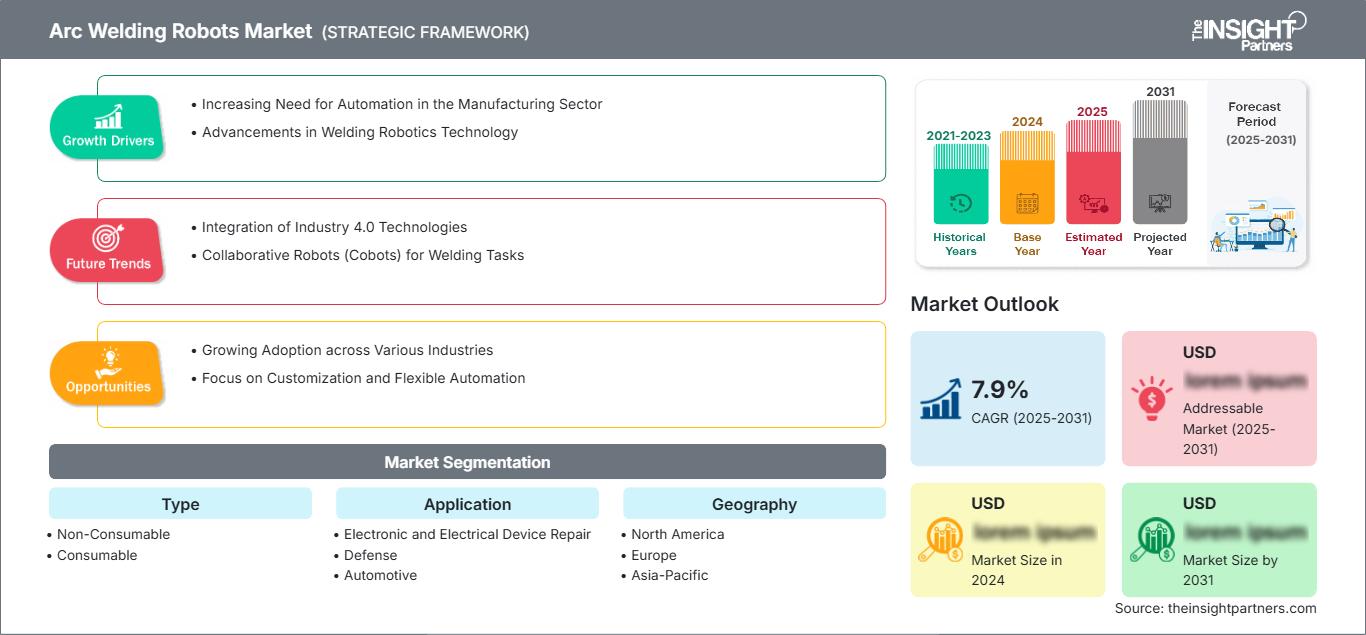
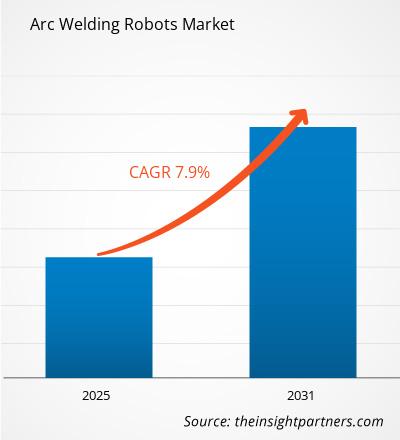
The Arc Welding Robots Market is valued at US$ 3.22 Billion in 2025 and is projected to reach US$ 4.1 Billion by 2034, registering a CAGR of 2.73% during 2026–2034. The market is driven by the demand for repeatable quality of welding, labor efficiency, and automation in the automotive industry, metal fabrication, defense equipment manufacture, and electrical assembly industry, where consistent arc control plays an integral role in productivity and economics of manufacturing.
North America is a strict automation market where the growth of the Arc Welding Robots Market Size is driven by the replacement of the old welding cells, shortage of qualified welders, and demands from automotive, defense equipment, and heavy machinery manufacturers. It is expected that the growth rate of the region will be within 2.5-3.1% per year for 2026-2034.
Arc Welding Robots Market Assessment and Insights
- North America: The region is estimated to hold 27–31% share in 2025 and grow at a CAGR of 2.5–3.1% during 2026–2034, supported by automotive reshoring, defense fabrication, and automation for skilled labor constraints.
- US: The country represents 78–82% of North America in 2025 and is projected to grow at a CAGR of 2.6–3.2% during 2026–2034, led by automotive and aerospace welding automation.
- Europe: Europe accounts for 24–28% share in 2025 and is expected to grow at a CAGR of 2.3–2.9% during 2026–2034. Germany, Italy, France, Spain, and the UK lead demand through automotive, machinery, and fabrication clusters.
- Asia Pacific: Asia Pacific represents 39–43% share in 2025 and is forecast to grow at a CAGR of 3.0–3.6% during 2026–2034, with China, Japan, South Korea, and India driving robot installations for vehicle and electronics manufacturing.
- Largest Segment: Consumable robots hold 72–76% market share in 2025 and are expected to grow at a CAGR of 2.7–3.3% during 2026–2034, reflecting widespread MIG and MAG welding use.
- High Growth Segment: Defense applications hold 8–11% market share in 2025 and are expected to grow at a CAGR of 3.4–4.0% during 2026–2034 as precision fabrication and domestic sourcing expand.
- Key companies analyzed in detail: ABB Ltd., Carl Cloos Schweisstechnik GmbH, FANUC Corporation, igm Robotersysteme AG, Jiangxi Danbahe Robot Co., Ltd., Kawasaki Heavy Industries, Ltd., KUKA AG, Nachi-Fujikoshi Corp., Panasonic Holdings Corporation, Yaskawa Electric Corporation.
Source: The Insight Partners' analysis based on proprietary research, government publications, company annual reports, investor presentations, industry databases, and expert interviews.
From a static system with high volume production cells, robotic arc welding is evolving into an advanced automation system incorporating servomotor driven manipulator systems, digital power sources, seam tracking and simulation software. The dynamics of manufacturing have been changed by reduced vehicle lifetimes, mixed material constructions and increased demands for traceable welds. Growth in the Arc Welding Robots Market will come from firms striving for reliable bead formation, reduced rework and a safer working environment using qualified welders for program development, inspection and complicated joints.
During the forecast period, demand will be expanded from vehicle body and chassis lines into heavy fabrication processes, defense construction, energy infrastructure and electronics repair processes. New geographic markets will adopt robotic cells as part of modular robots due to shorter deadlines and increased quality auditing at home factories. Safety concerns for workers, reshoring pressures and investments in industrial automation will provide justification for selective capital investment, particularly when robot performance is enhanced using offline programming and standardized fixtures.
Arc Welding Robots Market Report Scope
| Report Attribute | Details |
|---|---|
| Market size in 2025 | US$ 3.22 Billion |
| Market Size by 2034 | US$ 4.1 Billion |
| Global CAGR (2026 - 2034) | 2.73% |
| Historical Data | 2021-2024 |
| Forecast period | 2026-2034 |
Arc Welding Robots Market Analysis
Demand emanates from the necessity to produce consistently welded products since manual welding involves inconsistency, ergonomic issues, and production bottlenecks. Automotive firms continue to be essential buyers; however, SME fabricators have begun to use smaller cells because programming software, collaborative packages, and turnkey integrators make such an endeavor easier. The industry comprises robot makers, welding power sources providers, torch and wire feed makers, vision sensors suppliers, system integrators, and buyers who require consistent uptime.
The supply-side dynamics mirror those of other industries concerning industrial robots, according to the International Federation of Robotics, which highlighted 542,000 installations of industrial robots globally in 2024 as well as 4.664 million units installed at the time. Of these numbers, Asia contributed 74% of total installations, Europe 16%, and the Americas 9%. These numbers provide evidence for modeling the market size analysis for the Arc Welding Robots Market, where demand depends on welding needs that are based on automotive, metals, electronics, and machinery automation intensity and not just capacity expansions.
The competition is highly centered on global robot makers that have arm efficiency, reliability of controllers, welding packages, and services. ABB Ltd., FANUC Corporation, KUKA AG, Kawasaki Heavy Industries, Ltd., Yaskawa Electric Corporation, and Panasonic Holdings Corporation are key players in heavy duty operations, whereas Carl Cloos Schweisstechnik GmbH, igm Robotersysteme AG, Nachi-Fujikoshi Corp., and Jiangxi Danbahe Robot Co., Ltd. cater to specific welding automation needs.
Trends in investments are towards adaptive welding, data collection, and digital commissioning, as many of the users expect robots to take care of part variations with minimal retooling. Positioning trends indicate that there is going to be a trend towards the whole cell approach that includes the inclusion of the power source, torch cleaning, smoke extraction, safety systems, and software tools. Those vendors who minimize commissioning and training of operators are more likely to win better jobs.
● REPORT CUSTOMIZATION
Tailor This Report To Align With Your Specific Business Requirements
This report can be customized to align precisely with your business objectives, scope, and target markets. Customization options include tailored segmentation, geography, competitive analysis, and strategic insights to support informed decision-making.
Customize This Report →WHAT YOU CAN ADJUST
- ● Segmentations
- ● Geography
- ● Competitive Analysis
- ● Language Preferences
Arc Welding Robots Market: Strategic Insights
Regional Insights
North America Arc Welding Robots Market
North America holds an estimated 27–31% share in 2025 and is projected to expand at a CAGR of 2.5–3.1% during 2026–2034. The reasons behind the demand include the shortage of welding workers, refreshing of automotive platforms, and defense manufacturing projects with documented quality. Arc Welding Robots Market share in this region is also influenced by the strong integrator network as well as offline programming.
The focus on the part of manufacturers is now on the use of flexible welding cells that can be used for different products including commercial vehicles, farm equipment, trailers, and structures. Automation depends on the overall cost of welding rather than just the price of the robots. Canadian and Mexican plants play a role through their participation in the automobile chain, but the largest contribution comes from the US.
U.S. Arc Welding Robots Market
The US accounts for 78–82% of North American demand in 2025 and is expected to grow at a CAGR of 2.6–3.2% during 2026–2034. Users include automotive, aerospace, defense vehicles, and industrial equipment. The presence of companies such as ABB Ltd., FANUC Corporation, Yaskawa Electric Corporation, KUKA AG, and Kawasaki Heavy Industries, Ltd., enhances local expertise and support.
The technology is being deployed not only in conventional automotive cells but also in high-mix manufacturing processes, where the robots enable collaborative welding as well as easier path programming to compensate for the limited number of skilled welders. Robot technology is employed by defense contractors to ensure repeatability of manufacture of armored and mission-critical brackets. Repair facilities in the electronics and electrical sectors use smaller robots to create precise joints.
Europe Arc Welding Robots Market
Europe represents 24–28% share in 2025 and is projected to grow at a CAGR of 2.3–2.9% during 2026–2034. Germany leads owing to its automotive, machinery, and metal industries. The needs of the buyers of Germany include robot reliability, digital twin capability, and high welding quality, which makes KUKA AG, Carl Cloos Schweisstechnik GmbH, and igm Robotersysteme AG significant companies in the region.
The United Kingdom is characterized by automobile restoration, aerospace construction, and military manufacturing, with buyers desiring small-scale robot systems due to lack of adequate floor space. Italy gains due to machinery and metal furniture manufacturing, whereas France, Spain, and Central Europe help adopt robotics owing to railway industry, vehicles, and industrial equipment. Growth in Europe is slow since there is advanced automation already installed.
APAC Arc Welding Robots Market
APAC accounts for 39–43% share in 2025 and is expected to grow at a CAGR of 3.0–3.6% during 2026–2034. China leads the way, backed by massive robot deployments, supplier development, and production economies. Japan and South Korea continue to be highly automated countries in terms of automobiles and electronics; India is now automating more of its processes on vehicle chassis and metal fabrication.
Government policy favoring competitiveness in manufacturing, exports, and digitalization drives robot installations. Australia also participates in mining machinery and heavy fabrication applications. The region enjoys dense supplier networks in demand, but price sensitivity leaves room for local robots that offer satisfactory accuracy at reduced cost.
Middle East & Africa Arc Welding Robots Market
Middle East & Africa is expected to grow at a CAGR of 2.4–3.0% during 2026–2034. Saudi Arabia and UAE are leading the region in terms of adoption through oil and gas fabrication, infrastructure development, and industrial diversification initiatives. South Africa's contribution comes from automotive parts, mining machinery, and general engineering applications, whereas RoMEA's contribution continues to be project-driven.
Energy infrastructure development requires the need for repeated welding of structures such as frames, pipe support, tanks, and heavy structures. Nonetheless, factors limiting adoption include shallow integrators' presence and fluctuating capital budgeting. Suppliers who offer training services and robust diagnostics will make projects more viable, especially in areas where local maintenance capabilities are immature.
Segmentation Analysis
Type
Growth for the Type segment is expected to have a CAGR of 2.6–3.2% over the forecast period 2026–2034, owing to the configuration chosen by customers based on joint type, material thickness, consumable strategy, and uptime needs. In terms of scope, the most significant growth potential for the Arc Welding Robots Market lies in consumables since they apply to the auto industry, heavy fabrication, and other general industries.
- Non-consumable robots are used in TIG applications that need controlled heat input, clean welds, and high-quality joints. The application areas include electronic repair, assemblies of high precision, aerospace components, and thin materials.
- Consumable robots are used in applications such as MIG, MAG, and flux cored where deposition speed, consistent beads, and productivity are important considerations. Their importance is highest in automobile manufacturing, metal structures, trailers, and machinery.
Application
The Application section is forecasted to exhibit a CAGR of 2.8-3.4% between 2026 and 2034, as robotic systems find their utility in manufacturing, repairs, training, and high-value manufacturing. Automotive continues to be the key application area, yet defense and electrical repair become increasingly important owing to traceability, repeatability, and safety concerns with welded structures.
- Electronic and Electrical Device Repair applies arc welding robots for accurate assembly, repair of enclosures, and precise manufacturing, where repeatability helps reduce scrap and ensure quality in delicate assemblies.
- In the Defense Sector, reliable weld joints are needed for vehicles, frames, brackets, and enclosures. The application is facilitated by robots for repeatable manufacturing and process documentation by suppliers.
- The largest application area is the automotive industry, including chassis, exhaust, seat sub-assemblies, battery trays, and body parts. The demand for robots is connected with launch platforms and EV components.
- The Educational Sector is also becoming a more prominent application as welding robots are used by technical schools to educate operators, programmers, and maintenance personnel.
Opportunity Snapshot
| Application | Revenue Contribution (High/Medium/Low) | Trend Tag | Adoption Stage |
| Electronic and Electrical Device Repair | Medium | Precision Repair | Scaling |
| Defense | Medium | Certified Welds | Scaling |
| Automotive | High | EV Structures | Mature |
| Education Industry | Low | Skill Labs | Emerging |
| Others | Medium | Metal Fabrication | Scaling |
Arc Welding Robots Market Growth Drivers and Impact Analysis
Shortage of Qualified Welders and Rising Labor Costs
Robotic welding is being embraced by manufacturers due to the continued shortage of skilled welders in terms of recruiting and deployment for repetitive operations. This trend is most prevalent among automotive suppliers, trailer manufacturers, metal structures manufacturing plants, and defense manufacturers who require a consistent performance across several shifts. Robotic welding does not remove the need for welders at all; however, it changes the skill requirements from one based on welding proficiency to one where the emphasis is on programming, fixtures, inspections, and maintenance. Such an approach enables the skilled welders to oversee more products without the risks associated with exposure to fumes, heat, and repetitive body postures.
Need for Weld Consistency in Automotive and Heavy Fabrication
Expectations for quality continue to grow due to the increased criticality of the welds and increased documentation required for safety reasons. Welds for automotive battery cases, seating structures, chassis assemblies, farming equipment, and military parts demand consistent bead formation, penetration control, and low defect frequency. Robotic cells can maintain consistency in terms of travel speed, torch angles, and wire feeding. Market influence will be greater when there is downstream inspection, warranty costs, or rework associated with the weld. Consistency will help in implementing a lean system as consistent weld quality will remove the bottleneck in grinding and inspection and eventually final assembly.
Expansion of Digital Welding Cells and Offline Programming
Advances in technology, such as simulation, offline programming, and digital twins, make it possible for businesses to cut down on setup time, which in turn makes automation feasible even at small batch volumes. Engineers can validate their welding robot motion paths without halting the work cell, while welding data ensures traceability and continual improvements. The relevance of this driver becomes obvious when suppliers are dealing with shortened product life cycles and constant engineering changeovers. Robots are not limited only to long production series – cells can be used for other products without losing much time on it. In addition, it has an effect on education and training of employees since learners will be able to understand the principles of programming in advance through virtual machines.
Arc Welding Robots Market Future Trends
Adaptive Welding with Vision and Real-Time Process Control
Future Arc Welding Robots Market trends will be shaped by adaptive systems that use laser vision, through-arc sensing, and AI-assisted parameter adjustment to manage part variation. Such a feature would prove very useful in steel fabrication, shipbuilding, military structures, and construction machinery, where the presence of gaps and fit-ups makes it difficult to automate such processes. Adaptive control would enable robots to adjust the positions, speeds, and energy inputs for welding operations without having to reject work pieces or fix mistakes manually. As sensors become cheaper and computing power increases, adaptive welding could prove to be a viable upgrade option for robotic fleets already in use.
Collaborative Welding Cells for Small and Medium Fabricators
Compact and collaborative welding cells will allow for more automation among companies lacking space, money, or specialized engineers to implement fence-type automation. Cells will incorporate easy-to-use teaching methods, safety-engineered designs, and pre-welding package integration, thereby being applicable for job shops, repair shops, and educational institutions. The trend will not replace welding robots used in production in large-scale factories, but it will increase the addressable customer market. Implementation will require practical selection of applications, good fixtures, and proper training of operators. Companies that provide not only robots but also financing and services will have an easier time convincing companies to automate.
Arc Welding Robots Market Opportunities
Automation of Defense and Energy Fabrication Supply Chains
Defense and energy infrastructure create opportunities for suppliers that can deliver repeatable welding, documentation, and secure local support. The Arc Welding Robots Market Forecasts point toward selective investment in armored vehicles, offshore structures, renewable energy frames, power equipment, and pipeline support assemblies. These types of applications tend to include thicker materials, stringent processes, and costly inspections, making automation worthwhile in cases where cells are designed based on family of parts rather than individual products. Robot manufacturers and integrators have the potential to take up projects through providing process development, operator training, and data capture consistent with procurement auditing. This is particularly possible in regions where governments encourage manufacturing resilience and supplier qualification.
Retrofitting Installed Welding Lines with Sensors and Software
There are factories that have robots doing their welding operations but do not have sensors, analytics, and offline programming. It is more prudent to enhance existing cells through retrofit rather than replacing them, particularly for those under cost constraints. Enhancement would involve the incorporation of seam tracking systems, torch management systems, weld monitoring, simulation software, and controllers among others that increase efficiency and improve visibility of the process. The best fit for this would be the existing robot manufacturers with an established customer base and technology providers whose systems work with all types of robots.
Recent Developments
- May 2026: HD Hyundai Robotics has made a full-scale entry into the U.S. shipyard automation market and established a strategic foothold for expanding its global shipbuilding automation business. This was driven through HD Hyundai Robotics USA, Inc., the company's U.S. subsidiary based in Duluth, Georgia, which led on-the-ground business development and project coordination with Chouest Group.
- July 2026: Miller Electric Mfg. LLC, a leading worldwide manufacturer of Miller brand arc welding equipment, announced a free product upgrade for the Millermatic 211 PRO and Multimatic 215 PRO. The upgrade adds new capabilities, including Dyna-Pulse technology never before available from Miller in this amp class, to machines already in welders' shops. The upgrade is delivered through a quick USB-enabled software download at no additional cost.
- June 2026: ESAB Corp., a focused industrial compounder in North Bethesda, Md., has signed a definitive agreement to acquire EWM GmbH, a Germany-based provider of heavy industrial arc welding equipment and advanced automation. According to ESAB, the acquisition addresses its product gaps in heavy equipment and strengthens its technological capabilities.
Frequently Asked Questions

- Comprehensive Market Sizing and Forecast Analysis
- Detailed Segmentation Analysis
- In-Depth Market Dynamics Assessment
- Regional and Country-Level Insights
- Competitive Landscape and Company Benchmarking
- Strategic Business Intelligence
Recent Reports
Testimonials

The Insight Partners' SCADA System Market report is comprehensive, with valuable insights on current trends and future forecasts. The team was highly professional, responsive, and supportive throughout. We are very satisfied and highly recommend their services.
RAN KEDEM Partner, Reali Technologies LTDs
I requested a report on a very specific software market and the team produced the report in a few days. The information was very relevant and well presented. I then requested some changes and additions to the report. The team was again very responsive and I got the final report in less than a week.
JEAN-HERVE JENN Chairman, Future Analytica
We worked with The Insight Partners for an important market study and forecast. They gave us clear insights into opportunities and risks, which helped shape our plans. Their research was easy to use and based on solid data. It helped us make smart, confident decisions. We highly recommend them.
PIYUSH NAGPAL Sr. Vice President, High Beam Global
The Insight Partners delivered insightful, well-structured market research with strong domain expertise. Their team was professional and responsive throughout. The user-friendly website made accessing industry reports seamless. We highly recommend them for reliable, high-quality research services
YUKIHIKO ADACHI CEO, Deep Blue, LLC.
This is the first time I have purchased a market report from The Insight Partners.While I was unsure at first, I visited their web site and felt more comfortable to take the risk and purchase a market report.I am completely satisfied with the quality of the report and customer service. I had several questions and comments with the initial report, but after a couple of dialogs over email with their analyst I believe I have a report that I can use as input to our strategic planning process.Thank you so much for taking the extra time and making this a positive experience.I will definitely recommend your service to others and you will be my first call when we need further market data.
JOHN SUZUKI President and Chief Executive Officer, Board Director, BK Technologies
I wish to appreciate your support and the professionalism you displayed in the course of attending to my request for information regarding to infectious disease IVD market in Nigeria. I appreciate your patience, your guidance, and the fact that you were willing to offer a discount, which eventually made it possible for us to close a deal. I look forward to engaging The Insight Partners in the future, all thanks to the impression you have created in me as a result of this first encounter.
DR CHIJIOKE ONYIA MANAGING DIRECTOR, PineCrest Healthcare Ltd.Reason to Buy
- Informed Decision-Making
- Understanding Market Dynamics
- Competitive Analysis
- Identifying Emerging Markets
- Customer Insights
- Market Forecasts
- Risk Mitigation
- Boosting Operational Efficiency
- Strategic Planning
- Investment Justification
- Tracking Industry Innovations
- Aligning with Regulatory Trends





 Get Free Sample for