
Arthroscopy Forceps Market Size, Trends & Growth by 2034
Coverage: By Type (Straight, Curved); Application (Hospital, Clinic, Others) , and Geography (North America, Europe, Asia Pacific, and South and Central America)
- Status : Data Released
- Report Code : TIPRE00018023
- Category : Life Sciences
- No. of Pages : 150
- Available Report Formats :


- Last update date : September 09, 2026


2025 Market Size
US$ 730.7 Mn
Base year value
2034 Forecast
US$ 1,227.17 Mn
Projected by 2034
CAGR 2026-2034
5.93 %
Growth rate
Addressable Market
US$ 8,868.90 Mn
(2026-2034)
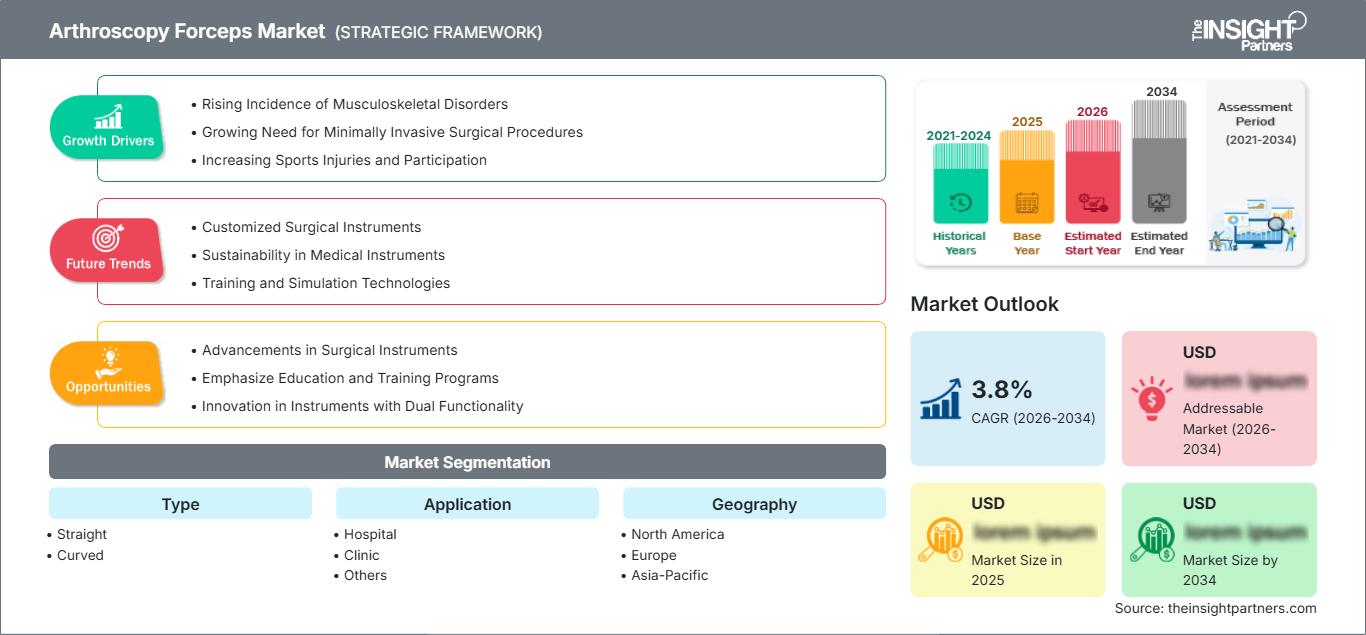
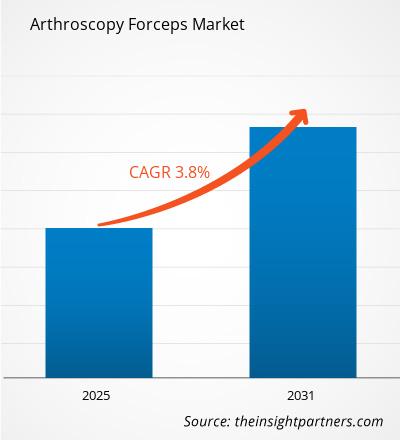
The arthroscopy forceps market is positioned for sustained expansion as minimally invasive orthopedic procedures gain wider acceptance across hospitals, clinics, and ambulatory settings. The market is valued at US$ 730.7 Million in 2025 and is projected to reach US$ 1,227.17 Million by 2034, registering a CAGR of 5.93% during 2026–2034. Demand is supported by procedural standardization, instrument innovation, increasing arthroscopic interventions, and continued preference for tissue-sparing surgical techniques.
North America is expected to remain a structurally important regional market, supported by established orthopedic infrastructure, high surgeon familiarity with arthroscopic techniques, and strong adoption of specialized hand instruments. The arthroscopy forceps market size is expected to expand at an estimated 5.7–6.5% CAGR during 2026–2034. Replacement demand, outpatient migration, and investments in reusable and precision-engineered instruments should sustain purchasing activity across the region.
Arthroscopy Forceps Market Assessment and Insights
- North America: North America is expected to account for a 38–42% arthroscopy forceps market share in 2025 and expand at a 5.7–6.5% CAGR between 2026–2034, supported by mature orthopedic services, established ambulatory surgery infrastructure, and consistent instrument replacement demand.
- US: The US is estimated to represent 76–80% of North American revenue in 2025, growing at a 5.6–6.4% CAGR during 2026–2034 as outpatient orthopedic procedures and sports medicine applications expand.
- Europe: Europe is projected to hold a 27–31% share in 2025 and grow at a 5.4–6.2% CAGR through 2034, led by Germany, the UK, France, Italy, and Spain, with demand supported by hospital modernization and specialist orthopedic care.
- Asia Pacific: Asia Pacific is estimated at a 19–23% share in 2025 and is expected to register a 6.5–7.4% CAGR through 2034, led by China, Japan, South Korea, and India as surgical capacity and minimally invasive adoption increase.
- Largest Segment: Straight forceps are expected to represent a 56–61% market share in 2025, growing at a 5.4–6.1% CAGR through 2034 because of broad procedural utility and established surgeon familiarity.
- High Growth Segment: Curved forceps are estimated at a 39–44% market share in 2025 and are expected to grow at a 6.4–7.3% CAGR through 2034, supported by access requirements in anatomically constrained areas.
- Key companies analyzed in detail: Arthrex, Endoscopy Superstore, Millennium Surgical, Medline Industries, Inc., ADVIN Healthcare, Stryker Corporation, Orient Medical, Sklar Corporation, Quintuple International, KARL STORZ SE & Co. KG.
Source: The Insight Partners' analysis based on proprietary research, government publications, company annual reports, investor presentations, industry databases, and expert interviews.
Product design in the arthroscopy forceps market has progressed beyond the realm of traditional graspers and cutters that are reusable to include products designed specifically with small joint spaces, ergonomic design, and reproducibility of tissue manipulation in mind. Differentiation is achieved by way of shaft design, jaw articulation, tip design, surface finish, and sterilization compatibility. For instance, Arthrex offers low-profile arthroscopic hand instruments with a range of shafts, as well as nano-scale instruments for challenging anatomies.
In terms of future product design considerations, emphasis should be placed on procedural efficiency, small access sizes, and visualization platforms. Investment is expected in emerging markets, which is driven by the growth of capabilities in orthopedics, while regulatory constraints regarding device reprocessing and sterilization validation will also continue to shape the design considerations. The convergence of outpatient surgeries and technology innovation presents opportunities for instrument differentiation.
Arthroscopy Forceps Market Report Scope
| Report Attribute | Details |
|---|---|
| Market size in 2025 | US$ 730.7 Million |
| Market Size by 2034 | US$ 1,227.17 Million |
| Global CAGR (2026 - 2034) | 5.93% |
| Historical Data | 2021-2024 |
| Forecast period | 2026-2034 |
Arthroscopy Forceps Market Analysis
Market growth in the arthroscopy forceps market will be driven by increased usage of minimally invasive techniques, greater need for precision manipulation of tissues, and procedural specialization. The value chain covers suppliers of stainless steel and engineering materials, manufacturing process, including precision machining, finishing, assembly, sterilization validation, distribution, and hospital procurement. Forceps suppliers compete with each other in terms of durability, jaw precision, ergonomics, shaft design, and compatibility with existing arthroscopy procedures.
In addition, the increase in the usage of ambulatory orthopedic procedures will also affect market dynamics. Hospitals and surgery centers start evaluating surgical tools based on their entire lifecycle cost rather than the purchase price only. Reusable forceps can provide the possibility for several procedures to be performed if effective cleaning and maintenance system is in place, while single use or limited use types can become more attractive due to their better contamination protection and faster turnaround times.
Arthroscopy manufacturers, surgical-device diversified firms, and instrument distributors represent the market structure of the industry. Arthrex provides a wide range of arthroscopy products, while Stryker offers hand instruments along with its resection, fluid management, visualization and sports medicine technologies. KARL STORZ offers arthroscopy systems covering visualization, hand instruments, fluid management, and energy technologies.
The arthroscopy forceps market report shows that competitive strategy in the industry requires portfolio diversification, surgeons' training, distribution system, and bundling of instruments into overall orthopedic procedures. Medline Industries, Inc. has a great opportunity to leverage its extensive capabilities in surgical instruments distribution. Sklar Corporation and specialty manufacturers provide reusable instruments. The results of market analysis reveal that companies that invest in small joint access, ergonomic designs, and digitalized surgical platform will be able to differentiate themselves.
● REPORT CUSTOMIZATION
Tailor This Report To Align With Your Specific Business Requirements
This report can be customized to align precisely with your business objectives, scope, and target markets. Customization options include tailored segmentation, geography, competitive analysis, and strategic insights to support informed decision-making.
Customize This Report →WHAT YOU CAN ADJUST
- ● Segmentations
- ● Geography
- ● Competitive Analysis
- ● Language Preferences
Arthroscopy Forceps Market: Strategic Insights
Regional Insights
North America arthroscopy forceps market
North America is estimated to command a 38–42% arthroscopy forceps market share in 2025 and register a 5.7–6.5% CAGR through 2034. It is advantageous in having strong arthroscopy services, orthopedic surgeons per capita, advanced ambulatory surgery facilities, and procurement networks. The market for this country dominates the US market, while Canada provides through their specialist centers and increasing capabilities for minimally invasive treatments.
The replacement process plays a crucial role in this aspect since forceps are subject to continuous mechanical loading, cleaning, sterilization, and handling. Hospital evaluation includes the performance over its lifetime, repair capability, and compatibility with processing. Key applications include sports medicine, knees, shoulders, and small joint procedures. Competing companies like Arthrex and Stryker rely on their wide procedural offerings, while specialists help in procurement flexibility.
U.S. arthroscopy forceps market
The US is estimated to contribute 76–80% of North American revenue in 2025, with a 5.6–6.4% CAGR through 2034. Orthopedic specialty, ambulatory surgical procedures, and usage of sports medicine all indicate the presence of regular demand. Arthrex and Stryker both have strong geographical coverage in the United States, while Medline Industries, Inc. and other specialists have wider coverage of institutional demand.
Usage demand is limited to knee and shoulder arthroscopy, with more emphasis on the use of small joint and ergonomics instrumentation. Companies are also stressing accuracy and speed of procedure. Arthrex provides different sized arthroscopic instrument shafts and nanoscale instruments for use in small joints, while Stryker has arthroscopy, resection, and fluid management system.
Europe arthroscopy forceps market
Europe is projected to hold a 27–31% of the arthroscopy forceps market in 2025 and grow at a 5.4–6.2% CAGR through 2034. Germany is anticipated to remain the top national market due to its well-developed surgical facility and home-grown manufacturing capability of medical devices. The UK and France generate demands through their well-developed orthopedics facilities, while Italy and Spain are contributing towards their demands through the growing minimally invasive surgery facility.
UK is benefited by its organized healthcare system and increased pressure on improving its surgical operations which in turn generates demand for durable instruments. In case of Germany, its highly developed hospital system along with home-grown manufacturing capability like that of KARL STORZ supports the growth of the market. On the other hand, France, Italy, and Spain have adopted arthroscopy in knee, shoulder, and sports medicine surgeries.
APAC arthroscopy forceps market
APAC is estimated to represent a 19–23% arthroscopy forceps market share in 2025 and expand at a 6.5–7.4% CAGR through 2034. Leading this would be China, then Japan, South Korea, India, and Australia. Orthopedic capacity building, increased procedure counts, device localization, and training contribute to the region's adoption of the product.
China and India offer significant volume potential over the long term, Japan and South Korea have technologically advanced needs, and Australia has a tradition of orthopedic procedures and hospitals. Investment in surgical capacity development as well as increased awareness of minimally invasive surgery should allow for purchase of forceps. It is important to develop local distribution partners since procurement practices vary significantly across APAC markets.
Middle East & Africa arthroscopy forceps market
The Middle East and Africa represent a smaller but developing opportunity, with Saudi Arabia expected to lead regional demand. Saudi Arabia and the UAE are investing in advanced hospital infrastructure, while South Africa remains an important gateway for specialized orthopedic services. The region is projected to expand at a 5.1–6.0% CAGR through 2034.
Healthcare modernization, medical-tourism development, and investments in tertiary hospitals support adoption of arthroscopic procedures. Saudi Arabia's healthcare transformation agenda and the UAE's specialist-care infrastructure can facilitate demand for premium surgical instruments. In Africa, procurement remains more price-sensitive, making durable reusable forceps and dependable distribution particularly relevant. Rest of MEA markets are likely to progress more gradually as specialist capacity expands.
Segmentation Analysis
Type
The Type segment is expected to register a 5.6–6.4% CAGR during 2026–2034. Selection depends on joint anatomy, portal positioning, tissue location, and required manipulation angle. Straight designs retain broad utility across routine procedures, while curved configurations provide improved reach around anatomical contours and difficult-to-access structures. Product differentiation increasingly focuses on jaw control, shaft strength, handle ergonomics, and low-profile construction.
- Straight: Straight forceps remain the primary configuration for routine arthroscopic manipulation because their direct geometry supports predictable handling. They are widely suited to general tissue grasping, retrieval, and resection workflows.
- Curved: Curved forceps provide improved access around joint contours and constrained anatomy. Their angled geometry can reduce instrument repositioning and support precision during procedures requiring reach beyond a direct portal trajectory.
Application
The Application segment is projected to grow at a 5.8–6.6% CAGR through 2034. Hospitals remain central purchasers because of their broad procedural mix and established sterilization infrastructure. Clinics are increasingly relevant where specialist orthopedic services are provided in dedicated settings, while other applications represent fragmented demand across specialized facilities and procedure environments.
- Hospital: Hospitals maintain a broad requirement for arthroscopy forceps because they perform diverse orthopedic procedures and generally maintain centralized instrument processing, inventory management, and procurement systems.
- Clinic: Clinics increasingly adopt specialized instruments as orthopedic care shifts toward focused outpatient environments. Demand favors compact, ergonomic products that support efficient procedures without requiring extensive instrument inventories.
- Others: Other facilities create niche demand through specialized orthopedic, sports medicine, and procedural settings. Purchasing decisions are typically influenced by portability, availability, compatibility, and straightforward instrument processing.
Opportunity Snapshot
| Application | Revenue Contribution (High/Medium/Low) | Trend Tag | Adoption Stage |
|---|---|---|---|
| Hospital | High | Complex Arthroscopy | Mature |
| Clinic | Medium | Outpatient Care | Scaling |
| Others | Low | Specialty Access | Emerging |
Arthroscopy Forceps Market Growth Drivers and Impact Analysis
Expansion of Outpatient Orthopedic Surgery
The migration of appropriate orthopedic surgical procedures from hospital inpatient departments to the ambulatory setting is contributing to an expanding market of purchasers of compact surgical instruments. In the outpatient setting, the requirements involve reliable instrument assembly, quick changeover, ergonomics, and sterilization compatibility. On one hand, this development will likely result in higher demand for standard forceps shapes; on the other hand, it will also create incentives for suppliers to produce compact instrument sets designed specifically for high volume procedures. From the perspective of the manufacturers, this shift has implications beyond just sales, as the use of outpatient facilities may lead to the need to maintain separate inventories of instruments that are not only sourced from the central hospital instrument inventory.
Increasing Procedural Specialization in Arthroscopy
The arthroscopy technique is becoming more specialized within knee joint, shoulder joint, hip joint and small joint procedures, hence creating a greater need for surgical instruments that take into consideration the anatomical specifics. Generic forceps are still relevant, but the specialist orthopedic surgeons are in need of forceps that have different lengths of shafts, jaw forms, curvatures and handles. Such specialization brings about an opportunity for suppliers to diversify their products and not only compete in prices. In addition, there is an increase in the relevance of the feedback given by the surgeons in the design process of the products, since even the smallest differences in the form of the instrument may affect the access, visualization and tissue manipulation.
Demand for Durable and Reprocessing-Compatible Instruments
Lifecycle economics have come to be emphasized more by hospitals as they try to take care of the costs involved in maintaining, cleaning, repairing, and replacing instruments used in their surgeries. Forceps which will retain their capability to keep jaws together, cutting efficiency, and mechanical stability after numerous cycles of being processed will offer economic benefits, even if they have higher acquisition costs initially. Such an environment will create pressure on manufacturers to make improvements in the choice of stainless steel, jointing, surface finish, and handle design. It will also create opportunities for creating a differentiation strategy on documentation, reprocessing guidance, repair, and traceability. This aspect is especially true in mature markets where procurement teams consider total cost of ownership rather than just acquisition cost.
Arthroscopy Forceps Market Future Trends
Miniaturization and Nano-Scale Instrumentation
arthroscopy forceps market trends are increasingly moving toward miniaturized instrumentation designed for smaller portals and anatomically constrained joint spaces. Nano-scale arthroscopy demonstrates how reduced instrument diameter can support access while preserving visualization and procedural control. Arthrex's Nano platform includes 2 mm instruments and a 1.9 mm NanoNeedle scope, illustrating the direction of development toward smaller, minimally invasive systems. Future forceps are likely to incorporate slimmer shafts, refined jaw mechanisms, improved articulation, and application-specific geometry. Such designs may broaden arthroscopy in small joints and pediatric procedures while supporting diagnostic and operative workflows outside traditional operating rooms. The trend could also increase demand for single-use sterile instrumentation where instrument turnaround and contamination control are important.
Integration With Digitally Enabled Surgical Workflows
Digital planning, advanced visualization, and navigation technologies are likely to influence forceps development by creating more data-driven procedural workflows. Smith+Nephew's TESSA Spatial Surgery System, which received FDA De Novo classification in July 2026, combines imaging, augmented reality, navigation, tracking, and patient-specific planning for sports medicine procedures. Although forceps remain mechanical instruments, their future value proposition may increasingly depend on compatibility with digitally enabled procedures and standardized surgical techniques. Manufacturers can respond by improving instrument identification, procedural integration, and ergonomic consistency. As visualization and navigation systems become more sophisticated, precise manual instruments may become increasingly important complements rather than substitutes, especially during tissue manipulation and repair.
Arthroscopy Forceps Market Opportunities
Expansion of Specialist Instrument Portfolios in Emerging Markets
arthroscopy forceps market Forecasts indicate that emerging markets can provide attractive opportunities for manufacturers that combine specialist products with localized distribution and training. China, India, Southeast Asia, and selected Middle Eastern markets are expanding orthopedic capabilities, but procurement environments vary considerably. Companies can address these differences through tiered product portfolios, regional distributor partnerships, localized technical support, and surgeon education. Rather than replicating mature-market offerings, suppliers can prioritize high-utilization straight configurations while progressively introducing curved and specialized designs. Local inventory availability can also reduce procurement delays and improve customer confidence. Strategic partnerships with hospitals and orthopedic centers can provide feedback on procedural preferences and enable manufacturers to refine product configurations for local requirements. This approach can create scalable market entry while controlling regulatory and commercialization complexity.
Lifecycle Services and Instrument Management Solutions
An additional opportunity lies in combining forceps sales with lifecycle services covering inspection, maintenance, repair, refurbishment, and inventory optimization. Hospitals increasingly need to control operating-room costs while maintaining reliable instrument availability. A service-led model can create recurring relationships and provide manufacturers with insight into instrument utilization, failure patterns, and replacement timing. Suppliers can use these insights to improve product design and forecast demand more accurately. Digital instrument tracking can further support inventory visibility and reprocessing documentation. For distributors, bundled service contracts can differentiate otherwise comparable products and strengthen retention. Manufacturers with established technical capabilities can also use refurbishment programs to address cost-sensitive markets without abandoning premium product positioning. This model is particularly relevant where reusable forceps remain central to routine arthroscopic procedures.
Recent Developments
- July 2026: Smith+Nephew received FDA De Novo classification for its TESSA Spatial Surgery System, introducing a new regulatory category for intra-articular orthopedic stereotaxic navigation instruments. The system combines patient-specific 3D anatomical models, augmented reality, imaging, navigation, and real-time tracking, initially supporting ACL reconstruction and expanding the digital technology layer surrounding arthroscopic procedures.
- September 2025: Arthrex announced the first clinical case using its NanoNeedle Scope 2.0, a next-generation minimally invasive visualization platform. The 1.9 mm device incorporates a 720 × 720 sensor and was cleared for pediatric orthopedic use in the US. The launch reinforces the industry's movement toward smaller visualization and instrumentation platforms for anatomically constrained procedures.
- June 2025: Arthrex launched the Synergy Power System, a battery-powered platform designed for orthopedic applications including sports medicine, arthroplasty, trauma, and distal extremities. The system includes rotary drill and sagittal saw handpieces, with components assembled in the US. The development illustrates continued investment in integrated, ergonomic powered instrumentation supporting broader orthopedic procedural workflows.
Frequently Asked Questions

- Comprehensive Market Sizing and Forecast Analysis
- Detailed Segmentation Analysis
- In-Depth Market Dynamics Assessment
- Regional and Country-Level Insights
- Competitive Landscape and Company Benchmarking
- Strategic Business Intelligence
Recent Reports
Testimonials

The Insight Partners provided valuable market intelligence that supported our global go-to-market strategy. Their team was professional, responsive, and attentive to our feedback, providing thoughtful analysis and helpful methodological clarifications throughout the project.
Junmo Kim Chief Financial Officer (CFO), Enertech Co., Ltd.
The Insight Partners' SCADA System Market report is comprehensive, with valuable insights on current trends and future forecasts. The team was highly professional, responsive, and supportive throughout. We are very satisfied and highly recommend their services.
RAN KEDEM Partner, Reali Technologies LTDs
I requested a report on a very specific software market and the team produced the report in a few days. The information was very relevant and well presented. I then requested some changes and additions to the report. The team was again very responsive and I got the final report in less than a week.
JEAN-HERVE JENN Chairman, Future Analytica
We worked with The Insight Partners for an important market study and forecast. They gave us clear insights into opportunities and risks, which helped shape our plans. Their research was easy to use and based on solid data. It helped us make smart, confident decisions. We highly recommend them.
PIYUSH NAGPAL Sr. Vice President, High Beam Global
The Insight Partners delivered insightful, well-structured market research with strong domain expertise. Their team was professional and responsive throughout. The user-friendly website made accessing industry reports seamless. We highly recommend them for reliable, high-quality research services
YUKIHIKO ADACHI CEO, Deep Blue, LLC.
This is the first time I have purchased a market report from The Insight Partners.While I was unsure at first, I visited their web site and felt more comfortable to take the risk and purchase a market report.I am completely satisfied with the quality of the report and customer service. I had several questions and comments with the initial report, but after a couple of dialogs over email with their analyst I believe I have a report that I can use as input to our strategic planning process.Thank you so much for taking the extra time and making this a positive experience.I will definitely recommend your service to others and you will be my first call when we need further market data.
JOHN SUZUKI President and Chief Executive Officer, Board Director, BK Technologies
I wish to appreciate your support and the professionalism you displayed in the course of attending to my request for information regarding to infectious disease IVD market in Nigeria. I appreciate your patience, your guidance, and the fact that you were willing to offer a discount, which eventually made it possible for us to close a deal. I look forward to engaging The Insight Partners in the future, all thanks to the impression you have created in me as a result of this first encounter.
DR CHIJIOKE ONYIA MANAGING DIRECTOR, PineCrest Healthcare Ltd.Reason to Buy
- Informed Decision-Making
- Understanding Market Dynamics
- Competitive Analysis
- Identifying Emerging Markets
- Customer Insights
- Market Forecasts
- Risk Mitigation
- Boosting Operational Efficiency
- Strategic Planning
- Investment Justification
- Tracking Industry Innovations
- Aligning with Regulatory Trends





 Get Free Sample for