
Articulated Hauler Market Size, Growth & Demand by 2034
Coverage: By Payload Capacity (Below 30 Tons, 30-40 Tons, Above 40 Tons); Engine Power (Up to 400 HP, 400-500 HP, More Than 500 HP); End-user (Mining, Construction, Forest and Agriculture), and Geography (North America, Europe, Asia Pacific, and South and Central America)
- Status : Data Released
- Report Code : TIPRE00017107
- Category : Automotive and Transportation
- No. of Pages : 150
- Available Report Formats :


- Last update date : September 01, 2026


2025 Market Size
US$ 12.25 Bn
Base year value
2034 Forecast
US$ 24.29 Bn
Projected by 2034
CAGR 2026-2034
7.91 %
Growth rate
Addressable Market
US$ 164.45 Bn
(2026-2034)
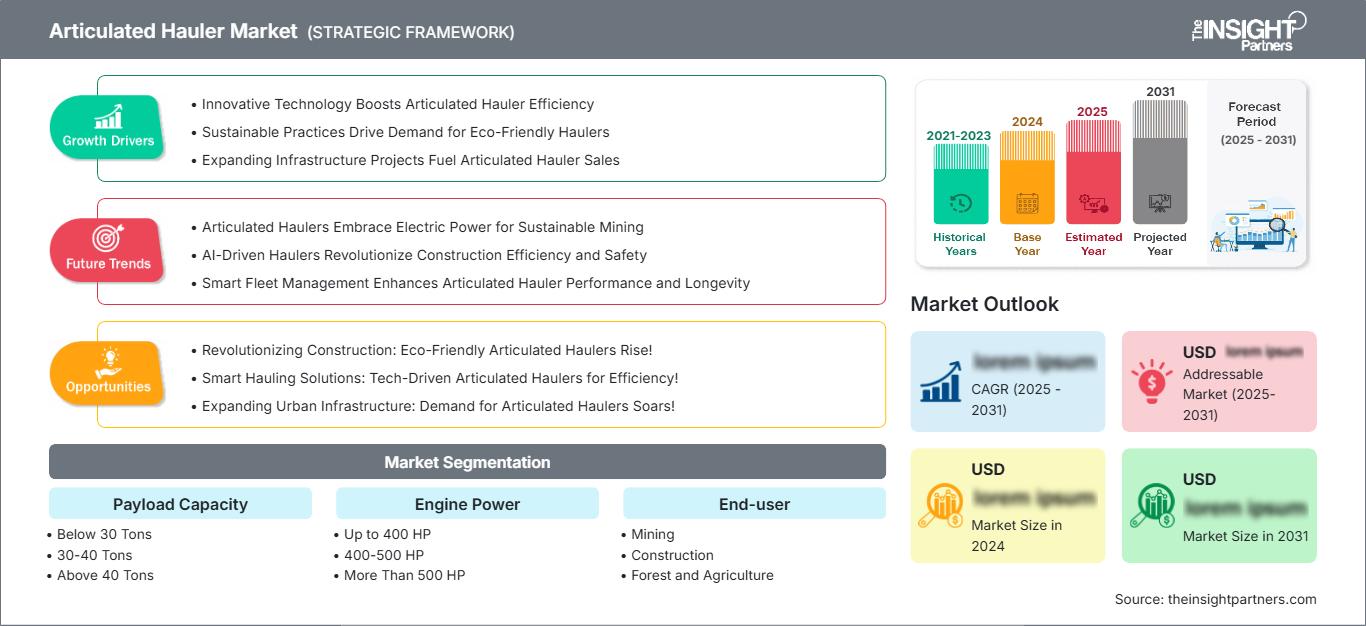
The articulated hauler market is projected to grow from US$ 12.25 billion in 2025 to US$ 24.29 Billion by 2034, recording a CAGR of 7.91% during 2026–2034. Demand is supported by above-ground mining, large earthmoving projects, quarry expansion, and contractor preference for high-traction hauling equipment that can operate on soft, uneven, and temporary haul roads without extensive civil preparation.
North America remains a structurally important demand center, with the articulated hauler market size supported by infrastructure renewal, quarry output, energy site preparation, and replacement of aging fleets. The region is estimated to expand at a CAGR range of 7.3–7.8% during 2026–2034, helped by rental penetration, telematics-based fleet control, and emission-compliant equipment procurement across the U.S. and Canada.
Articulated Hauler Market Assessment and Insights
- North America accounted for 30–33% share in 2025 and is expected to grow at a CAGR range of 7.3–7.8% between 2026–2034, led by infrastructure rebuilding, quarry hauling, and rental-fleet refresh cycles.
- The US accounted for 78–82% of North America in 2025 and is projected to grow at a CAGR of 7.4–7.9% between 2026–2034, supported by road, aggregate, and site-preparation activity.
- Europe held 23–26% share in 2025 and is forecast to grow at a CAGR range of 6.8–7.4% between 2026–2034, with Germany, the UK, France, Italy, and Spain leading replacement demand.
- Asia Pacific captured 28–31% share in 2025 and is anticipated to grow at a CAGR range of 8.4–9.1% between 2026–2034, led by China, India, Australia, Japan, and South Korea.
- Largest Segment: Construction held 48–52% market share in 2025 and is expected to grow at a CAGR range of 7.5–8.0% between 2026–2034, driven by infrastructure earthmoving and aggregates movement.
- High Growth Segment: Mining held 30–34% market share in 2025 and is expected to grow at a CAGR range of 8.2–8.8% between 2026–2034, supported by critical minerals extraction and overburden removal.
- Key companies analyzed in detail: AB Volvo, Bell Trucks America, Inc., Caterpillar Inc., CNH Industrial N.V., Deere & Company, HD Hyundai Infracore Co., Ltd., Komatsu Ltd., Liebherr-International Deutschland GmbH, SANY Group Co., Ltd., Rokbak Limited.
Source: The Insight Partners' analysis based on proprietary research, government publications, company annual reports, investor presentations, industry databases, and expert interviews.
The progression of equipment has gone from mechanical robustness to productivity analytics, automatic traction, load management systems, and operator assistance systems. The OEMs are now redesigning haulers for fuel consumption reduction, better load management, and safe downhill operations as well as adjusting their production capabilities according to emission norms, price volatility of steel, and regional lead times for deliveries. This market is also experiencing benefits from modular transmission system design, which can allow integrating future low-emission powertrains without compromising the performance of rugged terrain machines.
Regarding future trends, purchasing is likely to go into lifecycle costs instead of the acquisition price of equipment. Some additional demand may come from emerging economies of Asia Pacific, selected mining corridors of Africa, and some zones of Middle East infrastructure, as the replacement demand in Europe and North America will prevail. There will also be positive regulatory winds regarding the reduction of emissions, increased safety of workplaces, and digitalized maintenance records in favor of OEMs with fleet connectivity, a broad dealer network, and high parts availability.
Articulated Hauler Market Report Scope
| Report Attribute | Details |
|---|---|
| Market size in 2025 | US$ 12.25 Billion |
| Market Size by 2034 | US$ 24.29 Billion |
| Global CAGR (2026 - 2034) | 7.91% |
| Historical Data | 2021-2024 |
| Forecast period | 2026-2034 |
Articulated Hauler Market Analysis
Large earthmoving projects are becoming more schedule-sensitive, increasing demand for machines that can move material reliably across unpaved haul routes. In that setting, articulated hauler market growth is linked to quarry output, highway expansion, renewable-energy site development, and mine stripping ratios. Customers increasingly evaluate cost per ton, fuel consumed per cycle, tire wear, and uptime rather than nominal payload alone.
The value chain includes suppliers of engines, drivelines, hydraulic systems, sensors, telematics, dealers, rental companies, and maintenance services. The supply situation continues to be influenced by engines’ emissions compliance, transmissions, tires, and high-strength steel. Moreover, the fleet operators are now utilizing remote diagnostics in order to minimize idling and arrange preventive maintenance before machinery breakdowns stop mining or construction operations.
Competition is concentrated among established manufacturers with dealer scale and model breadth. In articulated hauler market analysis, AB Volvo and Caterpillar Inc. compete strongly on technology, parts coverage, and high-volume installed base, while Bell Trucks America, Inc., Komatsu Ltd., Rokbak Limited, and Deere & Company address buyers seeking specific payload, traction, and support configurations.
Positioning strategy is more often related to digital ecosystems. Heavy equipment portfolios of HD Hyundai Infracore Co., Ltd., CNH Industrial N.V., Liebherr-International Deutschland GmbH, and SANY Group Co., Ltd. are increasingly linked with expansion into developing markets and selected localization. Funding goes towards safety systems, automatic load management, improved fuel efficiency, and dealer services capabilities since downtime avoidance is seen as a prerequisite for purchases by fleet owners.
● REPORT CUSTOMIZATION
Tailor This Report To Align With Your Specific Business Requirements
This report can be customized to align precisely with your business objectives, scope, and target markets. Customization options include tailored segmentation, geography, competitive analysis, and strategic insights to support informed decision-making.
Customize This Report →WHAT YOU CAN ADJUST
- ● Segmentations
- ● Geography
- ● Competitive Analysis
- ● Language Preferences
Articulated Hauler Market: Strategic Insights
Regional Insights
North America articulated hauler market
North America held 30–33% share in 2025 and is expected to grow at a CAGR range of 7.3–7.8% between 2026–2034. The articulated hauler market share in the region is underpinned by infrastructure rehabilitation, highway widening, aggregates demand, landfill development, and mining support operations, particularly where temporary haul roads limit rigid-frame truck productivity.
Rental fleets remain central to regional adoption because contractors often prefer flexible access for earthmoving packages tied to public infrastructure schedules. Telematics, operator-assist controls, and Tier 4 Final compliant engines are accelerating replacement decisions. The U.S. leads demand, while Canada contributes through quarrying, oil sands support, and remote-resource projects requiring high-traction articulated units.
U.S. articulated hauler Market
The U.S. accounted for 78–82% of North America articulated hauler market in 2025 and is projected to grow at a CAGR range of 7.4–7.9% during 2026–2034. Demand is strongest in aggregates, roadbuilding, site preparation, energy infrastructure, and large residential land-development projects where mixed underfoot conditions require articulated mobility and short-cycle hauling.
Caterpillar Inc., AB Volvo, Deere & Company, Bell Trucks America, Inc., Komatsu Ltd., and Rokbak Limited maintain visible distribution, rental, parts, and service networks across the country. Application trends favor 30–40 ton machines for contractor fleets and higher-capacity units for quarries and heavy civil works. Buyers increasingly value payload lights, onboard weighing, and automated retarder functions.
Europe articulated hauler Market
Europe represented 23–26% share of the articulated hauler market in 2025 and is expected to expand at a CAGR range of 6.8–7.4% between 2026–2034. The UK remains a key market because quarrying, housebuilding infrastructure, and rental fleets use articulated haulers extensively. Germany leads in central Europe, supported by road renewal, aggregate production, and disciplined replacement of older emission-class equipment.
France, Italy, and Spain contribute through civil works, tunneling spoil handling, quarry rehabilitation, and regional infrastructure programs. Italy has shown improving equipment absorption in quarry and contractor channels, while Spain benefits from infrastructure and aggregates activity. European buyers tend to emphasize Stage V compliance, fuel efficiency, visibility, and low-noise operation near urban projects.
The region’s leading country is the UK by articulated hauler intensity, although Germany remains highly influential in machinery standards and purchasing sophistication. OEM competition is shaped by dealer performance, parts speed, residual values, and finance solutions. Replacement demand is expected to dominate new purchases more than greenfield capacity additions.
APAC articulated hauler Market
Asia Pacific accounted for 28–31% share of the articulated hauler market in 2025 and is forecast to grow at a CAGR range of 8.4–9.1% during 2026–2034. China remains the leading country by installed heavy equipment base, while India is gaining momentum through roads, rail corridors, mining, and industrial land development. Australia adds advanced demand from mining and quarry operations.
Japan and South Korea contribute through replacement demand, port work, and engineered construction projects. Policy-backed infrastructure, mineral security programs, and urban expansion support adoption, although pricing sensitivity remains higher than in Western markets. Localized service networks and flexible financing will be decisive for OEMs.
Middle East & Africa articulated hauler Market
Middle East & Africa is expected to grow at a CAGR range of 7.6–8.3% between 2026–2034, supported by mining, energy corridors, quarrying, and megaproject site preparation. Saudi Arabia is the leading country, with demand linked to infrastructure, industrial zones, and large-scale construction programs.
The UAE contributes through quarry logistics, roads, and real estate site preparation, while South Africa anchors regional demand through mining and aggregates. The rest of MEA opportunities depend on commodity cycles, project financing, and dealer support. Harsh climate, tire wear, and maintenance access make reliability and uptime critical purchasing criteria.
Segmentation Analysis
Payload Capacity
Payload Capacity is expected to grow at a CAGR range of 7.6–8.2% during 2026–2034. The articulated hauler market scope across this segment reflects the balance between maneuverability, legal transport constraints, loading-tool matching, and production targets. Contractors often prefer mid-capacity units for flexibility, while quarries and mines shift toward higher payloads where haul distances, loading efficiency, and operating hours justify larger machines.
- Below 30 Tons serves smaller construction sites, forestry tracks, and constrained earthmoving projects where maneuverability, lower ground pressure, and easier transport are more important than maximum cycle payload.
- 30-40 Tons remains the workhorse class for contractors and rental fleets because it balances productivity, loading compatibility, resale liquidity, and operating efficiency across mixed terrain.
- Above 40 Tons is strategically important for quarries, mining support, and heavy civil projects where higher payload per cycle reduces unit hauling cost and loader waiting time.
Engine Power
Engine Power is projected to grow at a CAGR range of 7.4–8.0% during 2026–2034. Demand is shaped by gradeability, fuel economy, emissions compliance, altitude performance, and payload requirements. Although input categories use HP bands that are unusually low for heavy haulers, the segment indicates buyers’ focus on power intensity, torque delivery, engine efficiency, and drivetrain responsiveness under loaded operating conditions.
- Up to 4 HP represents entry-level and simplified configurations in the input classification, relevant where buyers prioritize low operating cost, limited-duty cycles, and basic hauling productivity.
- 4-5 HP indicates mid-range power positioning in the classification, aligning with balanced applications that require traction, fuel control, and enough torque for changing haul-road conditions.
- More Than 5 HP reflects higher-power demand in the classification, strategically tied to heavy payloads, steeper gradients, mining support, and continuous quarry production cycles.
End-user
End-user is expected to expand at a CAGR range of 7.8–8.4% during 2026–2034. Demand varies by production intensity, haul-road quality, utilization rate, and equipment ownership model. Construction remains the largest revenue contributor, while mining offers faster expansion due to overburden movement, critical minerals projects, and higher operating hours. Forest and agriculture applications remain specialized but important in low-ground-pressure hauling conditions.
- Mining requires durable, high-utilization machines for overburden, ore support, and waste movement, making reliability, payload accuracy, retarder performance, and dealer response strategically significant.
- Construction drives broad-based demand through roadbuilding, drainage, site grading, and infrastructure earthworks, with rental fleets and contractor replacement cycles shaping procurement timing.
- Forest and Agriculture uses are more selective, favoring articulated mobility, flotation, and all-weather movement for timber roads, land improvement, biomass handling, and rural infrastructure work.
Opportunity Snapshot
| End-user | Revenue Contribution (High/Medium/Low) | Trend Tag | Adoption Stage |
| Mining | Medium | Mineral Hauling | Scaling |
| Construction | High | Site Earthworks | Mature |
| Forest and Agriculture | Low | Soft Ground | Emerging |
Articulated Hauler Market Growth Drivers and Impact Analysis
Infrastructure Earthworks and Quarry Material Movement
Infrastructure renewal and land development are boosting the volumes of bulk materials hauled prior to vertical construction. Articulated haulers find application when contractors need to work prior to the construction of permanent haul roads, particularly when the surface is wet, soft, and temporary. The greatest effect is seen in road widening, bridge replacement assistance, aggregates processing, and logistics site grading. Contrary to rigid trucks, articulated haulers are able to maintain steady cycle times on unfavorable surfaces, minimizing the need for dozing assistance and preparation of roads, thus enhancing utilization efficiency and stimulating rentals. Additionally, the hauler promotes fleet standardization in 30 to 40 tons of equipment, as it is suitable for various excavator and wheel loader configurations.
Critical Minerals and Overburden Removal Requirements
The energy transition has made the focus of the supply chain shift towards the use of copper, lithium, nickel, rare earth minerals, and many others, which will necessitate mining, pit expansions, and waste transportation activities. Global energy organizations have identified increased demand for minerals in the long run and the need to invest heavily in mining activities until 2040. As a result, the tangible effect is that there is a need for hauling capabilities before optimizing permanent truck routes in pits. It would be ideal to use articulated trucks in the initial stages of stripping activities, exploration site access, tailings operations, and satellite pits with irregular terrains.
Fleet Digitization and Safety Compliance
Construction and mining firms are transitioning from reactive maintenance practices to those based on information-driven fleet management. Features such as payload management, rollover alarms, speed limitation, traction control, diagnostics from afar, and driver recognition enhance job site management while reducing unnecessary downtime. It impacts the purchasing decision process directly, since buyers are starting to evaluate equipment based on productivity, safety, and maintenance performance. Information technology helps rental firms track operating hours, misuse, maintenance schedules, and conditions at the time of sale. With increasing regulatory requirements and a limited supply of competent drivers, advanced assistance technologies help handle difficult haul cycles.
Articulated Hauler Market Future Trends
Autonomous-Ready Hauling Systems
A key shift in articulated hauler market trends will be the movement from basic telematics toward autonomy-ready jobsite systems. Full autonomy will not arrive uniformly, because construction sites change daily and require mixed human-machine coordination. However, controlled quarry routes, repetitive mining support tasks, and large infrastructure corridors are suited to incremental automation. Machines will increasingly include drive-by-wire readiness, geofenced speed control, automated tipping safeguards, obstacle awareness, and fleet-dispatch integration. This trend will influence OEM differentiation because buyers will want equipment that can operate conventionally today while being upgraded for semi-autonomous workflows later. Dealers will also need software support skills, not only mechanical service capacity.
Lower-Carbon Powertrain Transition
The next phase of product development will focus on reducing fuel use and preparing platforms for alternative drivetrains. Diesel will remain dominant in heavy remote applications because payload, range, refueling speed, and durability requirements are demanding. Even so, hybrid assist, optimized transmissions, renewable diesel compatibility, idle reduction, and energy-efficient hydraulics will gain importance. Quarry operators and large contractors are under pressure to report emissions, particularly in Europe and North America. OEMs that design haulers with adaptable architecture will be better positioned as battery density, hydrogen infrastructure, and site power availability improve. The commercial priority will be lower total emissions without compromising uptime.
Articulated Hauler Market Opportunities
Rental Fleet Expansion in High-Utilization Regions
Rental channels offer a strong route for articulated hauler market Forecasts because contractors increasingly avoid owning specialized equipment for short-duration earthmoving projects. An investment opportunity lies in building fleets around high-demand payload classes, telematics-enabled maintenance, and rapid field support. North America, the UK, Australia, and selected Gulf markets are attractive because large contractors frequently shift machines between infrastructure, quarry, and land-development assignments. Rental providers can improve returns by bundling trucks with service contracts, operator training, and payload reporting. OEMs that support rental partners with guaranteed parts availability and residual-value management can capture recurring demand while lowering the purchase-risk barrier for end users.
Aftermarket Services and Rebuild Programs
The installed base creates a durable opportunity in parts, rebuilds, service agreements, telematics subscriptions, and certified used equipment. Articulated haulers operate in abrasive, muddy, and high-load conditions, making maintenance quality directly tied to productivity. Dealers can expand revenue by offering drivetrain rebuilds, hydraulic inspections, tire-management advisory, software updates, and condition-based service packages. This opportunity is especially relevant where buyers face high capital costs but still need reliable machines. Certified rebuild programs extend asset life, protect residual value, and help contractors meet project budgets. For OEMs, the aftermarket strengthens customer retention because downtime response often matters as much as the original machine specification.
Frequently Asked Questions

- Comprehensive Market Sizing and Forecast Analysis
- Detailed Segmentation Analysis
- In-Depth Market Dynamics Assessment
- Regional and Country-Level Insights
- Competitive Landscape and Company Benchmarking
- Strategic Business Intelligence
Recent Reports
Testimonials

The Insight Partners provided valuable market intelligence that supported our global go-to-market strategy. Their team was professional, responsive, and attentive to our feedback, providing thoughtful analysis and helpful methodological clarifications throughout the project.
Junmo Kim Chief Financial Officer (CFO), Enertech Co., Ltd.
The Insight Partners' SCADA System Market report is comprehensive, with valuable insights on current trends and future forecasts. The team was highly professional, responsive, and supportive throughout. We are very satisfied and highly recommend their services.
RAN KEDEM Partner, Reali Technologies LTDs
I requested a report on a very specific software market and the team produced the report in a few days. The information was very relevant and well presented. I then requested some changes and additions to the report. The team was again very responsive and I got the final report in less than a week.
JEAN-HERVE JENN Chairman, Future Analytica
We worked with The Insight Partners for an important market study and forecast. They gave us clear insights into opportunities and risks, which helped shape our plans. Their research was easy to use and based on solid data. It helped us make smart, confident decisions. We highly recommend them.
PIYUSH NAGPAL Sr. Vice President, High Beam Global
The Insight Partners delivered insightful, well-structured market research with strong domain expertise. Their team was professional and responsive throughout. The user-friendly website made accessing industry reports seamless. We highly recommend them for reliable, high-quality research services
YUKIHIKO ADACHI CEO, Deep Blue, LLC.
This is the first time I have purchased a market report from The Insight Partners.While I was unsure at first, I visited their web site and felt more comfortable to take the risk and purchase a market report.I am completely satisfied with the quality of the report and customer service. I had several questions and comments with the initial report, but after a couple of dialogs over email with their analyst I believe I have a report that I can use as input to our strategic planning process.Thank you so much for taking the extra time and making this a positive experience.I will definitely recommend your service to others and you will be my first call when we need further market data.
JOHN SUZUKI President and Chief Executive Officer, Board Director, BK Technologies
I wish to appreciate your support and the professionalism you displayed in the course of attending to my request for information regarding to infectious disease IVD market in Nigeria. I appreciate your patience, your guidance, and the fact that you were willing to offer a discount, which eventually made it possible for us to close a deal. I look forward to engaging The Insight Partners in the future, all thanks to the impression you have created in me as a result of this first encounter.
DR CHIJIOKE ONYIA MANAGING DIRECTOR, PineCrest Healthcare Ltd.Reason to Buy
- Informed Decision-Making
- Understanding Market Dynamics
- Competitive Analysis
- Identifying Emerging Markets
- Customer Insights
- Market Forecasts
- Risk Mitigation
- Boosting Operational Efficiency
- Strategic Planning
- Investment Justification
- Tracking Industry Innovations
- Aligning with Regulatory Trends





 Get Free Sample for