
Asia Pacific Continuous Glucose Monitoring Device (CGMD) Market Analysis and Forecast by Size, Share, Growth, Trends 2031
Asia Pacific Continuous Glucose Monitoring Device (CGMD) Market Size and Forecast (2021 - 2031), Regional Share, Trend, and Growth Opportunity Analysis Report Coverage: By Product (Sensors, Transmitters, and Receivers), Application (Type 1 Diabetes and Type 2 Diabetes), Testing Sites (Fingertip Testing and Alternate Site Testing), and End User (Hospitals and Clinics and Self or Homecare)
Historic Data: 2021-2023 | Base Year: 2024 | Forecast Period: 2025-2031- Status : Published
- Report Code : TIPRE00041817
- Category : Life Sciences
- No. of Pages : 219
- Available Report Formats :




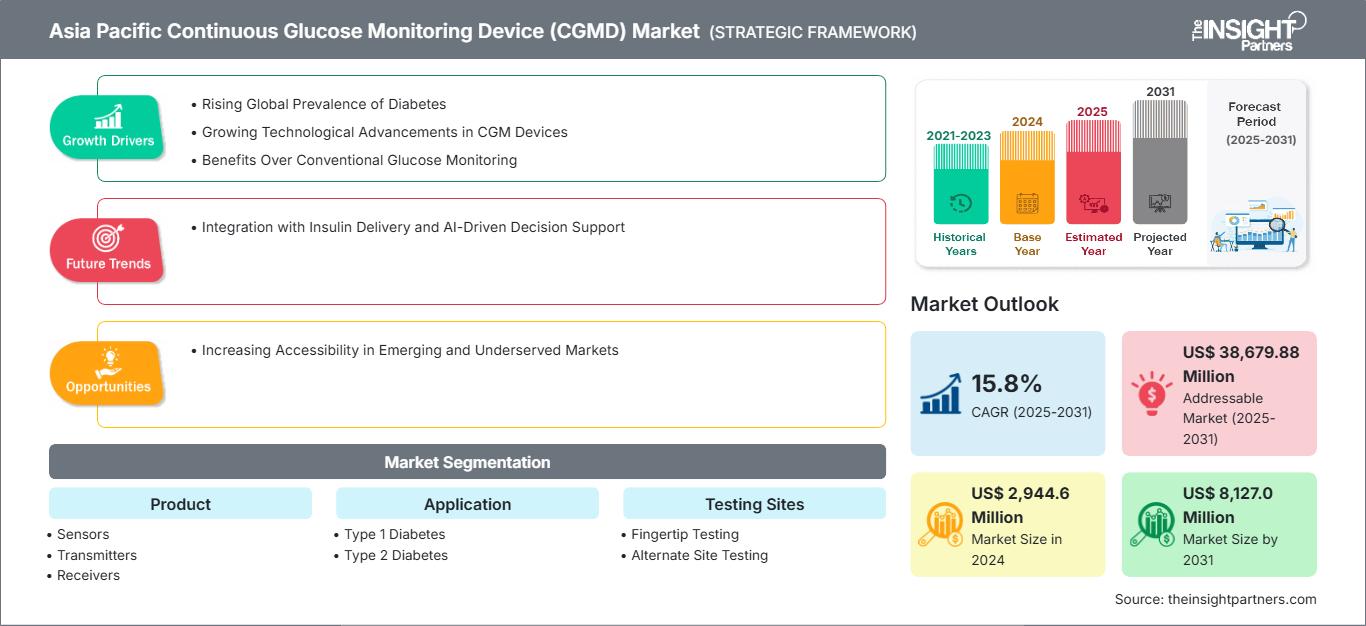
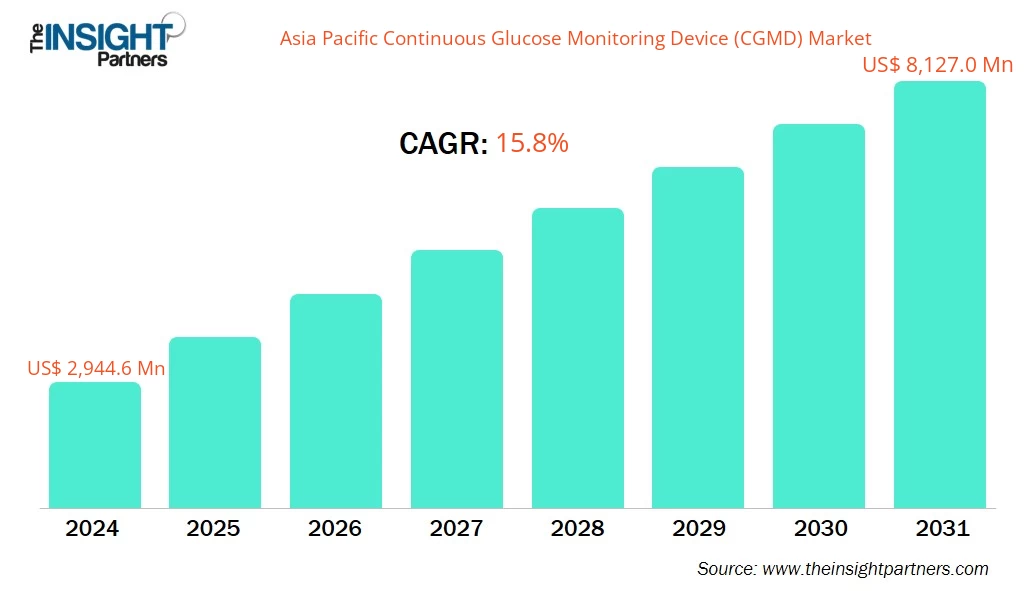
The Asia Pacific Continuous Glucose Monitoring Device (CGMD) Market size is expected to reach US$ 8,127.0 Million by 2031 from US$ 2,944.6 Million in 2024. The market is estimated to record a CAGR of 15.8% from 2025 to 2031.
Executive Summary and Asia Pacific Continuous Glucose Monitoring Device (CGMD) Market Analysis:
The continuous glucose monitoring devices market in Asia Pacific is segmented into China, Japan, India, South Korea, Australia, and the Rest of the Pacific. Asia Pacific (APAC) is experiencing a significant surge in diabetes prevalence, driving the adoption of Continuous Glucose Monitoring (CGM) devices. In 2024, the area had ~1.4 billion adults aged 20-79, with diabetes affecting over 320 million individuals. This figure is projected to rise to 440 million by 2050, making Asia the epicenter of the global diabetes epidemic. Notably, China and India account for over 50% of the region's diabetes cases, with China alone representing a quarter of the worldwide adult diabetic population.
The increasing prevalence is attributed to urbanization, sedentary lifestyles, and dietary changes. For instance, in India, the Longitudinal Aging Study revealed that 13.3% of adults aged 45-59 and 16.2% of those aged 60 and above have diabetes, with actual prevalence being higher than self-reported cases. Similarly, Southeast Asia has seen a rise from 34.9 million cases in 2000 to 106.9 million in 2024, with projections reaching 185 million by 2050, as per The Times of India.
In response to this growing health crisis, several companies are enhancing the availability and accessibility of CGM devices in APAC. Abbott Laboratories has introduced the FreeStyle Libre and Lingo systems, which offer over-the-counter availability, eliminating the need for prescriptions. These devices have gained traction in countries such as Saudi Arabia and the UAE, with a high demand for diabetes management solutions.
Customize This Report To Suit Your Requirement
Get FREE CUSTOMIZATIONAsia Pacific Continuous Glucose Monitoring Device (CGMD) Market: Strategic Insights
-
Get Top Key Market Trends of this report.This FREE sample will include data analysis, ranging from market trends to estimates and forecasts.
Asia Pacific Continuous Glucose Monitoring Device (CGMD) Market Segmentation Analysis:
- By Product, the Asia Pacific Continuous Glucose Monitoring Device (CGMD) Market is segmented into Sensors, Transmitters, and Receivers. Sensors held the largest share of the market in 2024.
- By Application, the Asia Pacific Continuous Glucose Monitoring Device (CGMD) Market is segmented into Type 1 Diabetes and Type 2 Diabetes. Type 2 Diabetes held the largest share of the market in 2024.
- By Testing Sites, the Asia Pacific Continuous Glucose Monitoring Device (CGMD) Market is segmented into Fingertip Testing and Alternate Site Testing. Fingertip Testing held the largest share of the market in 2024.
- By End User, the Asia Pacific Continuous Glucose Monitoring Device (CGMD) Market is segmented into Hospitals and Clinics and Self or Homecare. Self or Homecare held the largest share of the market in 2024.
Asia Pacific Continuous Glucose Monitoring Device (CGMD) Market Report Scope
| Report Attribute | Details |
|---|---|
| Market size in 2024 | US$ 2,944.6 Million |
| Market Size by 2031 | US$ 8,127.0 Million |
| CAGR (2025 - 2031) | 15.8% |
| Historical Data | 2021-2023 |
| Forecast period | 2025-2031 |
| Segments Covered |
By Product
|
| Regions and Countries Covered |
Asia Pacific
|
| Market leaders and key company profiles |
|
Asia Pacific Continuous Glucose Monitoring Device (CGMD) Market Players Density: Understanding Its Impact on Business Dynamics
The Asia Pacific Continuous Glucose Monitoring Device (CGMD) Market is growing rapidly, driven by increasing end-user demand due to factors such as evolving consumer preferences, technological advancements, and greater awareness of the product's benefits. As demand rises, businesses are expanding their offerings, innovating to meet consumer needs, and capitalizing on emerging trends, which further fuels market growth.
Asia Pacific Continuous Glucose Monitoring Device (CGMD) Market Outlook
Continuous glucose monitoring (CGM) devices offer substantial and clinically meaningful advantages over conventional blood glucose monitoring methods, fundamentally transforming diabetes management for millions worldwide. Unlike traditional approaches that rely on periodic finger-prick tests, CGMs provide real-time, continuous measurement of glucose levels via minimally invasive sensors, allowing users and clinicians to assess glucose variability and trends rather than single data points. Recent clinical studies report that CGM use achieves reductions in HbA1c levels ranging from 0.25% to 3.0% and improves "time in range" (the percentage of time glucose remains within target levels) by 15-34%, both of which are associated with lower risk of diabetes complications and improved long-term outcomes.
One of the most impactful developments in CGM technology is its ability to deliver real-time alerts for hypoglycemia and hyperglycemia. These alarms enable immediate intervention, such as prompt carbohydrate consumption or insulin dose adjustment, drastically reducing the frequency and severity of dangerous episodes. Studies show that low-glucose prediction algorithms integrated in newer CGMs can reduce time below range by up to 92% compared to no alerts and 47% compared to standard alerts, significantly improving safety, especially during sleep or for patients at high risk of hypoglycemia. Additionally, nocturnal low-glucose prediction technology has demonstrated a 37% reduction in nightly time spent below the safe glucose threshold, providing substantial protection during vulnerable hours.
CGMs are transformational educational tools, motivating personalized lifestyle change by mapping dietary intake, physical activity, medication response, and stress factors to corresponding glucose fluctuations. This ongoing visual feedback enhances self-management skills and patient engagement, offering insights far superior to conventional education methods that lack immediate and personalized physiological data. Such continuous data streams enable dynamic diabetes management, allowing patients and healthcare providers to make proactive, evidence-based decisions, adjust therapy between clinic visits, and recognize previously unnoticed patterns such as postprandial spikes or nocturnal highs.
CGM also delivers a detailed and comprehensive glucose profile for healthcare providers, including metrics such as time in range, hypoglycemia/hyperglycemia frequency, and glycemic variability. This enables more precise treatment intensification, risk stratification, and preventive strategies to lower hospitalization rates and avoid severe complications. The capability to remotely monitor patient data, enhanced by integrated wireless data transmission and cloud-based storage, streamlines care delivery and boosts adherence. This is particularly beneficial for vulnerable groups, including children, the elderly, pregnant women, and individuals with impaired awareness of hypoglycemia.
CGMs eliminate the practical and psychological burden of frequent finger sticks, a limitation that impaired adherence and quality of life with earlier methods. Children particularly value this "finger-prick-free" approach, and patients undergoing intensive therapy report higher treatment satisfaction and long-term device retention rates despite cost and device complexity challenges.
CGM encompasses dramatic improvements in glycemic control statistics, hypoglycemia prevention, patient empowerment through real-time data, holistic healthcare-team support with actionable metrics, and enhanced overall quality of life. With these clinically validated benefits, international diabetes care standards strongly recommend CGM for type 1 diabetes and expanding indications for type 2 diabetes. This reinforces CGM's role as a cornerstone of modern diabetes care.
Asia Pacific Continuous Glucose Monitoring Device (CGMD) Market Country Insights
By country, the Asia Pacific Continuous Glucose Monitoring Device (CGMD) Market is segmented into China, India, Japan, South Korea, Australia, and the Rest of APAC. China held the largest share in 2024.
China is confronting a significant and escalating diabetes epidemic, with projections indicating that by 2050, the country will have ~168 million individuals living with type 2 diabetes, a substantial increase from 2024 figures (148 million), as per the data of IDF. This surge is attributed to urbanization, dietary changes, and aging demographics. The Chinese government has set ambitious targets to enhance diabetes awareness and management. By 2030, the National Health Commission aims to achieve a 60% awareness rate among individuals aged 18 and above and ensure that 70% of type 2 diabetes patients receive standardized management services at the local level.
The growing prevalence of diabetes has spurred advancements in medical technology, particularly in continuous glucose monitoring (CGM). CGM devices, which provide real-time glucose readings, have become essential tools for individuals managing diabetes. International and domestic companies in China contribute to developing and distributing CGM systems. Global players such as Abbott, Dexcom, and Medtronic have introduced their CGM products to the Chinese market, while domestic companies such as Sinocare and Medtrum Technologies are leading innovations in affordable and user-friendly CGM solutions.
Asia Pacific Continuous Glucose Monitoring Device (CGMD) Market Company Profiles
Some of the key players operating in the market include Abbott Laboratories, Medtronic Plc, F. Hoffmann-La Roche Ltd, Tandem Diabetes Care Inc., Ypsomed Holding AG, Dexcom Inc., i-SENS Inc., Senseonics Holdings Inc., A. Menarini Diagnostics s.r.l., and Medtrum Technologies Inc.
These players are adopting various strategies such as expansion, product innovation, and mergers and acquisitions to provide innovative products to their consumers and increase their market share.
Asia Pacific Continuous Glucose Monitoring Device (CGMD) Market Research Methodology
The following methodology has been followed for the collection and analysis of data presented in this report:
Secondary Research
The research process begins with comprehensive secondary research, utilizing internal and external sources to gather qualitative and quantitative data for each market. Commonly referenced secondary research sources include, but are not limited to:
- Company websites, annual reports, financial statements, broker analyses, and investor presentations
- Industry trade journals and other relevant publications
- Government documents, statistical databases, and market reports
- News articles, press releases, and webcasts specific to companies operating in the market
Note:
All financial data included in the Company Profiles section has been standardized to US$. For companies reporting in other currencies, figures have been converted to US$ using the relevant exchange rates for the corresponding year.Primary Research
The Insight Partners conducts a significant number of primary interviews each year with industry stakeholders and experts to validate its data analysis and gain valuable insights. These research interviews are designed to:
- Validate and refine findings from secondary research
- Enhance the expertise and market understanding of the analysis team
- Gain insights into market size, trends, growth patterns, competitive dynamics, and future prospects
Primary research is conducted via email interactions and telephone interviews, encompassing various markets, categories, segments, and sub-segments across different regions. Participants typically include:
- Industry stakeholders: Vice Presidents, Business Development Managers, Market Intelligence Managers, and National Sales Managers
- External experts: Valuation specialists, research analysts, and key opinion leaders with industry-specific expertise

- Historical Analysis (2 Years), Base Year, Forecast (7 Years) with CAGR
- PEST and SWOT Analysis
- Market Size Value / Volume - Regional, Country
- Industry and Competitive Landscape
- Excel Dataset
Recent Reports
Testimonials

The Insight Partners' SCADA System Market report is comprehensive, with valuable insights on current trends and future forecasts. The team was highly professional, responsive, and supportive throughout. We are very satisfied and highly recommend their services.
RAN KEDEM Partner, Reali Technologies LTDs
I requested a report on a very specific software market and the team produced the report in a few days. The information was very relevant and well presented. I then requested some changes and additions to the report. The team was again very responsive and I got the final report in less than a week.
JEAN-HERVE JENN Chairman, Future Analytica
We worked with The Insight Partners for an important market study and forecast. They gave us clear insights into opportunities and risks, which helped shape our plans. Their research was easy to use and based on solid data. It helped us make smart, confident decisions. We highly recommend them.
PIYUSH NAGPAL Sr. Vice President, High Beam Global
The Insight Partners delivered insightful, well-structured market research with strong domain expertise. Their team was professional and responsive throughout. The user-friendly website made accessing industry reports seamless. We highly recommend them for reliable, high-quality research services
YUKIHIKO ADACHI CEO, Deep Blue, LLC.
This is the first time I have purchased a market report from The Insight Partners.While I was unsure at first, I visited their web site and felt more comfortable to take the risk and purchase a market report.I am completely satisfied with the quality of the report and customer service. I had several questions and comments with the initial report, but after a couple of dialogs over email with their analyst I believe I have a report that I can use as input to our strategic planning process.Thank you so much for taking the extra time and making this a positive experience.I will definitely recommend your service to others and you will be my first call when we need further market data.
JOHN SUZUKI President and Chief Executive Officer, Board Director, BK Technologies
I wish to appreciate your support and the professionalism you displayed in the course of attending to my request for information regarding to infectious disease IVD market in Nigeria. I appreciate your patience, your guidance, and the fact that you were willing to offer a discount, which eventually made it possible for us to close a deal. I look forward to engaging The Insight Partners in the future, all thanks to the impression you have created in me as a result of this first encounter.
DR CHIJIOKE ONYIA MANAGING DIRECTOR, PineCrest Healthcare Ltd.Reason to Buy
- Informed Decision-Making
- Understanding Market Dynamics
- Competitive Analysis
- Identifying Emerging Markets
- Customer Insights
- Market Forecasts
- Risk Mitigation
- Boosting Operational Efficiency
- Strategic Planning
- Investment Justification
- Tracking Industry Innovations
- Aligning with Regulatory Trends
Unlock Exclusive Report Discounts
Enquire Now




 Get Free Sample For