
Assistive Robotics Market Growth, Trends & Forecast by 2034
Coverage: by Mobility (Mobile, Stationary); Type (Socially Assistive Robots, Physically Assistive Robots, Mixed Assistive Robots); Application (Elderly Assistance, Surgery Assistance, Handicap Assistance, Defense, Industrial, Companionship, Others) , and Geography (North America, Europe, Asia Pacific, and South and Central America)
- Status : Data Released
- Report Code : TIPRE00007105
- Category : Electronics and Semiconductor
- No. of Pages : 150
- Available Report Formats :


- Last update date : July 15, 2026


2025 Market Size
US$ 15.1 Bn
Base year value
2034 Forecast
US$ 69.19 Bn
Projected by 2034
CAGR 2026-2034
18.43 %
Growth rate
Addressable Market
US$ 347.67 Bn
(2026-2034)
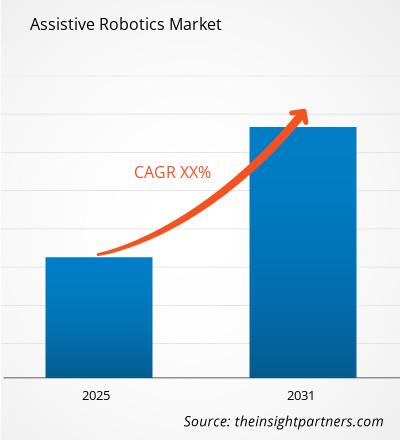
The global Assistive Robotics market was valued at US$ 15.1 billion in 2025 and is expected to reach US$ 69.19 billion by 2034; it is estimated to record a CAGR of 18.43% during 2026-2034.
Assistive Robotics Market Assessment and Insights
- North America holds 35–39% share in 2025 and is growing at a CAGR range of 19.4–20.4% during 2026–2034, led by surgical robotics density, rehabilitation reimbursement, and homecare technology adoption.
- US accounts for 78–82% of North American revenue in 2025 and grows at 19.2–20.2% CAGR, supported by hospital purchasing, exoskeleton therapy, and disability care demand.
- Europe represents 23–27% share in 2025 and grows at 18.5–19.5% CAGR, with Germany, the UK, France, Italy, and Spain leading clinical robotics and eldercare pilots.
- Asia Pacific captures 26–30% share in 2025 and expands at 22.0–23.0% CAGR, led by Japan, China, South Korea, India, and Australia through aging-policy support and robotics manufacturing scale.
- The largest segment is Physically Assistive Robots, holding 52–56% market share in 2025 and growing at 20.2–21.2% CAGR due to rehabilitation, mobility support, and exoskeleton demand.
- High Growth Segment is Elderly Assistance, with 31–35% market share in 2025 and 22.4–23.4% CAGR, driven by aging-in-place, fall prevention, and caregiver shortage pressures.
- Key companies analyzed in detail: Barrett Technology, LLC, CYBERDYNE Inc., Ekso Bionics Holdings, Inc., Focal Meditech B.V., Hyundai Motor Company, Intuitive Surgical, Inc., Kinova Inc., Lifeward Ltd., SoftBank Robotics Group Corp., and UBTECH Robotics Corp. Ltd.
Source: The Insight Partners' analysis based on proprietary research, government publications, company annual reports, investor presentations, industry databases, and expert interviews.
Assistive robotic technologies have matured from research-oriented systems to become clinically relevant and task-specific machines. Improvements in technologies such as machine vision, force sensing, weight-optimized actuators, battery capacity, natural language interfaces, and networked connectivity make it possible for robots to help with rehabilitation, manipulation, navigation, and human interaction in a more secure way. Manufacturing trends point to module-based systems, contract manufacturing, and software-defined differences as vendors reconcile regulation and parts sourcing.
Demand going forward will increase as hospitals, rehab centers, industry, military, and personal care seek productivity and independence improvements. Rapid aging of the population is listed by the World Health Organization as one of the key challenges to care systems, and research facilities are developing robotic applications capable of assisting the elderly with the ability to get up and prevent falls.
Assistive Robotics Market Report Scope
| Report Attribute | Details |
|---|---|
| Market size in 2025 | US$ 15.1 Billion |
| Market Size by 2034 | US$ 69.19 Billion |
| Global CAGR (2026 - 2034) | 18.43% |
| Historical Data | 2021-2024 |
| Forecast period | 2026-2034 |
Assistive Robotics Market Analysis
The factors responsible for the expansion of the Assistive Robotics Market include growing disability rates, elderly demographics, high demands for precise surgery, and a lack of professional caregivers. Other demand drivers include recovery from stroke injuries, spinal injuries, ergonomic working practices, and military mobility programs. These robots are being assessed based on their safety certification, performance in repetitive tasks, user interface, and the effectiveness of improvements in the independence of patients or the efficiency of employees.
The supply chain comprises suppliers of actuators, sensors, AI software, medical device makers, rehabilitation specialists, hospitals, insurance companies, distributors, and service partners. The market dynamics are driven by precise motor systems, embedded computer systems, batteries, compliant materials, haptic control, and cybersecurity. Users require a system that consists of certified hardware and software, along with training and maintenance services.
As per the Assisted Robotics market study, the competitive environment consists of surgical robotics players, rehabilitation exoskeleton players, humanoid robots, robotic arms, and assistive robots. Intuitive Surgical, Inc. is the key player in procedure-based adoption, whereas CYBERDYNE Inc., Ekso Bionics Holdings, Inc., and Lifeward Ltd. are the key players in mobility and rehabilitation. Kinova Inc., Barrett Technology, LLC, Focal Meditech B.V., SoftBank Robotics Group Corp., Hyundai Motor Company, and UBTECH Robotics Corp., Ltd. deal with manipulation, companionship, and service robotics.
AI-driven sensing, lightweight exoskeletons, cloud-based fleet management, remote clinician dashboards, and robot as a service business models are some investment trends. Competitive positioning is now more than ever influenced by clinical proof, regulation, interoperability, and economic lifecycle. Those companies which can show lesser caregiver burden, less time for rehabilitation, greater consistency of surgery or safety in industries will be able to charge premiums.
● REPORT CUSTOMIZATION
Tailor This Report To Align With Your Specific Business Requirements
This report can be customized to align precisely with your business objectives, scope, and target markets. Customization options include tailored segmentation, geography, competitive analysis, and strategic insights to support informed decision-making.
Customize This Report →WHAT YOU CAN ADJUST
- ● Segmentations
- ● Geography
- ● Competitive Analysis
- ● Language Preferences
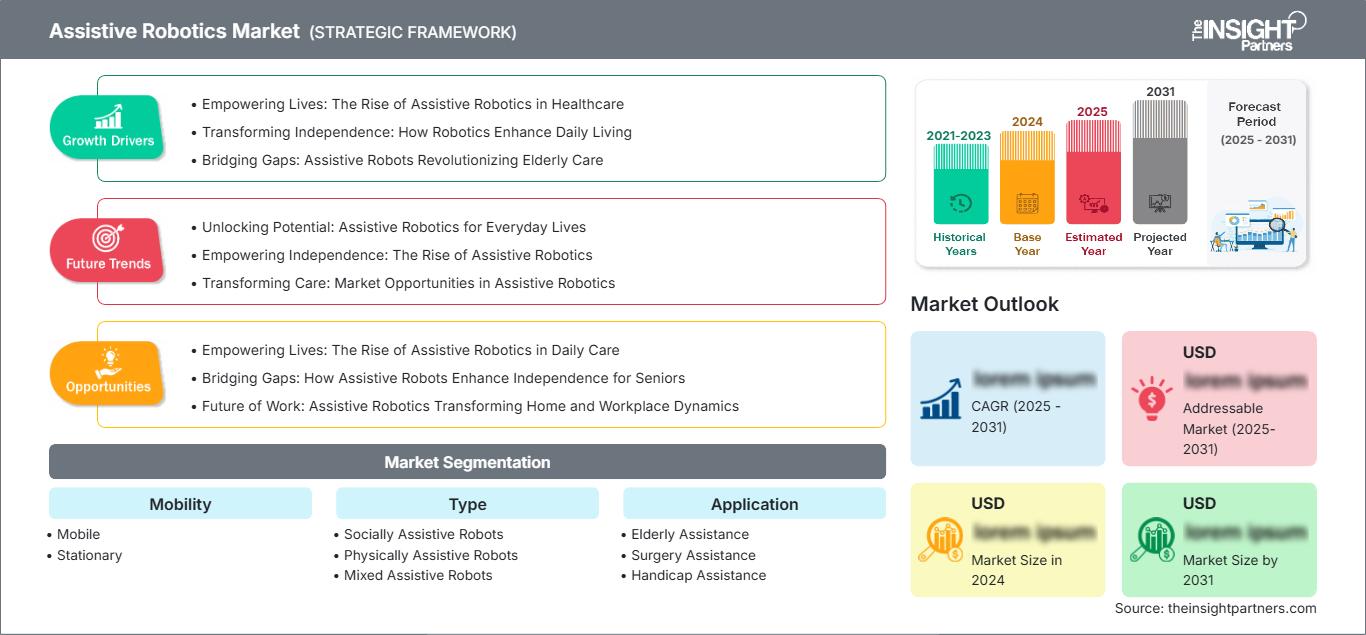
Assistive Robotics Market: Strategic Insights
Regional Insights
North America Assistive Robotics Market
North America holds an estimated 35–39% Assistive Robotics Market share in 2025 and is projected to grow at a CAGR range of 19.4–20.4% during 2026–2034. Demand is underpinned by surgery robotics, rehabilitation equipment, power-driven exoskeletons, automated healthcare facilities, and home-care robotics that cater to clinical efficiency and independence requirements.
The region has an advantage of being able to purchase medical devices, perform robotics research and the interest of insurance companies in home recovery models. Increasing demand is from providers for robots that will ease staffing burden, perform repetitive therapy, and provide care beyond hospitals.
U.S. Assistive Robotics Market Market
The U.S. represents 78 to 82% of North America’s revenues in 2025 and enjoys a CAGR of 19.2 to 20.2% until 2034. Application areas where there is most adoption include surgical assistance, stroke rehabilitation, spinal cord injury mobility assistance, veterans’ care, warehouse ergonomics, and university-health system-backed research-driven geriatric care solutions.
Clinical robotics, exoskeletons, robotic manipulation, and assistive arms have companies such as Intuitive Surgical, Inc., Ekso Bionics Holdings, Inc., Barrett Technology, LLC, and Kinova Inc. as key players. Application trends include robotic assistance in minimally invasive surgery, power gait training, home therapy, and autonomous technologies that minimize falls.
Europe Assistive Robotics Market Market
Europe holds 23-27% market share by 2025 and shows a growth CAGR in the range of 18.5-19.5%. Germany is the leading country due to the use of rehabilitation equipment, hospital robots, and assistance of the industry, whereas UK develops implementation through NHS innovation pathways, robotic university projects, and assistive technologies.
Other countries in the region are France, Italy, and Spain because of the development of surgical centers, pilot projects of eldercare, disability programs, and rehabilitation networks. The criteria of buyers include security, data protection, procurement, and acceptance by clinicians. Companies Focal Meditech B.V. and Hyundai Motor Company develop the regional environment.
APAC Assistive Robotics Market Market
The Asia Pacific region accounts for a 26–30% market share in 2025, and also registers a CAGR of 22.0–23.0% for 2026-2034. Japan dominates through robotics for elderly care and exoskeletons, China builds up on manufacturing, hospital trials, and humanoid robots, and South Korea, India, and Australia generate demand from rehabilitation, industrial protection, and government-supported innovations for elderly care.
Key regional policy factors include national robotic policies, the development of healthcare, and encouragement for technologies in elderly care. Key regional players include CYBERDYNE Inc., SoftBank Robotics Group Corp., Hyundai Motor Company, and UBTECH Robotics Corp. Ltd. The key purchasing criteria include affordability, local support network, multi-language interface, and systems capable of working in densely populated hospitals, apartments, and manufacturing environments.
Middle East & Africa Assistive Robotics Market Market
The Middle East & Africa experiences a CAGR of 17.0% - 18.0%, being driven by Saudi Arabia and the UAE due to hospital infrastructure, smart cities development, and rehabilitation services growth. South Africa and the rest of MEA are relatively smaller segments but indicate the necessity of assistance with disabilities, telemedicine, and industry.
Robots will be required to assist in dangerous work, inspections, and safety for employees in energy, logistics, and infrastructural constructions. Healthcare organizations prioritize learning, maintenance, and affordability since robots used in the clinical sector have to work efficiently regardless of the lack of services in some regions.
Segmentation Analysis
Mobility
The Mobility in the Assistive Robotics market scope includes both mobile and static platforms, with the dominant category growing at a CAGR of 20.0 to 21.0% between 2026 and 2034. The choice of mobility is influenced by the design of the space, the level of independence desired, safety certifications, battery life, navigation ability, and whether assistance is needed while moving or stationary.
- The mobile robot is used for navigation, transport, mobility aid, monitoring, and home care services, where moving between rooms, departments, or factories provides greater utility than being in one place.
- Stationary robots have roles to play in surgeries, rehabilitation stations, eating, and robotic arms, where precise positioning makes a better application.
Type
Types of Segmentation are Socially Assistive Robots, Physically Assistive Robots, and Hybrid Assistive Robots, with the primary type expected to grow at a CAGR rate between 20.5-21.5% from 2026 to 2034. Purchasers compare various aspects like physical assistance, quality of interaction, autonomy, clinical evidence, training requirements, and cost of ownership before making their purchase.
- Socially assistive robots cater to areas such as companionship, cognition, reminding, and communication, becoming significant in the elderly care environment due to issues of loneliness, monitoring, and caregiver availability.
- The physically assistive robots dominate the market due to their usefulness in rehabilitation, exoskeletal movement, lifting and manipulation of objects, which provide functional benefits to the user.
- Mixed assistive robots integrate both interaction and physical assistance, thus becoming highly strategic in home care, smart hospital, and aging-in-place systems.
Application
Application Segmentation includes Elderly Assistance, Surgery Assistance, Handicap Assistance, Defense, Industrial, and Companionship applications, with the major segment having a CAGR rate between 21.0 – 22.0% during the forecast period from 2026 – 2034. Adoption is determined based on the degree of safety needed, level of training, reimbursement, mission-critical nature, and better documentation capabilities.
- Elderly Assistance is a high growth application due to aging-in-place, fall prevention, mobility aid, medication reminder, and caregiver shortage that leads to continuous demand at home or institutions.
- Surgery Assistance is still a high value application as the robotic systems increase dexterity, vision, consistency, and minimally invasive procedures in hospitals where there is enough volume of procedures.
- Handicap Assistance is related to mobility aid, robotic arms, feeding aid, smart wheelchairs, and exoskeletons that help disabled and neurologically affected patients become more independent.
- Defense applications concentrate on load carrying, recovery from injury, manipulation, and human augmentation when safety, endurance, and mission success are key criteria.
- In industry, assistive robots are used for ergonomic lifting, repetitive operations, inspections, and safety where labor scarcity and injury prevention warrant the deployment of robots.
- Companion robots offer interaction, reminding, communicating, and stimulation, which is strategically important when social isolation and surveillance at home concern the elderly population.
Opportunity Snapshot
| Application | Revenue Contribution | Trend Tag | Adoption Stage |
| Elderly Assistance | High | Fall Prevention | Scaling |
| Surgery Assistance | High | Precision Surgery | Mature |
| Handicap Assistance | Medium | Mobility Access | Scaling |
| Defense | Medium | Human Augment | Emerging |
| Industrial | Medium | Ergonomic Lift | Scaling |
| Companionship | Low | Social Care | Emerging |
Assistive Robotics Market Growth Drivers and Impact Analysis
Aging Populations Increasing Care Capacity Pressure
The phenomenon of population aging is bringing about a need for assistive devices which will aid in extending the ability to live independently and lessen the caregiver's workload. Global health organizations anticipate a dramatic increase in the number of older individuals by 2030 and 2050, leading to an increase in the need for mobility assistance, surveillance, reminders, and transfer aid devices. Robotic devices can be used to assist the care team in providing repetitive services, thus leaving the clinician and the caregivers to do the judgment-intensive tasks. The market effect is highest where there is shortage of labor, high cost of care, and inability of the family to take care of older people.
Clinical Robotics Expanding Beyond Operating Rooms
The adoption of technology is expanding from the operating room to the rehab gym, the inpatient unit, the outpatient therapy facility, and even home-based rehab. In hospitals, robots help improve repeatability, accuracy, and reporting. Rehabilitation centers utilize exoskeletons and robotic trainers to conduct intense rehab sessions. The influence is felt even in procurement activities where purchasers consider outcomes, ease of use by clinicians, learning curve, and billing compatibility. As such, this trend reinforces demand for end-to-end solutions that incorporate hardware, software, services, and analytics capabilities. Organizations with evidence-based clinical pathways and post-sales support gain an advantage.
AI, Sensors, and Soft Robotics Improving Human Interaction
The improvements in areas such as artificial intelligence, tactile sensors, compliant materials, and motion planning have made robots much safer when interacting with humans and better adapted to their environment. Elder care support robots are getting more efficient at assisting the elderly with moving from sitting positions to standing, avoiding falls and walking around within homes. On the other hand, companion robots are making use of both speech and vision recognition for interactions. Market penetration can be seen in broader addressable environments like apartments, rehabilitation centers, factories, and military applications. The Assistive Robotics Market is positively affected by better perception that decreases the requirement for supervision and increases users' trust.
Assistive Robotics Market Future Trends
Home-Based Robotic Care Ecosystems
Assistive Robotics Market trends point toward home-based ecosystems where mobility robots, companion interfaces, remote monitoring, and clinician dashboards operate as connected care infrastructure. Futuristic implementations will address in-home aging, early detection of function deterioration, medication assistance, and mobility within tight confines. These implementations will need secure data transfer, privacy, affordability, and simplicity of maintenance. Future uptake will be less driven by innovation and more by proof of effectiveness in reducing the frequency of emergencies, postponing institution stays, and aiding families. Manufacturers who understand how to adapt to the home environment, and not just hospitals, will get their next wave of adoption.
Wearable Assistance Moving Into Workplaces
Robotic wearables will continue their advancement in use within the warehouse, manufacturing, logistics, construction, and military industries due to employers’ desire for increased safety and higher retention rates. The devices will most probably become lighter, better fitted, and more task-oriented to alleviate fatigue in tasks that involve lifting, overhead activity, and carrying loads. Buying in the future will entail ergonomic proof, user acceptance, energy efficiency, and coordination with safety programs. The scope of buyers will go beyond healthcare facilities. Companies that will be able to show a decrease in injuries, productivity increases, and minimal training time will have an advantage.
Assistive Robotics Market Opportunities
Elderly Assistance Platforms for Aging-in-Place
Elderly assistance offers a clear investment route because care systems need scalable support without replacing human judgment. Assistive Robotics Market Forecasts indicate Elderly Assistance is the high-growth application with 31–35% market share in 2025 and 22.4–23.4% CAGR during 2026–2034. These services can include help with transfers, fall alerts, mobility, reminders, and companionship on a modular platform basis. The best offer is one that has safe physical interaction, caregiver visibility from afar, and a subscription model for service. Partnerships with senior living facilities, insurance providers, hospitals, and home care agencies will turn pilots into scalable solutions.
Rehabilitation and Disability Support Networks
Rehabilitation and disability assistance networks present a chance for businesses that can demonstrate results and benefits over the long term. Hospitals, outpatient facilities, veterans’ hospitals, and specialty clinics require robots capable of providing repetitive, quantifiable treatments, which will change according to the patient’s progression. Exoskeletons, robot arms, smart wheelchairs, and therapy devices may be accompanied by training, maintenance, and data analysis services. Money must be spent on proving reimbursements, educating clinicians, and improving user experience instead of just purchasing technology. Businesses that helps acquire robots with studies and financing schemes will achieve success.
Recent Developments
- July 2026, Lifeward Ltd. (Nasdaq: LFWD) (“Lifeward” or the “Company”), a diversified biomedical innovation company with a portfolio of commercialized neurorehabilitation products and a biomedical pipeline, announced that it has entered into a securities purchase agreement with a group of institutional and accredited investors participating in the strategic financing framework established earlier this year with Oramed Pharmaceuticals (Nasdaq: ORMP).
- June 2025: Intuitive Surgical highlighted continued expansion of its da Vinci 5 surgical system after U.S. clearance and early commercial adoption, reinforcing the role of advanced robotic platforms in procedure assistance, surgeon control, and hospital robotics investment. The development supports broader clinical confidence in robotic assistance for minimally invasive surgery.
- October 2025: CYBERDYNE Inc., headquartered in Tsukuba, Ibaraki, Japan, announced that its HAL wearable cyborg has been recognized as the only exoskeleton device shown to promote neuroplasticity while delivering broad therapeutic benefits for individuals with spinal cord injuries (SCI). The conclusion is based on a systematic review published in a leading international medical journal, highlighting HAL's positive impact across multiple health outcomes associated with SCI.
Frequently Asked Questions

- Comprehensive Market Sizing and Forecast Analysis
- Detailed Segmentation Analysis
- In-Depth Market Dynamics Assessment
- Regional and Country-Level Insights
- Competitive Landscape and Company Benchmarking
- Strategic Business Intelligence
Recent Reports
Testimonials

The Insight Partners provided valuable market intelligence that supported our global go-to-market strategy. Their team was professional, responsive, and attentive to our feedback, providing thoughtful analysis and helpful methodological clarifications throughout the project.
Junmo Kim Chief Financial Officer (CFO), Enertech Co., Ltd.
The Insight Partners' SCADA System Market report is comprehensive, with valuable insights on current trends and future forecasts. The team was highly professional, responsive, and supportive throughout. We are very satisfied and highly recommend their services.
RAN KEDEM Partner, Reali Technologies LTDs
I requested a report on a very specific software market and the team produced the report in a few days. The information was very relevant and well presented. I then requested some changes and additions to the report. The team was again very responsive and I got the final report in less than a week.
JEAN-HERVE JENN Chairman, Future Analytica
We worked with The Insight Partners for an important market study and forecast. They gave us clear insights into opportunities and risks, which helped shape our plans. Their research was easy to use and based on solid data. It helped us make smart, confident decisions. We highly recommend them.
PIYUSH NAGPAL Sr. Vice President, High Beam Global
The Insight Partners delivered insightful, well-structured market research with strong domain expertise. Their team was professional and responsive throughout. The user-friendly website made accessing industry reports seamless. We highly recommend them for reliable, high-quality research services
YUKIHIKO ADACHI CEO, Deep Blue, LLC.
This is the first time I have purchased a market report from The Insight Partners.While I was unsure at first, I visited their web site and felt more comfortable to take the risk and purchase a market report.I am completely satisfied with the quality of the report and customer service. I had several questions and comments with the initial report, but after a couple of dialogs over email with their analyst I believe I have a report that I can use as input to our strategic planning process.Thank you so much for taking the extra time and making this a positive experience.I will definitely recommend your service to others and you will be my first call when we need further market data.
JOHN SUZUKI President and Chief Executive Officer, Board Director, BK Technologies
I wish to appreciate your support and the professionalism you displayed in the course of attending to my request for information regarding to infectious disease IVD market in Nigeria. I appreciate your patience, your guidance, and the fact that you were willing to offer a discount, which eventually made it possible for us to close a deal. I look forward to engaging The Insight Partners in the future, all thanks to the impression you have created in me as a result of this first encounter.
DR CHIJIOKE ONYIA MANAGING DIRECTOR, PineCrest Healthcare Ltd.Reason to Buy
- Informed Decision-Making
- Understanding Market Dynamics
- Competitive Analysis
- Identifying Emerging Markets
- Customer Insights
- Market Forecasts
- Risk Mitigation
- Boosting Operational Efficiency
- Strategic Planning
- Investment Justification
- Tracking Industry Innovations
- Aligning with Regulatory Trends





 Get Free Sample for