
Assistive Technology for Elderly Market Trends, Size & Forecast by 2034
Coverage: By Type (Living Aids Devices, Mobility Devices, Medical Furniture, Bathroom Safety Equipment); End User (Hospital, Home Care Settings, Old Age Homes); and Geography, and Geography (North America, Europe, Asia Pacific, and South and Central America)
- Status : Data Released
- Report Code : TIPRE00020473
- Category : Life Sciences
- No. of Pages : 150
- Available Report Formats :


- Last update date : September 08, 2026


2025 Market Size
US$ 47.81 Bn
Base year value
2034 Forecast
US$ 86.89 Bn
Projected by 2034
CAGR 2026-2034
6.86 %
Growth rate
Addressable Market
US$ 608.40 Bn
(2026-2034)
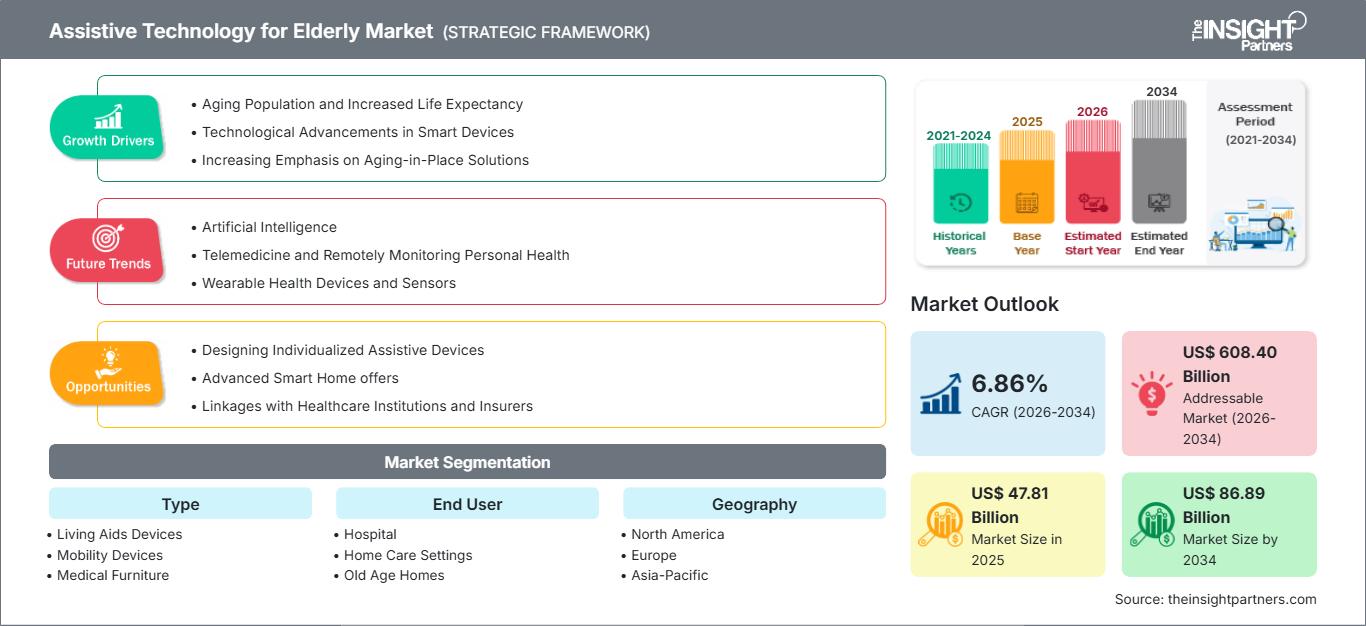
The assistive technology for elderly market is projected to expand from US$ 47.81 Billion in 2025 to US$ 86.89 Billion by 2034, registering a CAGR of 6.86% during 2026–2034. Expansion will be a result of higher demand for technologies that allow elderly people to remain mobile, hear, take care of themselves, communicate, and live independently. Technologies include physical devices, supportive tools, and technology-driven technologies provided in healthcare and residential care settings.
North America has prospects for sustained growth due to the relevance of ageing-in-place programs, insurance coverage programs, homecare, and technology-driven independence. Assistive technology for elderly market size will grow due to increased use of mobility technologies, hearing aids, safety equipment in bathrooms, and digital devices, while caregiver shortage will push the development of dependence-free products.
Assistive Technology for Elderly Market Assessment and Insights
- North America: North America is expected to represent a 30–34% share in 2025 and grow at a CAGR of 6.4–7.0% between 2026–2034, supported by mature healthcare infrastructure, reimbursement pathways, home-care adoption, and ageing-in-place initiatives.
- US: The US is expected to account for 78–82% of North America in 2025, with a CAGR of 6.3–6.9% between 2026–2034, led by home-based care and mobility requirements.
- Europe: Europe is estimated to hold a 27–31% share in 2025 and expand at a CAGR of 6.2–6.8% between 2026–2034, with Germany, the UK, France, Italy, and Spain supported by ageing populations and established social-care systems.
- Asia Pacific: Asia Pacific is estimated at a 20–24% share in 2025 and is projected to grow at a CAGR of 7.5–8.3% between 2026–2034, with China, Japan, South Korea, India, and Australia providing diverse adoption opportunities.
- Largest Segment: Mobility Devices is estimated to hold a 35–39% market share in 2025, expanding at a CAGR of 6.7–7.3% between 2026–2034 as walking and transfer assistance remain fundamental needs.
- High Growth Segment: Living Aids Devices is estimated at a 20–24% market share in 2025, with a CAGR of 7.5–8.2% between 2026–2034, supported by independence-focused home technologies.
- Key companies analyzed in detail: AI Squared, Drive Medical, GN Store Nord A/S, Invacare Corporation, Nordic Capital, Pride Mobility Products Corporation, Siemens Ltd., Sonova Holding AG, Liberator Ltd., Inclusive Technology Ltd.
Source: The Insight Partners' analysis based on proprietary research, government publications, company annual reports, investor presentations, industry databases, and expert interviews.
The assistive technologies for seniors industry will transition from traditional durable medical equipment towards integrated technologies, which are ergonomic, connected, personalized, and easy to operate. The mobility devices market will feature increasing incorporation of powered controls, improved seats, and modularity in the design, whereas the hearing aids market will feature increased integration with artificial intelligence and connectivity.
The development of the industry in the future can be expected to move beyond specialist medical channels to reach the consumer and home care markets. Healthy ageing policies, long-term care reforms, caregiver shortage, and increased digital health usage in developing countries will help to drive the demand. Product developers are likely to focus on affordable, interoperable, maintainable, and easily trainable products. The WHO guidance focuses on assistive technology for healthy aging and rehabilitation.
Assistive Technology for Elderly Market Report Scope
| Report Attribute | Details |
|---|---|
| Market size in 2025 | US$ 47.81 Billion |
| Market Size by 2034 | US$ 86.89 Billion |
| Global CAGR (2026 - 2034) | 6.86% |
| Historical Data | 2021-2024 |
| Forecast period | 2026-2034 |
Assistive Technology for Elderly Market Analysis
The assistive technology for elderly market growth is being shaped by demographic ageing, functional decline, and the increasing preference for independent living. WHO estimates that two in three people aged 60 years and older need at least one assistive product, while total global need is expected to exceed 3.5 billion people by 2050. This creates a broad addressable population across mobility, hearing, self-care, communication, and household safety.
The value chain includes the suppliers of components, device manufacturers, distributors, healthcare providers, therapists, home care providers, and users of end-products. The choice of product is increasingly becoming dependent on clinical evaluation, reimbursement, input of caregivers, and ease of use. The supply chain differs from one category to another: products such as mobility and furniture depend highly on manufacturing technologies, whereas hearing assistive technologies and smart devices depend on semiconductor, software, sensor, and connectivity technologies.
The assistive technology for elderly market report shows that there is a fragmented competition where big players in the field of healthcare are competing with specialized companies that focus on mobility, hearing, accessibility, and home solutions. The company that offers solutions in the field of hearing technologies is Sonova Holding AG, whereas Pride Mobility Products Corporation, Invacare Corporation, and Drive Medical are focused on mobility and durable medical equipment.
Investment focus areas include connected devices, personalization, artificial intelligence, and products intended to be used beyond hospital environment. The company that provides software-related capabilities is AI Squared, Inclusive Technology Ltd. is focused on accessible technology and independence, while Siemens Ltd. offers broader capabilities related to healthcare and engineering. The investment-oriented company is Nordic Capital as opposed to traditional device manufacturer.
● REPORT CUSTOMIZATION
Tailor This Report To Align With Your Specific Business Requirements
This report can be customized to align precisely with your business objectives, scope, and target markets. Customization options include tailored segmentation, geography, competitive analysis, and strategic insights to support informed decision-making.
Customize This Report →WHAT YOU CAN ADJUST
- ● Segmentations
- ● Geography
- ● Competitive Analysis
- ● Language Preferences
Assistive Technology for Elderly Market: Strategic Insights
Regional Insights
North America assistive technology for elderly market
North America is estimated to account for 30–34% of the assistive technology for elderly market share in 2025, with a CAGR of 6.4–7.0% through 2034. The region benefits from established healthcare systems, comparatively high purchasing power, widespread home-care services, and strong availability of mobility, hearing, and bathroom safety products. US demand remains the principal regional contributor.
Age-in-place programs are reinforcing the significance of living spaces as alternatives to conventional care facilities. Medicare, Medicaid, reimbursement policies, private health insurances, and speciality clinics have an effect on product selection. Even Canada provides chances by means of its publicly funded health care system. Service, customizing, maintenance, funding, and care giver friendliness are becoming competitive factors rather than mere technology.
U.S. assistive technology for elderly Market
The US represents approximately 78–82% of North America's 2025 market, with a CAGR of 6.3–6.9% through 2034. Demand is supported by a large older population, established home-care infrastructure, rehabilitation services, and strong availability of mobility equipment, hearing solutions, and safety products. Drive Medical, Pride Mobility Products Corporation, Invacare Corporation, and Sonova Holding AG have relevant commercial exposure.
Trends in application have begun to point more towards domestic environments, in which devices can help in fall prevention, transferring, communicating, and remaining independent on a daily basis. The recommendation from the manufacturer, insurance eligibility, the preferences of the caregiver, and the ease of use of the devices will all influence buying decisions. Aging through technology usage has become commonplace amongst consumers.
Europe assistive technology for elderly Market
Europe is estimated to represent 27–31% of the market in 2025, growing at a CAGR of 6.2–6.8%, with Germany positioned as a leading country. The region combines extensive social-care systems with high ageing intensity, although reimbursement structures and procurement practices differ substantially across countries.
UK has a well-established system of community care and access whereas in Germany there exists a combination of mandatory health insurance and special medical devices distribution channels. In France and Italy, opportunities exist due to ageing population and increasing demand for home-care. Spain also has its place in demand due to the need of providing mobility and safety in the household. The use of products is now also driven by reimbursement and independent living needs.
APAC assistive technology for elderly Market
The APAC region is projected to occupy 20–24% of the 2025 market with a CAGR growth rate of 7.5–8.3%, being driven by Japan. China provides the scale of the population, whereas South Korea, India, and Australia provide differentiation based on their ageing population, healthcare system modernization, and development of home-care solutions.
The Japanese market benefits from a matured elderly care market, thus offering more advanced mobility and safety products. China continues developing its healthcare system and elderly care services; India represents demographic attractiveness combined with affordability limitations. The Australian market has structured elderly care delivery process.
Middle East & Africa assistive technology for elderly Market
Middle East and Africa is expected to expand at a CAGR of 5.8–6.6%, with Saudi Arabia representing a leading opportunity within the region. UAE demand is supported by advanced private healthcare infrastructure, while South Africa offers a comparatively developed medical-device and rehabilitation ecosystem.
The healthcare reform plan of Saudi Arabia includes investment in new facilities and home-based care. The emphasis in the UAE is on tech-oriented care delivery, while South Africa focuses on institutional and community requirements. The Rest of MEA suffers from affordability, distribution, personnel, and accessibility constraints. Expansion thus hinges on local alliances, procurement, low cost product designs, and better service delivery networks.
Segmentation Analysis
Type
The Type segment is expected to expand at a CAGR of 6.7–7.3% during 2026–2034. The assistive technology for elderly market scope across product categories is influenced by functional need, affordability, clinical recommendation, and the shift from institutional care toward independent living. Mobility products remain essential, while living aids increasingly incorporate smart and ergonomic features.
- Living Aids Devices: These products support daily activities such as communication, medication management, environmental control, and personal independence. Demand is increasingly shaped by simple interfaces and home-based use.
- Mobility Devices: Wheelchairs, walkers, scooters, and transfer-support equipment address mobility limitations and fall-related risks. Their strategic importance remains high across hospitals, homes, and residential care environments.
- Medical Furniture: Adjustable beds, patient chairs, recliners, and related furniture support positioning, transfers, comfort, and caregiver efficiency. Demand is linked to long-term care and home adaptation.
- Bathroom Safety Equipment: Grab bars, shower supports, raised toilet solutions, and related products address high-risk household activities. Their relatively straightforward installation supports preventive adoption in ageing-in-place programs.
End User
The End User segment is projected to grow at a CAGR of 6.5–7.2% during 2026–2034. Purchasing decisions increasingly reflect the location where older adults spend most of their time, with home settings gaining strategic importance as healthcare systems seek to reduce avoidable institutional care.
- Hospital: Hospitals remain important for rehabilitation, discharge planning, acute mobility requirements, and clinical assessment. Procurement tends to emphasize durability, safety, infection control, and compatibility with established workflows.
- Home Care Settings: Home care is becoming increasingly important as families and healthcare systems prioritize ageing in place. Products emphasizing compact design, usability, installation simplicity, and caregiver support are strategically attractive.
- Old Age Homes: Residential facilities require scalable equipment portfolios covering mobility, transfers, personal care, and safety. Institutional purchasing favors reliability, maintenance support, standardized configurations, and lifecycle economics.
Opportunity Snapshot
| End User | Revenue Contribution | Trend Tag | Adoption Stage |
|---|---|---|---|
| Hospital | High | Clinical Mobility | Mature |
| Home Care Settings | High | Ageing-in-Place | Scaling |
| Old Age Homes | Medium | Care Automation | Scaling |
Assistive Technology for Elderly Market Growth Drivers and Impact Analysis
Ageing populations and rising functional limitations
Population ageing is expanding the number of consumers who require support with mobility, hearing, vision, cognition, communication, and self-care. WHO reports that more than 2.5 billion people globally require at least one assistive product, with need projected to exceed 3.5 billion by 2050. Older adults represent a particularly important user group because functional limitations can accumulate across several domains. This demographic trajectory increases replacement demand as well as first-time adoption. Manufacturers can therefore address broader needs by designing product families that accommodate changing capabilities over time. The commercial impact is strongest where products can preserve independence, reduce caregiver burden, and delay transitions into intensive care environments, creating value for users, families, providers, and public health systems.
Expansion of ageing-in-place and home-based care models
The transition from institution-centered care toward home and community settings is reshaping purchasing requirements. WHO's 2025 work on long-term-care financing highlights the potential for technology to support older adults in everyday activities and delay intensive long-term-care requirements. This creates demand for compact mobility products, bathroom safety equipment, adjustable furniture, communication aids, and monitoring technologies that can operate outside clinical environments. The commercial effect extends beyond device sales because home deployment requires assessment, installation, training, maintenance, and replacement services. Companies that develop simple installation procedures and caregiver-oriented interfaces can improve adoption. The shift also expands distribution opportunities through pharmacies, home-care providers, direct channels, and community healthcare networks.
Technology integration and personalization of assistive products
Assistive products are increasingly incorporating sensors, connectivity, software, artificial intelligence, and individualized settings. These capabilities can improve usability without requiring users to operate complex systems. Hearing solutions provide a visible example, with real-time processing and wireless connectivity becoming increasingly established. Similar principles are moving into mobility and environmental-control applications, where customization can improve comfort, safety, and independence. For manufacturers, technology integration changes competitive requirements by increasing the importance of software capabilities, cybersecurity, data management, and interoperability. It also creates opportunities for recurring service models and remote support. The market impact should be greatest where technology solves a clearly defined functional problem rather than adding features that increase complexity or acquisition cost without measurable user benefit.
Assistive Technology for Elderly Market Future Trends
AI-enabled personalization and adaptive assistance
The next phase of the assistive technology for elderly market trends is likely to emphasize systems that adapt automatically to individual behavior, environment, and functional capacity. Artificial intelligence can help hearing devices distinguish speech from surrounding noise, while sensor-enabled mobility products can support safer movement and personalized positioning. Future products may increasingly combine several functions through common interfaces, reducing the number of devices users must learn. Personalization will also extend to caregivers, allowing authorized users to configure settings or receive relevant alerts. Successful deployment will depend on transparent controls, reliable performance, privacy safeguards, and accessible interfaces. Companies able to translate AI into simple, clinically meaningful user benefits should gain stronger differentiation than providers relying primarily on feature accumulation.
Integrated home ecosystems for independent living
The market future is likely to move toward connected home ecosystems in which assistive products operate alongside communication, monitoring, environmental-control, and safety technologies. Rather than purchasing isolated equipment, users and caregivers may increasingly seek coordinated solutions that address several daily activities. Smart bathroom safety systems connected mobility equipment, medication reminders, voice interfaces, and remote caregiver support could form interoperable packages. This trend can shift competition from individual products toward ecosystem compatibility and service relationships. Standards, cybersecurity, device interoperability, and technical support will become more important purchasing criteria. Providers that can integrate equipment across different manufacturers while preserving straightforward user experiences may capture greater value from home-based care and develop longer-term relationships with healthcare providers and families.
Assistive Technology for Elderly Market Opportunities
Affordable products for emerging economies
The assistive technology for elderly market Forecasts indicates substantial opportunity to improve access in countries where demographic ageing is accelerating but product penetration remains limited. WHO and related global initiatives identify affordability, workforce limitations, supply constraints, and inadequate service delivery as major barriers. Manufacturers can address these gaps through simplified product architectures, local assembly, modular components, and regionally adapted distribution. Partnerships with governments, hospitals, community organizations, and social-care providers can reduce acquisition barriers while improving fitting and training. India, China, Southeast Asia, Latin America, and selected Middle Eastern markets offer particularly relevant expansion pathways. Commercial success will require price discipline, local service capabilities, and product designs that reflect household environments rather than simply adapting premium-market equipment.
Partnerships across healthcare and technology ecosystems
A second opportunity lies in partnerships linking device manufacturers with healthcare providers, insurers, home-care organizations, technology companies, and rehabilitation specialists. Such collaborations can connect product selection with assessment, installation, training, monitoring, and follow-up. The approach can also improve user retention because older adults often need adjustments as functional capabilities change. Companies with strong hardware portfolios can add software and remote-support capabilities through technology partnerships rather than developing every capability internally. Healthcare organizations, meanwhile, can use integrated procurement models to standardize equipment across discharge pathways and home-care programs. This ecosystem approach may create recurring revenue through maintenance, upgrades, subscriptions, and service contracts while improving continuity between clinical and residential care settings.
Recent Developments
- August 2026: Sonova Holding AG introduced the Phonak EON hearing aid portfolio, featuring third-generation proprietary real-time AI and enhanced scene intelligence, further extending AI-based hearing assistance and connectivity capabilities. The development illustrates the industry's movement toward adaptive hearing solutions that reduce listening complexity while supporting speech understanding across changing acoustic environments.
- March 2026: Sonova Holding AG announced a partnership with the Singapore Economic Development Board to accelerate innovation and profitable growth across Asia Pacific. The collaboration strengthens the company's regional innovation footprint and highlights the increasing strategic importance of APAC for technology development, market access, and localized healthcare solutions.
- October 2025: Sonova Holding AG introduced Phonak Infinio Ultra Sphere at EUHA 2025, extending real-time AI capabilities for speech enhancement in noise while improving battery performance and wax-management convenience. The launch reinforces the shift toward AI-enabled hearing solutions that combine personalization, usability, and reduced maintenance requirements.
Frequently Asked Questions

- Comprehensive Market Sizing and Forecast Analysis
- Detailed Segmentation Analysis
- In-Depth Market Dynamics Assessment
- Regional and Country-Level Insights
- Competitive Landscape and Company Benchmarking
- Strategic Business Intelligence
Recent Reports
Testimonials

The Insight Partners' SCADA System Market report is comprehensive, with valuable insights on current trends and future forecasts. The team was highly professional, responsive, and supportive throughout. We are very satisfied and highly recommend their services.
RAN KEDEM Partner, Reali Technologies LTDs
I requested a report on a very specific software market and the team produced the report in a few days. The information was very relevant and well presented. I then requested some changes and additions to the report. The team was again very responsive and I got the final report in less than a week.
JEAN-HERVE JENN Chairman, Future Analytica
We worked with The Insight Partners for an important market study and forecast. They gave us clear insights into opportunities and risks, which helped shape our plans. Their research was easy to use and based on solid data. It helped us make smart, confident decisions. We highly recommend them.
PIYUSH NAGPAL Sr. Vice President, High Beam Global
The Insight Partners delivered insightful, well-structured market research with strong domain expertise. Their team was professional and responsive throughout. The user-friendly website made accessing industry reports seamless. We highly recommend them for reliable, high-quality research services
YUKIHIKO ADACHI CEO, Deep Blue, LLC.
This is the first time I have purchased a market report from The Insight Partners.While I was unsure at first, I visited their web site and felt more comfortable to take the risk and purchase a market report.I am completely satisfied with the quality of the report and customer service. I had several questions and comments with the initial report, but after a couple of dialogs over email with their analyst I believe I have a report that I can use as input to our strategic planning process.Thank you so much for taking the extra time and making this a positive experience.I will definitely recommend your service to others and you will be my first call when we need further market data.
JOHN SUZUKI President and Chief Executive Officer, Board Director, BK Technologies
I wish to appreciate your support and the professionalism you displayed in the course of attending to my request for information regarding to infectious disease IVD market in Nigeria. I appreciate your patience, your guidance, and the fact that you were willing to offer a discount, which eventually made it possible for us to close a deal. I look forward to engaging The Insight Partners in the future, all thanks to the impression you have created in me as a result of this first encounter.
DR CHIJIOKE ONYIA MANAGING DIRECTOR, PineCrest Healthcare Ltd.Reason to Buy
- Informed Decision-Making
- Understanding Market Dynamics
- Competitive Analysis
- Identifying Emerging Markets
- Customer Insights
- Market Forecasts
- Risk Mitigation
- Boosting Operational Efficiency
- Strategic Planning
- Investment Justification
- Tracking Industry Innovations
- Aligning with Regulatory Trends





 Get Free Sample for