
Audio Conferencing Services Market Growth, Trends & Demand by 2034
Coverage: by Deployment Type (On-Premises and Cloud); End-User (BFSI , Government, Transportation , Utilities , and Communications), and Geography (North America, Europe, Asia Pacific, and South and Central America)
- Status : Data Released
- Report Code : TIPRE00002967
- Category : Technology, Media and Telecommunications
- No. of Pages : 150
- Available Report Formats :


- Last update date : August 28, 2026


2025 Market Size
US$ 13.87 Bn
Base year value
2034 Forecast
US$ 101.05 Bn
Projected by 2034
CAGR 2026-2034
24.7 %
Growth rate
Addressable Market
US$ 440.53 Bn
(2026-2034)
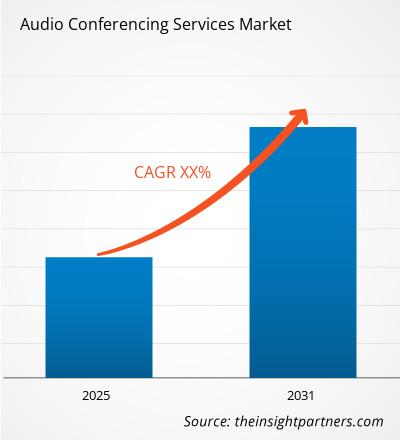
The Audio conferencing services market was valued at US$ 13.87 Billion in 2025 and is projected to reach US$ 101.05 Billion by 2034, registering a CAGR of 24.7% during 2026–2034. Growing enterprise demand for hybrid collaboration, increasing adoption of cloud-based communication platforms, and continuous investments in unified communications infrastructure are accelerating market expansion. Organizations across private and public sectors continue to prioritize scalable conferencing solutions that enhance productivity, support geographically distributed workforces, and improve business continuity while maintaining secure and reliable voice communication capabilities.
Across North America, enterprises are rapidly modernizing workplace communication ecosystems through cloud migration, unified communications adoption, and AI-enabled collaboration tools. The audio conferencing services market size continues to expand as organizations replace legacy telephony with subscription-based conferencing platforms that improve operational flexibility and reduce infrastructure costs. The region is estimated to account for 34–38% of global revenue in 2025 while recording a CAGR between 23.5% and 25.5% during the forecast period, supported by high digital maturity, widespread remote work adoption, and sustained investments in enterprise communication technologies.
Audio Conferencing Services Market Assessment and Insights
- North America: North America is expected to account for 34–38% share in 2025 and is projected to expand at a CAGR of 23.5–25.5% during 2026–2034, supported by strong enterprise cloud adoption, mature telecommunications infrastructure, and continuous investments in unified communications platforms.
- U.S.: The U.S. is anticipated to contribute 74–78% of the North American market in 2025, advancing at a CAGR of 23.8–25.8%, driven by large enterprise digital transformation initiatives and increasing deployment of AI-enabled collaboration platforms.
- Europe: Europe is estimated to hold 26–30% share in 2025 while growing at a CAGR of 22.5–24.5% through 2034. Germany, the UK, and France remain leading contributors due to strong enterprise digitalization and regulatory focus on secure communications.
- Asia Pacific: Asia Pacific is projected to account for 24–28% share in 2025 and register the fastest regional expansion with a CAGR of 26.5–28.5%, supported by rapid cloud adoption across China, India, Japan, South Korea, and Southeast Asia.
- Largest Segment: Cloud deployment is expected to command 64–68% market share in 2025, expanding at a CAGR of 25.5–27.5% as organizations increasingly migrate communication workloads to scalable cloud infrastructure.
- High Growth Segment: Government is anticipated to represent 14–18% market share in 2025 while recording a CAGR of 26.5–28.5%, supported by nationwide digital governance initiatives and secure communication modernization programs.
- Key companies analyzed in detail: Adobe Inc., Aastra Technologies Limited, Nokia Corporation, Avaya Holdings Corp., BroadSoft LLC, Cisco Systems, Inc., Damovo Deutschland GmbH & Co. KG, Logitech International S.A., GoTo Technologies USA, Inc., Microsoft Corporation.
Source: The Insight Partners' analysis based on proprietary research, government publications, company annual reports, investor presentations, industry databases, and expert interviews.
The audio conferencing services market has evolved from conventional telephone conferencing toward cloud-native, software-driven collaboration ecosystems capable of supporting enterprise-scale communications. The integration of technologies such as unified communications solutions, artificial intelligence, speech analytics, transcription, and workflow automation has helped add immense value to services. Growing interoperability between conferencing applications and productivity tools will further improve users' experience while helping companies to streamline their communication infrastructure, cut operating costs, and make their businesses more resilient in distributed working environments.
Future growth will be driven by emerging economies, cloud computing strategies of enterprises, and greater attention paid by regulators to issues of cybersecurity and data privacy. Companies will be looking for interoperable conferencing solutions that could bring together voice, messaging, workflow automation, and analytics into one unified collaborative environment. The growing use of broadband networks, enterprise mobility, and digitalization of government will create strong demand for vendors' solutions.
Audio Conferencing Services Market Report Scope
| Report Attribute | Details |
|---|---|
| Market size in 2025 | US$ 13.87 Billion |
| Market Size by 2034 | US$ 101.05 Billion |
| Global CAGR (2026 - 2034) | 24.7% |
| Historical Data | 2021-2024 |
| Forecast period | 2026-2034 |
Audio Conferencing Services Market Analysis
Growing enterprise digitalization continues to strengthen demand across the communication technology ecosystem, creating favorable conditions for audio conferencing services market growth. Organizations increasingly require secure, scalable, and flexible collaboration solutions capable of supporting hybrid workforces, geographically dispersed teams, and business continuity strategies. The shift toward subscription-based cloud communication services enables enterprises to reduce capital expenditure while benefiting from continuous software upgrades, AI-driven automation, enhanced security capabilities, and simplified deployment across multiple locations.
The market value chain is still evolving in terms of collaboration between providers of cloud infrastructure services, telecommunication service providers, software firms, cyber security experts, and enterprise integration systems. Better broadband connections, application programming interfaces (APIs), and speech processing have increased the capacity of the platforms while allowing companies to combine conference calls with customer relationship management, enterprise resource planning, and other business applications.
Competitive intensity within the audio conferencing services market analysis continues to increase as vendors differentiate through artificial intelligence, security enhancements, unified communications capabilities, and industry-specific offerings. Cisco Systems, Inc., Microsoft Corporation, Adobe Inc., Logitech International S.A., Nokia Corporation, and GoTo Technologies USA, Inc. continue investing in platform innovation, strategic partnerships, and ecosystem integration to strengthen customer retention while expanding enterprise deployments across multiple industry verticals.
The investment is still focused on cloud infrastructure, AI-driven collaboration, cybersecurity, and communications platform interoperability. The service providers have been building regional data centers, improving their capabilities with respect to compliance, and offering sector-specific products for industries such as finance, health care, government agencies, and utility services. Acquisitions, ecosystems, and product development are expected to continue being the major competitive drivers as the providers try to meet changing needs in enterprise communications.
● REPORT CUSTOMIZATION
Tailor This Report To Align With Your Specific Business Requirements
This report can be customized to align precisely with your business objectives, scope, and target markets. Customization options include tailored segmentation, geography, competitive analysis, and strategic insights to support informed decision-making.
Customize This Report →WHAT YOU CAN ADJUST
- ● Segmentations
- ● Geography
- ● Competitive Analysis
- ● Language Preferences
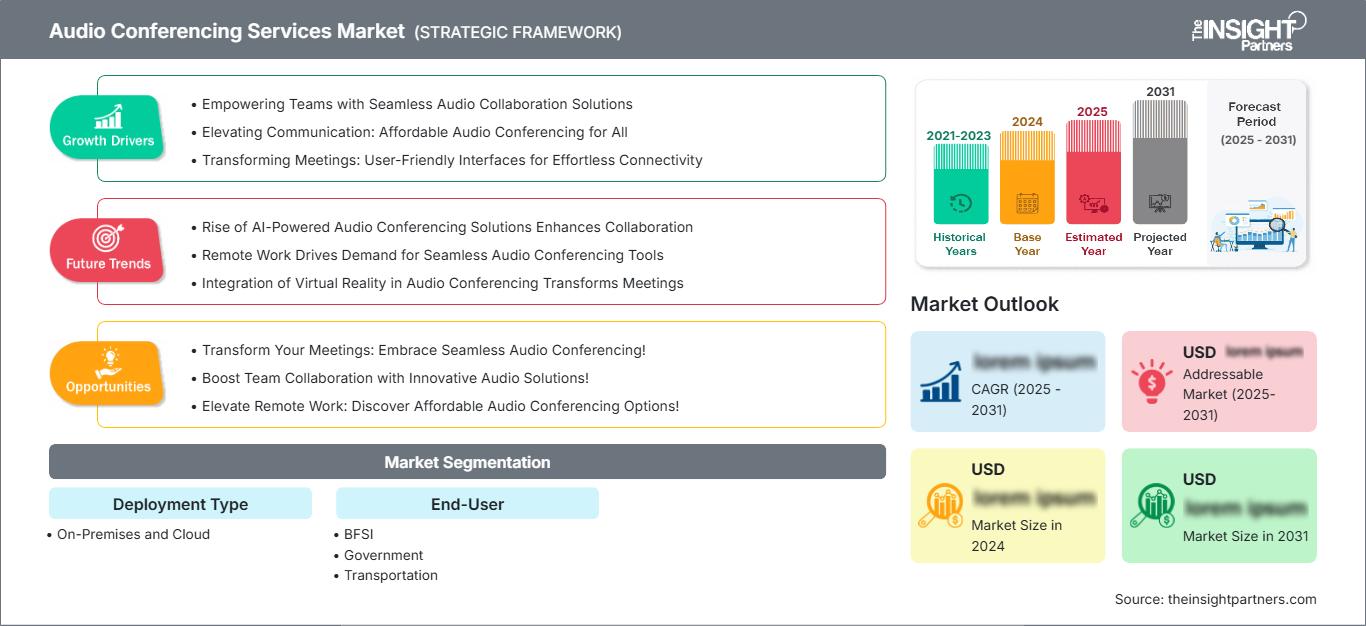
Audio Conferencing Services Market: Strategic Insights
Regional Insights
North America Audio Conferencing Services Market
North America accounted for an estimated 34–38% share of the audio conferencing services market in 2025 and is anticipated to register a CAGR of 23.5–25.5% during 2026–2034. The audio conferencing services market share remains the highest globally due to widespread adoption of unified communications, mature cloud infrastructure, and significant investments in enterprise collaboration technologies. Various firms from the fields of healthcare, BFSI, governments, and technology continue migrating from traditional telecom services to cloud conferencing solutions, which provide hybrid work environments and increased security.
In terms of technology capabilities, there are many hyperscale cloud service providers, sophisticated telecommunication networks, and a software industry full of competition. AI-powered meeting assistants, automated transcriptions, improvements in enterprise-level security, and easy integration with productivity solutions will keep fueling technology innovations in the field. With growing demand for subscription-based communications services and the focus of regulators on data security, the market encourages developers to launch new conferencing solutions.
U.S. Audio Conferencing Services Market
The U.S. represented approximately 74–78% of the North American Audio Conferencing Services Market in 2025 and is expected to expand at a CAGR of 23.8–25.8% throughout the forecast period. The large enterprises, governmental bodies, education establishments, and multinational firms keep investing in the unified communications tools for facilitating cooperation of employees as well as minimizing expenses on communication infrastructure. The high rate of cloud deployment, wide broadband networks, and robust enterprise software spending make the nation the regional leader in technologies.
Some of the largest companies in the field are Microsoft Corporation, Cisco Systems, Inc., Adobe Inc., Logitech International S.A., and GoTo Technologies USA, Inc. All of them have their vast activities in the United States, and they constantly develop new products for enterprises. The increasing integration of conference tools with customer relationship management, automation of workflows, cybersecurity solutions, and applications of artificial intelligence makes the usage of conference solutions more and more convenient.
Europe Audio Conferencing Services Market
Europe accounted for approximately 26–30% of the global Audio Conferencing Services Market in 2025 and is projected to record a CAGR of 22.5–24.5% between 2026 and 2034. Germany is the largest regional contributor due to the advanced level of digitization of its industrial sector, enterprise-level adoption of cloud computing, and considerable investments into secure communications infrastructure. German manufacturing industry, automotive industry, financial organizations, and the public sector are increasingly adopting unified communication solutions in order to increase their efficiency while adhering to cybersecurity and data protection requirements.
The UK continues showing considerable demand for unified communications as organizations rapidly transform their workplaces into digital environments. Financial organizations, professional service companies, education organizations, and healthcare organizations are increasingly adopting solutions for integrated conferencing. France, Italy, and Spain combined account for considerable regional demand due to digital government initiatives, modernization of telecommunication infrastructure, and enterprise-level adoption of software solutions.
Regulations regarding secure digital communications and cross-border collaboration will ensure the sustainable development of the regional market.
APAC Audio Conferencing Services Market
Asia Pacific is estimated to account for 24–28% of the global Audio Conferencing Services Market revenue in 2025 while registering the fastest regional expansion at a CAGR of 26.5–28.5% during the forecast period. China leads regional adoption through extensive enterprise digital transformation, while Japan and South Korea continue investing in advanced communication infrastructure supporting corporate collaboration and productivity improvements.
India and Australia are emerging as significant growth markets owing to expanding cloud adoption, increasing remote workforce participation, and supportive digital economy initiatives. Rapid enterprise modernization, growing startup ecosystems, improved broadband connectivity, and expanding investments in cloud communications continue strengthening regional demand for scalable conferencing platforms across multiple industry verticals.
Middle East & Africa Audio Conferencing Services Market
The Middle East & Africa market is projected to witness a CAGR of 22.0–24.0% during 2026–2034. Saudi Arabia and the United Arab Emirates remain key regional contributors due to ongoing digital transformation programs, smart city initiatives, and enterprise cloud adoption. Organizations increasingly deploy secure communication platforms to improve collaboration across government, financial services, healthcare, and energy industries.
South Africa continues to represent an important market supported by enterprise modernization and expanding digital infrastructure investments. The remaining MEA countries are gradually adopting cloud-based conferencing services as broadband accessibility improves and public-sector digitalization accelerates. Increasing investments in ICT infrastructure and cybersecurity are expected to strengthen long-term regional adoption.
Segmentation Analysis
Deployment Type
Cloud and on-premises deployment models continue to define enterprise purchasing strategies within the audio conferencing ecosystem. Organizations increasingly prioritize deployment flexibility, cybersecurity, operational efficiency, and integration capabilities when selecting conferencing solutions. The audio conferencing services market scope continues to expand as enterprises migrate communication workloads toward cloud-native platforms while highly regulated industries maintain selective investments in on-premises infrastructure to satisfy stringent compliance, governance, and data sovereignty requirements. The deployment type segment is projected to register a CAGR of 24.5–26.5% during 2026–2034.
- Cloud: Cloud deployment dominates enterprise adoption owing to scalable subscription models, simplified deployment, automatic software updates, seamless integration with unified communications platforms, and reduced infrastructure costs. Growing remote work and hybrid collaboration continue to strengthen demand across organizations of all sizes.
- On-Premises: On-premises deployments remain strategically important for organizations operating under strict regulatory and security requirements. Government agencies, financial institutions, and selected healthcare organizations continue investing in dedicated communication infrastructure to maintain greater operational control and compliance with internal security policies.
End-User
Demand varies significantly across end-user industries based on workforce distribution, regulatory requirements, communication intensity, and digital transformation maturity. Organizations increasingly seek conferencing platforms that combine secure voice communication with collaboration, workflow automation, artificial intelligence, and analytics capabilities. Continued modernization of enterprise communication infrastructure is expected to support sustained adoption across both public and private sectors. The end-user segment is anticipated to register a CAGR of 25.0–27.0% during the forecast period.
- BFSI: Financial institutions utilize audio conferencing solutions for secure client communication, internal collaboration, compliance management, and geographically distributed operations. Increasing cybersecurity investments and digital banking initiatives continue supporting enterprise-wide deployments.
- Government: Government organizations increasingly deploy secure conferencing platforms to support interdepartmental coordination, emergency response, citizen services, and digital governance initiatives. National digital transformation programs continue driving investments in resilient communication infrastructure.
- Transportation: Transportation companies leverage conferencing services to improve operational coordination, fleet management, logistics planning, and communication across geographically dispersed operations. The growing digitalization of supply chain networks supports continued enterprise adoption.
- Utilities: Utility providers utilize conferencing platforms to coordinate maintenance activities, emergency response operations, field workforce management, and infrastructure modernization projects. Expanding investments in smart utility infrastructure further strengthen communication requirements.
- Communications: Telecommunications operators and communication service providers employ conferencing platforms for enterprise collaboration, customer engagement, technical support, and partner coordination. Increasing demand for integrated unified communications solutions continues to support sustained adoption.
Opportunity Snapshot
| End-User | Revenue Contribution | Trend Tag | Adoption Stage |
|---|---|---|---|
| BFSI | High | Secure Banking | Mature |
| Government | High | Digital Governance | Scaling |
| Transportation | Medium | Connected Logistics | Scaling |
| Utilities | Medium | Grid Operations | Emerging |
| Communications | High | Unified Voice | Mature |
Audio Conferencing Services Market Growth Drivers and Impact Analysis
Expansion of Hybrid Workforces and Enterprise Collaboration Requirements
The growing acceptance of the hybrid and remote work environments keeps changing enterprise communication plans for all kinds of businesses. Businesses need more secure, efficient, and scalable conferencing tools that can help manage geographically scattered workers while ensuring business continuity and operational effectiveness. The use of audio conferencing along with unified communications, workflow automation, and productivity apps is enhancing collaboration and decision-making processes for enterprises. Increasing requests from multinational companies, educational institutions, healthcare organizations, and governmental bodies are pushing the vendors to include intelligent features such as AI-enabled transcriptions and speech analysis. This is making enterprises more productive and cutting down costs associated with infrastructure and communications.
Rapid Cloud Adoption and Unified Communications Modernization
The move from traditional telephony systems to the cloud-based unified communication platforms continues to be one of the most significant drivers for the market. The priority for enterprises is the use of subscription-based communication services that ensure scalability, consistent cost of operations, smooth software updates, and easy implementation across various business locations. Furthermore, cloud-based architecture ensures integration capabilities with CRM, ERP, cybersecurity solutions, and collaboration tools. Telecom companies and software providers are continuously developing their cloud infrastructure, data centers by regions, and API-driven compatibility. Given the increasing pace of digital transformation for enterprises, the cloud deployment is expected to stay the key delivery model for enterprises.
Growing Demand for Secure Communications Across Regulated Industries
In industries that face stiff regulatory pressures, there is an increase in the use of communication technologies that can secure information while ensuring compliance with such regulations. In industries such as banking, finance, healthcare, government, and utilities, conferencing solutions with strong encryption, identity management capabilities, access control features, audit capabilities, and compliance certifications are needed. Cybersecurity issues and the introduction of privacy laws have ensured that companies focus more on secure collaboration systems that help reduce business risk. There is still further strengthening of these platforms by technology vendors using artificial intelligence for threat detection and zero-trust security architecture.
Audio Conferencing Services Market Future Trends
Artificial Intelligence Becoming Central to Enterprise Conferencing
Artificial intelligence is expected to become a defining capability within enterprise conferencing platforms over the coming decade. The audio conferencing services market trends indicate increasing adoption of intelligent meeting assistants capable of generating automated summaries, real-time transcription, multilingual translation, speaker recognition, sentiment analysis, and action-item tracking. These capabilities improve productivity while reducing administrative workloads associated with meetings. Vendors are also embedding generative AI into collaboration platforms to deliver contextual recommendations, intelligent scheduling, and workflow automation. As organizations seek measurable productivity improvements, AI-enabled conferencing solutions are expected to transition from premium features into standard enterprise communication capabilities across multiple industry verticals.
Greater Integration with Industry-Specific Digital Ecosystems
Conferencing systems in future enterprises would become more integrated into ecosystems of software applications catering to specific industries such as healthcare, finance, manufacturing, education, government, and logistics sectors. Businesses want their conferencing solutions to be connected and fully integrated with workflow management solutions, enterprise resource planning, customer engagement platforms, and business intelligence solutions. It is believed that open application programming interfaces (APIs), low-code integration solutions, and cloud-based architecture would help make these systems easier to deploy and offer customized communication workflows.
Audio Conferencing Services Market Opportunities
Expansion Across Emerging Digital Economies
Emerging economies present substantial long-term investment potential as enterprises accelerate digital transformation and cloud adoption. Audio conferencing services market Forecasts indicate increasing demand from rapidly expanding business sectors across Asia Pacific, the Middle East, Latin America, and parts of Africa, where improving broadband infrastructure and supportive government digitalization initiatives are encouraging adoption of cloud communications. Vendors investing in localized cloud infrastructure, multilingual platforms, regional compliance capabilities, and strategic channel partnerships will be well-positioned to address growing enterprise demand. Continued expansion of small and medium-sized businesses further strengthens opportunities for subscription-based conferencing platforms tailored to evolving regional communication requirements.
Vertical-Specific Collaboration Solutions and Managed Services
Growing demand for industry-focused communication platforms offers significant opportunities for technology providers to differentiate through specialized capabilities. Vendors are increasingly developing conferencing solutions tailored for regulated industries requiring enhanced security, compliance management, workflow integration, and operational resilience. Healthcare providers seek secure patient collaboration, financial institutions require compliance-ready communication environments, and government agencies prioritize protected digital collaboration. Managed communication services, analytics-driven optimization, and AI-enabled operational support are expected to create additional recurring revenue streams. Organizations capable of delivering end-to-end communication ecosystems supported by consulting, implementation, cybersecurity, and managed services are expected to strengthen long-term competitive positioning within the global market.
Frequently Asked Questions

- Comprehensive Market Sizing and Forecast Analysis
- Detailed Segmentation Analysis
- In-Depth Market Dynamics Assessment
- Regional and Country-Level Insights
- Competitive Landscape and Company Benchmarking
- Strategic Business Intelligence
Recent Reports
Testimonials

The Insight Partners provided valuable market intelligence that supported our global go-to-market strategy. Their team was professional, responsive, and attentive to our feedback, providing thoughtful analysis and helpful methodological clarifications throughout the project.
Junmo Kim Chief Financial Officer (CFO), Enertech Co., Ltd.
The Insight Partners' SCADA System Market report is comprehensive, with valuable insights on current trends and future forecasts. The team was highly professional, responsive, and supportive throughout. We are very satisfied and highly recommend their services.
RAN KEDEM Partner, Reali Technologies LTDs
I requested a report on a very specific software market and the team produced the report in a few days. The information was very relevant and well presented. I then requested some changes and additions to the report. The team was again very responsive and I got the final report in less than a week.
JEAN-HERVE JENN Chairman, Future Analytica
We worked with The Insight Partners for an important market study and forecast. They gave us clear insights into opportunities and risks, which helped shape our plans. Their research was easy to use and based on solid data. It helped us make smart, confident decisions. We highly recommend them.
PIYUSH NAGPAL Sr. Vice President, High Beam Global
The Insight Partners delivered insightful, well-structured market research with strong domain expertise. Their team was professional and responsive throughout. The user-friendly website made accessing industry reports seamless. We highly recommend them for reliable, high-quality research services
YUKIHIKO ADACHI CEO, Deep Blue, LLC.
This is the first time I have purchased a market report from The Insight Partners.While I was unsure at first, I visited their web site and felt more comfortable to take the risk and purchase a market report.I am completely satisfied with the quality of the report and customer service. I had several questions and comments with the initial report, but after a couple of dialogs over email with their analyst I believe I have a report that I can use as input to our strategic planning process.Thank you so much for taking the extra time and making this a positive experience.I will definitely recommend your service to others and you will be my first call when we need further market data.
JOHN SUZUKI President and Chief Executive Officer, Board Director, BK Technologies
I wish to appreciate your support and the professionalism you displayed in the course of attending to my request for information regarding to infectious disease IVD market in Nigeria. I appreciate your patience, your guidance, and the fact that you were willing to offer a discount, which eventually made it possible for us to close a deal. I look forward to engaging The Insight Partners in the future, all thanks to the impression you have created in me as a result of this first encounter.
DR CHIJIOKE ONYIA MANAGING DIRECTOR, PineCrest Healthcare Ltd.Reason to Buy
- Informed Decision-Making
- Understanding Market Dynamics
- Competitive Analysis
- Identifying Emerging Markets
- Customer Insights
- Market Forecasts
- Risk Mitigation
- Boosting Operational Efficiency
- Strategic Planning
- Investment Justification
- Tracking Industry Innovations
- Aligning with Regulatory Trends





 Get Free Sample for