
Authentication Software Market Growth, Size & Forecast by 2034
Coverage: by Authentication Type (Single-Factor Authentication, Multi-Factor Authentication); Type (Password, Passwordless); Industry (IT and Telecom, BFSI, Healthcare, Government, Retail), and Geography (North America, Europe, Asia Pacific, and South and Central America)
- Status : Data Released
- Report Code : TIPRE00012061
- Category : Technology, Media and Telecommunications
- No. of Pages : 150
- Available Report Formats :


- Last update date : September 03, 2026


2025 Market Size
US$ 20.68 Bn
Base year value
2034 Forecast
US$ 47.33 Bn
Projected by 2034
CAGR 2026-2034
10.91 %
Growth rate
Addressable Market
US$ 323.64 Bn
(2026-2034)
The authentication software market was valued at US$ 20.68 billion in 2025 and is projected to reach US$ 47.33 billion by 2034, expanding at a CAGR of 10.91% during 2026–2034. The market continues to expand as enterprises strengthen digital identity protection, secure remote access, and comply with increasingly stringent cybersecurity regulations. Rising adoption of cloud computing, hybrid work environments, and zero-trust security architectures continues to accelerate demand for advanced authentication technologies across multiple industries.
North America remains the leading regional market owing to the rapid deployment of enterprise cybersecurity solutions, strong cloud infrastructure, and high awareness regarding digital identity protection. The authentication software market size across the region is supported by increasing implementation of zero-trust security frameworks, widespread cloud migration, and growing investments in identity and access management platforms. Continuous cybersecurity modernization initiatives among public and private organizations further reinforce long-term regional demand.
Authentication Software Market Assessment and Insights
- North America: North America accounted for 36–40% share in 2025 and is anticipated to register a CAGR of 10.2–10.8% during 2026–2034. Strong cybersecurity spending, mature cloud adoption, and widespread deployment of identity and access management platforms continue supporting market expansion.
- U.S.: The U.S. represented 78–82% of the North American market in 2025 and is projected to grow at a CAGR of 10.3–10.9% during 2026–2034, supported by enterprise investments in zero-trust architecture and identity security modernization.
- Europe: Europe captured 25–29% share in 2025 and is expected to expand at a CAGR of 10.0–10.6% during 2026–2034. Germany, the United Kingdom, and France remain the leading adopters owing to strict data protection regulations and enterprise cybersecurity investments.
- Asia Pacific: Asia Pacific accounted for 23–27% share in 2025 and is forecast to grow at a CAGR of 12.2–12.8% during 2026–2034. China, Japan, India, South Korea, and Australia are witnessing accelerated adoption through digital transformation initiatives and expanding cloud infrastructure.
- Largest Segment: Multi-Factor Authentication held 63–67% market share in 2025 and is expected to register a CAGR of 11.3–11.9% during 2026–2034, driven by increasing enterprise security requirements and regulatory compliance.
- High Growth Segment: Passwordless Authentication accounted for 34–38% market share in 2025 while advancing at a CAGR of 13.0–13.6% during 2026–2034, supported by biometric technologies and phishing-resistant authentication methods.
- Key companies analyzed in detail: Okta, Inc., AuthX, Microsoft Corporation, Cisco Systems, Inc. (Duo Security), Thales S.A., OneSpan Inc., Ping Identity Holding Corp., RSA Security LLC, Entrust Corporation, HID Global Corporation.
Source: The Insight Partners' analysis based on proprietary research, government publications, company annual reports, investor presentations, industry databases, and expert interviews.
Cybersecurity strategies have evolved considerably as organizations transition from perimeter-based defenses toward identity-centric security frameworks. Authentication software has progressed from traditional password validation to intelligent identity verification platforms incorporating biometrics, adaptive authentication, behavioral analytics, and artificial intelligence. These technological advancements have significantly improved user experience while strengthening protection against credential theft, phishing attacks, and unauthorized system access across cloud and on-premise environments.
Future market expansion will be supported by increasing adoption of zero-trust security models, accelerated cloud migration, and expanding regulatory requirements governing digital identity management. Organizations are expected to prioritize passwordless authentication, AI-driven threat detection, and continuous identity verification capabilities. Growing investments in digital transformation across emerging economies, combined with expanding cybersecurity budgets, are anticipated to create sustained opportunities for authentication software vendors throughout the forecast period.
Authentication Software Market Report Scope
| Report Attribute | Details |
|---|---|
| Market size in 2025 | US$ 20.68 Billion |
| Market Size by 2034 | US$ 47.33 Billion |
| Global CAGR (2026 - 2034) | 10.91% |
| Historical Data | 2021-2024 |
| Forecast period | 2026-2034 |
Authentication Software Market Analysis
The authentication software market growth is primarily driven by the rapid increase in cyberattacks targeting enterprise credentials, remote workforce environments, and cloud applications. Organizations increasingly deploy advanced authentication technologies to reduce identity-based threats while strengthening regulatory compliance. The rising prevalence of zero-trust security models, cloud computing, Software as a Service applications, and hybrid working patterns has driven up the need for identity verification technology that is able to offer secure and seamless access. Artificial intelligence, adaptive authentication, and behavioral biometrics improve security even further by analyzing the actions of users and reducing authentication threats.
The authentication software market keeps growing through partnerships between cloud service providers, cybersecurity companies, identity management experts, hardware security firms, and enterprise software companies. The integration with identity governance solutions, privileged access management software, endpoint security technologies, and Security Information and Event Management systems helps businesses create identity protection solutions.
The authentication software market analysis reflects intensifying competition as technology providers expand beyond conventional authentication capabilities toward integrated identity security platforms. Okta, Inc., Microsoft Corporation, Cisco Systems, Inc. (Duo Security), Ping Identity Holding Corp., Thales S.A., RSA Security LLC, Entrust Corporation, OneSpan Inc., HID Global Corporation, and AuthX continue investing in passwordless authentication, AI-driven identity analytics, and cloud-native identity services to strengthen competitive positioning across enterprise and public sector markets.
Strategic investments increasingly focus on artificial intelligence, decentralized identity technologies, biometric authentication, and cloud-native security architectures. Vendors are expanding interoperability with enterprise applications, workforce collaboration platforms, financial services systems, and government identity programs to improve security while minimizing user friction. As digital identity becomes central to enterprise cybersecurity strategies, providers delivering scalable, compliant, and intelligent authentication platforms are expected to strengthen their long-term competitive advantage.
● REPORT CUSTOMIZATION
Tailor This Report To Align With Your Specific Business Requirements
This report can be customized to align precisely with your business objectives, scope, and target markets. Customization options include tailored segmentation, geography, competitive analysis, and strategic insights to support informed decision-making.
Customize This Report →WHAT YOU CAN ADJUST
- ● Segmentations
- ● Geography
- ● Competitive Analysis
- ● Language Preferences
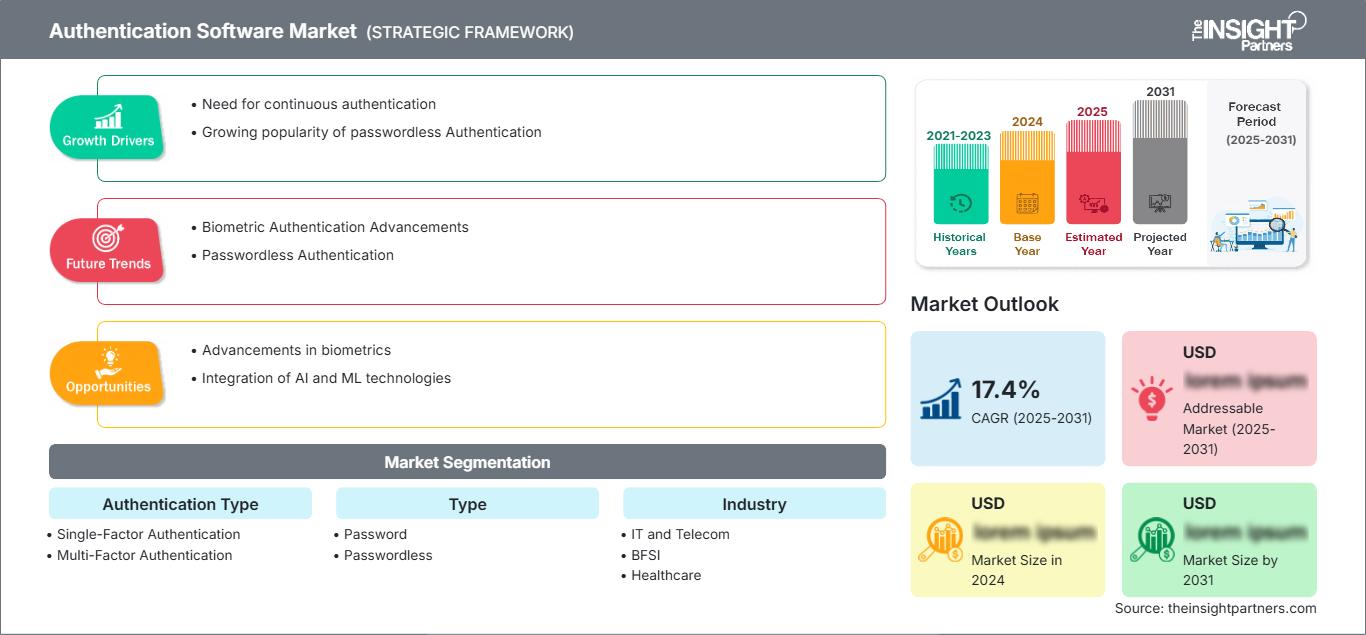
Authentication Software Market: Strategic Insights
Regional Insights
North America Authentication Software Market
North America accounted for 36–40% of the authentication software market share in 2025 and is expected to expand at a CAGR of 10.2–10.8% during 2026–2034. The region continues to lead global adoption due to high cybersecurity expenditure, mature cloud infrastructure, and widespread implementation of identity and access management solutions across enterprises. Increasing cyber threats, ransomware attacks, and stringent regulatory compliance requirements have encouraged organizations to strengthen identity verification through multi-factor authentication, adaptive authentication, and biometric technologies. Government agencies, financial institutions, healthcare organizations, and technology enterprises remain among the largest adopters of advanced authentication platforms.
The regional market is further supported by the presence of leading cybersecurity vendors, continuous investments in zero-trust security frameworks, and rapid digital transformation initiatives. Organizations increasingly integrate authentication software with cloud applications, endpoint security, privileged access management, and identity governance platforms to establish comprehensive cybersecurity ecosystems. Growing adoption of passwordless authentication and AI-driven identity intelligence is expected to further reinforce regional market growth throughout the forecast period.
U.S. Authentication Software Market
The U.S. represented 78–82% of the North American market in 2025 and is anticipated to register a CAGR of 10.3–10.9% during 2026–2034. Large enterprises continue investing heavily in identity-centric security architectures to secure cloud workloads, hybrid work environments, and digital customer platforms. Increasing adoption of zero-trust security models, regulatory compliance requirements, and rising cyberattack frequency continue driving enterprise deployment of advanced authentication technologies. Financial services, healthcare, government, retail, and information technology sectors remain major contributors to domestic market demand.
The country also hosts many of the world's leading identity security providers, cloud platform developers, and cybersecurity innovators, enabling continuous product development and rapid commercialization of advanced authentication technologies. Enterprises increasingly prioritize passwordless authentication, biometric verification, AI-powered adaptive authentication, and risk-based identity management to improve both security and user experience while reducing credential-based cyber risks.
Europe Authentication Software Market
Europe accounted for 25–29% of the global market in 2025 and is projected to expand at a CAGR of 10.0–10.6% during 2026–2034. Strict privacy regulations, expanding enterprise digitalization, and increasing cybersecurity investments continue to strengthen market demand across the region. Germany remains the largest regional market because of strong enterprise technology investments and industrial cybersecurity initiatives, while the United Kingdom demonstrates significant adoption across financial services, healthcare, and public sector organizations.
Germany continues to strengthen industrial cybersecurity by integrating identity protection solutions into manufacturing, automotive, and critical infrastructure operations. The United Kingdom experiences robust enterprise demand for cloud-based identity management, adaptive authentication, and privileged access management platforms as organizations modernize cybersecurity frameworks while maintaining compliance with evolving regulatory standards.
France, Italy, and Spain continue expanding enterprise identity security deployments through increasing cloud adoption, government-led digital transformation initiatives, and modernization of critical infrastructure. Organizations across these countries increasingly implement multi-factor authentication, biometric verification, and centralized identity governance to reduce cyber risks while supporting secure digital service delivery across public and private sectors.
APAC Authentication Software Market
Asia Pacific accounted for 23–27% of the global market in 2025 and is projected to register the fastest regional expansion with a CAGR of 12.2–12.8% during 2026–2034. Rapid cloud adoption, expanding digital economies, increasing cyber threats, and government cybersecurity initiatives continue accelerating enterprise investment across the region.
China leads regional deployment through extensive enterprise digitalization and cloud infrastructure expansion, while Japan and South Korea continue strengthening identity security across financial services and manufacturing industries. India demonstrates rapid growth through digital public infrastructure, expanding IT services, and increasing cybersecurity spending, while Australia continues investing in zero-trust security architectures across government and commercial enterprises.
Middle East & Africa Authentication Software Market
The Middle East & Africa market is anticipated to grow at a CAGR of 9.4–10.0% during 2026–2034, supported by increasing investments in cybersecurity, digital government initiatives, and enterprise cloud adoption. Organizations increasingly deploy authentication software to strengthen digital identity protection while complying with evolving cybersecurity regulations.
Saudi Arabia still retains its position as the largest market in the region because of Vision 2030 digital transformation initiatives, whereas the UAE constantly expands its investments in smart governance services and cloud computing cybersecurity infrastructure. South Africa is ahead of other countries in the Sub-Saharan African region due to increasing enterprise cybersecurity spending and the implementation of digital identity technologies.
Segmentation Analysis
Authentication Type
Authentication type remains the foundation of enterprise identity security strategies as organizations strengthen protection against credential theft, phishing attacks, and unauthorized system access. Businesses increasingly implement layered authentication mechanisms that balance security, compliance, and user convenience across cloud and hybrid IT environments. This segment is projected to grow at a CAGR of 11.2–11.8% during 2026–2034. The authentication software market scope continues to broaden as enterprises adopt adaptive identity verification technologies that support zero-trust security frameworks and evolving regulatory requirements.
- Single-Factor Authentication: Single-factor authentication continues to serve low-risk enterprise applications where ease of access and operational simplicity remain priorities. Adoption persists in internal systems with supplementary security controls and limited exposure to external cyber threats.
- Multi-Factor Authentication: Multi-factor authentication dominates enterprise deployments by combining passwords with biometric verification, hardware tokens, mobile authenticators, or one-time passwords, significantly strengthening identity assurance while reducing risks associated with credential compromise and phishing attacks.
Type
The type segment reflects the industry's transition from traditional password-based security toward passwordless authentication technologies that improve both security and user experience. Enterprises increasingly deploy advanced identity verification solutions that minimize credential dependency while supporting regulatory compliance and workforce productivity. The segment is expected to register a CAGR of 11.5–12.1% during 2026–2034, driven by enterprise digital transformation and increasing adoption of biometric authentication technologies.
- Password: Password-based authentication continues to support legacy enterprise applications and compatibility with existing IT infrastructure. Organizations increasingly strengthen password security through centralized identity management, policy enforcement, and integration with multi-factor authentication solutions.
- Passwordless: Passwordless authentication experiences rapid adoption through biometric authentication, security keys, mobile authenticators, and cryptographic credentials that reduce phishing risks, simplify user access, and enhance enterprise cybersecurity across cloud-native environments.
Industry
Industry-specific adoption continues to accelerate as organizations strengthen identity security to protect digital assets, sensitive information, and critical infrastructure. Regulatory compliance, remote workforce expansion, and increasing cyber threats continue to encourage investment across multiple sectors. This segment is anticipated to expand at a CAGR of 10.9–11.5% during 2026–2034, supported by growing enterprise cybersecurity investments and expanding implementation of zero-trust identity frameworks.
- IT and Telecom: IT and telecom organizations remain leading adopters because of extensive cloud deployments, large distributed workforces, and continuous requirements for secure identity verification across enterprise networks and digital service platforms.
- BFSI: Financial institutions deploy advanced authentication platforms to secure digital banking, online transactions, payment systems, customer onboarding, and regulatory compliance while minimizing fraud and protecting sensitive financial information.
- Healthcare: Healthcare providers increasingly implement authentication software to safeguard electronic health records, telemedicine platforms, connected medical devices, and sensitive patient information while meeting evolving privacy and cybersecurity regulations.
- Government: Government agencies continue strengthening digital identity management through multi-factor authentication, identity governance, and secure citizen service platforms that protect critical infrastructure and confidential public sector information.
- Retail: Retail organizations adopt advanced authentication technologies to secure e-commerce platforms, payment systems, customer accounts, loyalty programs, and workforce access while minimizing account takeover fraud and unauthorized transactions.
Opportunity Snapshot
| Industrye | Revenue Contribution | Trend Tag | Adoption Stage |
|---|---|---|---|
| IT and Telecom | High | Zero Trust | Mature |
| BFSI | High | Fraud Prevention | Mature |
| Healthcare | Medium | Digital Health | Scaling |
| Government | Medium | Digital Identity | Scaling |
| Retail | Medium | Secure Commerce | Scaling |
Authentication Software Market Growth Drivers and Impact Analysis
Increasing Adoption of Zero-Trust Security Architectures
Enterprises around the world are moving away from perimeter-focused cybersecurity approaches to zero trust architecture that calls for continuous authentication of all users, devices, and applications seeking to connect to an enterprise’s resources. Authentication tools have become essential elements of such systems as they facilitate adaptive authentication, context-based controls, and continuous risk assessment. Multi-factor authentication, biometric authentication, and behavioral analysis solutions are being implemented in a growing number of organizations within the financial services, healthcare, governmental bodies, and manufacturing industries. The growth of the digitalization wave and the adoption of hybrid work models are fueling further interest in identity-focused security solutions.
Growing Frequency of Identity-Based Cyberattacks
The growing trend of identity theft, phishing attacks, ransomware and account takeovers has made authentication technology a must-have component for any security strategy. More businesses are becoming aware of the fact that identity theft is one of the major attack vectors used by cyber criminals. The use of advanced authentication techniques, based on risk assessment through artificial intelligence, adaptive and passwordless authentication, makes it possible to reduce the risk of unauthorized access without impacting user experience. Privacy laws, financial regulations, and other laws related to healthcare further push companies toward securing their identities.
Expansion of Cloud Computing and Hybrid Workforce Models
The migration of IT infrastructures to the cloud, along with the use of hybrid working models, will keep on changing enterprise IT environments through an increase in the number of users, devices, and applications that need secure authentication processes. Enterprises will require identity platforms that can authenticate identities across many different cloud services, endpoints, and applications within the enterprise. Through the use of authentication software, companies can authenticate identities in a uniform manner irrespective of the location of users, while ensuring single sign-on, federated identity management, and privileged access controls. Vendors will continue to make improvements to their cloud-based authentication platforms with AI capabilities.
Authentication Software Market Future Trends
Rapid Evolution of Passwordless Authentication Technologies
The authentication software market trends increasingly indicate enterprise migration toward passwordless authentication solutions that reduce credential-related vulnerabilities while improving user convenience. Organizations have begun using technologies like biometrics, hardware-based security keys, passkeys, and cryptographic approaches to get rid of passwords. Vendors keep on improving interoperability in operating systems, cloud platforms, and enterprise applications to make deployment easier. Upcoming adoption is predicted to emphasize phishing-resilient authentication, decentralized identity management, and AI-powered identity validation.
Artificial Intelligence Enhances Adaptive Identity Verification
The artificial intelligence technology is becoming a vital part of enterprise authentication systems because it helps to continuously verify users’ identities through contextual and behavioral risk analysis. Modern authentication systems will be able to consider such factors as device characteristics, user behaviors, location, network interaction, and transactions to define their authentication needs. Companies will gain the ability to detect fraud and cyber threats more effectively, as well as reduce false positives. Vendors who use machine learning technologies together with identity governance and access management systems will make enterprises safer and simplify the process of authentication for users.
Authentication Software Market Opportunities
Growing Enterprise Investment Across Emerging Digital Economies
Rapid digitalization across Asia Pacific, Latin America, the Middle East, and Africa creates significant opportunities for authentication solution providers. The authentication software market Forecasts indicate sustained investments in cloud computing, financial technology, digital government services, and enterprise cybersecurity across these regions. The demand for flexible authentication platforms that can secure increasingly large digital systems is on the rise as organizations need to comply with regulations. The vendors who will set up cloud services, localized authentication solutions, and partner channels in the region will have an advantage.
Expansion of Industry-Specific Identity Security Solutions
The companies that provide authentication software products have ample scope to design industry-specific solutions for healthcare, finance, government, retail, manufacturing, and other infrastructures. The industry-specific platform will help resolve compliance issues and secure transactions, as well as make things easy for the organizations in terms of implementation. Biometric authentication, fraud detection using artificial intelligence, and dynamic access controls allow companies to be operationally resilient without affecting users' experience. The providers of authentication platforms that offer compliance-specific capabilities for industries are predicted to see higher customer retention, along with additional subscription income through identity security services.
Frequently Asked Questions

- Comprehensive Market Sizing and Forecast Analysis
- Detailed Segmentation Analysis
- In-Depth Market Dynamics Assessment
- Regional and Country-Level Insights
- Competitive Landscape and Company Benchmarking
- Strategic Business Intelligence
Recent Reports
Testimonials

The Insight Partners' SCADA System Market report is comprehensive, with valuable insights on current trends and future forecasts. The team was highly professional, responsive, and supportive throughout. We are very satisfied and highly recommend their services.
RAN KEDEM Partner, Reali Technologies LTDs
I requested a report on a very specific software market and the team produced the report in a few days. The information was very relevant and well presented. I then requested some changes and additions to the report. The team was again very responsive and I got the final report in less than a week.
JEAN-HERVE JENN Chairman, Future Analytica
We worked with The Insight Partners for an important market study and forecast. They gave us clear insights into opportunities and risks, which helped shape our plans. Their research was easy to use and based on solid data. It helped us make smart, confident decisions. We highly recommend them.
PIYUSH NAGPAL Sr. Vice President, High Beam Global
The Insight Partners delivered insightful, well-structured market research with strong domain expertise. Their team was professional and responsive throughout. The user-friendly website made accessing industry reports seamless. We highly recommend them for reliable, high-quality research services
YUKIHIKO ADACHI CEO, Deep Blue, LLC.
This is the first time I have purchased a market report from The Insight Partners.While I was unsure at first, I visited their web site and felt more comfortable to take the risk and purchase a market report.I am completely satisfied with the quality of the report and customer service. I had several questions and comments with the initial report, but after a couple of dialogs over email with their analyst I believe I have a report that I can use as input to our strategic planning process.Thank you so much for taking the extra time and making this a positive experience.I will definitely recommend your service to others and you will be my first call when we need further market data.
JOHN SUZUKI President and Chief Executive Officer, Board Director, BK Technologies
I wish to appreciate your support and the professionalism you displayed in the course of attending to my request for information regarding to infectious disease IVD market in Nigeria. I appreciate your patience, your guidance, and the fact that you were willing to offer a discount, which eventually made it possible for us to close a deal. I look forward to engaging The Insight Partners in the future, all thanks to the impression you have created in me as a result of this first encounter.
DR CHIJIOKE ONYIA MANAGING DIRECTOR, PineCrest Healthcare Ltd.Reason to Buy
- Informed Decision-Making
- Understanding Market Dynamics
- Competitive Analysis
- Identifying Emerging Markets
- Customer Insights
- Market Forecasts
- Risk Mitigation
- Boosting Operational Efficiency
- Strategic Planning
- Investment Justification
- Tracking Industry Innovations
- Aligning with Regulatory Trends





 Get Free Sample for