
Privacy Management Software Market Size, Share & Trends by 2034
Coverage: By Application (Compliance Management, Risk Management, Reporting and Analytics, Others); Deployment Mode (On-Premises, Cloud); Organization Size (SMEs, Large Enterprises); Industry Vertical (Telecommunication and IT, BFSI, Government and Defense, Others)
- Status : Data Released
- Report Code : TIPRE00003470
- Category : Technology, Media and Telecommunications
- No. of Pages : 150
- Available Report Formats :


- Last update date : March 18, 2026


2025 Market Size
US$ 2.7 Bn
Base year value
2034 Forecast
US$ 16.92 Bn
Projected by 2034
CAGR 2026-2034
24.66 %
Growth rate
Addressable Market
US$ 85.58 Bn
(2026-2034)
The global Privacy Management Software Market size is projected to reach US$ 16.92 billion by 2034 from US$ 2.7 billion in 2025. The market is anticipated to register a CAGR of 24.66% during the forecast period 2026–2034
Key market dynamics include the massive surge in global data creation, the implementation of complex, outcome-oriented privacy mandates like the EU AI Act and India DPDP Act, and a growing emphasis on data sovereignty. Additionally, the market is set to benefit from the rise in AI-driven data discovery tools, the increasing cost of non-compliance fines, which now frequently exceed billion-dollar thresholds, and the strategic shift toward privacy as a core component of brand trust and consumer loyalty.
Privacy Management Software Market Analysis
The privacy management software market analysis reveals a fundamental transition from static compliance toward dynamic data intelligence. Organizations are increasingly moving away from manual spreadsheets to embrace automated platforms that provide real-time visibility into data flows. Procurement trends show a clear preference for integrated GRC (Governance, Risk, and Compliance) ecosystems that can handle everything from consent management to cross-border transfer impact assessments within a single interface. Strategic opportunities are concentrated in AI governance, where software is needed to audit training datasets for bias and ensure personal information is not leaked into large language models. The analysis also highlights that long-term market sustainability relies on interoperability, specifically the ability of privacy tools to sync with diverse cloud environments and legacy databases. Competitive differentiation is now defined by the speed of DSAR (Data Subject Access Request) automation, as companies look to reduce the operational burden of fulfilling thousands of individual rights requests simultaneously.
Privacy Management Software Market Overview
Privacy management solutions have transformed from specialized legal checklists into critical pieces of the enterprise technology stack. Privacy management software currently encompasses a sophisticated array of modules for automated data mapping, real-time incident response, and granular consent tracking across multi-channel digital touchpoints. Both global software giants and hyper-focused privacy startups compete in this space, leveraging cloud-native architectures to provide the scalability required by modern digital businesses. Growing demand for data localization tools, particularly in regions with strict residency requirements, has boosted the adoption of geofencing and encryption technologies. North America maintains a strong revenue lead due to its dense concentration of data-heavy industries and high litigation risks, while Asia-Pacific is seeing a rapid expansion in adoption rates as emerging economies formalize their national data protection frameworks. The US market is also being reshaped by the privacy-by-design movement, which integrates compliance checks directly into the software development lifecycle to prevent privacy risks before they manifest.
Market Research Highlights
- Global market for Privacy Management Software was valued at US$ 2.70 Billion in 2025
- Annual market size is expected to reach US$ 16.92 Billion by 2034
- Total addressable market (TAM) during 2026-2034 is projected to reach approximately US$ 85.58 Billion
- Market is anticipated to register a CAGR of 24.66% during the forecast period
- The United States represents a key market, supported by Increasing data breaches and cyberattacks, Growing adoption of privacy protection tools, as well as evolving industry dynamics
- Market analysis covers North America, Europe, Asia-Pacific, South and Central America, Middle East and Africa, with growth evaluated across the forecast period
- Market opportunities such as Expansion in privacy regulations, Growth in data protection technologies are expected to influence market dynamics and addressable market
- Report profiles industry participants, including AvePoint, Inc., BigID, Inc., IBM Corporation, Nymity Inc., OneTrust, LLC, Protiviti Inc., RSA Security LLC, LogicGate, Inc., SureCloud, TrustArc Inc., while analyzing competitive strategies and innovation developments
-
Source: The Insight Partners' analysis based on proprietary research, government publications, company annual reports, investor presentations, industry databases, and expert interviews.
● REPORT CUSTOMIZATION
Tailor This Report To Align With Your Specific Business Requirements
This report can be customized to align precisely with your business objectives, scope, and target markets. Customization options include tailored segmentation, geography, competitive analysis, and strategic insights to support informed decision-making.
Customize This Report →WHAT YOU CAN ADJUST
- ● Segmentations
- ● Geography
- ● Competitive Analysis
- ● Language Preferences
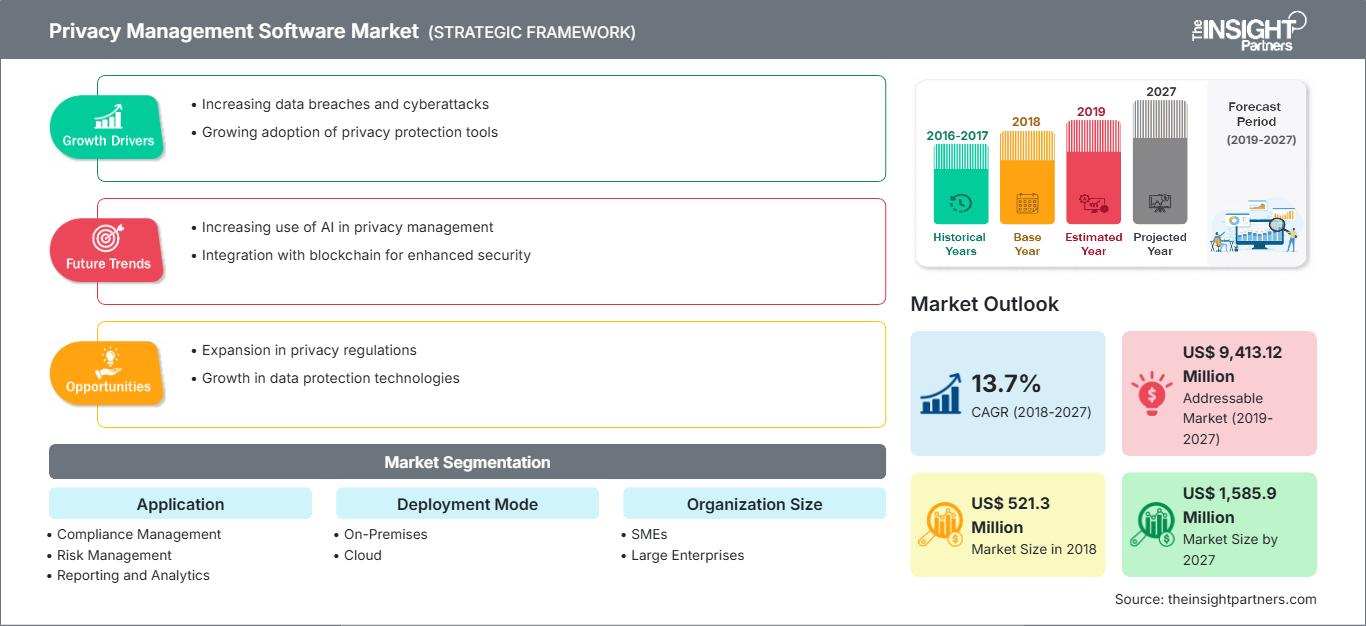
Privacy Management Software Market: Strategic Insights
-
Get Top Key Market Trends of this report.This FREE sample will include data analysis, ranging from market trends to estimates and forecasts.
Privacy Management Software Market Drivers and Opportunities
Market Drivers:
- Expansion of Global Regulatory Landscapes: The continuous rollout of new privacy laws across different jurisdictions necessitates automated software to manage conflicting requirements and ensure constant audit-readiness.
- Escalating Data Breach Costs: As the financial and reputational damage from data leaks grows, enterprises are investing heavily in privacy software to identify and secure sensitive personal information proactively.
- Mainstreaming of AI and Machine Learning: The integration of AI allows for the automated classification of massive datasets, significantly improving the accuracy of risk assessments and reducing the time required for data discovery.
Market Opportunities:
- Development of Privacy-Preserving Analytics: Strategic opportunities exist for vendors providing tools that allow companies to extract business value from datasets without ever exposing raw personal information to analysts.
- Cloud-Native Compliance for SMEs: Creating streamlined, subscription-based platforms that cater to small and medium enterprises can capture a massive segment currently struggling with the complexity of manual compliance.
- Standardization of AI Auditing: As AI regulations take effect, there is a burgeoning opportunity to provide third-party validation and automated auditing tools for the datasets used in algorithmic decision-making.
Privacy Management Software Market Report Segmentation Analysis
The Privacy Management Software Market share is analyzed across various segments to provide a clearer understanding of its structure, growth potential, and emerging trends. Below is the standard segmentation approach used in most industry reports:
By Application:
- Compliance Management: Remains the largest segment, focused on core tasks such as record-keeping, policy management, and meeting the specific documentation requirements of laws like GDPR.
- Risk Management: A high-growth area where software is used to perform Privacy Impact Assessments (PIAs) and manage the risks associated with third-party vendors and data processors.
- Reporting and Analytics: Increasingly vital for providing executive boards with clear metrics on compliance health and for generating the evidence required during regulatory audits.
By Deployment Mode:
- Cloud: The dominant deployment model (holding over 65% share) due to its rapid implementation, lower upfront costs, and superior scalability for global organizations.
- On-Premises: Favored by sectors like government and defense, where total control over the data environment and physical hardware is a non-negotiable security requirement.
By Organization Size:
- Large Enterprises: Currently the primary revenue driver as they manage the most complex data inventories and face the highest risk of massive regulatory penalties.
- SMEs: Expected to grow at the fastest CAGR during the forecast period as they transition from manual processes to affordable, cloud-based automation tools to protect their reputations.
By Industry Vertical:
- Telecommunication and IT: A leading segment driven by the vast amounts of consumer data handled and the sector’s early adoption of digital-first compliance strategies.
- BFSI: Represents a significant share due to the extreme sensitivity of financial data and the need to comply with both general privacy laws and sector-specific financial regulations.
- Government and Defense: Focuses on maintaining public trust and national security by ensuring the highest standards of data protection for citizen information and classified records.
By Geography:
- North America
- Europe
- Asia Pacific
- South & Central America
- Middle East & Africa
Privacy Management Software Market Report Scope
| Report Attribute | Details |
|---|---|
| Market size in 2025 | US$ 2.7 Billion |
| Market Size by 2034 | US$ 16.92 Billion |
| Global CAGR (2026 - 2034) | 24.66% |
| Historical Data | 2021-2024 |
| Forecast period | 2026-2034 |
| Segments Covered |
By Application
|
| Regions and Countries Covered |
North America
|
| Market leaders and key company profiles |
|
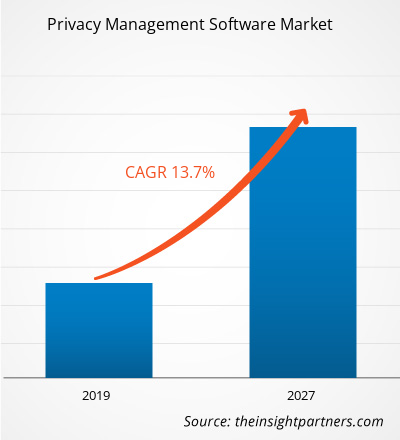
Privacy Management Software Market Players Density: Understanding Its Impact on Business Dynamics
The Privacy Management Software Market is growing rapidly, driven by increasing end-user demand due to factors such as evolving consumer preferences, technological advancements, and greater awareness of the product's benefits. As demand rises, businesses are expanding their offerings, innovating to meet consumer needs, and capitalizing on emerging trends, which further fuels market growth.
Privacy Management Software Market Share Analysis by Geography
Asia-Pacific is expected to grow fastest in the coming years. Emerging markets in South & Central America, the Middle East, and Africa also present numerous untapped opportunities as local governments modernize their digital laws to facilitate international trade.
The privacy management software market is undergoing a significant transition from manual compliance checklists to automated, intelligence-driven ecosystems. Growth is propelled by a global wave of sovereignty-first legislation and the critical need to govern data used in AI modeling. Below is a summary of market share and trends by region:
North America
- Market Share: Holds the largest share globally, driven by a complex patchwork of state-level laws such as the CCPA/CPRA (California), VCDPA (Virginia), and CPA (Colorado).
- Key Drivers:
- High concentration of data-intensive technology and BFSI firms.
- Rapid adoption of Privacy-Enhancing Technologies (PETs) to facilitate secure data collaboration.
- Strict federal oversight in sectors like healthcare (HIPAA) and finance (GLBA).
- Trends: A major shift toward automated DSAR (Data Subject Access Request) fulfillment and the integration of privacy controls within DevSecOps workflows.
Europe
- Market Share: A mature market anchored by the GDPR, representing a significant portion of global revenue due to high compliance maturity.
- Key Drivers:
- Rigorous enforcement by national Data Protection Authorities (DPAs) with multi-million euro fines acting as a deterrent.
- The rollout of the EU AI Act, which mandates strict data governance for high-risk AI systems.
- Deep-seated consumer culture prioritizing Right to be Forgotten and data portability.
- Trends: Strategic focus on sovereign cloud solutions to reduce reliance on non-EU tech providers and a rise in Privacy-by-Design certifications for software vendors.
Asia-Pacific
- Market Share: The fastest-growing region, led by massive digital economies in China, India, and Australia.
- Key Drivers:
- Implementation of landmark laws like India's DPDP Act and China's PIPL, compelling millions of firms to adopt compliance software.
- Rapid urbanization and a surge in e-commerce and fintech adoption.
- Government-led initiatives to establish smart Cities requiring robust data protection frameworks.
- Trends: Heavy reliance on mobile-first consent management and the growth of domestic B2B privacy startups catering to local language and regulatory requirements.
South and Central America
- Market Share: An emerging market with a strong growth trajectory following Brazil's LGPD implementation.
- Key Drivers:
- Modernization of banking systems requires advanced risk management tools.
- Rising awareness of data privacy as a prerequisite for international trade and OECD membership.
- Trends: Adoption of cloud-native privacy tools by SMEs to meet partner compliance requirements in global supply chains.
Middle East and Africa
- Market Share: A developing segment characterized by rapid regulatory formalization in the GCC (Saudi Arabia, UAE) and South Africa (POPIA).
- Key Drivers:
- National vision programs (e.g., Saudi Vision 2030) prioritizing digital transformation and cybersecurity.
- Demand for data localization tools to keep sensitive citizen data within national borders.
- Trends: Implementation of Smart Agriculture and healthcare privacy platforms to protect sensitive biometric and environmental data.
High Market Density and Competition
The competitive landscape is intensifying as traditional GRC (Governance, Risk, and Compliance) players merge with specialized privacy startups. Leading entities like OneTrust, TrustArc, and BigID currently command significant market presence, but the density is increasing due to the entry of hyper-specialized Privacy-as-Code innovators.
This competitive environment pushes vendors to differentiate through:
- AI-Powered Discovery: Using machine learning to identify PII (Personally Identifiable Information) across unstructured data lakes and shadow IT environments.
- Zero-Trust Integration: Positioning privacy as a security layer where access is granted based on the purpose of use rather than just user credentials.
- Unified Governance: Consolidating privacy, ethics, and security into a single platform to eliminate tool fatigue for overstretched compliance teams.
- Scalable SaaS Models: Offering flexible pricing that allows SMEs to access enterprise-grade automation without massive upfront infrastructure costs.
Opportunities and Strategic Moves
- Converged AI & Privacy Governance: Strategic opportunities lie in building platforms that treat AI risk and Data Privacy as a single discipline, providing Fairness and Bias audits alongside traditional compliance.
- Expansion into Privacy-Preserving Analytics: Moving beyond blocking data to enabling it through technologies like Differential Privacy and Homomorphic Encryption, allowing firms to gain insights without seeing raw personal data.
- Strategic Partnerships with Cloud Service Providers (CSPs): Aligning with AWS, Azure, or Google Cloud to offer native privacy modules that can be activated with a single click, capturing the growing cloud-first market.
Major Companies operating in the Privacy Management Software Market are:
- AvePoint, Inc.
- BigID, Inc.
- IBM Corporation
- Nymity Inc.
- OneTrust, LLC
- Protiviti Inc.
- RSA Security LLC
- LogicGate, Inc.
- SureCloud
- TrustArc Inc.
Disclaimer: The companies listed above are not ranked in any particular order.
Privacy Management Software Market News and Recent Developments
- In January 2026, IBM announced IBM Sovereign Core, the industry's first AI-ready sovereign-enabled software for enterprises, governments, and service providers to build, deploy, and manage AI-ready sovereign environments. Organizations around the world are facing a growing imperative to exercise control over their technology infrastructure. Driven by evolving regulatory requirements and the need for auditable governance, enterprises and governments are seeking self-managed environments where they maintain complete operational authority, particularly as they deploy AI workloads that amplify sovereignty concerns.
- In April 2025, AvePoint announced new capabilities available in the AvePoint Elements Platform, empowering managed service providers (MSPs) to simplify user lifecycle management and unify device management across tenants with security and scale.
Privacy Management Software Market Report Coverage and Deliverables
The Privacy Management Software Market Size and Forecast (2021–2034) report provides a detailed analysis of the market covering below areas:
- Privacy Management Software Market size and forecast at global, regional, and country levels for all the key market segments covered under the scope
- Privacy Management Software Market trends, as well as market dynamics such as drivers, restraints, and key opportunities
- Detailed PEST and SWOT analysis
- Privacy Management Software Market analysis covering key market trends, global and regional framework, major players, regulations, and recent market developments
- Industry landscape and competition analysis covering market concentration, heat map analysis, prominent players, and recent developments in the Privacy Management Software Market.
- Detailed company profiles
Frequently Asked Questions

- Comprehensive Market Sizing and Forecast Analysis
- Detailed Segmentation Analysis
- In-Depth Market Dynamics Assessment
- Regional and Country-Level Insights
- Competitive Landscape and Company Benchmarking
- Strategic Business Intelligence
Recent Reports
Testimonials

The Insight Partners' SCADA System Market report is comprehensive, with valuable insights on current trends and future forecasts. The team was highly professional, responsive, and supportive throughout. We are very satisfied and highly recommend their services.
RAN KEDEM Partner, Reali Technologies LTDs
I requested a report on a very specific software market and the team produced the report in a few days. The information was very relevant and well presented. I then requested some changes and additions to the report. The team was again very responsive and I got the final report in less than a week.
JEAN-HERVE JENN Chairman, Future Analytica
We worked with The Insight Partners for an important market study and forecast. They gave us clear insights into opportunities and risks, which helped shape our plans. Their research was easy to use and based on solid data. It helped us make smart, confident decisions. We highly recommend them.
PIYUSH NAGPAL Sr. Vice President, High Beam Global
The Insight Partners delivered insightful, well-structured market research with strong domain expertise. Their team was professional and responsive throughout. The user-friendly website made accessing industry reports seamless. We highly recommend them for reliable, high-quality research services
YUKIHIKO ADACHI CEO, Deep Blue, LLC.
This is the first time I have purchased a market report from The Insight Partners.While I was unsure at first, I visited their web site and felt more comfortable to take the risk and purchase a market report.I am completely satisfied with the quality of the report and customer service. I had several questions and comments with the initial report, but after a couple of dialogs over email with their analyst I believe I have a report that I can use as input to our strategic planning process.Thank you so much for taking the extra time and making this a positive experience.I will definitely recommend your service to others and you will be my first call when we need further market data.
JOHN SUZUKI President and Chief Executive Officer, Board Director, BK Technologies
I wish to appreciate your support and the professionalism you displayed in the course of attending to my request for information regarding to infectious disease IVD market in Nigeria. I appreciate your patience, your guidance, and the fact that you were willing to offer a discount, which eventually made it possible for us to close a deal. I look forward to engaging The Insight Partners in the future, all thanks to the impression you have created in me as a result of this first encounter.
DR CHIJIOKE ONYIA MANAGING DIRECTOR, PineCrest Healthcare Ltd.Reason to Buy
- Informed Decision-Making
- Understanding Market Dynamics
- Competitive Analysis
- Identifying Emerging Markets
- Customer Insights
- Market Forecasts
- Risk Mitigation
- Boosting Operational Efficiency
- Strategic Planning
- Investment Justification
- Tracking Industry Innovations
- Aligning with Regulatory Trends





 Get Free Sample for