
Clinical Intelligence Market Size, Trends & Growth by 2034
Coverage: By Type (Population Health Management, Retrospective Performance Measures and Predictive Analytics, Clinical Benchmarking, Clinical Decision Support (CDSS) System, Quality Improvement, Performance Measurement Systems, Other Types); Component (Software, Hardware, Services); Application (Revenue Cycle Management (RCM), Supply Chain, Fraud Management, Financial Management, Clinical, Claim Processing); End User (Hospitals, Clinics, Others) , and Geography (North America, Europe, Asia Pacific, and South and Central America)
- Status : Data Released
- Report Code : TIPRE00007330
- Category : Technology, Media and Telecommunications
- No. of Pages : 150
- Available Report Formats :


- Last update date : March 17, 2026


2025 Market Size
US$ 7 Bn
Base year value
2034 Forecast
US$ 20.17 Bn
Projected by 2034
CAGR 2026-2034
17.54 %
Growth rate
Addressable Market
US$ 153.97 Bn
(2026-2034)
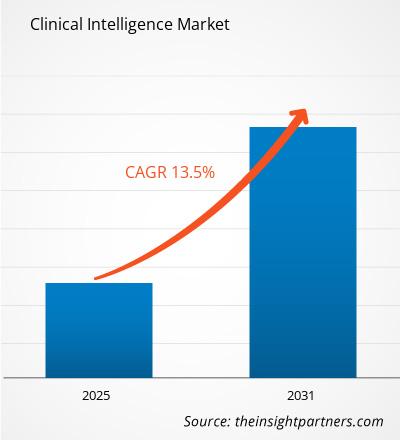
The global Clinical Intelligence Market size is projected to reach US$ 20.17 billion by 2034 from US$ 7 billion in 2025. The market is anticipated to register a CAGR of 17.54% during the forecast period 2026–2034
Key market dynamics include an escalating global demand for data-driven decision-making in healthcare, the rapid digitization of patient records, and a significant shift toward value-based care models. Additionally, the market is expected to benefit from the integration of generative AI in clinical workflows, the rising prevalence of chronic diseases requiring long-term population health management, and a heightened focus on reducing preventable medical errors and hospital readmissions through predictive modeling.
Clinical Intelligence Market Analysis
The clinical intelligence market analysis reveals a decisive transition from descriptive reporting to prescriptive and predictive actionability. Healthcare providers are no longer satisfied with retrospective data; they are seeking real-time intelligence that can intervene at the point of care. Strategic opportunities are emerging in specialty clinical decision support (CDSS) and automated quality improvement, where intelligence platforms assist clinicians in adhering to evolving medical guidelines. The analysis also suggests that market players must focus on interoperability-first designs, ensuring that intelligence layers can seamlessly extract and push data back into disparate Electronic Health Records (EHR) systems. Competitive differentiation now depends on the ability to provide transparent, explainable AI that builds trust among medical professionals and satisfies stringent regulatory requirements regarding data privacy and clinical evidence.
Clinical Intelligence Market Overview
Clinical intelligence is evolving from a back-office administrative tool into a frontline clinical necessity. Historically focused on basic financial reporting and retrospective performance measurement, clinical intelligence now encompasses complex ecosystems of population health management and predictive analytics. The market is fueled by the explosion of healthcare data from wearables, IoT devices, and digital health records, necessitating advanced software to synthesize this information into actionable medical insights. While hospitals remain the primary adopters, there is a growing trend of expansion into ambulatory clinics and long-term care facilities. As global healthcare systems face mounting pressure to lower costs while improving outcomes, clinical intelligence serves as the technological bridge connecting operational efficiency with superior patient care. For instance, the market in the US represents a mature yet dynamic landscape for clinical intelligence, characterized by high adoption rates of advanced healthcare IT. Rigorous regulatory frameworks and the widespread transition to risk-based payment models primarily drive market expansion. The focus remains on enhancing clinician productivity and optimizing resource allocation across large integrated delivery networks.
Market Assessment and Insights
- Global market for Clinical Intelligence was valued at US$ 7.00 Billion in 2025
- Annual market size is expected to reach US$ 20.17 Billion by 2034
- Total addressable market (TAM) during 2026-2034 is projected to reach approximately US$ 153.97 Billion
- Market is anticipated to register a CAGR of 17.54% during the forecast period
- The United States represents a key market, supported by Increasing Volume of Healthcare Data, Growing Emphasis on Value-Based Care, as well as evolving industry dynamics
- Market analysis covers North America, Europe, Asia-Pacific, South and Central America, Middle East and Africa, with growth evaluated across the forecast period
- Market opportunities such as Collaboration and Partnerships with Healthcare Providers, Integration with Wearables and Remote Patient Monitoring are expected to influence market dynamics and addressable market
- Report profiles industry participants, including GENERAL ELECTRIC COMPANY, NXGN Management, LLC, Allscripts Healthcare, LLC, Cerner Corporation, IBM, Epic Systems Corporation, Greenway Health, LLC, McKesson Corporation, eClinicalWorks, Saama Technologies, Inc., Premier, Appex Innovations, Nuance Communications, Inc(Microsoft), ZeOmega, Apervita, Inc., while analyzing competitive strategies and innovation developments
-
Source: The Insight Partners' analysis based on proprietary research, government publications, company annual reports, investor presentations, industry databases, and expert interviews.
● REPORT CUSTOMIZATION
Tailor This Report To Align With Your Specific Business Requirements
This report can be customized to align precisely with your business objectives, scope, and target markets. Customization options include tailored segmentation, geography, competitive analysis, and strategic insights to support informed decision-making.
Customize This Report →WHAT YOU CAN ADJUST
- ● Segmentations
- ● Geography
- ● Competitive Analysis
- ● Language Preferences
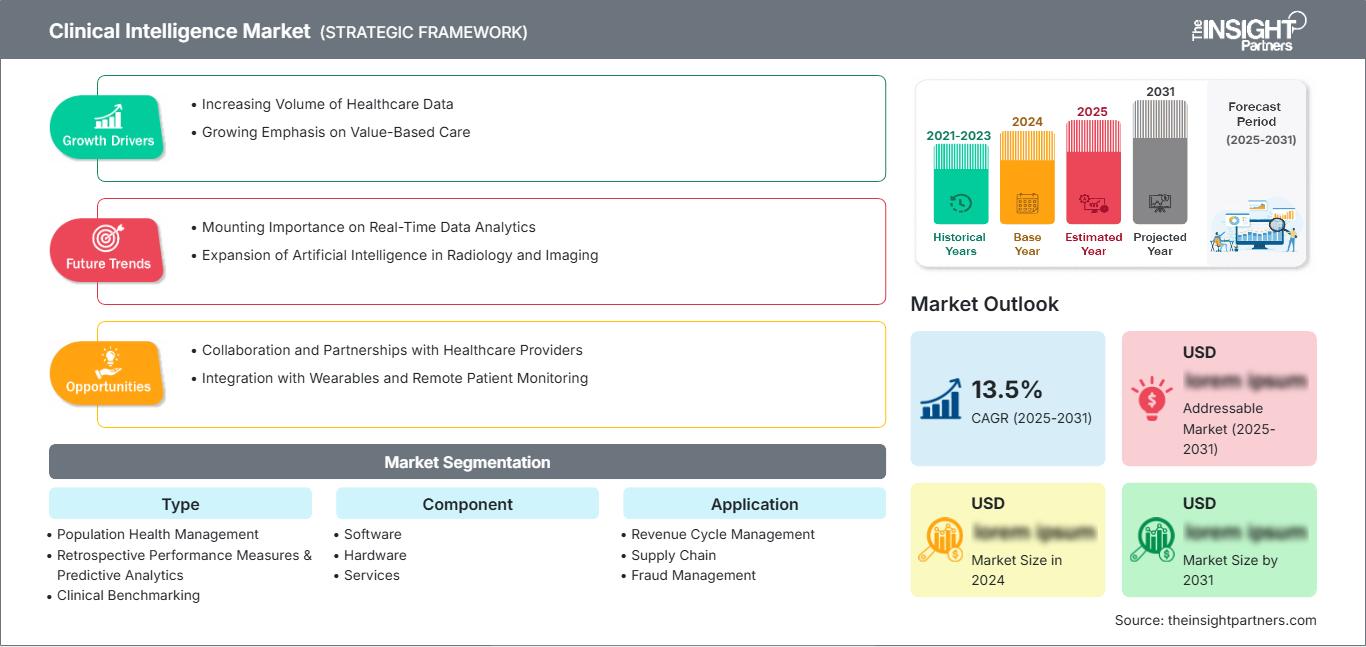
Clinical Intelligence Market: Strategic Insights
-
Get Top Key Market Trends of this report.This FREE sample will include data analysis, ranging from market trends to estimates and forecasts.
Clinical Intelligence Market Drivers and Opportunities
Market Drivers:
- Transition to Value-Based Care: Governments and private payers are shifting from fee-for-service to value-based reimbursement models. This necessitates clinical intelligence tools to track patient outcomes and demonstrate high-quality care to ensure full reimbursement.
- Rising Volume of Complex Healthcare Data: The proliferation of digital health data from EHRs, medical imaging, and genomic sequencing has created a critical need for intelligence platforms that can aggregate and analyze big data to support clinical decisions.
- Focus on Patient Safety and Error Reduction: Clinical intelligence systems provide real-time alerts and evidence-based recommendations, which are instrumental in reducing diagnostic errors, medication mishaps, and unnecessary hospital readmissions.
Market Opportunities:
- Integration of Generative AI and NLP: There is a significant opportunity to incorporate Natural Language Processing (NLP) and Generative AI to automate medical documentation and summarize complex patient histories, significantly reducing physician burnout.
- Expansion into Rural and Underserved Markets: As telehealth gains permanent status in global health systems, clinical intelligence platforms can be deployed to provide high-level diagnostic support to remote clinics that lack specialized medical staff.
- Personalized and Precision Medicine: Advanced analytics offer the opportunity to tailor treatment plans based on a patient’s specific genetic profile and lifestyle data, moving the market toward highly individualized clinical intelligence.
Clinical Intelligence Market Report Segmentation Analysis
The Clinical Intelligence Market share is analyzed across various segments to provide a clearer understanding of its structure, growth potential, and emerging trends. Below is the standard segmentation approach used in most industry reports:
By Type:
- Population Health Management: Focuses on aggregating and analyzing data across a community to improve health outcomes and manage chronic diseases.
- Retrospective Performance Measures and Predictive Analytics: Combines historical data analysis with forward-looking algorithms to forecast patient risks and hospital needs.
- Clinical Benchmarking: Allows institutions to compare their clinical performance against industry standards or peer groups to identify gaps.
- Clinical Decision Support (CDSS) System: Provides clinicians with person-specific, intelligently filtered information at appropriate times to enhance health and healthcare.
- Quality Improvement: Specifically designed to monitor clinical protocols and ensure adherence to safety and efficacy standards.
- Performance Measurement Systems: Tracks specific metrics related to clinical throughput, staff efficiency, and departmental outcomes.
- Other Types: Includes specialized modules for genomic analytics and clinical trial intelligence.
By Component:
- Software: The core intelligence engines, including cloud-based SaaS platforms and on-premise analytical tools.
- Hardware: Comprises the underlying server infrastructure, networking equipment, and specialized devices required for data processing.
- Services: Includes consulting, implementation, training, and ongoing technical support provided by vendors.
By Application:
- Revenue Cycle Management (RCM): Focuses on the clinical documentation and coding accuracy necessary to maximize financial capture.
- Supply Chain: Uses intelligence to optimize the procurement of clinical supplies and manage hospital inventory levels.
- Fraud Management: Analyzes patterns to detect and prevent clinical billing fraud and waste.
- Financial Management: Provides high-level insights into the profitability and cost-efficiency of specific clinical departments.
- Clinical: The primary application focused on direct patient care, diagnostics, and treatment planning.
- Claim Processing: Streamlines the interaction between clinical data and payer requirements for faster claim resolution.
By End User:
- Hospitals: The largest segment, utilizing comprehensive intelligence suites across multiple departments.
- Clinics: A Growing segment focused on outpatient care and specialized medical practices.
- Others: Includes diagnostic laboratories, research institutions, and long-term care facilities.
By Geography:
- North America
- Europe
- Asia Pacific
- South & Central America
- Middle East & Africa
Clinical Intelligence Market Report Scope
| Report Attribute | Details |
|---|---|
| Market size in 2025 | US$ 7 Billion |
| Market Size by 2034 | US$ 20.17 Billion |
| Global CAGR (2026 - 2034) | 17.54% |
| Historical Data | 2021-2024 |
| Forecast period | 2026-2034 |
| Segments Covered |
By Type
|
| Regions and Countries Covered |
North America
|
| Market leaders and key company profiles |
|
Clinical Intelligence Market Players Density: Understanding Its Impact on Business Dynamics
The Clinical Intelligence Market is growing rapidly, driven by increasing end-user demand due to factors such as evolving consumer preferences, technological advancements, and greater awareness of the product's benefits. As demand rises, businesses are expanding their offerings, innovating to meet consumer needs, and capitalizing on emerging trends, which further fuels market growth.
Clinical Intelligence Market Share Analysis by Geography
Asia-Pacific is expected to grow fastest in the coming years. Emerging markets in South & Central America, the Middle East, and Africa also have many untapped opportunities for digital health providers and clinical analytics firms to expand.
The clinical intelligence market is undergoing a significant transformation, moving from a traditional retrospective reporting tool to a global, high-value predictive necessity. Growth is driven by the rising prevalence of chronic diseases, a surge in demand for value-based care, and the rapid expansion of AI-driven clinical decision support. Below is a summary of market share and trends by region:
North America
- Market Share: Holds the largest share globally (approx. 45–49% of the total market), anchored by a mature digital healthcare ecosystem and rigorous regulatory frameworks.
- Key Drivers:
- Presence of leading global healthcare IT vendors (e.g., Oracle, Epic, Microsoft).
- Strong government incentives for EHR modernization and data interoperability.
- High demand for specialized predictive analytics in oncology and chronic care.
- Trends: A strategic shift toward Explainable AI to build clinician trust and the integration of Natural Language Processing (NLP) to automate medical documentation and reduce provider burnout.
Europe
- Market Share: A dominant market segment, driven by large-scale public health systems and the transition toward agile, scalable health data infrastructures.
- Key Drivers:
- Implementation of the European Health Data Space (EHDS) to facilitate cross-border data exchange.
- Rising healthcare costs and aging populations are forcing the adoption of efficiency-driven analytics.
- Strict adherence to GDPR, fueling the demand for secure, privacy-compliant intelligence platforms.
- Trends: Increasing adoption of Decentralized Clinical Trial (DCT) services and a move toward Sovereign Cloud solutions to ensure data ownership within national boundaries.
Asia-Pacific
- Market Share: The fastest-growing region, with a massive push for healthcare digitization in China, India, and Southeast Asia.
- Key Drivers:
- Government-led Smart Hospital initiatives and national digital health IDs (e.g., Ayushman Bharat in India).
- Rapid urbanization is leading to the construction of large-scale private hospital networks.
- Rising investments in telehealth platforms that require integrated clinical intelligence.
- Trends: Heavy reliance on Mobile-first clinical platforms and the use of AI for digital triage to manage high patient volumes in emerging urban corridors.
South and Central America
- Market Share: An emerging market with a growing artisanal sector of health-tech startups in countries like Brazil, Argentina, and Chile.
- Key Drivers:
- Modernization of regulatory frameworks to streamline the approval of digital health tools.
- Increasing interest in data-driven strategies to optimize hospital resource allocation.
- The rising prevalence of lifestyle diseases necessitates better population health management.
- Trends: Growth of Cloud-based analytical platforms to minimize local infrastructure costs and a shift toward Patient-centered preventive care models.
Middle East and Africa
- Market Share: A developing market with deep roots in regional healthcare expansion, transitioning toward formalized commercial intelligence.
- Key Drivers:
- Strategic national visions (e.g., Saudi Vision 2030) prioritize digital health as a core economic pillar.
- High demand for shelf-stable, scalable UHT-style digital infrastructure in remote areas.
- Strategic investments in Smart Agriculture and Smart Cities that integrate health surveillance.
- Trends: Implementation of Remote patient monitoring through wearable devices and a focus on AI-powered diagnostic tools to bridge the gap in specialist physician shortages.
High Market Density and Competition
Competition is intensifying due to the presence of established leaders such as Cerner, IBM, Epic Systems, and Microsoft (Nuance). Regional specialists and niche players like Health Catalyst, Allscripts (Veradigm), and Inovalon, alongside medical device giants like Philips and GE HealthCare, contribute to a highly sophisticated and rapidly expanding landscape.
This competitive environment pushes vendors to differentiate through:
- Clinical Relevance and UX: Vendors are focusing on reducing alert fatigue by ensuring clinical intelligence is highly relevant, non-intrusive, and integrated into the natural workflow of clinicians.
- AI and Predictive Accuracy: Companies are competing to provide the most accurate predictive models for sepsis detection, readmission risks, and patient deterioration.
- Full-Stack Integration: Leaders are moving toward offering end-to-end solutions that manage everything from the data lake and ingestion to the final bedside clinical recommendation.
- Cybersecurity and Compliance: In an era of frequent healthcare data breaches, robust security certifications and compliance-by-design are becoming major selling points.
Opportunities and Strategic Moves
- Partner with Big Tech for Scalability: Small to medium clinical intelligence firms are increasingly partnering with cloud giants (AWS, Google Cloud, Azure) to leverage their massive computing power and AI frameworks.
- Focus on Health Equity Analytics: There is a strategic move toward developing modules that analyze Social Determinants of Health (SDOH) to help providers address health disparities and improve community-wide outcomes.
Major Companies operating in the Clinical Intelligence Market are:
- GENERAL ELECTRIC COMPANY
- NXGN Management, LLC
- Allscripts Healthcare, LLC
- Cerner Corporation
- IBM
- Epic Systems Corporation
- Greenway Health, LLC
- McKesson Corporation
- eClinicalWorks
- Saama Technologies, Inc.
- Premier
- Appex Innovations
- Nuance Communications, Inc(Microsoft)
- ZeOmega
Disclaimer: The companies listed above are not ranked in any particular order.
Clinical Intelligence Market News and Recent Developments
- In April 2025, Johnson & Johnson (NYSE: JNJ) announced it had completed its acquisition of Intra-Cellular Therapies, Inc. Following the transaction, Intra-Cellular Therapies was integrated into the company’s portfolio to operate as a specialized business unit within Johnson & Johnson Innovative Medicine. This acquisition allowed the company to significantly bolster its Clinical Intelligence capabilities, particularly in the analysis of neurological treatment outcomes and the management of complex mental health data.
- In February 2025, Axtria Inc., a global leader in cloud software and data analytics for the life sciences industry, announced groundbreaking advancements in its Clinical Intelligence practice with the launch of Axtria Rapid CSR. This innovative solution utilized Generative AI to streamline the processing and automation of clinical study report (CSR) development. Axtria Rapid CSR was specifically trained and tested to reduce report generation timelines by 30%–50% for most large-scale phase III clinical trials, representing a significant shift in how researchers leverage high-level data to expedite regulatory submissions.
Clinical Intelligence Market Report Coverage and Deliverables
The Clinical Intelligence Market Size and Forecast (2021–2034) report provides a detailed analysis of the market covering below areas:
- Market size and forecast at global, regional, and country levels for all the key market segments covered under the scope
- Market trends, as well as market dynamics such as drivers, restraints, and key opportunities
- Detailed PEST and SWOT analysis
- Market analysis covering key market trends, global and regional framework, major players, regulations, and recent market developments
- Industry landscape and competition analysis covering market concentration, heat map analysis, prominent players, and recent developments in the Clinical Intelligence Market.
- Detailed company profiles
Frequently Asked Questions

- Comprehensive Market Sizing and Forecast Analysis
- Detailed Segmentation Analysis
- In-Depth Market Dynamics Assessment
- Regional and Country-Level Insights
- Competitive Landscape and Company Benchmarking
- Strategic Business Intelligence
Recent Reports
Testimonials

The Insight Partners' SCADA System Market report is comprehensive, with valuable insights on current trends and future forecasts. The team was highly professional, responsive, and supportive throughout. We are very satisfied and highly recommend their services.
RAN KEDEM Partner, Reali Technologies LTDs
I requested a report on a very specific software market and the team produced the report in a few days. The information was very relevant and well presented. I then requested some changes and additions to the report. The team was again very responsive and I got the final report in less than a week.
JEAN-HERVE JENN Chairman, Future Analytica
We worked with The Insight Partners for an important market study and forecast. They gave us clear insights into opportunities and risks, which helped shape our plans. Their research was easy to use and based on solid data. It helped us make smart, confident decisions. We highly recommend them.
PIYUSH NAGPAL Sr. Vice President, High Beam Global
The Insight Partners delivered insightful, well-structured market research with strong domain expertise. Their team was professional and responsive throughout. The user-friendly website made accessing industry reports seamless. We highly recommend them for reliable, high-quality research services
YUKIHIKO ADACHI CEO, Deep Blue, LLC.
This is the first time I have purchased a market report from The Insight Partners.While I was unsure at first, I visited their web site and felt more comfortable to take the risk and purchase a market report.I am completely satisfied with the quality of the report and customer service. I had several questions and comments with the initial report, but after a couple of dialogs over email with their analyst I believe I have a report that I can use as input to our strategic planning process.Thank you so much for taking the extra time and making this a positive experience.I will definitely recommend your service to others and you will be my first call when we need further market data.
JOHN SUZUKI President and Chief Executive Officer, Board Director, BK Technologies
I wish to appreciate your support and the professionalism you displayed in the course of attending to my request for information regarding to infectious disease IVD market in Nigeria. I appreciate your patience, your guidance, and the fact that you were willing to offer a discount, which eventually made it possible for us to close a deal. I look forward to engaging The Insight Partners in the future, all thanks to the impression you have created in me as a result of this first encounter.
DR CHIJIOKE ONYIA MANAGING DIRECTOR, PineCrest Healthcare Ltd.Reason to Buy
- Informed Decision-Making
- Understanding Market Dynamics
- Competitive Analysis
- Identifying Emerging Markets
- Customer Insights
- Market Forecasts
- Risk Mitigation
- Boosting Operational Efficiency
- Strategic Planning
- Investment Justification
- Tracking Industry Innovations
- Aligning with Regulatory Trends





 Get Free Sample for