
Automated 3D Printing Market Share, Demand & Growth by 2034
Coverage: by Offering (Hardware, Software, Services); Process (Automated Production, Material Handling, Part Handling, Multiprocessing, Post-Processing); End User (Automotive, Healthcare, Aerospace and Defense, Consumer Products, Energy, Others) , and Geography (North America, Europe, Asia Pacific, and South and Central America)
- Status : Data Released
- Report Code : TIPRE00007113
- Category : Electronics and Semiconductor
- No. of Pages : 150
- Available Report Formats :


- Last update date : July 20, 2026


2025 Market Size
US$ 169.2 Mn
Base year value
2034 Forecast
US$ 1,170.12 Mn
Projected by 2034
CAGR 2026-2034
23.97 %
Growth rate
Addressable Market
US$ 5,176.91 Mn
(2026-2034)
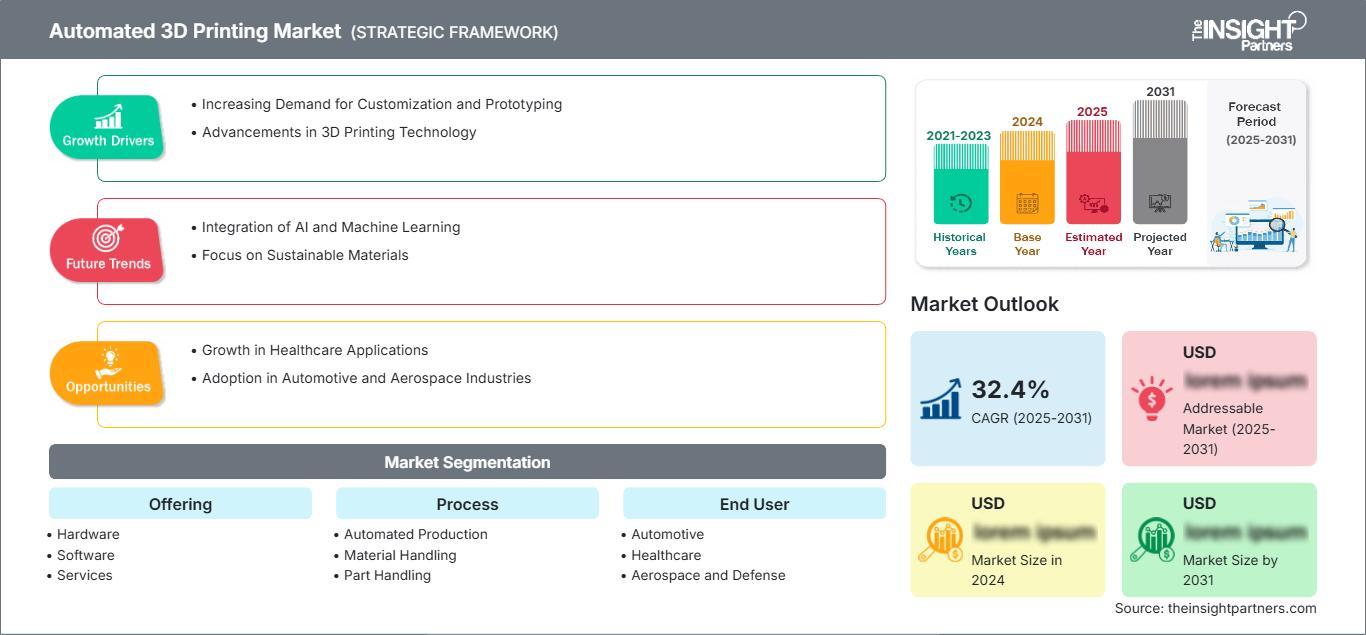
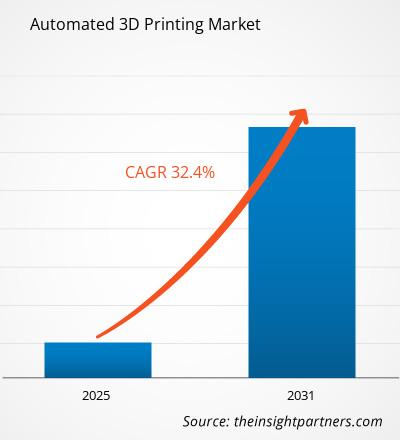
The global Automated 3D Printing market was valued at US$ 169.2 million in 2025 and is expected to reach US$ 1170.12 million by 2034; it is estimated to record a CAGR of 23.97% during 2026-2034.
Automated 3D Printing Market Assessment and Insights
- North America: Expected to hold 34–38% share in 2025, growing at 25–29% CAGR 2026–2034. Growth is driven by strong investments in aerospace and defense applications, a robust healthcare device ecosystem, and the early adoption of lights-out manufacturing capabilities.
- U.S. Automated 3D Printing Market: Accounted for approximately 85–88% of the North American market in 2025, expanding at a CAGR of 26–30%. Substantial federal funding for advanced manufacturing R&D, along with the presence of major industry players like 3D Systems and Stratasys, supports strong market performance.
- Europe: Estimated to capture 26–30% share in 2025, with a projected CAGR of 24–28%. Germany, the UK, and France are leading adopters. Growth is propelled by the widespread implementation of smart manufacturing initiatives, stringent sustainability goals, and a strong industrial base in automotive and aerospace.
- Asia Pacific: Expected to be the fastest-growing region, with a 24–28% share in 2025 and a CAGR of 30–34%. China, Japan, and South Korea are key markets, driven by aggressive industrial digitalization, government-backed automation initiatives, and the rapid expansion of electronics manufacturing.
- Largest Segment (Hardware): Held a share of 52–56% in 2025, with a CAGR of 26–30%. The hardware segment dominates as advanced printers, sensors, robotic arms, and automated material feeders form the foundation of intelligent additive manufacturing ecosystems.
- High Growth Segment (Services): Captured 24–28% share in 2025, with a CAGR of 28–32%. Services are projected to outpace hardware growth, underpinned by subscription bundles that wrap software, consumables, and predictive maintenance into multiyear contracts.
- Key Companies Analyzed in Detail: 3D Systems Corporation; ABB Ltd.; EOS GmbH; Formlabs Inc.; General Electric Company; KUKA AG; Materialise NV; SLM Solutions Group AG; Stratasys Ltd.; The ExOne Company.
Source: The Insight Partners' analysis based on proprietary research, government publications, company annual reports, investor presentations, industry databases, and expert interviews.
The Automated 3D Printing Market report is undergoing a significant transformation as the industry shifts from standalone machines to integrated production systems where software, automation, quality assurance, and data governance matter as much as hardware. Manufacturers are increasingly focusing on developing hybrid cells that integrate multiple manufacturing processes, including additive, subtractive, heat treatment, and inspection tasks within a single platform. Production dynamics are evolving toward modular pallet pools that seamlessly interface with additive-subtractive cells, increasing unmanned operational hours and boosting throughput without expanding physical footprints. The integration of AI-driven process monitoring and real-time defect detection systems is further enhancing product quality and reducing scrap rates, making automated 3D printing viable for end-use production across regulated industries.
Looking forward, the market is poised for sustained growth, with emerging economies in Asia-Pacific presenting significant opportunities due to rapid industrialization and government-backed digital manufacturing initiatives. Regulatory tailwinds, including the increasing adoption of ISO and AS9100 quality standards, are driving demand for automated systems with robust documentation and traceability capabilities. The push toward sustainable manufacturing is informing investment choices, with new materials and closed-loop recycling systems reducing the lifecycle environmental impact of additive production. Furthermore, the convergence of automated 3D printing with AI-driven design tools and digital thread implementations is expected to create new application paradigms in sectors like healthcare, aerospace, and consumer products, expanding the Automated 3D Printing market scope into personalized and on-demand manufacturing.
Automated 3D Printing Market Report Scope
| Report Attribute | Details |
|---|---|
| Market size in 2025 | US$ 169.2 Million |
| Market Size by 2034 | US$ 1,170.12 Million |
| Global CAGR (2026 - 2034) | 23.97% |
| Historical Data | 2021-2024 |
| Forecast period | 2026-2034 |
Automated 3D Printing Market Analysis
The escalating demand for manufacturing flexibility and supply chain resilience is a primary driver for the market. Industries such as automotive, healthcare, and aerospace are increasingly leveraging automated additive manufacturing to produce complex geometries with unparalleled precision while reducing lead times and inventory costs. The value chain encompasses printer hardware suppliers, material producers, software developers, robotics integrators, service bureaus, and manufacturing workflow partners, with supply dynamics influenced by the availability of advanced materials and semiconductor components. Organizations are recognizing the strategic value of automated additive workflows for rapid prototyping, low-volume production, and tooling applications, driving consistent demand for integrated solutions. The market is also benefiting from the increasing adoption of smart factory initiatives, with automation already reshaping more than 50% of manufacturing workflows worldwide.
The competitive landscape is characterized by a mix of established additive manufacturing OEMs, automation providers, and software workflow companies, with Stratasys Ltd., 3D Systems Corporation, and EOS GmbH accounting for a substantial market share through comprehensive product portfolios and strong R&D capabilities. Investment trends are heavily skewed toward product innovation, particularly in the development of multi-laser powder-bed systems, hybrid machines, and automated post-processing solutions. Strategic positioning involves expanding manufacturing capabilities in high-growth regions, forming partnerships with robotics integrators and software providers, and focusing on application-specific solutions to maintain competitive advantage. Companies are differentiating through product quality, technical capability, channel reach, and lifecycle support, with a growing emphasis on certification pathways and standards alignment for regulated industries.
● REPORT CUSTOMIZATION
Tailor This Report To Align With Your Specific Business Requirements
This report can be customized to align precisely with your business objectives, scope, and target markets. Customization options include tailored segmentation, geography, competitive analysis, and strategic insights to support informed decision-making.
Customize This Report →WHAT YOU CAN ADJUST
- ● Segmentations
- ● Geography
- ● Competitive Analysis
- ● Language Preferences
Automated 3D Printing Market: Strategic Insights
Regional Insights
North America Automated 3D Printing Market
North America is expected to be a significant market for automated 3D printing, holding approximately 34–38% of the share in 2025, with a projected CAGR of 25–29% from 2026 to 2034. The region's growth is driven by substantial investments in additive manufacturing research, strong aerospace and defense ecosystems, and the early adoption of lights-out manufacturing capabilities. The United States leads the regional market, supported by extensive integration of robotics and AI within additive workflows across automotive, aerospace, and healthcare sectors. The commercial and defense aerospace sectors are particularly active, with qualification initiatives and digital inventory programs embedding additive manufacturing into supply chains where resilience and availability matter more than unit cost. Government initiatives, including federal funding for advanced manufacturing R&D, are playing a pivotal role in accelerating adoption across the region.
U.S. Automated 3D Printing Market
The U.S. Automated 3D Printing Market size is estimated to represent 85–88% of the North American share in 2025, growing at a CAGR of 26–30%. Growth is fueled by federal funding for advanced manufacturing R&D, the modernization of aerospace and defense supply chains, and increasing investments in medical device manufacturing. Key application sectors include aerospace, defense, healthcare, and automotive, where companies are leveraging national innovation frameworks to accelerate product development and commercialization. The presence of major manufacturers like 3D Systems Corporation, Stratasys Ltd., and General Electric Company ensures a robust supply chain and technological innovation. The growing emphasis on reshoring domestic production and supply chain resilience further supports sustained demand for automated 3D printing systems.
Europe Automated 3D Printing Market
Europe is anticipated to capture 26–30% of the global Automated 3D Printing market share in 2025, with a CAGR of 24–28%. Germany leads the regional market due to its strong manufacturing base, industrial automation initiatives, and the widespread implementation of smart manufacturing programs. The UK is a significant market, driven by defense-linked additive programs and digital inventory initiatives. France, Italy, and Spain contribute notably, with investments in automotive and aerospace applications. The European market is distinguished by strict adherence to sustainability goals and a strong focus on energy-efficient production, influencing product design and adoption. The region's commitment to reducing carbon emissions and advancing circular economy principles is accelerating the deployment of automated additive manufacturing systems.
APAC Automated 3D Printing Market
Asia Pacific is poised for the highest growth, holding approximately 24–28% of the market in 2025 and projected to expand at a CAGR of 30–34%. China and Japan are the leading countries, with growth fueled by rapid industrial digitalization, extensive electronics manufacturing, and significant government-backed automation initiatives. South Korea is an important market, owing to the development of its manufacturing industries and investment in smart factories. Countries like India and Australia are becoming important markets due to rising interest in digital manufacturing. Government support for industrial automation and production in the country is driving market growth. The region's aggressive move toward digital manufacturing and an emphasis on supply chain resilience are creating demand for automated additive manufacturing solutions.
Middle East & Africa Automated 3D Printing Market
The Middle East & Africa region is expected to show steady growth, with a CAGR of 22–26%. Saudi Arabia and the UAE are making substantial investments in industrial diversification, smart city development, and advanced manufacturing technologies. The key market here is South Africa, which has developed an interest in mining automation and additive manufacturing of spare parts. The region's efforts toward infrastructure development and reduced reliance on foreign components provide ample scope for the implementation of automated 3D printers.
Segmentation Analysis
Offering
The Automated 3D Printing Market is segmented by offering into Hardware, Software, and Services. The offering segment is projected to grow at a CAGR of 26–30% from 2026 to 2034, driven by the diversification of end-user requirements and the increasing need for integrated solutions. Hardware currently holds the largest share, reflecting investment in multi-laser powder-bed systems and hybrid machines, while services are projected to outpace hardware growth as subscription models gain traction. The integration of software-driven simulation tools and robotic arms ensures a seamless link between digital design and physical output, driving demand across all offering categories.
- Hardware: Hardware dominates the market as the core enabler of intelligent additive manufacturing ecosystems. Advanced printers, sensors, robotic arms, and automated material feeders are designed to operate with minimal human supervision, supporting end-to-end automation and seamless workflow optimization.
- Software: Software solutions are increasingly critical for closed-loop process control, real-time monitoring, and machine learning-driven parameter optimization. Simulation suites automate support generation and build orientation, significantly reducing pre-production labor and enabling faster qualification cycles.
- Services: Services encompass subscription bundles, predictive maintenance, and remote diagnostics that convert capital expenditure into operational expenditure. This model allows clients to scale part volumes without heavy balance-sheet exposure, expanding market accessibility.
Process
The Automated 3D Printing Market is segmented by process into Automated Production, Material Handling, Part Handling, Multiprocessing, and Post-Processing. The process segment is expected to exhibit a strong CAGR of 27–31% from 2026 to 2034, propelled by the increasing need for end-to-end workflow automation. Automated production currently holds the largest share, yet multiprocessing is projected to expand rapidly as hybrid cells integrate additive, subtractive, heat treatment, and inspection tasks within a single setup. The shift toward fully autonomous production environments is driving innovation across all process categories.
- Automated Production: Automated production dominates with integrated systems that operate continuously with minimal human intervention. These systems incorporate real-time defect detection and auto-correction features, dramatically improving product quality and operational efficiency.
- Material Handling: Material handling automation is essential for scalable additive manufacturing, involving robotic material feeders and automated powder management systems that ensure consistent feedstock supply and reduce operator intervention.
- Part Handling: Robotic part-handling systems autonomously swap build plates and transfer components between process stages, significantly enhancing operational efficiency and enabling lights-out production capabilities.
- Multiprocessing: Multiprocessing involves hybrid cells that combine additive manufacturing with subtractive machining, heat treatment, and inspection. This approach eliminates inter-operation queues and reduces tooling lead times by up to 60%.
- Post-Processing: Automated post-processing solutions include depowdering systems, surface finishing, and quality inspection. Automated depowdering systems have emerged as critical innovations, cutting manual touch time by up to 70% in high-mix production environments.
End User
The Automated 3D Printing Market is segmented by end user into Automotive, Healthcare, Aerospace and Defense, Consumer Products, Energy, and Others. The end user segment is expected to grow at a CAGR of 26–30% from 2026 to 2034, propelled by increasing adoption across diverse industry verticals. The automotive sector leads in revenue contribution due to rapid digitization and demand for lightweight, high-performance components, while healthcare is emerging as the fastest-growing segment driven by personalized medical devices and implants.
- Automotive: The automotive sector drives significant demand for automated 3D printing across prototyping, tooling, and production of end-use parts. Manufacturers adopt automation to streamline supply chains, produce customized components at scale, and reduce vehicle weight for improved efficiency.
- Healthcare: Healthcare applications include personalized medical devices, implants, surgical instruments, and bioprinting. Automation enables precise fabrication of patient-specific anatomies and accelerates the development of novel treatments.
- Aerospace and Defense: Aerospace and defense prioritize qualification pathways, material provenance, and production repeatability. Automated additive manufacturing is embedded into supply chains for digital inventories and expeditionary manufacturing.
- Consumer Products: Consumer products leverage automated 3D printing for rapid prototyping, customization, and on-demand production. The sector emphasizes cost-effective aesthetics and speed to market.
- Energy: Energy applications include production of components for oil and gas, renewable energy systems, and nuclear power. Automation enables the fabrication of complex geometries with high material integrity.
Opportunity Snapshot
| Segment | Revenue Contribution | Trend Tag | Adoption Stage |
| Automotive | High | Lightweighting | Scaling |
| Healthcare | High | Personalized Devices | Scaling |
| Aerospace and Defense | High | Digital Inventory | Scaling |
| Consumer Products | Medium | On-Demand | Scaling |
| Energy | Medium | Asset Integrity | Emerging |
| Hardware | High | System Integration | Mature |
| Software | High | Workflow Automation | Scaling |
| Services | High | Subscription Models | Scaling |
| Automated Production | High | Lights-Out | Mature |
| Multiprocessing | Medium | Hybrid Cells | Emerging |
Automated 3D Printing Market Growth Drivers and Impact Analysis
Growing Demand for Manufacturing Flexibility and Supply Chain Resilience
Growth in the automated 3D printing market is largely driven by rising demand for production flexibility and dependable supply chains. With the help of advanced additive manufacturing technology, companies can minimize lead times, reduce inventory costs, and manufacture components on demand. As additive manufacturing offers rapid prototyping and customization capabilities, companies can adapt according to market changes. The pandemic-related disruptions in the supply chain have led companies to adopt the technology early, as they had to resort to local vendors.
Integration of Artificial Intelligence and Machine Learning in Additive Manufacturing
The incorporation of AI and machine learning algorithms within the 3D printing processes is revolutionizing the industry through real-time process optimization and autonomous decision-making. With AI, sensors analyze processes during 3D printing to detect anomalies and adjust settings accordingly, thereby improving product quality and minimizing scrap. Machine learning algorithms can optimize material properties and 3D printing settings, outperforming traditional techniques in materials development. This combination is making 3D printing more feasible and economical, hence usable in end-use manufacturing.
Expansion of Applications Beyond Prototyping to End-Use Production
There is a clear trend developing in the market as automated 3D printing technology progresses from use in prototype manufacturing and toolmaking to the production of end-use components. This is mainly due to developments in materials science, manufacturing processes, and qualification techniques. The creation of complex shapes that cannot be manufactured through conventional processes is a unique characteristic of this process. As certification guidelines become more developed and economical manufacturing becomes easier, there will be more adoption of automated 3D printing technology in large-scale manufacturing.
Automated 3D Printing Market Future Trends
Emergence of Hybrid Manufacturing Cells Integrating Multiple Processes
Automated 3D Printing Market trends include the advent of hybrid manufacturing cells, in which additive, subtractive, and heat-treatment inspection processes converge on a single platform. These systems are beneficial in eliminating waiting lines for compatible operations, reducing tool creation time by 60 percent, and allowing companies to receive tools within one day. The hybrid cells work well when high accuracy and complexity are required, such as in aerospace turbine blade repair and the manufacture of conformal cooling channels. This trend signifies that the industry has evolved from standalone machines to complete production systems, where software and automation are as crucial as hardware capabilities.
Adoption of AI-Powered Process Monitoring and Self-Correcting Systems
There is an increased deployment of AI-based systems for process monitoring, which can detect defects in real time and correct themselves on the fly while printing. These systems use computer vision and sensor data, along with machine learning techniques, to detect faults and adjust parameters to ensure print quality. Large language models are being used as autonomous systems in additive manufacturing to assess print quality, detect failure modes, and take corrective action without human involvement. This trend toward autonomous, self-improving process control is enhancing product consistency, reducing material waste, and expanding the viability of automated 3D printing for regulated production environments.
Automated 3D Printing Market Opportunities
Expansion into Personalized Healthcare and Medical Device Manufacturing
Automated 3D Printing market forecasts indicate increasing demand for customized medical devices, implants, and surgical tools, creating significant opportunities for manufacturers of automated 3D printers. Additive manufacturing enables the production of patient-specific anatomy with greater accuracy, leading to better clinical outcomes and shorter procedures. The healthcare industry is emerging as the fastest-growing end-user segment, owing to the increased use of automated additive manufacturing for customized medical products. Businesses that can design automated processes for qualification, traceability, and compliance in medical applications have great potential to dominate the market. The integration of bioprinting capabilities and the development of biocompatible materials further expand the scope of applications.
Development of Sustainable and Circular Manufacturing Solutions
The trend towards sustainable manufacturing and the concept of the circular economy have created significant opportunities for automated 3D printing companies. This type of manufacturing is inherently environmentally friendly due to the layer-by-layer construction of parts, yet further progress in developing closed-loop recycling technology, energy-efficient printers, and optimal design for manufacturing would reduce environmental impact throughout the parts' life cycle. Companies that develop technologies in line with green building standards and sustainability practices will gain a clear advantage over others.
Recent Developments
- February 2026: Hawk Ridge Systems announced a new partnership with Stratasys (NASDAQ: SSYS), a global leader in polymer additive manufacturing, to expand its 3D printing solutions. This partnership broadens Hawk Ridge Systems' manufacturing portfolio with production-grade technologies that offer advanced prototyping, tooling, and end-use manufacturing applications to customers across several industries, such as aerospace, automotive, medical and dental, industrial equipment, and consumer markets.
- March 2026: Midlands 3D announces automated polymer 3D print production facility in operation in the UK. Midlands 3D threw open the doors of their new HQ at an industry open day to demonstrate their latest investments and this new capability. More than quadrupling their floor space in the recent move, Midlands 3D has taken the opportunity to upgrade their fleet of market-leading HP MultiJet Fusion (MJF) Printers, adding their automation system to each.
- July 2025: ICON, the global leader of construction-scale 3D printing and robotics, announced the commercial launch of Titan, a next-generation multi-story robotic construction system designed to build at lower cost and with greater speed and quality. Titan has been engineered to enable builders to deliver multi-story wall systems for roughly $20 per square foot, a potential 40% reduction compared to the national industry-reported averages for conventional wall systems.
Frequently Asked Questions

- Comprehensive Market Sizing and Forecast Analysis
- Detailed Segmentation Analysis
- In-Depth Market Dynamics Assessment
- Regional and Country-Level Insights
- Competitive Landscape and Company Benchmarking
- Strategic Business Intelligence
Recent Reports
Testimonials

The Insight Partners provided valuable market intelligence that supported our global go-to-market strategy. Their team was professional, responsive, and attentive to our feedback, providing thoughtful analysis and helpful methodological clarifications throughout the project.
Junmo Kim Chief Financial Officer (CFO), Enertech Co., Ltd.
The Insight Partners' SCADA System Market report is comprehensive, with valuable insights on current trends and future forecasts. The team was highly professional, responsive, and supportive throughout. We are very satisfied and highly recommend their services.
RAN KEDEM Partner, Reali Technologies LTDs
I requested a report on a very specific software market and the team produced the report in a few days. The information was very relevant and well presented. I then requested some changes and additions to the report. The team was again very responsive and I got the final report in less than a week.
JEAN-HERVE JENN Chairman, Future Analytica
We worked with The Insight Partners for an important market study and forecast. They gave us clear insights into opportunities and risks, which helped shape our plans. Their research was easy to use and based on solid data. It helped us make smart, confident decisions. We highly recommend them.
PIYUSH NAGPAL Sr. Vice President, High Beam Global
The Insight Partners delivered insightful, well-structured market research with strong domain expertise. Their team was professional and responsive throughout. The user-friendly website made accessing industry reports seamless. We highly recommend them for reliable, high-quality research services
YUKIHIKO ADACHI CEO, Deep Blue, LLC.
This is the first time I have purchased a market report from The Insight Partners.While I was unsure at first, I visited their web site and felt more comfortable to take the risk and purchase a market report.I am completely satisfied with the quality of the report and customer service. I had several questions and comments with the initial report, but after a couple of dialogs over email with their analyst I believe I have a report that I can use as input to our strategic planning process.Thank you so much for taking the extra time and making this a positive experience.I will definitely recommend your service to others and you will be my first call when we need further market data.
JOHN SUZUKI President and Chief Executive Officer, Board Director, BK Technologies
I wish to appreciate your support and the professionalism you displayed in the course of attending to my request for information regarding to infectious disease IVD market in Nigeria. I appreciate your patience, your guidance, and the fact that you were willing to offer a discount, which eventually made it possible for us to close a deal. I look forward to engaging The Insight Partners in the future, all thanks to the impression you have created in me as a result of this first encounter.
DR CHIJIOKE ONYIA MANAGING DIRECTOR, PineCrest Healthcare Ltd.Reason to Buy
- Informed Decision-Making
- Understanding Market Dynamics
- Competitive Analysis
- Identifying Emerging Markets
- Customer Insights
- Market Forecasts
- Risk Mitigation
- Boosting Operational Efficiency
- Strategic Planning
- Investment Justification
- Tracking Industry Innovations
- Aligning with Regulatory Trends





 Get Free Sample for