
Automated Fingerprint Identification Systems Market Growth, Demand & Size by 2034
Coverage: by Component (Hardware, Software, Services); End User (Healthcare, BFSI, Government, Transportation and Logistics, Hospitality, Others) , and Geography (North America, Europe, Asia Pacific, and South and Central America)
- Status : Data Released
- Report Code : TIPRE00009869
- Category : Electronics and Semiconductor
- No. of Pages : 150
- Available Report Formats :


- Last update date : July 17, 2026


2025 Market Size
US$ 14.43 Bn
Base year value
2034 Forecast
US$ 60.89 Bn
Projected by 2034
CAGR 2026-2034
17.35 %
Growth rate
Addressable Market
US$ 314.31 Bn
(2026-2034)
The Automated Fingerprint Identification System (AFIS) Market is valued at US$ 14.43 Billion in 2025 and is projected to reach US$ 60.89 Billion by 2034, registering a CAGR of 17.35% during 2026–2034. Demand is shaped by criminal identification modernization, civil identity programs, financial fraud prevention, patient identity assurance, and transport security workflows where fingerprint matching remains a proven biometric foundation.
North America will remain a high-value demand center as public safety agencies, border authorities, and regulated enterprises modernize identity infrastructure. The Automated Fingerprint Identification System (AFIS) Market size in the region is supported by data-governance maturity, cloud-ready deployments, and federal security programs. A modelled CAGR range of 16.6–17.2% during 2026–2034 reflects replacement cycles, multimodal integration, and broader use of mobile capture devices.
Automated Fingerprint Identification Systems Market Assessment and Insights
- North America: The region is estimated to hold 32–36% share in 2025 and grow at a CAGR of 16.6–17.2% during 2026–2034, supported by law-enforcement upgrades, airport identity pilots, and regulated financial verification.
- US: The country represents 78–82% of North America in 2025 and is projected to grow at a CAGR of 16.8–17.4% during 2026–2034, led by federal and state public safety systems.
- Europe: Europe accounts for 24–28% share in 2025 and is expected to grow at a CAGR of 15.8–16.5% during 2026–2034. Germany, France, the UK, Italy, and Spain lead demand through policing, border, and e-ID programs.
- Asia Pacific: Asia Pacific represents 29–33% share in 2025 and is forecast to grow at a CAGR of 18.2–18.9% during 2026–2034, with China, India, Japan, South Korea, and Australia expanding civil and criminal biometric infrastructure.
- Largest Segment: Hardware holds 39–43% market share in 2025 and is expected to grow at a CAGR of 16.5–17.1% during 2026–2034, reflecting scanner replacement and live-scan deployment.
- High Growth Segment: Services hold 24–28% market share in 2025 and are expected to grow at a CAGR of 18.5–19.2% during 2026–2034 as integration, maintenance, and database migration rise.
- Key companies analyzed in detail: Biometrics4ALL, Inc.; HID Global Corporation (Crossmatch); DERMALOG Identification Systems GmbH; Fujitsu Limited; Thales S.A. (Gemalto); M2SYS Technology; IDEMIA Public Security (Morpho); NEC Corporation; Suprema Inc.; Safran S.A.
Source: The Insight Partners' analysis based on proprietary research, government publications, company annual reports, investor presentations, industry databases, and expert interviews.
The Automated Fingerprint Identification System (AFIS) Market has evolved from centralized criminal fingerprint repositories into interoperable identification platforms that support live capture, latent print search, mobile enrollment, and enterprise authentication. Production dynamics now emphasize algorithm accuracy, sensor durability, standards compliance, and secure database migration. Vendors are also adapting products for agencies that must connect legacy records with cloud-hosted workflows while protecting chain-of-custody, auditability, and privacy obligations.
Forward demand will be shaped by emerging national ID schemes, border digitalization, patient identity controls, and banking compliance workflows. Investment will concentrate in geographies upgrading paper-based criminal records or fragmented civil registries. Regulatory tailwinds are strongest where biometric use is paired with consent management, data localization, and independent testing, allowing agencies to scale identification without weakening public trust.
Automated Fingerprint Identification Systems Market Report Scope
| Report Attribute | Details |
|---|---|
| Market size in 2025 | US$ 14.43 Billion |
| Market Size by 2034 | US$ 60.89 Billion |
| Global CAGR (2026 - 2034) | 17.35% |
| Historical Data | 2021-2024 |
| Forecast period | 2026-2034 |
Automated Fingerprint Identification Systems Market Analysis
Demand is anchored in identity assurance where false matches, duplicate records, or manual search delays create operational and legal risk. Automated Fingerprint Identification System (AFIS) Market growth is strongest in government programs because criminal justice, voter registration, social benefits, and border screening depend on reliable one-to-many matching across large databases. Healthcare and BFSI buyers add demand through patient de-duplication, staff access, KYC, and fraud controls.
The value chain includes fingerprint scanners, palm capture devices, matching engines, casework software, database infrastructure, secure middleware, system integrators, and managed-service providers. Supply dynamics are moving toward modular deployment because agencies want to retain proven archives while adding cloud orchestration, mobile field capture, and multimodal verification. IATA digital identity work and TSA biometric pilots reinforce transport use cases, while WHO-aligned patient safety programs support cleaner identity management in care settings.
Competitive positioning is led by vendors with proven matching algorithms, certified capture hardware, government references, and long service contracts. Automated Fingerprint Identification System (AFIS) Market analysis indicates that NEC Corporation, IDEMIA Public Security (Morpho), Thales S.A. (Gemalto), and DERMALOG Identification Systems GmbH compete on national-scale performance, while HID Global Corporation (Crossmatch), Suprema Inc., M2SYS Technology, Fujitsu Limited, Biometrics4ALL, Inc., and Safran S.A. address specialized workflows and regional deployments.
Investment trends are shifting from stand-alone fingerprint repositories toward resilient identity platforms that combine fingerprint, face, iris, demographic, and document evidence. Buyers increasingly value migration support, privacy-by-design architecture, and measurable search performance over lowest hardware cost. Vendors that can reduce implementation risk, provide local training, and document compliance with criminal justice and data-protection rules will gain stronger negotiating power in multi-year modernization programs.
● REPORT CUSTOMIZATION
Tailor This Report To Align With Your Specific Business Requirements
This report can be customized to align precisely with your business objectives, scope, and target markets. Customization options include tailored segmentation, geography, competitive analysis, and strategic insights to support informed decision-making.
Customize This Report →WHAT YOU CAN ADJUST
- ● Segmentations
- ● Geography
- ● Competitive Analysis
- ● Language Preferences
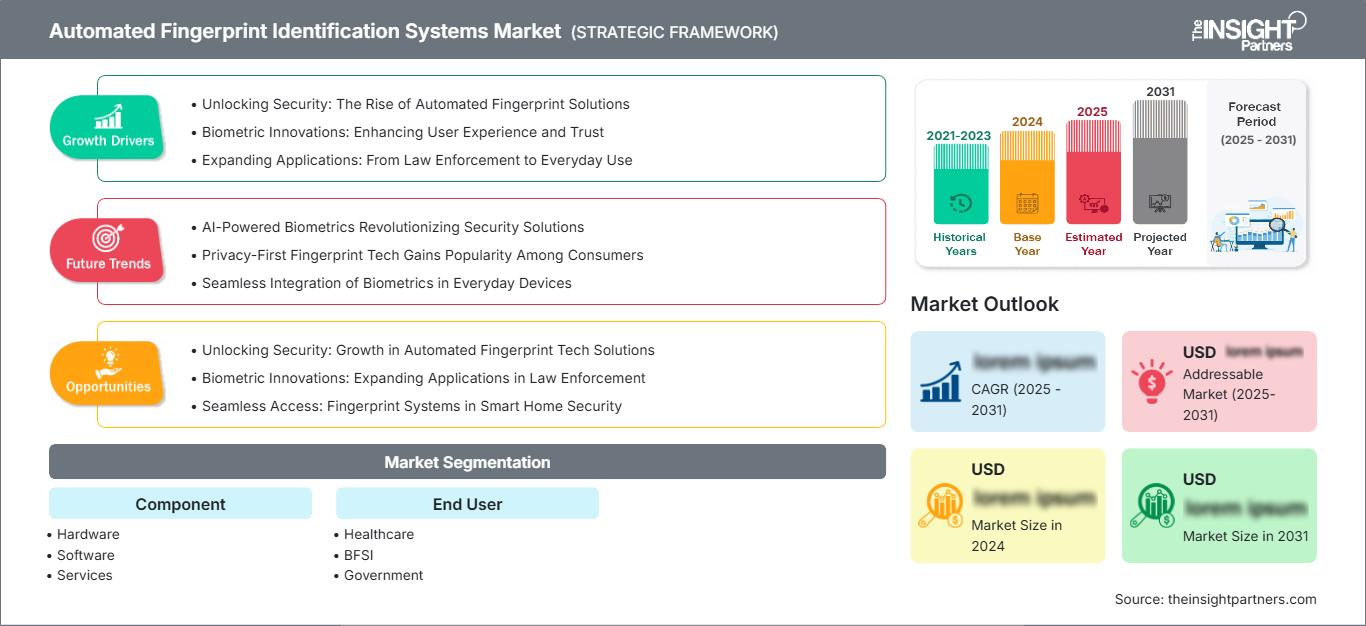
Automated Fingerprint Identification Systems Market: Strategic Insights
Regional Insights
North America Automated Fingerprint Identification System (AFIS) Market
North America holds 32–36% share in 2025 and is projected to expand at a CAGR of 16.6–17.2% during 2026–2034. Automated Fingerprint Identification System (AFIS) Market share in the region reflects mature law-enforcement repositories, airport identity modernization, and strong procurement discipline around privacy, cybersecurity, and interoperability.
The federal government, along with state and provincial departments, is choosing to update its live-scan hardware, latent case work software, and database interfaces rather than updating all of its databases simultaneously. Fingerprinting is used by banks to verify identity for higher-risk customer onboarding and bank branch authentication, whereas health care networks use fingerprint identification to minimize duplicate identities.
U.S. Automated Fingerprint Identification System (AFIS) Market
The US Automated Fingerprint Identification System (AFIS) Market accounts for 78–82% of North American demand in 2025 and is expected to grow at a CAGR of 16.8–17.4% during 2026–2034. Adoption is tied to federal biometric repositories, state criminal justice systems, border processing, immigration workflows, and correctional identity management.
The company has an extensive presence in the market, including NEC Corporation, IDEMIA Public Safety (Morpho), HID Global Corporation (Crossmatch), Biometrics4All, Inc., and M2SYS Technology, among others. Application trends for this company include fast booking and identification processes, background checks, evidence linking, and improved audit trails for biometrics.
Europe Automated Fingerprint Identification System (AFIS) Market
Europe represents 24–28% share in 2025 and is projected to grow at a CAGR of 15.8–16.5% during 2026–2034. Germany is the leading country because police modernization, industrial security, and border databases are supported by strict procurement standards. France and the UK remain important due to public safety, immigration, and digital identity programs.
Germany places importance on correctness, auditability, and integration into broader systems of justice, whereas the UK is concerned with police productivity and the control of biometrics. France invests in creating workflows for borders and civil identity, Italy meets local public administration needs, and Spain uses biometric infrastructure in travel, policing, and regulatory fields.
APAC Automated Fingerprint Identification System (AFIS) Market
APAC holds a 29-33% market share in 2025 and will register CAGR growth of 18.2-18.9% between 2026-2034. The dominant countries are China, India, Japan, South Korea, and Australia. Drivers of implementation include industrial-scale enrollment, smart-city policing, border initiatives, and financial inclusion projects.
The key policy drivers include digital governments, registration reform, and anti-fraud mechanisms for social welfare programs and banking. In Japan and South Korea, the focus has been on developing accurate biometric systems for transport and other public-sector applications. India sees a large-scale identity infrastructure, combined with enterprise-level KYC needs. Australia supports forensic modernization, border efficiency, and regulated workforce screening.
Middle East & Africa Automated Fingerprint Identification System (AFIS) Market
Middle East & Africa is expected to grow at a CAGR of 16.1–16.8% during 2026–2034. Saudi Arabia leads among countries owing to factors such as border modernization, a secure workforce, and infrastructure development. Biometric applications in the UAE include travel, smart governance, and financial compliance, whereas in South Africa, the focus lies on law enforcement modernization.
Applications in the energy and infrastructure domains include the need for contractor identification, site access, and population security. Adoption of the solution in the rest of the MEA is project-based; however, donor-driven public safety and cross-border criminality initiatives are contributing to the development of the baseline capability. Successful companies combine rugged devices along with other elements.
Segmentation Analysis
Component
The Component segment is projected to grow at a CAGR of 17.2–17.8% during 2026–2034 as agencies combine capture hardware, matching software, and lifecycle services. Automated Fingerprint Identification System (AFIS) Market scope is broadening from device procurement toward system integration, archive cleansing, cybersecurity hardening, and managed upgrades that keep legacy records usable while adding real-time search capability.
- Hardware remains the largest component because live-scan stations, mobile readers, palm scanners, and forensic workstations must meet durability, image-quality, and standards requirements across law enforcement and civil enrollment sites.
- Software is strategically important as matching engines, latent print tools, workflow dashboards, and APIs determine search accuracy, processing speed, database interoperability, and cross-agency information sharing.
- Services are expanding as buyers require migration, integration, training, maintenance, cybersecurity review, and performance tuning for systems expected to operate continuously in mission-critical environments.
End User
The End User segment is estimated to grow at a CAGR of 17.0–17.6% during 2026–2034 as fingerprint identification moves beyond police databases into healthcare, BFSI, transport, hospitality, and government service delivery. Government remains the anchor buyer, but private-sector adoption is rising where biometric assurance reduces identity fraud, duplicate accounts, and unauthorized access.
- Healthcare uses fingerprint verification to reduce duplicate patient records, improve medication safety, protect controlled areas, and support accurate insurance- or benefits-linked identification in high-throughput facilities.
- BFSI demand is driven by branch authentication, high-risk account onboarding, fraud prevention, and customer verification where fingerprints complement document checks and device-based identity signals.
- Government remains the most established buyer, covering criminal investigation, civil registry, border control, voter programs, welfare distribution, and correctional identity management across centralized and decentralized systems.
- Transportation and Logistics adoption is linked to airport processing, seaport security, driver credentialing, secure warehouse access, and trusted workforce identity across cross-border and regulated operations.
- Hospitality uses biometric identification selectively for staff access, guest identity assurance, restricted-area controls, and payment or loyalty security in properties with higher compliance exposure.
Opportunity Snapshot
| End User | Revenue Contribution | Trend Tag | Adoption Stage |
| Healthcare | Medium | Patient Match | Scaling |
| BFSI | Medium | Fraud Proofing | Scaling |
| Government | High | Civil Registry | Mature |
| Transportation and Logistics | Medium | Border Flow | Scaling |
| Hospitality | Low | Staff Access | Emerging |
Automated Fingerprint Identification Systems Market Growth Drivers and Impact Analysis
Modernization of Criminal Identification Infrastructure
Law enforcement agencies are now updating their old fingerprint databases due to outdated manual fingerprint-matching methods, a lack of integration among booking systems, and inefficiencies in processing latent prints. The modern solutions will allow linking of prints collected at the crime scene, fingerprint databases, palm print files, and case information within an environment that supports controlled searches. The effect will be practical rather than aesthetic: better suspect identification, more efficient chain-of-custody procedures for prosecutors, and the ability to exchange records via authorized means. The demand for the solutions will be particularly strong in places where vendors’ legacy products have reached the end of life.
Expansion of Civil Identity and Benefit Integrity Programs
The government is using fingerprints to enhance civil registration systems, welfare benefits distribution, voter registration, pension schemes, and permit issuance in situations where multiple identities lead to revenue leakage or administrative disputes. Fingerprinting remains useful because it is relatively inexpensive and easy to deploy, thanks to readily available capture technology, proven algorithms, and the ability to integrate legacy databases with the new enrollment system. This trend becomes more prominent where identity initiatives progress from the single registration process to ongoing validation of service delivery. There is a need for more consultation and governance services as agencies begin to require consent processes, retention policies, and dispute resolution mechanisms.
Rising Enterprise Need for Reliable Biometric Assurance
Fingerprint verification by BFSI, healthcare, transport, and hospitality purchasers is being used where passwords, cards, or document checks are inadequate for high-risk transactions. Fingerprinting is being used by banks to improve onboarding and transaction authentication, by hospitals to eliminate patient duplication, and by transport companies to manage employee entry and security checkpoints. This brings in revenue through means other than national policing schemes. Enterprise purchasers are cost-sensitive; hence, integration needs to be easy for suppliers, APIs need to be offered, and there needs to be demonstrable reductions in fraud, rework savings, or access management efficiencies.
Automated Fingerprint Identification Systems Market Future Trends
AI-Assisted Latent Print Matching and Quality Scoring
Automated Fingerprint Identification System (AFIS) Market trends will increasingly center on AI-assisted latent print processing, automated quality scoring, and explainable candidate ranking. This enables forensic experts to use partial, smeared, or low-contrast data without removing the human decision-making element when legal requirements come into play. The next generation of solutions will go beyond providing fast hit lists; they will provide details on ridge quality, the probability of distortion, and search quality, giving the expert the freedom to select which images need to be examined. This will require independent testing, endorsement from examiners, and model management. Those vendors who can combine effective algorithms with transparent workflows stand a good chance of contributing to justice sector modernization.
Interoperable Multimodal Identity Platforms
In the future, system procurement would prefer the integration of fingerprint, facial, and iris recognition, as well as document and demographic data, within a single governance framework. Fingerprints will be the core of the identity verification process, but agencies require flexibility to verify identities through the enrollment center, mobile stations, airports, courthouses, and websites. This would also be critical, since many public-sector buyers will already have multiple databases from other projects. Open standard, flexible privacy, and secure information exchange will determine upgrade priority. Suppliers who embrace open architecture and a phased migration will limit buyer risk while increasing their long-term service revenue.
Automated Fingerprint Identification Systems Market Opportunities
Service-Led Modernization of Legacy Biometric Archives
Automated Fingerprint Identification System (AFIS) Market Forecasts point to attractive opportunities in archive cleansing, database migration, and service-led modernization. Many organizations have valuable collections of historic fingerprint and palm print records, but due to outdated media types and poor metadata management, searching becomes less effective. The vendors may create value by offering migration services and data normalization and validation with minimal disruption to the existing system platform. In this case, the specific investment opportunity is to transform the installed base into service revenues. Consumers benefit from safer operations, while suppliers enhance customer relations through training, maintenance, cybersecurity upgrades, and benchmarking.
Mobile Identification for Field and Border Operations
Identification via mobile device technology provides a clear path forward for law enforcement, immigration, disaster response, and secure workforce management. Field identification via handheld and tablet devices can avoid wasted time on identity verification at roadblocks, ports of entry, enrollment sites, and other transient locations. This is due to the need for rugged hardware, connectivity, offline capability, and restricted access due to privacy and handling issues involved in fieldwork. The manufacturers have to offer the devices bundled with enrolment applications, supervision platforms, training, and maintenance support. Agencies gain faster verification, fewer manual handoffs, and better linkage between field evidence and central biometric repositories.
Recent Developments
- May 2026: Minister of Interior and the Minister of Justice, the national authorities and the partners of the AFIS Project of the WAPIS Programme (Western African Police Information System), financed by the European Union, officially launched the Automated Fingerprint Identification System (AFIS) for criminal use. The event also marked the inauguration of the renovated premises of the Criminal Records Office/Scientific Support Unit (CRO/SSU) in The Gambia.
- May 2024: NEC Corporation has announced that NEC Technologies India (NECTI), a pioneer in the integration of IT and network technologies, has partnered with the Centre for Development of Advanced Computing (C-DAC) to deploy its industry-leading automated fingerprint identification system (AFIS) for the Kerala State Police in India.
Frequently Asked Questions

- Comprehensive Market Sizing and Forecast Analysis
- Detailed Segmentation Analysis
- In-Depth Market Dynamics Assessment
- Regional and Country-Level Insights
- Competitive Landscape and Company Benchmarking
- Strategic Business Intelligence
Recent Reports
Testimonials

The Insight Partners provided valuable market intelligence that supported our global go-to-market strategy. Their team was professional, responsive, and attentive to our feedback, providing thoughtful analysis and helpful methodological clarifications throughout the project.
Junmo Kim Chief Financial Officer (CFO), Enertech Co., Ltd.
The Insight Partners' SCADA System Market report is comprehensive, with valuable insights on current trends and future forecasts. The team was highly professional, responsive, and supportive throughout. We are very satisfied and highly recommend their services.
RAN KEDEM Partner, Reali Technologies LTDs
I requested a report on a very specific software market and the team produced the report in a few days. The information was very relevant and well presented. I then requested some changes and additions to the report. The team was again very responsive and I got the final report in less than a week.
JEAN-HERVE JENN Chairman, Future Analytica
We worked with The Insight Partners for an important market study and forecast. They gave us clear insights into opportunities and risks, which helped shape our plans. Their research was easy to use and based on solid data. It helped us make smart, confident decisions. We highly recommend them.
PIYUSH NAGPAL Sr. Vice President, High Beam Global
The Insight Partners delivered insightful, well-structured market research with strong domain expertise. Their team was professional and responsive throughout. The user-friendly website made accessing industry reports seamless. We highly recommend them for reliable, high-quality research services
YUKIHIKO ADACHI CEO, Deep Blue, LLC.
This is the first time I have purchased a market report from The Insight Partners.While I was unsure at first, I visited their web site and felt more comfortable to take the risk and purchase a market report.I am completely satisfied with the quality of the report and customer service. I had several questions and comments with the initial report, but after a couple of dialogs over email with their analyst I believe I have a report that I can use as input to our strategic planning process.Thank you so much for taking the extra time and making this a positive experience.I will definitely recommend your service to others and you will be my first call when we need further market data.
JOHN SUZUKI President and Chief Executive Officer, Board Director, BK Technologies
I wish to appreciate your support and the professionalism you displayed in the course of attending to my request for information regarding to infectious disease IVD market in Nigeria. I appreciate your patience, your guidance, and the fact that you were willing to offer a discount, which eventually made it possible for us to close a deal. I look forward to engaging The Insight Partners in the future, all thanks to the impression you have created in me as a result of this first encounter.
DR CHIJIOKE ONYIA MANAGING DIRECTOR, PineCrest Healthcare Ltd.Reason to Buy
- Informed Decision-Making
- Understanding Market Dynamics
- Competitive Analysis
- Identifying Emerging Markets
- Customer Insights
- Market Forecasts
- Risk Mitigation
- Boosting Operational Efficiency
- Strategic Planning
- Investment Justification
- Tracking Industry Innovations
- Aligning with Regulatory Trends





 Get Free Sample for