
Automated Machine Learning (AutoML) Market Share, Size & Demand by 2034
Automated Machine Learning (AutoML) Market Size and Forecasts (2021–2034), Global and Regional Share, Trends, and Growth Opportunity Analysis Report Coverage : By Offering (Solutions, Services), Application (Data Processing, Model Selection, Hyperparameter Optimization & Tuning, Feature Engineering, Model Ensembling, Others); Industry Vertical (BFSI, Telecommunications, Manufacturing, Automotive, Others)
- Status : Data Released
- Report Code : TIPRE00039735
- Category : Technology, Media and Telecommunications
- No. of Pages : 150
- Available Report Formats :


- Last update date : August 19, 2026


2025 Market Size
US$ 2.01 Bn
Base year value
2034 Forecast
US$ 54.15 Bn
Projected by 2034
CAGR 2026-2034
50.90 %
Growth rate
Addressable Market
US$ 235.79 Bn
(2026-2034)
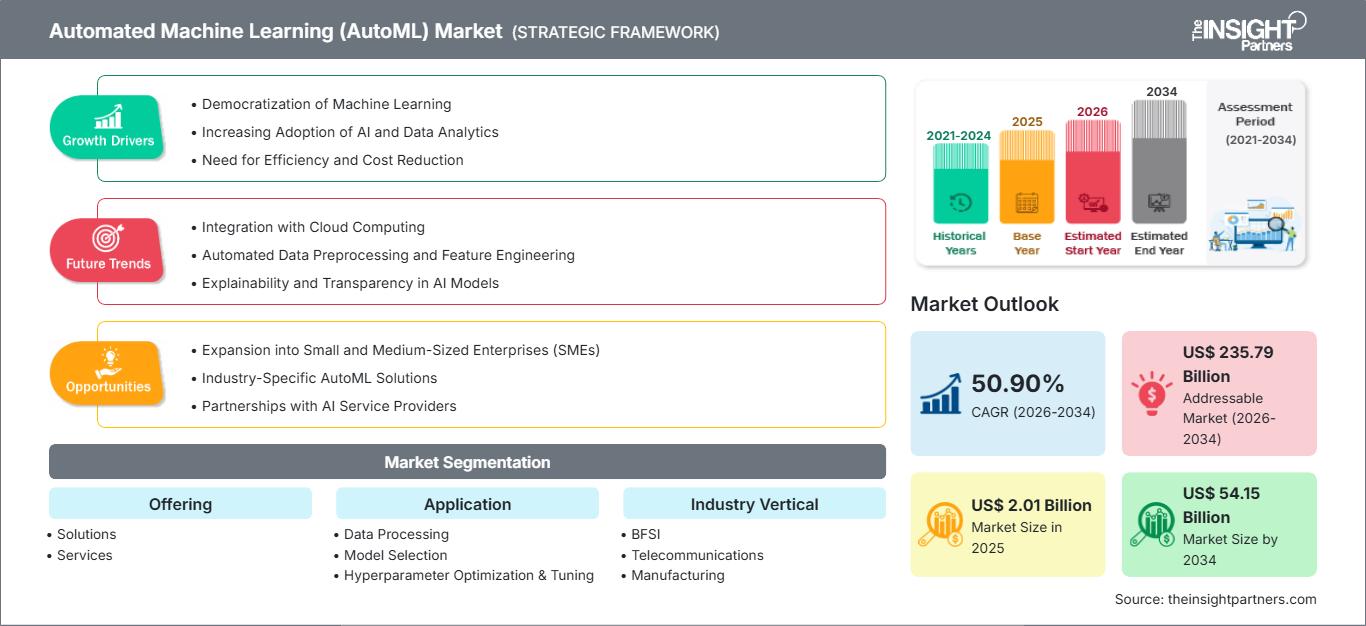
The Automated machine learning market is witnessing rapid expansion as enterprises increasingly adopt artificial intelligence platforms to automate data preparation, model development, deployment, and lifecycle management. According to the provided market inputs, the automated machine learning market was valued at US$ 2.01 Billion in 2025 and is projected to reach US$ 54.15 Billion by 2034, expanding at a CAGR of 50.90% during 2026–2034. The market is benefiting from growing enterprise digitalization, cloud-native AI infrastructure, and the rising demand for democratized machine learning capabilities across industries.
Across North America, the adoption of enterprise AI platforms, cloud computing, and advanced analytics continues to accelerate investments in AutoML technologies. The automated machine learning market size in the region is expected to expand at an estimated CAGR of 49–52% during the forecast period, supported by extensive AI spending, a mature cloud ecosystem, and increasing demand for low-code and no-code machine learning solutions among enterprises seeking faster model deployment and reduced dependence on specialized data science talent.
Automated Machine Learning (AutoML) Market Assessment and Insights
- North America: Accounted for 38–42% share in 2025 and is expected to register a CAGR of 49–52% during 2026–2034, supported by extensive cloud infrastructure, AI innovation, strong enterprise software adoption, and continuous investments in intelligent automation.
- US: Represented nearly 76–80% of the North American market in 2025 and is anticipated to grow at a CAGR of 49–52%, driven by widespread AI implementation across financial services, healthcare, manufacturing, and public sector organizations.
- Europe: Held approximately 24–28% market share in 2025 and is forecast to expand at a CAGR of 47–50%, with Germany, the UK, France, and the Netherlands leading enterprise AI adoption and regulatory-driven digital transformation initiatives.
- Asia Pacific: Captured 24–28% market share in 2025 and is expected to record the fastest regional expansion at a CAGR of 53–56%, led by China, Japan, South Korea, India, and Singapore through accelerated investments in AI infrastructure.
- Largest Segment: Solutions dominated the market with an estimated 68–72% market share in 2025 and is projected to grow at a CAGR of 49–52%, reflecting widespread enterprise demand for integrated AutoML software platforms.
- High Growth Segment: Hyperparameter Optimization & Tuning is projected to register the fastest growth, representing 18–22% market share in 2025 while advancing at a CAGR of 55–58% due to increasing demand for automated model optimization.
- Key companies analyzed in detail: IBM Corporation, Oracle Corporation, Microsoft Corporation, ServiceNow, Inc., Google LLC, Amazon Web Services, Inc., Alteryx, Inc., Baidu, Inc., Salesforce, Inc., Altair Engineering Inc.
Source: The Insight Partners' analysis based on proprietary research, government publications, company annual reports, investor presentations, industry databases, and expert interviews.
The developments in cloud-native computing, automated feature engineering, explainable artificial intelligence, and scalable machine learning operations have radically changed the analytics process in enterprises. There is an increasing preference for automated machine learning development processes that simplify the process and enhance prediction precision and governance. Continued advancements in computing infrastructure, open source AI technology and GPU enablement are enhancing the commercialization of automated machine learning solutions in various industries.
In the future, there will be increased market expansion driven by sovereign AI initiatives, stronger governance demands, and trustworthy AI deployment demands from enterprises. Increased adoption in mid-size enterprises, innovations in foundation models and increased investments in AI infrastructure in Asia Pacific, Latin America and the Middle East will increase commercial opportunities and make these technologies more accessible using low-code development tools.
Automated Machine Learning (AutoML) Market Report Scope
| Report Attribute | Details |
|---|---|
| Market size in 2025 | US$ 2.01 Billion |
| Market Size by 2034 | US$ 54.15 Billion |
| Global CAGR (2026 - 2034) | 50.90% |
| Historical Data | 2021-2024 |
| Forecast period | 2026-2034 |
Automated Machine Learning (AutoML) Market Analysis
Growing enterprise investment in artificial intelligence platforms, predictive analytics, and intelligent automation continues to accelerate the automated machine learning market growth across developed and emerging economies. More and more organizations are embracing AutoML solutions that would help them automate feature engineering, selection of algorithms, model validation, and deployment with minimal reliance on data scientists. The value chain has grown from just the software companies to also include hyperscale cloud vendors, consulting firms, semiconductor makers, and managed service providers of AI ecosystems.
The supply-side development is marked by constant innovation in the area of foundation models, cloud computing capabilities, and machine learning operation platforms. Pre-trained models, computing scalability, and AI-as-a-service capabilities enable fast deployment of machine learning solutions. Strategic collaborations between cloud providers and software vendors further improve interoperability while reducing implementation timelines across banking, healthcare, manufacturing, telecommunications, and automotive sectors.
Competitive intensity within the automated machine learning market analysis continues to increase as technology vendors compete through platform capabilities, AI governance, explainability, and industry-specific solutions. IBM Corporation, Microsoft Corporation, Google LLC, Amazon Web Services, Inc., Oracle Corporation, and Salesforce, Inc. continue expanding AutoML functionality through integrated cloud ecosystems, while Alteryx, Inc., Altair Engineering Inc., ServiceNow, Inc., and Baidu, Inc. focus on workflow automation, enterprise AI integration, and vertical-specific applications to strengthen market positioning.
Investment activity is increasingly directed toward generative AI integration, automated model monitoring, responsible AI frameworks, and multimodal analytics capabilities. Venture capital funding and enterprise partnerships continue supporting innovation in autonomous data science platforms. Growing demand for AI governance, compliance automation, and scalable deployment environments is expected to intensify strategic acquisitions, cloud partnerships, and product development initiatives throughout the forecast period.
● REPORT CUSTOMIZATION
Tailor This Report To Align With Your Specific Business Requirements
This report can be customized to align precisely with your business objectives, scope, and target markets. Customization options include tailored segmentation, geography, competitive analysis, and strategic insights to support informed decision-making.
Customize This Report →WHAT YOU CAN ADJUST
- ● Segmentations
- ● Geography
- ● Competitive Analysis
- ● Language Preferences
Automated Machine Learning (AutoML) Market: Strategic Insights
Regional Insights
North America Automated Machine Learning Market
North America accounted for an estimated 38–42% share in 2025, maintaining its leadership through extensive investments in cloud infrastructure, enterprise artificial intelligence, and digital transformation. Major technology providers continue expanding AutoML capabilities through integrated AI ecosystems, while organizations increasingly automate predictive analytics, fraud detection, customer intelligence, and operational optimization. The region is projected to expand at a CAGR of 49–52% between 2026 and 2034, supported by continued enterprise AI adoption and favorable innovation ecosystems.
The automated machine learning market share remains strongest in the United States and Canada due to advanced digital infrastructure, high cloud penetration, and strong enterprise software spending. Financial institutions, healthcare providers, manufacturing companies, and government agencies increasingly deploy automated AI platforms to improve operational efficiency, regulatory compliance, and decision-making accuracy while addressing growing shortages of skilled data science professionals.
U.S. Automated Machine Learning Market
The United States represented approximately 76–80% of the North American market in 2025 and is forecast to grow at a CAGR of 49–52% throughout the study period. Strong investments in cloud computing, semiconductor technologies, generative AI, and enterprise analytics continue to strengthen the country's leadership position. Large technology companies, research institutions, and startups collectively contribute to continuous innovation across automated model development and deployment solutions.
Financial services, healthcare, retail, manufacturing, and public sector organizations continue integrating AutoML into digital transformation strategies. Strong presence of Microsoft Corporation, Google LLC, Amazon Web Services, Inc., IBM Corporation, Oracle Corporation, Salesforce, Inc., and numerous AI startups enables rapid commercialization of advanced solutions while encouraging enterprise adoption through cloud-based subscription models and industry-specific AI platforms.
Europe Automated Machine Learning Market
Europe accounted for approximately 24–28% of the global market in 2025 and is anticipated to expand at a CAGR of 47–50% during the forecast period. Regulatory measures to promote trustworthy AI, rising cloud adoptions, and digitalization strategies by enterprises are continuously increasing the adoption of AI within banks, manufacturing, healthcare, and public administrations. Germany is the leader among all other countries within the region, while the UK, France, Italy, and Spain contribute towards increased demand for the technology through enterprise adoption of AI technologies.
Enterprise adoption of AI within the United Kingdom is increasing within financial services, insurance, healthcare, and retail industries. In Germany, Industry 4.0 strategies and automation within manufacturing industries encourage larger adoption of machine learning platforms. France, Italy, and Spain are increasing their investment in public sector services using AI, digital manufacturing, and enterprise analytics.
APAC Automated Machine Learning Market
Asia Pacific represented approximately 24–28% of global revenue in 2025 and is projected to record the highest regional expansion with a CAGR of 53–56% through 2034. China makes regional investments via national programs for AI development, whereas Japan and South Korea move forward with intelligent automation implementations in manufacturing, financial services, and healthcare industries.
India continues improving enterprise AI implementation through the use of cloud infrastructure, public digitalization initiatives, and new tech startups. Australia uses more and more AutoML solutions in finance, mining, and healthcare industries, while favorable government policies in relation to artificial intelligence and digital transformation create a positive environment for further market growth.
Middle East & Africa Automated Machine Learning Market
The Middle East & Africa market is projected to expand at a CAGR of 44–47% between 2026 and 2034, supported by digital economy strategies, cloud adoption, and government-led artificial intelligence investments. Saudi Arabia and the UAE keep on making substantial investments in their projects of AI-powered public services, smart cities, and enterprise modernization.
South Africa is a leader in the AI deployment in financial services and telecom industries, whereas other countries in the region are slowly building their digital infrastructure to enhance analytics. Greater investments in cloud computing, cybersecurity, and enterprise software solutions will contribute to the growing demand for automated machine learning systems in the region.
Segmentation Analysis
Offering
The Offering segment is expected to grow at a CAGR of 49–52% during 2026–2034 as organizations increasingly invest in scalable AI platforms that simplify model development and deployment. The automated machine learning market scope continues expanding through cloud-native solutions, integrated governance tools, and managed services that improve operational efficiency while enabling organizations with limited AI expertise to implement advanced analytics.
- Solutions – Enterprise software platforms dominate adoption by automating model creation, feature engineering, deployment, monitoring, and governance while integrating seamlessly with existing cloud infrastructure and business intelligence environments.
- Services – Consulting, implementation, training, integration, and managed support services assist organizations in accelerating deployment, optimizing AI workflows, and ensuring regulatory compliance across complex enterprise environments.
Application
The Application segment is projected to expand at a CAGR of 51–54% during the forecast period. Organizations increasingly automate multiple stages of the machine learning lifecycle to improve development speed, model accuracy, operational efficiency, and scalability while reducing manual intervention throughout AI implementation processes.
- Data Processing – Automated data preparation improves dataset quality, accelerates preprocessing activities, and enables organizations to manage structured and unstructured information efficiently across enterprise environments.
- Model Selection – Intelligent algorithm selection enables faster identification of optimal machine learning models, reducing experimentation time while improving predictive performance across diverse business applications.
- Hyperparameter Optimization & Tuning – Automated optimization techniques improve model accuracy by efficiently identifying optimal parameter combinations, significantly reducing computational effort and development cycles.
- Feature Engineering – Automated feature generation and selection improve predictive capabilities while minimizing manual engineering tasks, supporting rapid AI deployment across multiple business functions.
- Model Ensembling – Ensemble learning combines multiple predictive models to improve stability, reliability, and forecasting accuracy for enterprise decision-making applications.
Industry Vertical
The Industry Vertical segment is anticipated to register a CAGR of 50–53% during 2026–2034 as organizations across data-intensive industries increasingly deploy AutoML platforms to accelerate analytics, improve forecasting accuracy, and automate decision-making processes. Digital transformation initiatives, cloud migration, and growing AI governance requirements continue driving enterprise adoption across multiple sectors.
- BFSI – Financial institutions extensively deploy AutoML for fraud detection, credit risk assessment, customer segmentation, anti-money laundering, algorithmic trading, and predictive financial analytics while improving compliance and operational efficiency.
- Telecommunications – Telecom operators utilize automated machine learning for network optimization, predictive maintenance, customer churn prediction, capacity planning, and service quality monitoring across increasingly complex communication infrastructures.
- Manufacturing – Manufacturers implement AutoML to improve predictive maintenance, quality inspection, production planning, inventory optimization, and intelligent supply chain management while supporting Industry 4.0 initiatives.
- Automotive – Automotive companies increasingly apply AutoML for autonomous driving research, connected vehicle analytics, predictive maintenance, manufacturing automation, and intelligent mobility solutions, improving operational performance and product innovation.
Opportunity Snapshot
| Industry Vertical | Revenue Contribution | Trend Tag | Adoption Stage |
|---|---|---|---|
| BFSI | High | Fraud Analytics | Mature |
| Telecommunications | High | Network AI | Scaling |
| Manufacturing | High | Predictive Factory | Scaling |
| Automotive | Medium | Autonomous AI | Emerging |
Automated Machine Learning (AutoML) Market Growth Drivers and Impact Analysis
Enterprise-wide adoption of cloud-based artificial intelligence platforms
Companies are quickly shifting their analytical processes to the cloud, making it possible to develop scalable machine learning models without heavy investment in infrastructure. Automated machine learning helps to develop complicated models using automated processes and makes it possible for business analysts and domain experts to create predictive models easily. Cloud-based deployments make it possible to have collaboration, governance, and model monitoring continuously in an inexpensive manner. In the drive for digital transformation, there is an increasing demand for scalable AI services that are forcing software providers to enhance their platforms, incorporate generative AI and automation specific to industries.
Growing shortage of experienced data science professionals
The global demand for AI-based solutions is increasing at a pace much faster than that of machine learning engineers and data scientists. The concept of automated machine learning caters to this problem by decreasing the number of models to be developed manually, automating the process of feature engineering, and making algorithm selection easy. Therefore, businesses can implement predictive analytics quickly without getting into complexities or spending much on development. Democratization of AI allows business professionals to perform complex analyses without requiring them to be proficient programmers.
Expansion of AI governance and regulatory compliance initiatives
More attention is being paid to responsible AI, transparency, explainability, and regulation on the part of governments and businesses alike. Automated machine learning tools are now built with governance features, bias detection, model monitoring, audit logging, and explanations for their AI functionality that increase accountability through the entire life cycle of the machine learning models. This comes as compliance is becoming more strict within industries such as banking, healthcare, insurance, and government. Vendors are continually working to develop trustworthy AI solutions.
Automated Machine Learning (AutoML) Market Future Trends
Integration of Generative AI with Automated Machine Learning Platforms
Generative artificial intelligence is transforming how AutoML platforms build, validate, and optimize predictive models. The automated machine learning market trends increasingly reflect integration of large language models, automated code generation, intelligent feature engineering, and natural language interfaces that enable non-technical users to develop sophisticated machine learning workflows. Vendors are embedding AI copilots into development environments, allowing organizations to automate experimentation, documentation, and model deployment while improving governance and explainability. These capabilities are expected to accelerate enterprise productivity, shorten development cycles, and broaden AI accessibility across organizations of all sizes.
Expansion of Edge AI and Real-Time Automated Analytics
Companies are moving towards using machine learning algorithms near the source of the data using the edge computing architecture. The auto ML tools are being developed for creating lightweight models for real-time inference and continuous monitoring for industrial machinery, automobiles, healthcare products, and smart infrastructures. It will reduce latency, improve responsiveness, and reduce the reliance on cloud services. Vendors will need to build better distributed AI capabilities by incorporating automated management throughout the lifecycle.
Automated Machine Learning (AutoML) Market Opportunities
Growing Adoption Among Small and Medium-Sized Enterprises
Small and medium-sized enterprises represent one of the largest untapped customer segments as cloud-based subscription models reduce implementation costs and technical barriers. Automated machine learning market Forecasts indicate increasing investments in low-code AI platforms that enable SMEs to improve customer analytics, operational efficiency, fraud detection, demand forecasting, and business intelligence without maintaining large data science teams. Technology vendors are expected to introduce industry-specific solutions, simplified deployment models, and flexible pricing strategies to accelerate adoption. Expanding digital transformation initiatives across emerging economies further strengthens long-term commercial opportunities for cloud-native AutoML providers.
Industry-Specific Artificial Intelligence Solutions
The demand is gradually shifting towards specific AutoML platforms that cater to applications in diagnostics in healthcare, risk analysis in finance, automation in industries, personalization in retail, optimization in telecommunications, and engineering in automobiles. Specific AutoML solutions help increase implementation speed through predefined workflows, compliance attributes, and specialized data sets. The providers who will be able to offer vertical AI ecosystems are believed to have an edge in competition while also enjoying greater revenue generation from managed services, platforms, and enterprise deals.
Frequently Asked Questions

- Comprehensive Market Sizing and Forecast Analysis
- Detailed Segmentation Analysis
- In-Depth Market Dynamics Assessment
- Regional and Country-Level Insights
- Competitive Landscape and Company Benchmarking
- Strategic Business Intelligence
Recent Reports
Testimonials

The Insight Partners' SCADA System Market report is comprehensive, with valuable insights on current trends and future forecasts. The team was highly professional, responsive, and supportive throughout. We are very satisfied and highly recommend their services.
RAN KEDEM Partner, Reali Technologies LTDs
I requested a report on a very specific software market and the team produced the report in a few days. The information was very relevant and well presented. I then requested some changes and additions to the report. The team was again very responsive and I got the final report in less than a week.
JEAN-HERVE JENN Chairman, Future Analytica
We worked with The Insight Partners for an important market study and forecast. They gave us clear insights into opportunities and risks, which helped shape our plans. Their research was easy to use and based on solid data. It helped us make smart, confident decisions. We highly recommend them.
PIYUSH NAGPAL Sr. Vice President, High Beam Global
The Insight Partners delivered insightful, well-structured market research with strong domain expertise. Their team was professional and responsive throughout. The user-friendly website made accessing industry reports seamless. We highly recommend them for reliable, high-quality research services
YUKIHIKO ADACHI CEO, Deep Blue, LLC.
This is the first time I have purchased a market report from The Insight Partners.While I was unsure at first, I visited their web site and felt more comfortable to take the risk and purchase a market report.I am completely satisfied with the quality of the report and customer service. I had several questions and comments with the initial report, but after a couple of dialogs over email with their analyst I believe I have a report that I can use as input to our strategic planning process.Thank you so much for taking the extra time and making this a positive experience.I will definitely recommend your service to others and you will be my first call when we need further market data.
JOHN SUZUKI President and Chief Executive Officer, Board Director, BK Technologies
I wish to appreciate your support and the professionalism you displayed in the course of attending to my request for information regarding to infectious disease IVD market in Nigeria. I appreciate your patience, your guidance, and the fact that you were willing to offer a discount, which eventually made it possible for us to close a deal. I look forward to engaging The Insight Partners in the future, all thanks to the impression you have created in me as a result of this first encounter.
DR CHIJIOKE ONYIA MANAGING DIRECTOR, PineCrest Healthcare Ltd.Reason to Buy
- Informed Decision-Making
- Understanding Market Dynamics
- Competitive Analysis
- Identifying Emerging Markets
- Customer Insights
- Market Forecasts
- Risk Mitigation
- Boosting Operational Efficiency
- Strategic Planning
- Investment Justification
- Tracking Industry Innovations
- Aligning with Regulatory Trends





 Get Free Sample for