
Emergency Medical Services (EMS) Billing Software Market Size, Demand & Growth by 2034
Coverage: By Provider Type (Small Ambulance Companies, Medium Ambulance Companies, Large Ambulance Companies), Component (Outsourced, In-house), Type (Land Ambulance Services, Air Ambulance Services, Water Ambulance Services) and Geography (North America, Europe, Asia Pacific, Middle East and Africa, and South and Central America)
- Status : Published
- Report Code : TIPRE00017539
- Category : Technology, Media and Telecommunications
- No. of Pages : 240
- Available Report Formats :


- Last update date : August 13, 2026


2025 Market Size
US$ 1.08 Bn
Base year value
2034 Forecast
US$ 2.29 Bn
Projected by 2034
CAGR 2026-2034
8.6 %
Growth rate
Addressable Market
US$ 15.02 Bn
(2026-2034)
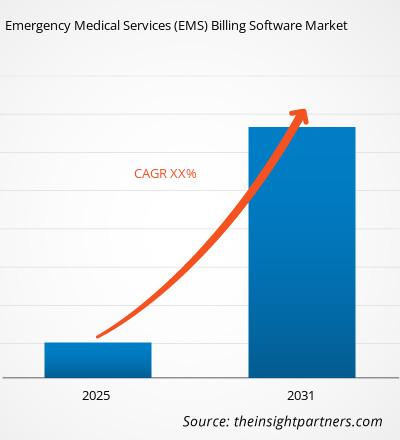
The Emergency Medical Services (EMS) Billing Software Market was valued at US$ 1.08 billion in 2025 and is projected to reach US$ 2.29 billion by 2034, registering a CAGR of 8.6% during the forecast period from 2026 to 2034. The market includes specialized software platforms that support ambulance providers, emergency response organizations, and healthcare entities in automating billing workflows, improving claims management, and optimizing revenue cycle operations.
Growing use of digital healthcare infrastructure is influencing the size of the EMS Billing Software market, especially in terms of seeking scalable solutions to cope with the complicated reimbursement environment. North America still represents an important contributor in the EMS Billing Software market due to its developed healthcare IT ecosystem, use of electronic documentation, and need for claims processing.
Emergency Medical Services (EMS) Billing Software Market Assessment and Insights
- North America represents a leading regional market, with an estimated share of 55% in 2025 and growing at a CAGR of 8.9% between 2026–2034. The region benefits from mature EMS infrastructure, reimbursement complexity, and widespread healthcare digitization.
- US maintains a dominant position within North America, accounting for 91.71% share in 2025 and expanding at a CAGR of 9.0% during 2026–2034. Demand is influenced by payer diversity, compliance requirements, and revenue optimization needs.
- Europe holds an estimated share of 20.37% in 2025 and is projected to grow at a CAGR of 8.5% between 2026–2034. Germany, the UK, and France are key contributors due to healthcare modernization initiatives and EMS technology adoption.
- Asia Pacific accounts for an estimated 17.76% share in 2025 and is expected to expand at a CAGR of 9.3% from 2026–2034. China, India, Japan, and Australia are driving regional adoption through healthcare infrastructure investments and digital health programs.
- Largest Segment: Large Ambulance Companies represent the largest provider type segment, accounting for a market share of 45.49% in 2025 and growing at a CAGR of 8.3% between 2026–2034 due to higher billing volumes and enterprise technology adoption.
- High Growth Segment: In-house billing services represent the fastest-expanding component segment, with a market share of 44.82% in 2025 and a CAGR of 9.6–10.0% between 2026–2034 as smaller providers seek specialized revenue cycle support.
- Key companies analyzed in detail: MP Cloud Technologies, AIM EMS Software & Services, ESO, ZOLL Medical Corporation, Digitech, AngelTrack, ImageTrend, TraumaSoft, AdvancedMD, Inc., Integra Connect, LLC
Source: The Insight Partners' analysis based on proprietary research, government publications, company annual reports, investor presentations, industry databases, and expert interviews.
Emergency Medical Services (EMS) Billing Software Market is changing through the integration of electronic patient care records, dispatch solutions, and automated claims management solutions. Cloud software solutions are becoming more acceptable due to the preference for flexibility, less maintenance requirement, and accessibility to multiple locations by EMS entities. Artificial Intelligence, automated coding functionality, and analytics software have become commonplace in the market environment as vendors strive to ensure higher billing accuracy and identify billing problems.
Development in the future will be driven by the expansion into new healthcare environments, the rise in investments in EMS infrastructure and the change in the reimbursement systems. The Software as a Service approach to software solutions is becoming popular due to fewer barriers to implementation and regular upgrades. The regulatory push towards electronic documentation, interoperability, and management of health care information is expected to ensure strong demand by ambulance companies, hospitals, and emergency service government agencies.
Emergency Medical Services (EMS) Billing Software Market Report Scope
| Report Attribute | Details |
|---|---|
| Market size in 2025 | US$ 1.08 Billion |
| Market Size by 2034 | US$ 2.29 Billion |
| Global CAGR (2026 - 2034) | 8.6% |
| Historical Data | 2021-2024 |
| Forecast period | 2026-2034 |
Emergency Medical Services (EMS) Billing Software Market Analysis
The Emergency Medical Services (EMS) Billing Software Market growth is stimulated by the increase in the volume of emergencies, increase in administration complexities, and the need for efficient reimbursement management. EMS companies deal with an increasing number of documents and claims transactions related to emergency transportation in developed and developing areas. Higher demand for ambulance services is caused by aging populations, chronic diseases prevalence, and wider emergency transport coverage.
The EMS software value chain consists of the suppliers, implementation partners, EMS operators, healthcare providers, and the reimbursement entities. The major focus of the suppliers is on integrated solutions which unite electronic patient care reporting, scheduling, dispatch management, and financial workflows. The cloud-based architecture became essential due to fast deployment opportunities, central updates, and increased accessibility in geographically dispersed EMS operations.
The competitive dynamics of Emergency Medical Services (EMS) Billing Software Market analysis show the moderately fragmented industry with the competition between specialized vendors and major healthcare technology providers. Such firms as ESO, ZOLL Medical Corporation, ImageTrend, and MP Cloud Technologies develop their positions in the industry with help of the integration features, automation, and analytics of the platforms. The main strategic moves of such companies are the improvement of claims accuracy and reduction of the reimbursement delays.
The participants of the EMS Billing Software Market pursue various partnership opportunities, product improvements, and geographic expansions in order to meet different needs of EMS organizations. Automation, prediction, and interoperability became important competitive differentiators. Providers such as AIM EMS Software & Services, Digitech, AngelTrack, TraumaSoft, AdvancedMD, Inc., and Integra Connect, LLC contribute to competitive diversity of EMS Billing Software Market.
● REPORT CUSTOMIZATION
Tailor This Report To Align With Your Specific Business Requirements
This report can be customized to align precisely with your business objectives, scope, and target markets. Customization options include tailored segmentation, geography, competitive analysis, and strategic insights to support informed decision-making.
Customize This Report →WHAT YOU CAN ADJUST
- ● Segmentations
- ● Geography
- ● Competitive Analysis
- ● Language Preferences
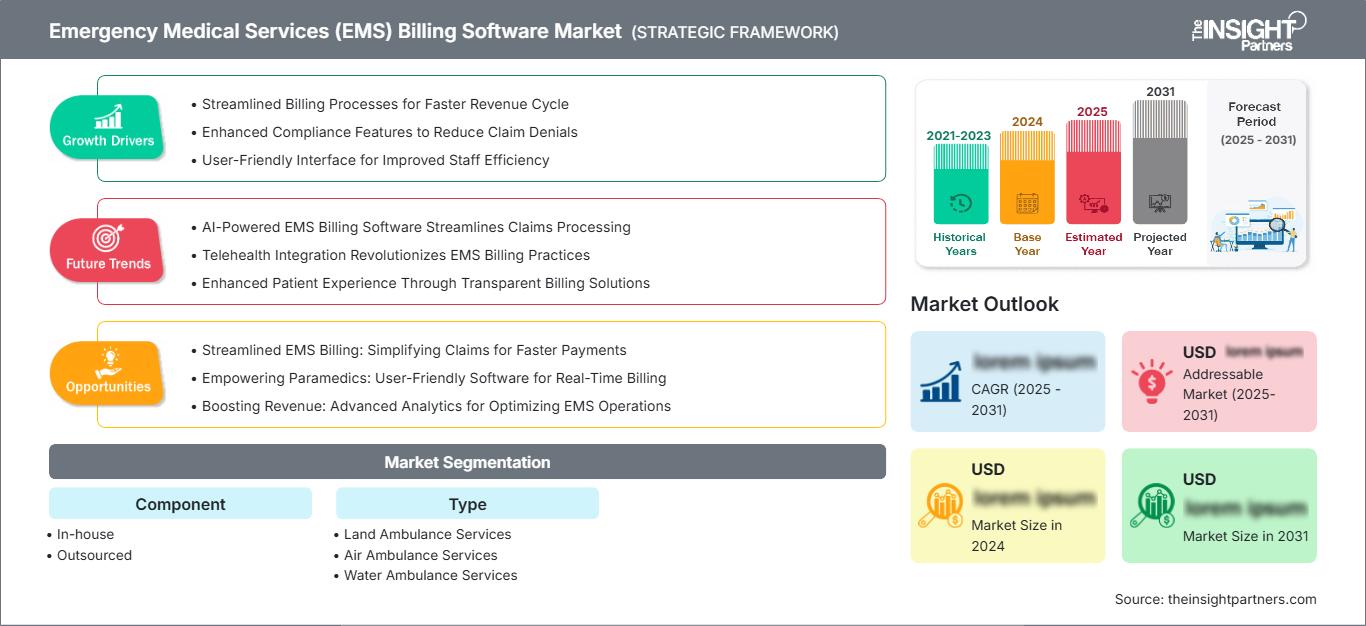
Emergency Medical Services (EMS) Billing Software Market: Strategic Insights
Regional Insights
North America Emergency Medical Services (EMS) Billing Software Market
North America leads the Emergency Medical Services (EMS) Billing Software Market, supported by advanced healthcare technology adoption, established ambulance networks, and complex reimbursement structures. The region represented a 55% share in 2025 and growing at a CAGR of 8.9% between 2026–2034. The United States remains the primary contributor due to extensive private and government payer systems requiring sophisticated billing management.
U.S. Emergency Medical Services (EMS) Billing Software Market
The U.S. Emergency Medical Services (EMS) Billing Software Market represents the largest national market within North America, accounting for 91.71% share in 2025 and expanding at a CAGR of 9.0% during 2026–2034, supported by complex reimbursement processes involving Medicare, Medicaid, and commercial insurance providers. The presence of companies including ESO, ZOLL Medical Corporation, MP Cloud Technologies, and ImageTrend strengthens domestic market development through advanced software solutions.
Europe Emergency Medical Services (EMS) Billing Software Market
Europe accounted for an estimated 20.37% in 2025 and is projected to grow at a CAGR of 8.5% between 2026–2034. The region is influenced by healthcare modernization programs, interoperability initiatives, and increasing demand for digital emergency management systems.
The UK represents a leading market due to continued digital transformation across healthcare services and increasing integration of electronic records. Germany demonstrates strong adoption supported by structured healthcare financing and statutory insurance systems. France, Italy, and Spain are experiencing steady demand as public and private healthcare organizations invest in improved emergency service coordination and billing efficiency.
APAC Emergency Medical Services (EMS) Billing Software Market
The APAC Emergency Medical Services (EMS) Billing Software Market accounted for an estimated 17.76% share in 2025 and is expected to expand at a CAGR of 9.3% from 2026–2034. China represents the leading regional contributor, supported by healthcare infrastructure expansion, government digital health programs, and increasing adoption of technology-enabled emergency services.
India, Japan, South Korea, and Australia are contributing to market expansion through investments in healthcare connectivity, private ambulance networks, and electronic healthcare systems. Policy initiatives focused on improving emergency response capacity and expanding healthcare access are encouraging EMS providers to adopt billing platforms that improve operational efficiency and reimbursement management.
Middle East & Africa Emergency Medical Services (EMS) Billing Software Market
The Middle East & Africa Emergency Medical Services (EMS) Billing Software Market is expected to expand at a CAGR of 4.7% between 2026–2034, supported by healthcare infrastructure investments and modernization initiatives. Saudi Arabia represents the leading market due to Vision 2030 healthcare transformation programs and increased private-sector participation in emergency services.
The UAE and South Africa are emerging contributors through advanced healthcare facilities and technology adoption. Rest of MEA markets are gradually adopting digital EMS platforms as healthcare systems develop. Energy-sector investments, urban infrastructure growth, and increasing demand for organized emergency response networks are creating opportunities for software providers
Segmentation Analysis
Provider Type
The provider type segment of the Emergency Medical Services (EMS) Billing Software Market includes Small Ambulance Companies, Medium Ambulance Companies, and Large Ambulance Companies. The Medium Ambulance Companies segment is expected to expand at a CAGR of 9.6% between 2026–2034, supported by increasing demand for automated financial processes across ambulance operators. Large providers continue adopting enterprise platforms, while smaller organizations increasingly prefer scalable cloud-based solutions.
- Small ambulance companies are adopting cost-efficient billing platforms to reduce administrative workload and improve reimbursement processes. Cloud-based solutions provide access to essential revenue cycle capabilities without requiring extensive internal technology resources.
- Medium ambulance companies are increasingly investing in integrated systems that combine billing, dispatch, and patient documentation functions. These solutions support operational expansion while improving financial visibility and claims management efficiency.
- Large ambulance companies represent the largest adoption segment due to complex billing requirements, extensive service networks, and higher transaction volumes. Enterprise-grade platforms enable automation, analytics, and multi-location financial management.
Component
The component segment consists of Outsourced and In-house solutions. The In-house segment is expected to grow at a CAGR of 9.4% between 2026–2034 as EMS organizations evaluate different approaches to managing revenue cycle operations. Outsourcing adoption is increasing among organizations seeking specialized expertise, while larger providers continue maintaining internal systems for operational control.
- Outsourced billing services are gaining importance among EMS organizations requiring specialized reimbursement expertise. These solutions help providers manage complex payer requirements, improve claim processing consistency, and reduce administrative staffing requirement.
- In-house solutions remain important for organizations requiring direct control over billing operations and patient information workflows. Large EMS providers often integrate internal systems with broader healthcare technology environments.
Type
The type segment includes Land Ambulance Services, Air Ambulance Services, and Water Ambulance Services. The Air Ambulance Services segment is expected to grow at a CAGR of 9.6% between 2026–2034 due to increasing demand for specialized emergency transportation management. Land ambulance services maintain the broadest adoption base, while air and water services require more specialized billing capabilities.
- Land ambulance services represent the largest application area due to widespread emergency transportation demand. Billing platforms support diverse payer structures, documentation requirements, and high-volume claim processing activities across municipal and private operators.
- Air ambulance services require specialized billing capabilities because of complex reimbursement arrangements, higher service costs, and detailed operational documentation. Technology adoption supports accurate claims processing and financial management.
- Water ambulance services represent a specialized segment serving coastal and island regions. Billing platforms support unique documentation requirements and operational workflows associated with marine emergency transportation services
Opportunity Snapshot
| End Users | Revenue Contribution | Trend Tag | Adoption Stage |
| Municipal and Fire Department EMS Agencies | High | Compliance Automation | Scaling |
| Private Ambulance Services | High | Revenue Optimization | Scaling |
| Hospital-Based EMS Networks | Medium | System Integration | Scaling |
| Community Paramedicine Programs | Medium | Population Health | Emerging |
| Mobile Integrated Health Services | Low | Alternative Billing | Emerging |
Emergency Medical Services (EMS) Billing Software Market Growth Drivers and Impact Analysis
Increasing Complexity of EMS Reimbursement Requirements
The processes of billing and payments for the medical services rendered become increasingly complicated because of payer policies, documentation requirements, and compliance. EMS providers need to cope with various reimbursement systems and provide correct coding and submissions of claims. A billing system facilitates the process of verification, enhances the quality of documentation, and helps to prevent financial losses in case of claim denials. The growing importance of the correct exchange of health care data prompts ambulance companies to switch from manual procedures to automated solutions. This trend is especially relevant in regions where the government and commercial payers have different reimbursement systems.
Expansion of Digital Healthcare Infrastructure
There is global investment being made in digital transformation initiatives that will enhance interoperability, data handling, and service coordination in healthcare organizations. There are many EMS providers who are integrating their billing system with electronic patient care reports and dispatch system so as to develop an integrated operational environment. This allows the exchange of data to take place rapidly, improves documentation accuracy, and gives an insight into financial status. The emerging economies are also making an effort in terms of digitalizing the healthcare system, thus providing a new avenue for the adoption of EMS billing software.
Rising Need for Operational Efficiency in Emergency Services
EMS organizations have come under mounting pressure to enhance their productivity levels without compromising on their quality of service provision. Manual billing systems can be resource-intensive and may cause delays in the reimbursement process. Using automated software solutions makes it easier for EMS companies to manage the claims processing procedures, assess the financial status of the company and eliminate redundant administrative activities. There has been a rising number of emergencies as well as ambulances in use which means that there is an increased need for management tools. Solutions that include reporting, automation and financial analysis features help organizations make sound decisions.
Emergency Medical Services (EMS) Billing Software Market Future Trends
Integration of Advanced Predictive Analytics Capabilities
Future EMS Billing Software Market Trends are likely to see a growing use of software that uses predictive analytics to foresee any difficulties in reimbursements that may occur prior to submitting the claim. By using more advanced algorithms to look at historical data of billing practices, payment behavior, and the quality of documentation, such systems will enable EMS organizations to make financially informed decisions. Predictive technologies can be considered an important part of the future generation of EMS billing software due to the increasing amount of data available in the healthcare system.
Growth of Artificial Intelligence-Enabled Automation
AI is forecasted to impact future software development through improvements in automated coding, documentation checking, and workflow management processes. AI technology can be useful for EMS organizations to examine patient data, determine missing data, and help in creating bills. All these can help to decrease manual efforts needed in these processes and increase consistency of a big number of claims. Providers of software solutions are developing AI technology to make their products more intelligent and able to work in emergency healthcare facilities.
Emergency Medical Services (EMS) Billing Software Market Opportunities
Expansion Across Emerging Healthcare Economies
Emergency healthcare infrastructure development in emerging economies represents ample opportunity for software suppliers. Emerging economies that are building out ambulance systems, healthcare insurance services, and e-health systems need technologies that will help manage finance. According to the Emergency Medical Services (EMS) Billing Software Market Forecasts, there is growing potential in regions where the development of an EMS system has gone beyond paper-based processes into the digital realm. Technology vendors may develop collaborations with healthcare institutions, government institutions, and other technology providers in order to gain a foothold in the region.
Development of Specialized Solutions for Advanced EMS Models
Expansion of services in the specialized emergency transport sector presents opportunities for software vendors to create products that can solve unique problems. The air ambulance sector, for instance, would benefit from the creation of a billing system that is customized for the specific processes used in these institutions. Differentiation can be achieved through creating products that offer customization, interoperability, and unique payment process support. It could even be possible to invest in software systems that offer flexibility for multiple EMS operations in different geographical locations.
Recent Developments
- February 2026: EMS Management & Consultants (EMS|MC), a leading provider of revenue cycle management, compliance, and operational solutions for fire, emergency medical services (EMS), and mobile healthcare organizations nationwide announced the acquisition of Health Services Integration (HSI), a specialized air medical billing and reimbursement company
- May 2025: ESO expanded availability of its Auto-Generated Narrative electronic patient care record capability across EMS agencies. The feature uses structured documentation inputs from emergency responders to generate clinical narratives, supporting improved documentation efficiency and helping organizations strengthen claims submission workflows. The enhancement reflects continued investment in automation across EMS technology platforms.
- April 2024: Traumasoft, a leading provider of cloud-based software for private emergency medical services (EMS) agencies and healthcare organizations received a growth investment from Serent Capital, a growth-focused private equity firm with deep expertise in government technology and public safety markets.
Frequently Asked Questions

- Comprehensive Market Sizing and Forecast Analysis
- Detailed Segmentation Analysis
- In-Depth Market Dynamics Assessment
- Regional and Country-Level Insights
- Competitive Landscape and Company Benchmarking
- Strategic Business Intelligence
Recent Reports
Testimonials

The Insight Partners provided valuable market intelligence that supported our global go-to-market strategy. Their team was professional, responsive, and attentive to our feedback, providing thoughtful analysis and helpful methodological clarifications throughout the project.
Junmo Kim Chief Financial Officer (CFO), Enertech Co., Ltd.
The Insight Partners' SCADA System Market report is comprehensive, with valuable insights on current trends and future forecasts. The team was highly professional, responsive, and supportive throughout. We are very satisfied and highly recommend their services.
RAN KEDEM Partner, Reali Technologies LTDs
I requested a report on a very specific software market and the team produced the report in a few days. The information was very relevant and well presented. I then requested some changes and additions to the report. The team was again very responsive and I got the final report in less than a week.
JEAN-HERVE JENN Chairman, Future Analytica
We worked with The Insight Partners for an important market study and forecast. They gave us clear insights into opportunities and risks, which helped shape our plans. Their research was easy to use and based on solid data. It helped us make smart, confident decisions. We highly recommend them.
PIYUSH NAGPAL Sr. Vice President, High Beam Global
The Insight Partners delivered insightful, well-structured market research with strong domain expertise. Their team was professional and responsive throughout. The user-friendly website made accessing industry reports seamless. We highly recommend them for reliable, high-quality research services
YUKIHIKO ADACHI CEO, Deep Blue, LLC.
This is the first time I have purchased a market report from The Insight Partners.While I was unsure at first, I visited their web site and felt more comfortable to take the risk and purchase a market report.I am completely satisfied with the quality of the report and customer service. I had several questions and comments with the initial report, but after a couple of dialogs over email with their analyst I believe I have a report that I can use as input to our strategic planning process.Thank you so much for taking the extra time and making this a positive experience.I will definitely recommend your service to others and you will be my first call when we need further market data.
JOHN SUZUKI President and Chief Executive Officer, Board Director, BK Technologies
I wish to appreciate your support and the professionalism you displayed in the course of attending to my request for information regarding to infectious disease IVD market in Nigeria. I appreciate your patience, your guidance, and the fact that you were willing to offer a discount, which eventually made it possible for us to close a deal. I look forward to engaging The Insight Partners in the future, all thanks to the impression you have created in me as a result of this first encounter.
DR CHIJIOKE ONYIA MANAGING DIRECTOR, PineCrest Healthcare Ltd.Reason to Buy
- Informed Decision-Making
- Understanding Market Dynamics
- Competitive Analysis
- Identifying Emerging Markets
- Customer Insights
- Market Forecasts
- Risk Mitigation
- Boosting Operational Efficiency
- Strategic Planning
- Investment Justification
- Tracking Industry Innovations
- Aligning with Regulatory Trends





 Get Free Sample for