
Automated Parking Management Systems Market Size, Share & Growth by 2034
Coverage: By Automation Type (Semi-automated Parking System, and Fully automated Parking System); System Component (Hardware Equipment, and Software) Technology Used (Sensor Technology, Mobile Technology, RFID Technology, and others); End use (Residential, Non-residential), and Geography (North America, Europe, Asia Pacific, and South and Central America)
- Status : Data Released
- Report Code : TIPMC00002628
- Category : Electronics and Semiconductor
- No. of Pages : 150
- Available Report Formats :


- Last update date : July 20, 2026


2025 Market Size
US$ 2.73 Bn
Base year value
2034 Forecast
US$ 11.47 Bn
Projected by 2034
CAGR 2026-2034
17.31 %
Growth rate
Addressable Market
US$ 59.34 Bn
(2026-2034)
The Automated Parking Management Systems Market was valued at US$2.73 Billion in 2025 and is projected to reach US$11.47 Billion by 2034, registering a CAGR of 17.31% from 2026 to 2034. This robust expansion is driven by rapid urbanization, shrinking parking spaces in densely populated cities, and the growing demand for smart, space-saving infrastructure. Automated parking management systems integrate robotics, AI-based slot management, sensors, and IoT technologies to optimize space utilization, reduce traffic congestion, and minimize environmental impact. The technology's capacity to enhance safety, streamline traffic flow, and offer a premium user experience has positioned it as an essential component of modern urban mobility and smart city initiatives.
North America is estimated to account for approximately 28–32% of the global Automated Parking Management Systems Market size in 2025, growing at a CAGR of 14–18% during the forecast period. This regional position is supported by substantial investments in mobility infrastructure, premium real estate developments, and the increasing adoption of smart city technologies across major metropolitan areas like New York, Los Angeles, and Toronto. The United States leads the regional market, driven by state and city-level policies incentivizing green construction and LEED-certified developments, which encourage the integration of robotic parking systems. Additionally, the growing adoption of electric vehicles is prompting the inclusion of EV-compatible automated systems with integrated charging infrastructure, further accelerating market expansion.
Automated Parking Management Systems Market Assessment and Insights
- North America: Expected to hold 28–32% share in 2025, growing at 14–18% CAGR 2026–2034. Growth is driven by smart city initiatives, premium real estate development, and increasing demand for space-efficient parking solutions in densely populated urban centers.
- U.S. Automated Parking Management Systems Market: Accounted for approximately 70–75% of the North American market in 2025, expanding at a CAGR of 15–19%. Federal and state-level incentives for sustainable construction, along with rising EV adoption, support strong market performance.
- Europe: Estimated to capture 24–28% share in 2025, with a projected CAGR of 13–17%. Germany, the UK, and France are leading adopters. Growth is propelled by stringent sustainability mandates, dense historical urban cores favoring compact vertical solutions, and strong automotive industry presence.
- Asia Pacific: Expected to be the fastest-growing region, with a 30–34% share in 2025 and a CAGR of 18–22%. China, Japan, South Korea, and India are key markets, driven by rapid urbanization, high land costs in dense cities, and ambitious government-backed smart city programs.
- Largest Segment (Hardware): Held a share of 42–46% in 2025, with a CAGR of 16–20%. Hardware dominates as sensors, lifts, AGVs, and conveyor systems form the core of any automated parking operation, with demand for durable, high-performance components continuing to grow.
- High Growth Segment (Software): Captured 30–34% share in 2025, with a CAGR of 19–23%. Software is projected to outpace hardware growth, driven by advancements in AI analytics, real-time data processing, cloud-based platforms, and predictive maintenance capabilities.
- Key Companies Analyzed in Detail: Skyline Parking AG; Citylift; Robotic Parking Systems, Inc.; Unitronics; Dayang Parking Co. Ltd.; Klaus Multiparking Systems Pvt. Ltd.; Automotion Parking Systems; EITO&GLOBAL, Inc.; Parkmatic; Konnectshift Technologies, Inc.
Source: The Insight Partners' analysis based on proprietary research, government publications, company annual reports, investor presentations, industry databases, and expert interviews.
The Automated Parking Management Systems Market report is undergoing a significant transformation as the industry shifts from standalone parking ECUs to integrated, software-defined architectures where modular hardware, edge analytics, and mobility platforms are increasingly important. Manufacturers are focusing on developing modular, scalable system designs that allow for rapid component substitution and supplier diversification, reducing exposure to trade policy volatility and accelerating installation cycles. Production dynamics are evolving toward hybrid cells integrating advanced sensing stacks, including camera, infrared, radar, and ultrasonic sensors, to maximize reliability across diverse environmental conditions. The integration of AI-driven process monitoring, real-time analytics, and cloud-based management platforms is enabling predictive maintenance, dynamic pricing, and remote diagnostics, making automated parking systems more reliable and cost-effective.
Looking forward, the Automated Parking Management Systems Market is poised for sustained growth, with emerging economies in Asia-Pacific presenting significant opportunities due to rapid industrialization, expanding smart city projects, and government-backed digital infrastructure initiatives. Regulatory tailwinds, including the increasing adoption of LEED certification and municipal incentives for green construction, are driving demand for automated systems with robust sustainability credentials. The push toward multimodal mobility and seamless traveler experiences is informing investment decisions, with parking assets being integrated into broader transportation and property management platforms. Furthermore, the convergence of automated parking with AI-driven analytics, EV charging infrastructure, and shared mobility services is expected to create new revenue opportunities, expanding the market's scope into integrated urban mobility solutions.
Automated Parking Management Systems Market Report Scope
| Report Attribute | Details |
|---|---|
| Market size in 2025 | US$ 2.73 Billion |
| Market Size by 2034 | US$ 11.47 Billion |
| Global CAGR (2026 - 2034) | 17.31% |
| Historical Data | 2021-2024 |
| Forecast period | 2026-2034 |
Automated Parking Management Systems Market Analysis
The escalating demand for efficient urban mobility solutions and space optimization across residential, commercial, and municipal sectors is a primary driver for the Automated Parking Management Systems Market. With shrinking parking spaces and rising vehicle density in densely populated cities, stakeholders are increasingly turning to mechanized and software-driven solutions to maximize footprint efficiency, reduce operational overhead, and improve user experience. The value chain encompasses hardware suppliers, sensor manufacturers, software developers, system integrators, and service providers, with supply dynamics influenced by the availability of semiconductors, mechanical components, and tariff policies. Organizations are recognizing the strategic value of automated parking as a digital asset that can generate recurring revenue through dynamic pricing, remote monitoring, and value-added services, driving consistent demand for integrated solutions. The Automated Parking Management Systems market is also benefiting from rising labor costs and pandemic-era shifts toward touch-minimized interactions, accelerating interest in configurations that reduce human intervention while improving throughput.
The competitive landscape is characterized by a moderately consolidated structure with specialized integrators and mechanical engineering firms, with Skyline Parking AG, Robotic Parking Systems, Inc., and Dayang Parking Co. Ltd. accounting for a substantial market share through comprehensive product portfolios and strong project delivery capabilities. Investment trends are heavily skewed toward product innovation, particularly in the development of AI-powered analytics platforms, multi-sensor sensing stacks, and cloud-based management interfaces. Strategic positioning involves expanding manufacturing capabilities in high-growth regions, forming partnerships with elevator OEMs, sensor suppliers, and building management providers, and focusing on outcomes-based service contracts to maintain competitive advantage. Companies are differentiating through integration capability, lifecycle service excellence, and platform-based product strategies, with a growing emphasis on sustainability targets and modular system designs that reduce total cost of ownership.
● REPORT CUSTOMIZATION
Tailor This Report To Align With Your Specific Business Requirements
This report can be customized to align precisely with your business objectives, scope, and target markets. Customization options include tailored segmentation, geography, competitive analysis, and strategic insights to support informed decision-making.
Customize This Report →WHAT YOU CAN ADJUST
- ● Segmentations
- ● Geography
- ● Competitive Analysis
- ● Language Preferences
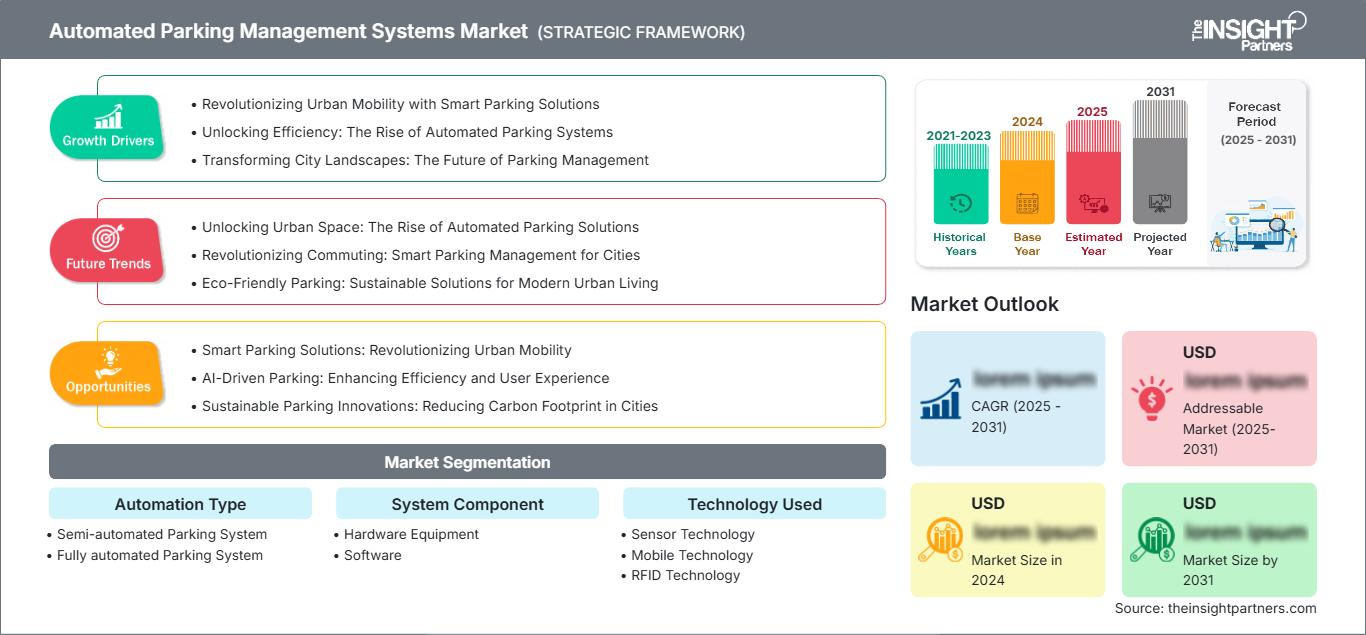
Automated Parking Management Systems Market: Strategic Insights
Regional Insights
North America Automated Parking Management Systems Market
North America is expected to be a significant market for automated parking management systems, holding approximately 28–32% of the share in 2025, with a projected CAGR of 14–18% from 2026 to 2034. The region's growth is driven by substantial investments in mobility infrastructure, premium real estate development, and the increasing adoption of smart city technologies across major metropolitan areas like New York, Los Angeles, Toronto, and Chicago. The commercial end-user category continues to dominate installations, particularly in the United States, as businesses seek to optimize parking costs and land usage. The residential sector is also witnessing growing demand, especially in high-rise developments where space-efficient, non-palletized, fully automated systems align with ESG goals and offer value-added amenities. The focus on green construction and LEED-certified developments, along with the growing adoption of EVs prompting the inclusion of EV-compatible automated systems with charging docks, is further propelling demand for advanced automated parking solutions.
U.S. Automated Parking Management Systems Market
The U.S. Automated Parking Management Systems Market share is estimated to represent 70–75% of the North American share in 2025, growing at a CAGR of 15–19%. Growth is fueled by federal and state-level policies incentivizing green construction, the modernization of urban infrastructure, and increasing investments in commercial real estate and mixed-use developments. Key application sectors include commercial buildings, retail centers, hospitals, and premium residential developments where reliability, throughput, and user experience are paramount. The presence of major system integrators like Robotic Parking Systems, Inc., Automotion Parking Systems, and Parkmatic ensures a robust supply chain and technological innovation. The growing emphasis on sustainability, smart building integration, and grid resilience supports sustained demand for advanced automated parking solutions.
Europe Automated Parking Management Systems Market
Europe is anticipated to capture 24–28% of the global Automated Parking Management Systems market share in 2025, with a CAGR of 13–17%. Germany leads the regional market due to its strong automotive industry, investment in smart city projects, and advanced urban infrastructure, with the country generating substantial revenue and forecasted to grow significantly through the forecast period. The UK is a significant market, driven by dense historical urban cores favoring creative vertical solutions and government-backed smart mobility initiatives. France, Italy, and Spain contribute notably, with investments in building retrofits, renewable energy integration, and sustainable urban planning. The European market is distinguished by strict adherence to EU energy efficiency directives and a strong focus on sustainability, influencing product design and adoption. The region's commitment to reducing carbon emissions and advancing circular economy principles is accelerating the deployment of energy-efficient, low-emission automated parking solutions.
APAC Automated Parking Management Systems Market
Asia Pacific is poised for the highest growth, holding approximately 30–34% of the Automated Parking Management Systems market in 2025 and projected to expand at a CAGR of 18–22%. China and Japan are the leading countries, with growth fueled by rapid urbanization, extensive residential and commercial construction projects, and significant government-backed smart city programs. South Korea is a key market due to advanced manufacturing sectors and investments in smart factory technologies. India and Australia are also emerging as significant markets with increasing interest in digital manufacturing and sustainable urban planning. Government policies promoting domestic production and infrastructure modernization are catalyzing market expansion. The region's high land costs and dense commute flows make mechanized parking solutions particularly attractive, creating substantial demand for sensor-rich, high-throughput systems.
Middle East & Africa Automated Parking Management Systems Market
The Middle East & Africa region is expected to show steady growth, with a CAGR of 12–16%. Saudi Arabia and the UAE are the primary drivers, investing heavily in smart city projects, energy infrastructure, and commercial real estate development. South Africa is a notable market with increasing interest in modernizing its building stock and addressing parking constraints in major metropolitan centers. The region's focus on infrastructure modernization, energy diversification, and sustainable urban planning presents significant opportunities for automated parking system deployment. Investments in hospitality, healthcare, and commercial facilities further support market growth, with emerging cities presenting greenfield opportunities for large-scale, integrated deployments.
Segmentation Analysis
Automation Type
The Automated Parking Management Systems Market is segmented by automation type into Semi-automated Parking System and Fully automated Parking System. The automation type segment is projected to grow at a CAGR of 16–20% from 2026 to 2034, driven by varying operational requirements and budget considerations across end-user sectors. Semi-automated systems currently hold a substantial share due to cost efficiency, quick setup, and ease of use, offering a balance between automation and manual control without the high upfront investment of fully automated alternatives. Fully automated systems, while holding a smaller current share, are projected to expand rapidly as technological advancements reduce costs and adoption barriers.
- Semi-automated Parking System: Semi-automated systems offer a balance between automation and manual control, providing enhanced user experience without the high upfront investment of fully automated alternatives. Their low maintenance requirements and user-friendly features contribute to widespread acceptance.
- Fully automated Parking System: Fully automated systems minimize human intervention and support higher throughput in constrained footprints, utilizing robotics and conveyor systems to move vehicles directly. They are gaining traction in high-throughput commercial and dense urban environments.
System Component
The Automated Parking Management Systems Market is segmented by system component into Hardware Equipment and Software. The system component segment is expected to exhibit a CAGR of 17–21% from 2026 to 2034, propelled by the increasing need for integrated hardware-software solutions. Hardware currently dominates due to the essential nature of physical components, but software is the fastest-growing segment, driven by advancements in AI analytics, real-time data processing, and cloud-based platforms.
- Hardware Equipment: Hardware dominates the market as physical sensors, lifts, AGVs, and conveyor systems form the core of any automated parking operation. As systems become more sophisticated, demand for durable, high-performance hardware continues to grow, especially in projects requiring long-term reliability.
- Software: Software solutions are increasingly critical for reservation management, revenue capture, predictive maintenance, and real-time analytics. Cloud-based platforms enable centralized management of parking facilities across multiple locations, optimizing pricing strategies and improving overall efficiency.
Technology Used
The Automated Parking Management Systems Market is segmented by technology used into Sensor Technology, Mobile Technology, and RFID Technology. The technology segment is expected to grow at a CAGR of 17–21% from 2026 to 2034, propelled by advancements in sensing, machine vision, and connectivity. Sensor technology currently dominates due to its critical role in vehicle detection and guidance, while mobile technology is the fastest-growing segment driven by consumer demand for app-based booking and contactless payments.
- Sensor Technology: Sensor technology enables real-time vehicle detection, occupancy monitoring, and guidance. Advances in camera systems, infrared arrays, radar modules, and ultrasonic sensors now enable higher detection fidelity and redundancy, reducing failure modes and simplifying automated workflows.
- Mobile Technology: Mobile technology facilitates app-based reservations, payment processing, and real-time availability updates. Integration with mobile platforms enhances user convenience and enables dynamic pricing strategies.
- RFID Technology: RFID technology streamlines entry, exit, and fee collection processes through automated vehicle identification. It enables seamless access control and reduces transaction times in high-traffic facilities.
End Use
The Automated Parking Management Systems Market is segmented by end use into Residential and Non-residential. The end use segment is expected to grow at a CAGR of 16–20% from 2026 to 2034, propelled by increasing construction activity and the growing emphasis on efficient space utilization. Non-residential applications currently hold the largest share due to adoption in office buildings, retail centers, hospitals, and hospitality venues where throughput and user experience are critical.
- Residential: Residential applications include apartment complexes, condominiums, and high-rise residential developments where automated parking maximizes space utilization and provides convenient parking options for residents. Demand is growing in urban areas where space is at a premium.
- Non-residential: Non-residential applications encompass commercial buildings, retail centers, airports, hospitals, and mixed-use developments. These environments benefit immensely from automated parking's ability to enhance capacity, reduce congestion, and provide quicker access to vehicles.
Opportunity Snapshot
| Segment | Revenue Contribution | Trend Tag | Adoption Stage |
| Non-residential | High | Commercial Automation | Mature |
| Residential | Medium | Urban Living | Scaling |
| Hardware | High | System Integration | Mature |
| Software | High | Platform Management | Scaling |
| Fully Automated | Medium | Lights-Out | Emerging |
| Semi-Automated | High | Cost-Effective | Mature |
| Sensor Technology | High | Smart Sensing | Scaling |
| Mobile Technology | Medium | App Integration | Emerging |
Automated Parking Management Systems Market Growth Drivers and Impact Analysis
Increasing Urbanization and Shrinking Parking Spaces
The rising trend in urbanization and the associated shortage of parking spaces in densely populated cities are the major drivers of growth in the Automated Parking Management Systems Market. With increasing population and vehicle numbers in metropolitan areas, conventional parking solutions are unable to meet demand. The introduction of automated parking management systems represents a revolutionary approach that improves land utilization, enables multi-level parking, and reduces the space required for parking. The increasing need for efficient utilization of space has compelled the urban population to consider vertical or underground automated parking systems.
Expansion of Smart City Initiatives and IoT-Based Infrastructure
Governments around the world are developing smart city infrastructure, which includes intelligent transportation systems, real-time parking availability platforms, and application-based parking bookings. Parking management systems are essential components of such developments and instrumental in building an interconnected, sensor-based infrastructure that supports urban mobility. The use of the Internet of Things (IoT), Artificial Intelligence (AI), and Cloud Computing is enabling the development of predictive parking management, dynamic pricing, and improved user experience. Smart city projects are being developed around the world, with large-scale investments in urban mobility.
Integration of Electric Vehicle Charging Infrastructure
Increasingly common electric cars have created a need for parking lots that can accommodate electric vehicle charging stations. In automated parking facilities equipped with chargers, the combination of parking and the ability to charge one’s car without an assigned space makes for an attractive offer for electric car owners. The ability to provide parking lots equipped with electric vehicle charging stations is a way for parking lot developers and operators to stand out from the competition. With annual sales of electric cars increasing significantly worldwide, there is a growing need for parking facilities capable of accommodating them.
Automated Parking Management Systems Market Future Trends
Adoption of AI-Powered Analytics and Predictive Management
The market is becoming increasingly receptive towards the use of AI-based analytics tools, which allow optimization, predictive maintenance, and dynamic pricing. Machine learning algorithms are used in these systems to predict occupancy rates and peak periods, and to optimize pricing strategies for maximum gains. AI-based systems can predict equipment malfunctions and perform predictive maintenance, thus minimizing downtime. The Automated Parking Management Systems market trends towards autonomous and self-optimizing solutions, which are making operations more efficient while creating revenue streams.
Shift Toward Shared Compute Architectures and Software-Defined Vehicles
The development of SDVs in the automotive sector is also affecting the development of automated parking systems, with a transition away from dedicated parking ECUs toward common ADAS compute platforms. With this trend, computing resources are reused across various vehicle systems, reducing the need for redundant hardware and software upgrades. The trend towards common compute platforms will emerge as the mainstay approach and will become widespread by the mid-2030s. This is indicative of an industry maturing from standalone systems to platform approaches, in which software, automation, and data management are as important as hardware.
Automated Parking Management Systems Market Opportunities
Expansion into Emerging Markets with Rapid Urbanization
The rapid pace at which cities in emerging economies, mainly in the Asia-Pacific region and the Middle East, are being urbanized and their infrastructure developed is an important market opportunity for manufacturers of automated parking systems. Emerging economies such as China, India, Saudi Arabia, and the UAE are making huge investments in smart cities, commercial real estate, and transport infrastructure, hence a huge demand for parking solutions that do not require much space. With rising costs in urban areas, mechanized parking is becoming more favored. With the government's efforts to promote industrial automation and local manufacturing capacity, the Automated Parking Management Systems Market forecast to grow rapidly.
Integration with Multimodal Mobility and Property Management Platforms
The convergence of parking technology with other mobility and property management solutions offers significant opportunities for revenue generation. The integration of parking assets into the traveler experience is gaining momentum with the development of technologies such as reservations, dynamic pricing, and multimodal trip-planning solutions. This opens new revenue streams but also requires an efficient API strategy and a data management system. Facility owners have many opportunities to generate income through premium services, data monetization, and additional amenities. Companies that focus on developing API solutions and forming partnerships with mobility platforms will be well-positioned to capture the growing demand for connected, data-rich parking solutions.
Recent Developments
- January 2026: HUB Parking Technology today announced the global launch of its new multi-purpose parking kiosk, a self-service solution designed to extend the role of traditional payment machines into flexible, service-oriented touchpoints for indoor environments. The kiosk has been developed to support a wide range of parking and non-parking interactions, including ticket and ticketless payments, non-parking product purchases, subscription renewals, voucher validation, and targeted digital content. Designed for deployment in locations such as airports, hotels, shopping centers, and mixed-use facilities, it combines a compact footprint with a configurable user interface and integration-ready architecture. The software is fully designed in‑house and built to scale through integrations with third‑party systems, such as guiding visitors, indoor navigation, ground transportation, and ticketing for cinema or theatre.
- July 2026: EQT announced that BPEA EQT Mid-Market Growth Partnership (the "MMG Fund" or "EQT") has agreed to acquire Orikan (the "Company"), a leading provider of integrated parking, enforcement, and compliance technology solutions. Headquartered in Melbourne, Orikan provides integrated parking operations and enforcement and infringement management services, supported by software, hardware, payments, and data capabilities designed and operated by the Company. With nearly 400 employees, the Company serves hundreds of government and private sector customers – including universities, airports, hospitals and stadiums – across Australia, New Zealand, and North America.
- August 2025: PRRS, the leading provider of parking compliance solutions, announced the introduction of Autostart, a groundbreaking AI-powered parking management technology designed to transform the way drivers access and pay for parking. Powered by Paralign's ARCFlex software and leveraging advanced AI vision, Autostart offers an open network, precise payment activation for gateless, free-flow parking facilities, capturing and verifying license plate data the instant a vehicle enters and exits a facility, and automatically charging drivers for the exact amount of time that the parking session lasted via your preferred payment platform. Unlike other payment networks serving the parking industry, this is an open network, which allows parking owners and operators to choose their preferred payment provider for collecting parking fees.
Frequently Asked Questions

- Comprehensive Market Sizing and Forecast Analysis
- Detailed Segmentation Analysis
- In-Depth Market Dynamics Assessment
- Regional and Country-Level Insights
- Competitive Landscape and Company Benchmarking
- Strategic Business Intelligence
Recent Reports
Testimonials

The Insight Partners' SCADA System Market report is comprehensive, with valuable insights on current trends and future forecasts. The team was highly professional, responsive, and supportive throughout. We are very satisfied and highly recommend their services.
RAN KEDEM Partner, Reali Technologies LTDs
I requested a report on a very specific software market and the team produced the report in a few days. The information was very relevant and well presented. I then requested some changes and additions to the report. The team was again very responsive and I got the final report in less than a week.
JEAN-HERVE JENN Chairman, Future Analytica
We worked with The Insight Partners for an important market study and forecast. They gave us clear insights into opportunities and risks, which helped shape our plans. Their research was easy to use and based on solid data. It helped us make smart, confident decisions. We highly recommend them.
PIYUSH NAGPAL Sr. Vice President, High Beam Global
The Insight Partners delivered insightful, well-structured market research with strong domain expertise. Their team was professional and responsive throughout. The user-friendly website made accessing industry reports seamless. We highly recommend them for reliable, high-quality research services
YUKIHIKO ADACHI CEO, Deep Blue, LLC.
This is the first time I have purchased a market report from The Insight Partners.While I was unsure at first, I visited their web site and felt more comfortable to take the risk and purchase a market report.I am completely satisfied with the quality of the report and customer service. I had several questions and comments with the initial report, but after a couple of dialogs over email with their analyst I believe I have a report that I can use as input to our strategic planning process.Thank you so much for taking the extra time and making this a positive experience.I will definitely recommend your service to others and you will be my first call when we need further market data.
JOHN SUZUKI President and Chief Executive Officer, Board Director, BK Technologies
I wish to appreciate your support and the professionalism you displayed in the course of attending to my request for information regarding to infectious disease IVD market in Nigeria. I appreciate your patience, your guidance, and the fact that you were willing to offer a discount, which eventually made it possible for us to close a deal. I look forward to engaging The Insight Partners in the future, all thanks to the impression you have created in me as a result of this first encounter.
DR CHIJIOKE ONYIA MANAGING DIRECTOR, PineCrest Healthcare Ltd.Reason to Buy
- Informed Decision-Making
- Understanding Market Dynamics
- Competitive Analysis
- Identifying Emerging Markets
- Customer Insights
- Market Forecasts
- Risk Mitigation
- Boosting Operational Efficiency
- Strategic Planning
- Investment Justification
- Tracking Industry Innovations
- Aligning with Regulatory Trends





 Get Free Sample for