
Automated Parking System Market Growth and Forecast by 2034
Coverage: By Component (Hardware, Software); Automation Level (Semi-automated, Fully automated); Platform (Palleted, Non-palleted); End-User (Residential, Commercial, Mixed-Use), and Geography
- Status : Data Released
- Report Code : TIPRE00015000
- Category : Electronics and Semiconductor
- No. of Pages : 150
- Available Report Formats :


- Last update date : July 17, 2026


2025 Market Size
US$ 2.61 Bn
Base year value
2034 Forecast
US$ 8.41 Bn
Projected by 2034
CAGR 2026-2034
13.9 %
Growth rate
Addressable Market
US$ 47.62 Bn
(2026-2034)
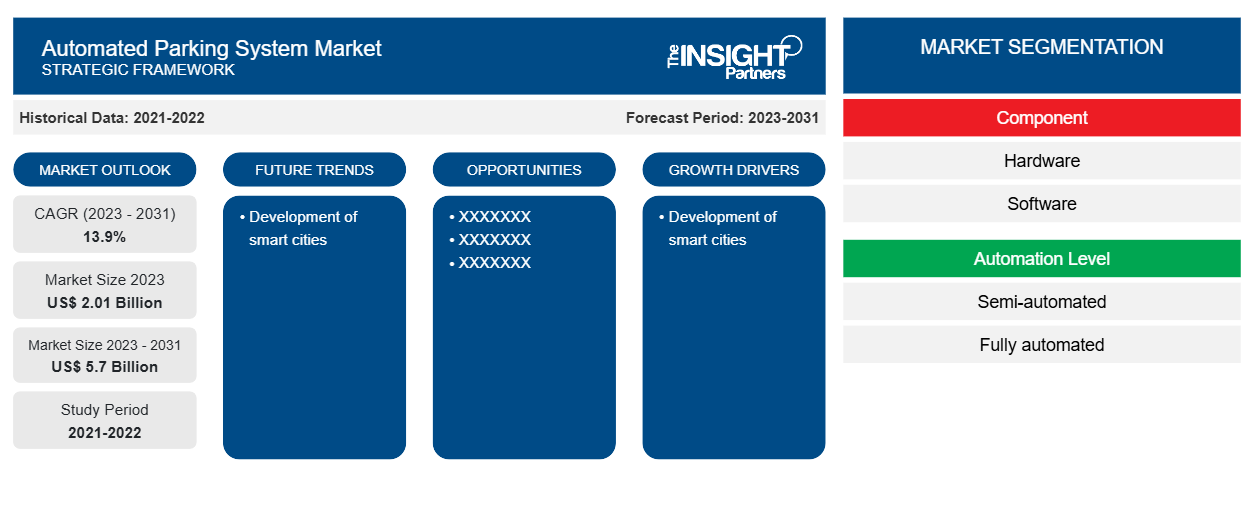
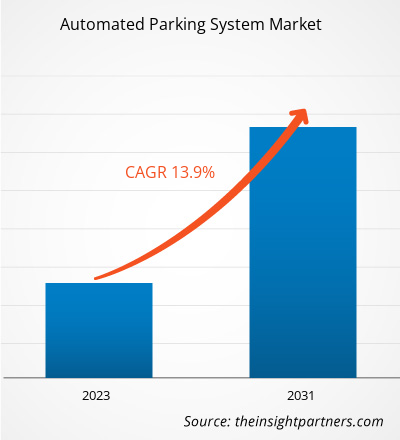
The Automated Parking System Market is projected to grow from US$ 2.61 Billion in 2025 to US$ 8.41 Billion by 2034, registering a CAGR of 13.9% during 2026–2034. Demand is supported by urban land constraints, high-density real estate development, and the shift toward compact parking infrastructure that reduces circulation space, improves vehicle retrieval efficiency, and supports digitally managed mobility assets.
Across North America, the Automated Parking System Market size is expected to advance at an estimated CAGR range of 12.8–14.2% through 2034, driven by urban redevelopment, premium multifamily housing, and mixed-use projects in space-constrained city cores. Developers are prioritizing robotic garages to raise vehicle density per square foot, reduce ramp construction, and integrate EV charging-ready parking bays.
Automated Parking System Market Assessment and Insights
- North America held a 29–32% share in 2025 and is growing at a CAGR range of 12.8–14.2% during 2026–2034, supported by mixed-use redevelopment and automation-led parking density gains.
- US accounted for 78–82% of North America in 2025 and is growing at a CAGR range of 12.9–14.4% through 2034, led by urban infill projects.
- Europe represented a 34–37% share in 2025 and is growing at a CAGR range of 12.4–13.8%, with Germany, the UK, and France leading adoption.
- Asia Pacific captured a 23–26% share in 2025 and is growing at a CAGR range of 14.8–16.2%, led by China, Japan, South Korea, and India.
- Largest Segment Hardware held a 68–72% market share in 2025 and is growing at a CAGR range of 12.6–13.9%, reflecting the capital intensity of lifts, pallets, robotics, and control equipment.
- High Growth Segment: Fully automated systems held a 43–47% market share in 2025 and are growing at a CAGR range of 15.2–16.8%, driven by driverless retrieval and premium real estate use cases.
- Key companies analyzed in detail: Park Plus Inc., Dayang Parking Company Ltd., WÖHR Autoparksysteme GmbH, Unitronics Ltd., City Lift Parking LLC, Lödige Industries GmbH, ShinMaywa Industries Ltd., Robotic Parking Systems Inc., Parkmatic, and AutoMotion Parking Systems LLC.
Source: The Insight Partners' analysis based on proprietary research, government publications, company annual reports, investor presentations, industry databases, and expert interviews.
Technology adoption has shifted the Automated Parking System Market from mechanically assisted stacking toward integrated robotic storage, vehicle sensing, and software-supervised retrieval. Hardware remains the largest revenue base because every project requires steel structures, conveyors, elevators, transfer cabins, and safety systems. Software is gaining influence as operators add predictive maintenance, user reservations, license plate recognition, remote diagnostics, and building management integration. Production dynamics are also changing as suppliers standardize modules to shorten installation cycles and reduce project engineering risk.
Future demand is likely to broaden beyond premium towers and luxury residences as cities link parking efficiency with sustainable land use, congestion control, and transit-oriented development. Emerging geographies in Asia Pacific and the Middle East are investing in smart city districts, while European retrofit activity benefits from compact urban cores. Regulatory support for energy-efficient buildings and safer pedestrian zones is expected to lift adoption among developers seeking measurable space and operating advantages.
Automated Parking System Market Report Scope
| Report Attribute | Details |
|---|---|
| Market size in 2025 | US$ 2.61 Billion |
| Market Size by 2034 | US$ 8.41 Billion |
| Global CAGR (2026 - 2034) | 13.9% |
| Historical Data | 2021-2024 |
| Forecast period | 2026-2034 |
Automated Parking System Market Analysis
Urban density, rising vehicle ownership, and tighter building economics are driving Automated Parking System Market growth as developers seek higher parking capacity without expanding land footprints. The value chain spans structural design, electromechanical hardware, sensors, software, installation, maintenance, and operator services, making supplier coordination essential for project reliability.
Supply dynamics remain project-led because systems must fit building geometry, fire codes, vehicle mix, and throughput expectations. Modular platforms are reducing customization, but procurement still depends on local construction partners, certified installers, and long-term service capability. The strongest demand comes from mixed-use towers, hospitals, airports, and dense residential developments where land cost outweighs automation capital expenditure.
Competitive positioning in Automated Parking System Market analysis is shaped by engineering depth, installed base, safety certification, and integration capability. WÖHR Autoparksysteme GmbH, Unitronics Ltd., Robotic Parking Systems Inc., Park Plus Inc., and Lödige Industries GmbH compete through system reliability, project references, and service networks rather than price alone.
Investment is moving toward software-enabled lifecycle revenue, EV charging integration, and lower-maintenance robotics. Parkmatic, AutoMotion Parking Systems LLC, City Lift Parking LLC, ShinMaywa Industries Ltd., and Dayang Parking Company Ltd. are positioned around regional construction channels and application-specific layouts. Buyers increasingly evaluate vendors on retrieval time, redundancy, energy use, and post-installation uptime guarantees.
● REPORT CUSTOMIZATION
Tailor This Report To Align With Your Specific Business Requirements
This report can be customized to align precisely with your business objectives, scope, and target markets. Customization options include tailored segmentation, geography, competitive analysis, and strategic insights to support informed decision-making.
Customize This Report →WHAT YOU CAN ADJUST
- ● Segmentations
- ● Geography
- ● Competitive Analysis
- ● Language Preferences
Automated Parking System Market: Strategic Insights
Regional Insights
North America Automated Parking System Market
North America held a 29–32% Automated Parking System Market share in 2025 and is projected to grow at a CAGR range of 12.8–14.2% through 2034. Growth is concentrated in the US and Canada, where infill housing, healthcare campuses, airports, and downtown commercial projects face limited parking footprints and expensive structured garage construction.
Adoption is supported by real estate owners seeking higher stall density, reduced driver circulation, and premium tenant amenities. Municipal interest in congestion reduction and safer curbside management also favors automated formats. Vendors with local service teams and code-compliant safety architectures are better positioned because buyers prioritize uptime, retrieval reliability, and project execution certainty.
U.S. Automated Parking System Market
The US represented 78–82% of North America in 2025 and is expected to grow at a CAGR range of 12.9–14.4% during 2026–2034. Demand is strongest in New York, California, Florida, Texas, and major university and medical districts where land values make conventional ramp garages less attractive.
Company presence is broad, with Park Plus Inc., Robotic Parking Systems Inc., City Lift Parking LLC, Parkmatic, and AutoMotion Parking Systems LLC active in residential towers, commercial buildings, and institutional facilities. Application trends include robotic valet systems, automated stacking for constrained parcels, and software-controlled access that supports reservations, digital payments, and building security integration.
Europe Automated Parking System Market
Europe held a 34–37% share in 2025 and is growing at a CAGR range of 12.4–13.8% through 2034, with Germany the leading country. Germany benefits from mature mechanical parking engineering, strong supplier depth, and dense urban redevelopment, while the UK uses automated parking in premium residential and mixed-use projects where planning constraints limit conventional garage expansion.
France, Italy, and Spain contribute through hotel, office, and city-center residential applications where heritage streets, limited basements, and pedestrianization policies restrict parking supply. European buyers emphasize safety compliance, low-noise operation, energy efficiency, and design compatibility with existing buildings. WÖHR Autoparksysteme GmbH and Lödige Industries GmbH benefit from regional engineering credibility and exportable project expertise.
APAC Automated Parking System Market
APAC held a 23–26% share in 2025 and is forecast to grow at a CAGR range of 14.8–16.2%, led by China. China, Japan, South Korea, India, and Australia are adopting automated parking in high-rise housing, transit-adjacent projects, hospitals, and commercial complexes where land scarcity and car ownership growth intersect.
Policy support for smart cities, metro-linked redevelopment, and digital infrastructure improves the regional outlook. Japan and South Korea bring mature automation cultures, while India is scaling pilot deployments in dense metros. Dayang Parking Company Ltd. and ShinMaywa Industries Ltd. are important regional suppliers, supported by local manufacturing, engineering customization, and urban infrastructure investment.
Middle East & Africa Automated Parking System Market
Middle East & Africa is projected to grow at a CAGR range of 13.6–15.1% during 2026–2034, with the UAE leading adoption. Saudi Arabia, the UAE, South Africa, and the Rest of MEA are deploying automated systems in luxury real estate, airports, hospitals, and mixed-use districts linked to infrastructure modernization.
Energy-efficient urban development and large-scale construction pipelines are shaping demand. Gulf projects prioritize compact layouts, premium user experience, and integration with smart building platforms. In South Africa, adoption remains selective and project-specific, but constrained city-center developments and secured parking requirements create opportunities for semi-automated and modular systems.
Segmentation Analysis
Component
Component is expected to grow at a CAGR range of 13.1–14.6% during 2026–2034. The Automated Parking System Market scope across components remains hardware-led, but software is becoming strategically important as owners demand monitoring, reservations, payment links, and predictive maintenance. Hardware procurement is tied to project construction schedules, while software upgrades can extend system value after installation.
- Hardware remains the core revenue contributor because elevators, shuttles, pallets, sensors, motors, control panels, and safety assemblies define system capacity, reliability, and construction integration.
- Software is gaining strategic relevance as parking operators seek remote diagnostics, user apps, automated allocation, payment interfaces, cybersecurity controls, and building management connectivity.
Automation Level
Automation Level is projected to expand at a CAGR range of 13.7–15.2% from 2026 to 2034. Semi-automated systems remain relevant for cost-sensitive projects and constrained retrofits, while fully automated formats gain share where premium land values, high throughput, and driverless convenience justify higher capital investment. Safety redundancy and retrieval speed are decisive purchasing criteria.
- Semi-automated systems support residential and small commercial properties that need space efficiency while retaining some user interaction, limiting project complexity and capital exposure.
- Fully automated systems are increasingly selected for premium towers, hospitals, airports, and dense mixed-use assets where driverless retrieval improves safety, throughput, and user convenience.
Platform
Platform is expected to grow at a CAGR range of 13.4–14.9% during 2026–2034. Palleted systems continue to dominate established installations because they simplify vehicle handling and protect tires and underbodies. Non-palleted systems are gaining attention where faster cycle time, lower moving mass, and compatibility with advanced robotics can improve operating economics.
- Palleted platforms remain widely used because they provide predictable vehicle transfer, reduce direct tire handling, and suit projects requiring proven mechanical reliability.
- Non-palleted platforms appeal to high-throughput facilities because robotic carriers can reduce transfer steps, lower equipment weight, and support more flexible slot allocation.
Opportunity Snapshot
| Component | Revenue Contribution | Trend Tag | Adoption Stage |
| Hardware | High | Robotic Lifts | Mature |
| Software | Medium | Remote Diagnostics | Scaling |
| Semi-automated | Medium | Compact Retrofit | Mature |
| Fully automated | High | Robotic Valet | Scaling |
| Palleted | High | Protected Transfer | Mature |
| Non-palleted | Medium | Carrier Robotics | Emerging |
Automated Parking System Market Growth Drivers and Impact Analysis
Urban Land Scarcity and Higher Parking Density
The land cost factor is the most straightforward reason automated parking would be used, since traditional parking garages require ramps, drive lanes, turning circles, exhaust ducts, and walking spaces, which reduce their efficiency and capacity. With automated parking, it is possible to design parking facilities in more efficient layouts and use machinery for circulation, thus saving sellable/leaseable square footage. In turn, it is possible to develop an economic rationale in dense residential, office, hotel, hospital, and airport development cases. It is especially relevant when zoning laws demand certain parking minimums, but there is no possibility of building a basement on the parcel. By converting parking from a space-consuming requirement into a compact infrastructure asset, the Automated Parking System Market gains relevance in high-value urban redevelopment.
Smart Buildings and Digitized Facility Operations
Parking management has now been incorporated into the building's larger ecosystem, where the space is integrated rather than a stand-alone utility. Automated systems assist with access controls, booking schedules, payments, occupancy tracking, and security surveillance – a feature consistent with the demands of facility managers, who require operational predictability. Technology supports preventive maintenance to help avoid downtime for high-traffic buildings. Information collected through the parking system can be analyzed by developers to offer the best services to tenants, manage visitor movement, and allocate charging stations for electric vehicles. With such integration, it becomes easier for buyers to invest in the automation process due to improved service delivery and greater facility efficiency.
Sustainability, Congestion Control, and Safer Urban Access
Automated parking entails fewer vehicle movements, as drivers drop off their cars at transit points rather than making rounds through the different levels of multi-level car parks. Reduced vehicle movement may lead to decreased pollution, improved pedestrian safety, and better airflow within enclosed structures. Pedestrian-friendly streets, less congested curbs, and proper urban land-use planning suggest that cities are seeing smaller parking facilities in line with the concept of mobility. In mixed-use zones, the driver's role is crucial, as queuing for parking affects both traffic and pedestrian flow. For property developers, sustainability means differentiating lease agreements.
Automated Parking System Market Future Trends
AI-Based Retrieval Optimization
Automated Parking System Market trends will be geared towards the use of Artificial Intelligence to optimize parking systems by predicting user departure patterns and positioning cars closer to exit cabins. This trend will be particularly useful in hospitals, office buildings, and residential buildings, where peak retrieval times increase the risk of queues. Machine learning algorithms can use information on bookings, access logs, events, and sensors to minimize waiting time without necessarily increasing machinery. Software firms that can extract value from operations through their software will be differentiated. In the long run, this trend may enable dynamic slot assignment for electric vehicle (EV) charging, oversized vehicles, and priority users.
EV-Ready Automated Parking Architectures
The advent of EVs is projected to impact automated parking systems, as they require charging accessibility, cable safety, fire safety, battery safety, and energy management within tight parking spaces. Future systems will have a more complex design, including the use of computerized means to allocate charging bays and to synchronize energy consumption with the building's overall loads. Such systems create new business opportunities for companies that specialize in mechanical parking and in integrating electrical infrastructure. Moreover, developers will need parking systems that allow them to maintain vehicle density while meeting changing demands related to electric vehicles.
Automated Parking System Market Opportunities
Retrofit Solutions for Dense Existing Buildings
Existing buildings represent a major opportunity because many city-center assets were designed before current parking demand, EV charging expectations, and tenant convenience standards. Small semi-automated systems and fully automated modular units can make underperforming basement spaces, surface lots, and oddly shaped interior areas more productive for parking. The Automated Parking System Market Forecast indicates that retrofit opportunities will increase where new development is limited by zoning, heritage conservation, and land availability. Manufacturers would earn their money through feasibility studies, staged installations, and guaranteed performance through after-sales services. The most promising markets include apartment buildings, luxury hotels, medical clinics, and office buildings.
Smart City District Partnerships
Smart City districts that combine public and private interests offer automated parking providers the opportunity to move their services from individual building implementations to comprehensive mobility infrastructures. Deploying at the district level enables the integration of parking availability, booking, payment, curbside management, and transit connections via common data platforms. Companies that collaborate with developers, local government, and transportation companies will be able to build pipelines of sizable projects and earn service revenue over time. Such collaboration is especially important in Asia Pacific and Gulf regions, where new city districts are built with digital infrastructure in mind right from the start.
Recent Developments
- August 2025: PRRS, a leading provider of parking compliance solutions, has announced the launch of Autostart, an AI-powered parking management technology designed to change the way drivers access and pay for parking. Powered by Paralign's ARCFlex software and utilizing advanced AI vision, Autostart provides an open network with precise payment activation for gateless, free-flow parking facilities by capturing and verifying license plate data as vehicles enter and exit a facility, then automatically charging drivers for the exact duration of their parking session through their preferred payment platform.
- March 2025: HUB Parking Technology, a leading brand of FAAC Parking Solutions, today announced the launch of its transformative Digital Portfolio, a comprehensive suite of digital applications designed to redefine parking management across diverse urban environments. Leveraging the robust native digital ecosystem of JMS (JMS Management System), the new portfolio represents a significant leap forward in integrated parking solutions and an enterprise-level turnkey parking offering.
- August 2025: The Hyderabad Metro Rail’s ₹120-crore multi-level automated parking facility at Nampally is approaching completion and is expected to open soon, providing a modern solution to parking congestion in one of the city's busiest areas. Developed near the Nampally Metro station, the facility is designed to accommodate around 250 cars and 150–200 two-wheelers through a fully automated parking system that requires minimal human intervention. Motorists will receive a smart card with a QR code at the entrance, park their vehicle on a designated turntable, and exit the vehicle. Sensors will identify the vehicle type and automatically transport it to an available parking slot.
Frequently Asked Questions

- Comprehensive Market Sizing and Forecast Analysis
- Detailed Segmentation Analysis
- In-Depth Market Dynamics Assessment
- Regional and Country-Level Insights
- Competitive Landscape and Company Benchmarking
- Strategic Business Intelligence
Recent Reports
Testimonials

The Insight Partners' SCADA System Market report is comprehensive, with valuable insights on current trends and future forecasts. The team was highly professional, responsive, and supportive throughout. We are very satisfied and highly recommend their services.
RAN KEDEM Partner, Reali Technologies LTDs
I requested a report on a very specific software market and the team produced the report in a few days. The information was very relevant and well presented. I then requested some changes and additions to the report. The team was again very responsive and I got the final report in less than a week.
JEAN-HERVE JENN Chairman, Future Analytica
We worked with The Insight Partners for an important market study and forecast. They gave us clear insights into opportunities and risks, which helped shape our plans. Their research was easy to use and based on solid data. It helped us make smart, confident decisions. We highly recommend them.
PIYUSH NAGPAL Sr. Vice President, High Beam Global
The Insight Partners delivered insightful, well-structured market research with strong domain expertise. Their team was professional and responsive throughout. The user-friendly website made accessing industry reports seamless. We highly recommend them for reliable, high-quality research services
YUKIHIKO ADACHI CEO, Deep Blue, LLC.
This is the first time I have purchased a market report from The Insight Partners.While I was unsure at first, I visited their web site and felt more comfortable to take the risk and purchase a market report.I am completely satisfied with the quality of the report and customer service. I had several questions and comments with the initial report, but after a couple of dialogs over email with their analyst I believe I have a report that I can use as input to our strategic planning process.Thank you so much for taking the extra time and making this a positive experience.I will definitely recommend your service to others and you will be my first call when we need further market data.
JOHN SUZUKI President and Chief Executive Officer, Board Director, BK Technologies
I wish to appreciate your support and the professionalism you displayed in the course of attending to my request for information regarding to infectious disease IVD market in Nigeria. I appreciate your patience, your guidance, and the fact that you were willing to offer a discount, which eventually made it possible for us to close a deal. I look forward to engaging The Insight Partners in the future, all thanks to the impression you have created in me as a result of this first encounter.
DR CHIJIOKE ONYIA MANAGING DIRECTOR, PineCrest Healthcare Ltd.Reason to Buy
- Informed Decision-Making
- Understanding Market Dynamics
- Competitive Analysis
- Identifying Emerging Markets
- Customer Insights
- Market Forecasts
- Risk Mitigation
- Boosting Operational Efficiency
- Strategic Planning
- Investment Justification
- Tracking Industry Innovations
- Aligning with Regulatory Trends





 Get Free Sample for