
Aerospace and Defense Wire Harness Market Size, Share & Demand by 2034
Coverage: By Product Type (Wire Harness Connector, Wire Harness Terminal, Wire, Others), Insulation Material (Polyvinyl Chloride (PVC), Cross-linked Polyethylene (XLPE), Polyethylene (PE), Polypropylene (PP), Polyurethane (PU), Thermoplastic Elastomer (TPE), Others), Aerospace & Defense Application (Avionics Wiring, Flight Control System, Cabin Management System, Radar System, Military Communication Systems, Others), Voltage Capacity (Low Voltage (0 to 50V), Medium Voltage (50 to 300V), High Voltage (More than 300V)), Conducting Material (Copper, Aluminium, Optical Fiber, Others), Sales Channel (OEMs, Aftermarket) and Geography (North America, Europe, Asia Pacific, Middle East and Africa, and South and Central America)
- Status : Published
- Report Code : TIPRE00044060
- Category : Electronics and Semiconductor
- No. of Pages : 335
- Available Report Formats :


- Last update date : August 17, 2026


2025 Market Size
US$ 8.35 Bn
Base year value
2034 Forecast
US$ 12.68 Bn
Projected by 2034
CAGR 2026-2034
4.7 %
Growth rate
Addressable Market
US$ 95.22 Bn
(2026-2034)
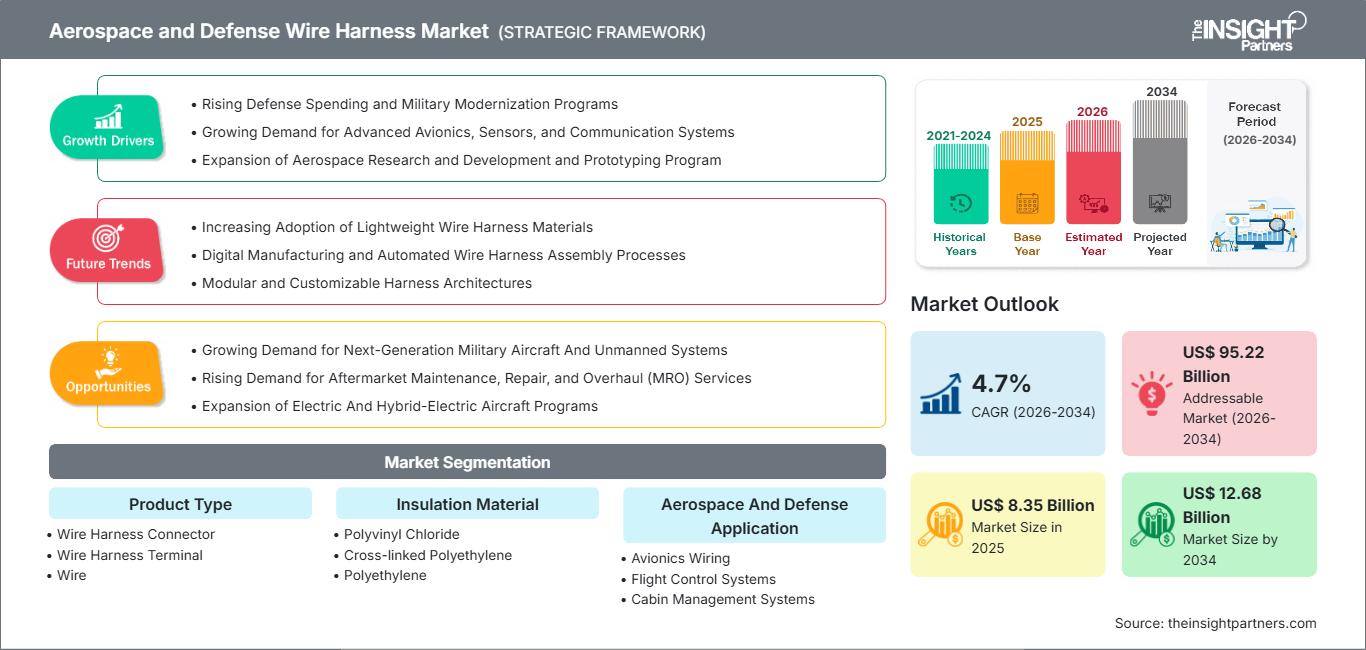
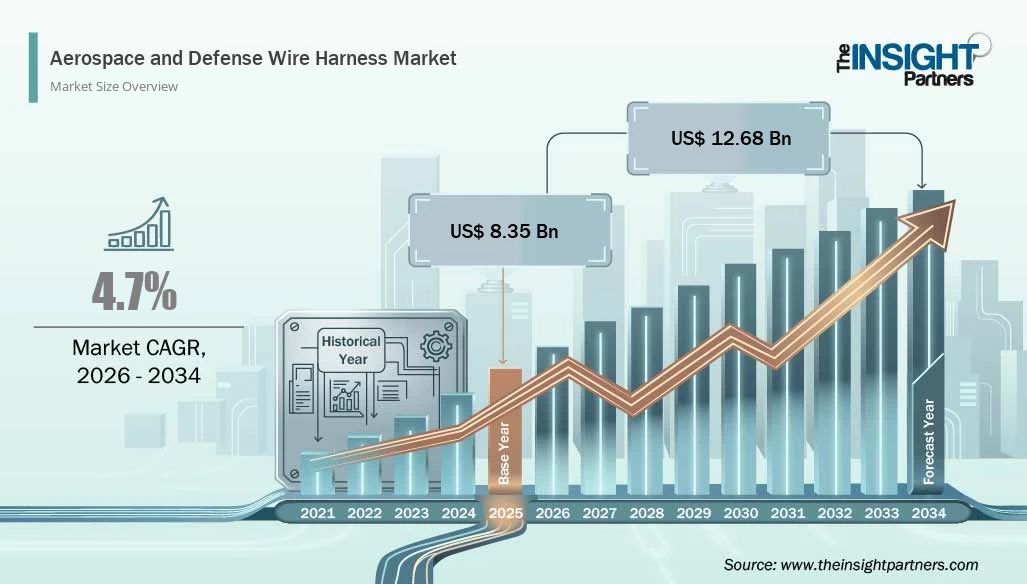
The Aerospace and Defense Wire Harness Market is expected to reach US$ 8.35 Billion in 2025 and decline to US$ 12.68 Billion by 2034, registering a CAGR of 4.7% from 2026 to 2034. Demand remains tied to aircraft electrification, avionics integration, mission-system upgrades, and defense platform modernization, while near-term value normalization reflects tighter procurement cycles and redesigned harness architectures.
The Aerospace and Defense Wire Harness Market is growing as aircraft manufacturers and defense companies add more electrical and electronic systems to commercial aircraft, military platforms, unmanned systems, and advanced air mobility aircraft. Wire harnesses are essential for transmitting power and signals across avionics, flight controls, radar, communication systems, cabin equipment, sensors, and other critical functions.
Aerospace and Defense Wire Harness Market Assessment and Insights
- North America held 23.43% share in 2025 and is projected to grow at a 4.8% CAGR between 2026–2034, driven by fleet retrofit, defense avionics, and satellite communication upgrades.
- US represented 67.94% of North America in 2025 and is expected to grow at a 5.0% CAGR between 2026–2034.
- Europe accounted for 22.78% share in 2025 and is set to grow at a 4.2% CAGR, led by the UK, Germany, France, Italy, and Spain.
- Asia Pacific captured 44.13% share in 2025 and is projected to grow at a 5.3% CAGR, with China, Japan, South Korea, India, and Australia leading demand.
- Largest Segment Avionics Wiring held 31.50% market share in 2025 and is expected to expand at a 5.5% CAGR between 2026–2034.
- High Growth Segment Cooper held 74.74% market share in 2025 and is forecast to grow at a 4.7% CAGR between 2026–2034.
- Key companies analyzed in detail: TE Connectivity plc, Glenair, Inc., Amphenol CIT, Yazaki Corporation, kSARIA Corporation, InterConnect Wiring LLP, Bel Fuse Inc., TransDigm Group Incorporated, Crane Aerospace & Electronics, and Radiant Power Corporation.
Source: The Insight Partners' analysis based on proprietary research, government publications, company annual reports, investor presentations, industry databases, and expert interviews.
Aircraft electrical architectures are shifting from individual, manually routed bundles to modular harness sets. These sets combine power, signal, radio frequency, and fiber transmission. The Aerospace and Defense Wire Harness Market is influenced by stricter design validation, increased connector density, lighter insulation, and the need for traceability. This includes everything from cutting wire to final continuity testing and platform certification.
Forward demand will increasingly come from India, South Korea, the Gulf states, and Eastern Europe as domestic aerospace programs, offset-linked defense manufacturing, and MRO localization expand. Regulatory emphasis on fire resistance, electromagnetic compatibility, and lifecycle documentation is expected to favor suppliers with AS9100, NADCAP, ITAR, and platform-specific qualification capabilities.
Aerospace and Defense Wire Harness Market Report Scope
| Report Attribute | Details |
|---|---|
| Market size in 2025 | US$ 8.35 Billion |
| Market Size by 2034 | US$ 12.68 Billion |
| Global CAGR (2026 - 2034) | 4.7% |
| Historical Data | 2021-2024 |
| Forecast period | 2026-2034 |
Aerospace and Defense Wire Harness Market Analysis
The aerospace and defense wire harness is steadily growing as aircraft, spacecraft, unmanned platforms, and military systems require more electrical power. Wire harnesses are now seen as essential interconnection systems that support power distribution, signal transmission, data communication, flight safety, and mission reliability. Demand is increasing due to higher aircraft production, fleet upgrades, defense electronics improvements, and the move toward more electric aircraft designs.
Manufacturers are concentrating on lightweight conductors, compact connectors, improved insulation materials, and harness designs that can handle vibration, heat, fluid exposure, electromagnetic interference, and strict certification standards. In defense applications, there is a strong demand for durable wiring for radar systems, communication platforms, avionics, and flight control systems. Overall, the market is expected to grow as aerospace programs focus on reducing weight, ensuring reliability, providing modularity, and enhancing long lifecycle performance.
The aerospace and defense wire harness market includes engineered assemblies of wires, cables, terminals, connectors, sleeves, shields, and insulation systems used in aircraft and defense platforms. These harnesses connect avionics, power systems, sensors, flight controls, radar equipment, cabin electronics, military communication systems, and mission-critical subsystems. As platforms become more digital and software-defined, the wiring architecture needs to support higher data speeds, safer routing, better electromagnetic compatibility, and lower overall weight.
Commercial aviation programs create steady demand through new aircraft deliveries and retrofit work. Meanwhile, defense programs drive demand for rugged harnesses that can operate in harsh environments. Suppliers are investing in automated wire processing, digital design tools, better traceability, and materials that meet strict aerospace and military standards. The market outlook is positive, driven by aircraft electrification, modernization of older fleets, and increasing integration of advanced electronic systems.
● REPORT CUSTOMIZATION
Tailor This Report To Align With Your Specific Business Requirements
This report can be customized to align precisely with your business objectives, scope, and target markets. Customization options include tailored segmentation, geography, competitive analysis, and strategic insights to support informed decision-making.
Customize This Report →WHAT YOU CAN ADJUST
- ● Segmentations
- ● Geography
- ● Competitive Analysis
- ● Language Preferences
Aerospace and Defense Wire Harness Market: Strategic Insights
Regional Insights
North America Aerospace and Defense Wire Harness Market
North America remains the anchor region, with 23.43% share in 2025 and a 4.8% CAGR expected through 2034. Regional demand is supported by commercial aircraft backlogs, fighter modernization, space launch electronics, and UAV production, all requiring high-density wiring, shielded assemblies, and ruggedized terminations. The Aerospace and Defense Wire Harness Market share is concentrated around U.S. OEM clusters and Canadian aerospace manufacturing corridors.
North America remains a well-established and technologically advanced market for aerospace and defense wire harnesses. Strong aircraft manufacturing, defense programs, fleet modernization, and a large aftermarket base continue to support demand. The US is the region’s main market, while Canada contributes through aerospace manufacturing and specialized engineering activities. The region’s large installed aircraft fleet also generates ongoing requirements for wiring inspection, replacement, retrofits, and modifications, in addition to harnesses used in newly produced aircraft.
U.S. Aerospace and Defense Wire Harness Market
The U.S. accounted for 67.94% of North America in 2025 and is projected to grow at a 5.0% CAGR during 2026–2034. The U.S. is the largest demand center in North America’s aerospace and defense wire harness market, supported by commercial aircraft production, military aviation programs, defense electronics, and a well-established MRO sector. Demand comes from avionics, flight-control systems, radar, communications, cabin electronics, sensors, and power-distribution systems. The country’s large aircraft fleet also creates steady requirements for wiring inspections, repairs, replacements, retrofits, and modifications.
Europe Aerospace and Defense Wire Harness Market
Competition in the European market increasingly favors suppliers that can meet strict aerospace qualification, traceability, environmental, and reliability standards. Manufacturers are investing in automation, digital production systems, lightweight wiring solutions, and advanced connectivity as aircraft electrical systems become more complex. Supply-chain resilience is also becoming a greater priority, encouraging closer cooperation between aircraft manufacturers, defense contractors, and component suppliers. This is creating opportunities for companies with local production, engineering support, and the ability to provide complete, integrated harness solutions.
MEA Aerospace and Defense Wire Harness Market
The Middle East & Africa aerospace and defense wire harness market is being supported by expanding aviation infrastructure, defense modernization, fleet expansion, and efforts to develop local aerospace capabilities. Saudi Arabia and the UAE are the main regional demand centers, backed by commercial aviation activity, military procurement, MRO development, and investments in domestic aerospace manufacturing. South Africa also has an established aerospace and defense engineering base, while other countries in the region are seeing demand from fleet upgrades, airport development, and defense programs.
Segmentation Analysis
Product Type
Wire Harness Connector is projected to register a 4.4% CAGR during 2026–2034. The Aerospace and Defense Wire Harness Market scope across this segment reflects demand for connectors, terminals, wires, and integrated assemblies that meet airframe, propulsion, and mission-system reliability requirements.
- Wire Harness Connector demand is supported by higher pin counts, modular avionics, and harsh-environment sealing needs across aircraft zones where vibration, moisture, and maintenance access influence design selection.
- Wire Harness Terminal adoption remains tied to repeatable crimp quality, corrosion resistance, and traceable installation practices that reduce electrical faults in flight-critical and cabin systems.
- Wire remains essential as OEMs optimize conductor gauge, shielding, insulation thickness, and routing weight for platform-specific electrical loads and certification requirements.
Insulation Material
Insulation Material is projected to grow at a 4.2–4.9% CAGR during 2026–2034 as aircraft wiring requires heat resistance, abrasion control, fire safety, and dielectric stability. Selection depends on voltage level, bend radius, installation environment, and maintainability inside dense avionics, cabin, and defense electronic compartments.
- Polyvinyl Chloride (PVC) remains useful in lower-stress applications where cost control, routing flexibility, and basic insulation performance matter, although aerospace use is limited by higher fire and smoke requirements.
- Thermoplastic Elastomer (TPE) supports flexible harness routing in confined spaces and offers good abrasion behavior, making it strategically relevant for cabin, control, and maintenance-intensive assemblies.
- Polyurethane (PU) is valued for toughness, cut resistance, and mechanical endurance in areas exposed to movement, vibration, or repeated service access across aircraft platforms.
- Polyethylene (PE) supports light insulation needs and stable dielectric properties, particularly where low weight, moisture resistance, and predictable electrical behavior are important.
- Cross-linked Polyethylene (XLPE) is important for higher temperature and voltage environments because cross-linking improves thermal endurance, insulation strength, and service reliability.
- Polypropylene (PP) serves applications requiring low density, chemical resistance, and cost efficiency, especially where harnesses need stable insulation without premium material complexity.
Aerospace & Defense Application
Aerospace & Defense Application is expected to grow at a 4.6–5.2% CAGR during 2026–2034. Avionics wiring remains the largest use case, while radar, communication, and flight control systems raise requirements for shielding, redundancy, and high-data-rate performance across commercial and defense aircraft.
- Avionics Wiring leads demand because navigation, cockpit displays, sensors, and flight computers require dense signal routing, high reliability, and strict documentation for airworthiness compliance.
- Flight Control Systems require highly reliable harnesses for actuation, feedback, and redundancy, making quality control and shielding essential for safety-critical aircraft operations.
- Cabin Management Systems use wiring for lighting, entertainment, connectivity, environmental controls, and passenger interfaces, with demand rising as airlines modernize cabin electronics.
- Radar Systems need shielded, high-integrity wiring to support signal stability, thermal management, and electromagnetic compatibility in military surveillance and targeting applications.
- Military Communication Systems create demand for secure, ruggedized wiring pathways that support encrypted data, battlefield networking, and resilient connectivity across airborne defense platforms.
Voltage Capacity
Voltage Capacity is projected to grow at a 4.4–5.1% CAGR during 2026–2034. Low-voltage architectures dominate signal and control routing, while medium- and high-voltage harnesses gain relevance as electric actuation, power distribution, and advanced mission systems increase onboard electrical load.
- Low Voltage (0 to 50V) dominates control, sensor, lighting, and data functions where compact harnesses, lightweight conductors, and routing flexibility matter most.
- Medium Voltage (50 to 300V) is becoming more important for actuation, cabin systems, and aircraft subsystems that need balanced power capacity and insulation reliability.
- High Voltage (More than 300V) supports emerging electrification, propulsion-adjacent systems, and high-power defense electronics where insulation, shielding, and thermal durability are critical.
Conducting Material
Conducting Material is expected to grow at a 4.7–5.4% CAGR during 2026–2034. Copper remains the baseline for power reliability, aluminium is selected where weight reduction offsets conductivity trade-offs, and optical fiber expands in high-speed data links, secure communication, and electromagnetic interference-sensitive systems.
- Copper remains the preferred conductor for power and signal reliability because it offers strong conductivity, proven termination methods, and wide qualification familiarity.
- Aluminium supports weight reduction strategies in airframes, although termination design and corrosion protection must be carefully managed for long-term reliability.
- Optical Fiber is the high-growth material option, supporting secure, lightweight, high-bandwidth links for avionics, radar, and mission system data transfer.
Sales Channel
Sales Channel is projected to grow at a 4.1–4.8% CAGR during 2026–2034. OEM demand is tied to new aircraft and defense platform production, while aftermarket demand is supported by fleet aging, wiring inspection cycles, cabin upgrades, avionics retrofits, and component replacement programs.
- OEMs represent the primary channel for certified harness assemblies installed during aircraft, defense platform, and subsystem production, with strong dependence on program schedules.
- Aftermarket is strategically important because wiring repairs, inspection-driven replacements, avionics upgrades, and cabin retrofits generate recurring demand throughout aircraft service lives.
Opportunity Snapshot
| Aerospace & Defense Application | Revenue Contribution | Trend Tag | Adoption Stage |
| Avionics Wiring | High | Digital Avionics | Mature |
| Flight Control System | High | Fly-by-Wire | Scaling |
| Cabin Management System | Medium | Smart Cabin | Scaling |
| Radar System | Medium | AESA Radar | Scaling |
| Military Communication Systems | High | Secure Links | Scaling |
| Others | Low | Auxiliary Loads | Emerging |
Aerospace and Defense Wire Harness Market Growth Drivers and Impact Analysis
More-Electric Aircraft Architectures
The shift toward more-electric aircraft is increasing the amount and complexity of electrical equipment installed across modern aircraft, supporting demand for advanced wire harnesses, connectors, terminals, and insulation materials. As electrical systems replace some traditional hydraulic, pneumatic, and mechanical functions, aircraft require greater power-distribution capacity, better thermal management, electromagnetic protection, and efficient harness routing.
Lightweight conductors and improved insulation are also becoming more important as manufacturers work to reduce aircraft weight without compromising safety or reliability. Electrically powered flight controls, environmental systems, braking, cabin equipment, and other onboard functions are adding to harness complexity and increasing the need for compact, reliable wiring designs. This trend is creating opportunities for suppliers with aerospace-qualified products, high-voltage connectivity, customized electrical distribution solutions, automated production, advanced testing capabilities, and materials designed for next-generation aircraft.
Aerospace and Defense Wire Harness Market Future Trends
Sensor-Enabled Harness Diagnostics
Sensor-enabled harness diagnostics are gaining attention as aircraft operators and manufacturers look for better ways to identify wiring problems before they lead to failures. Sensors integrated into or placed around harness assemblies can monitor factors such as temperature, current, voltage, vibration, and insulation condition. This allows maintenance teams to detect signs of wiring degradation, connector faults, overheating, or intermittent failures earlier and take corrective action before more serious issues develop. These systems can also support predictive maintenance by providing real-time condition data, helping reduce troubleshooting time and unplanned aircraft downtime.
The growing use of digital aircraft systems is further supporting this trend, as maintenance data can be connected with onboard monitoring and fleet-management platforms. Going forward, demand is likely to favor harness solutions that combine sensing, digital identification, and data connectivity while meeting strict requirements for weight, reliability, electromagnetic compatibility, and aerospace certification..
Aerospace and Defense Wire Harness Market Opportunities
Localized Defense Harness Manufacturing
Localized defense harness manufacturing is becoming an attractive opportunity as governments place greater emphasis on domestic aerospace and defense supply chains and reducing reliance on overseas suppliers. Regional production can support military aircraft, unmanned systems, radar platforms, secure communication equipment, and MRO programs while reducing lead times for customized and replacement harnesses. Local facilities can also improve coordination with defense contractors, allow quicker responses to design changes, and provide greater control over sensitive manufacturing processes.
The opportunity extends beyond assembly to include testing, qualification, repair, engineering, and local sourcing of materials. For suppliers, establishing facilities in strategic defense hubs can improve access to long-term programs while supporting workforce development and technology-transfer goals. Partnerships with local aerospace companies and defense organizations can further ease qualification, strengthen program integration, and support the development of broader regional manufacturing capabilities.
Recent Developments
- June 2025: GKN Aerospace has completed and delivered the first high-voltage Electrical Wiring Interconnection System (EWIS) for the Clean Aviation SWITCH project. The system, developed at GKN Aerospace’s site in Papendrecht, the Netherlands, is designed for megawatt-class hybrid electric propulsion and will undergo system integration testing later this year at Collins Aerospace’s advanced electric power systems lab, The Grid, in Rockford, Illinois. Following this, it will support future hybrid-electric Pratt & Whitney GTF engine demonstrator testing at EME Aero in Poland.
- November 2025: Collins Aerospace, an RTX (NYSE: RTX) business, opened its new Collins India Operations Center (CIOC), a 26-acre manufacturing facility at KIADB Aerospace Park in Bengaluru, enhancing the company’s capability to manufacture advanced aerospace products for global markets
Frequently Asked Questions

- Comprehensive Market Sizing and Forecast Analysis
- Detailed Segmentation Analysis
- In-Depth Market Dynamics Assessment
- Regional and Country-Level Insights
- Competitive Landscape and Company Benchmarking
- Strategic Business Intelligence
Recent Reports
Testimonials

The Insight Partners' SCADA System Market report is comprehensive, with valuable insights on current trends and future forecasts. The team was highly professional, responsive, and supportive throughout. We are very satisfied and highly recommend their services.
RAN KEDEM Partner, Reali Technologies LTDs
I requested a report on a very specific software market and the team produced the report in a few days. The information was very relevant and well presented. I then requested some changes and additions to the report. The team was again very responsive and I got the final report in less than a week.
JEAN-HERVE JENN Chairman, Future Analytica
We worked with The Insight Partners for an important market study and forecast. They gave us clear insights into opportunities and risks, which helped shape our plans. Their research was easy to use and based on solid data. It helped us make smart, confident decisions. We highly recommend them.
PIYUSH NAGPAL Sr. Vice President, High Beam Global
The Insight Partners delivered insightful, well-structured market research with strong domain expertise. Their team was professional and responsive throughout. The user-friendly website made accessing industry reports seamless. We highly recommend them for reliable, high-quality research services
YUKIHIKO ADACHI CEO, Deep Blue, LLC.
This is the first time I have purchased a market report from The Insight Partners.While I was unsure at first, I visited their web site and felt more comfortable to take the risk and purchase a market report.I am completely satisfied with the quality of the report and customer service. I had several questions and comments with the initial report, but after a couple of dialogs over email with their analyst I believe I have a report that I can use as input to our strategic planning process.Thank you so much for taking the extra time and making this a positive experience.I will definitely recommend your service to others and you will be my first call when we need further market data.
JOHN SUZUKI President and Chief Executive Officer, Board Director, BK Technologies
I wish to appreciate your support and the professionalism you displayed in the course of attending to my request for information regarding to infectious disease IVD market in Nigeria. I appreciate your patience, your guidance, and the fact that you were willing to offer a discount, which eventually made it possible for us to close a deal. I look forward to engaging The Insight Partners in the future, all thanks to the impression you have created in me as a result of this first encounter.
DR CHIJIOKE ONYIA MANAGING DIRECTOR, PineCrest Healthcare Ltd.Reason to Buy
- Informed Decision-Making
- Understanding Market Dynamics
- Competitive Analysis
- Identifying Emerging Markets
- Customer Insights
- Market Forecasts
- Risk Mitigation
- Boosting Operational Efficiency
- Strategic Planning
- Investment Justification
- Tracking Industry Innovations
- Aligning with Regulatory Trends





 Get Free Sample for