
Medical Wire Harness Market
Coverage: By Product Type (Wire Harness Connector, Wire Harness Terminal, Wire, Others), Insulation Material (Polyvinyl Chloride (PVC), Cross-linked Polyethylene (XLPE), Polyethylene (PE), Polypropylene (PP), Polyurethane (PU), Thermoplastic Elastomer (TPE), Others), Medical Application (Diagnostic Imaging Equipment, Patient Monitoring Systems, Surgical Equipment, Therapeutic Devices, Laboratory Equipment, Others), Voltage Capacity (Low Voltage (0 to 50V), Medium Voltage (50 to 300V), High Voltage (More than 300V)), Conducting Material (Copper, Aluminium, Optical Fiber, Others), Sales Channel (OEMs, Aftermarket), and Geography (North America, Europe, Asia Pacific, Middle East and Africa, and South and Central America)
- Status : Published
- Report Code : TIPRE00043479
- Category : Electronics and Semiconductor
- No. of Pages : 355
- Available Report Formats :


- Last update date : August 11, 2026


2025 Market Size
US$ 5.79 Bn
Base year value
2034 Forecast
US$ 8.38 Bn
Projected by 2034
CAGR 2026-2034
4.2 %
Growth rate
Addressable Market
US$ 64.37 Bn
(2026-2034)
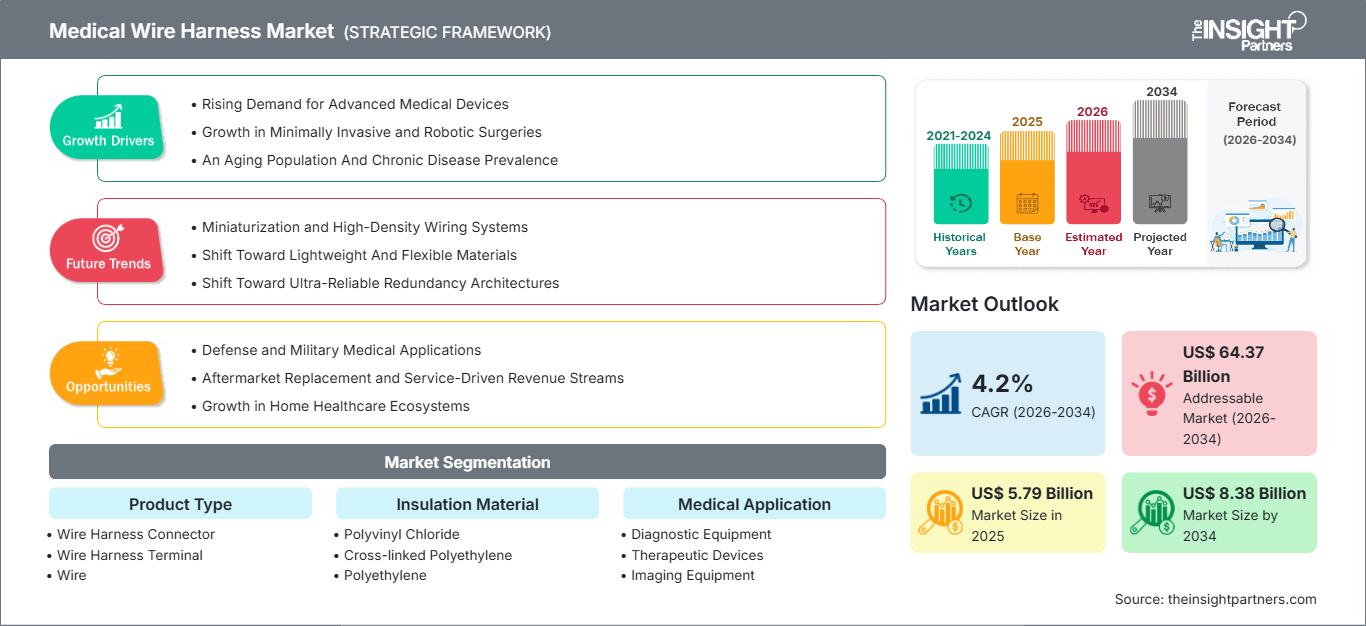
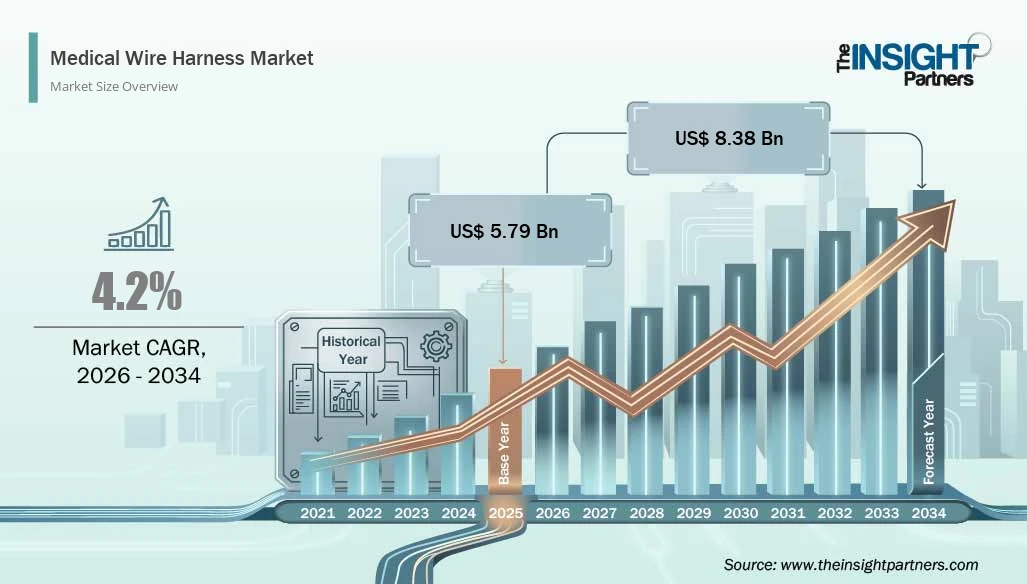
Medical Wire Harness Market was valued at US$ 5.79 billion in 2025 and is projected to reach US$ 8.38 billion by 2034, expanding at a CAGR of 4.2% during 2026–2034. The market reflects rising demand for safe power, signal, and data transmission across diagnostic equipment, therapeutic devices, imaging systems, medical control panels, and patient monitoring platforms.
North America remains a key demand center as hospitals, device OEMs, and contract manufacturers continue platform upgrades for imaging, monitoring, and surgical systems. The Medical Wire Harness Market size in the region is expected to expand at a 3.9-4.5%CAGR, supported by ISO 13485 manufacturing, FDA quality-system expectations, equipment replacement cycles, and higher use of patient-connected electronic devices.
Medical Wire Harness Market Assessment and Insights
- Asia Pacific dominated the market with 44.1% share in 2025.
- Asia Pacific is poised to grow at a CAGR of 4.7% over the forecast period.
- United States market is projected to grow at a CAGR of 4.5% over the forecast period.
- By Product Type, the Wire segment accounted for the largest market share of 51.9% in 2025.
- By Insulation Material, the Thermoplastic Elastomer (TPE) segment is anticipated to witness the fastest growth, registering a CAGR of 6.7% over the forecast period
- By Medical Application, the Imaging Equipment segment accounted for the largest market share of 29.5% in 2025.
- By Voltage Capacity, the High Voltage (More than 300V) segment is anticipated to witness the fastest growth, registering a CAGR of 5.8% over the forecast period
- By Conducting Material, the Copper segment accounted for the largest market share of 74.7% in 2025.
- By Sales Channel, the Aftermarket segment is anticipated to witness the fastest growth, registering a CAGR of 4.9% over the forecast period
- The report profiles key industry players such as Molex LLC, TE Connectivity Ltd, Aptiv Plc, Fujikura Ltd., Amphenol Corporation, Lapp Holding SE, Volex Plc, Nien-Yi Group, Kato Cable, Loganmex, while also analyzing key developments in novel ideas, disruptive products, and innovative services that could reshape the future market and reveal emerging themes across the industry.
Source: The Insight Partners' analysis based on proprietary research, government publications, company annual reports, investor presentations, industry databases, and expert interviews.
In terms of design evolution, there is an ongoing trend to develop medical harnesses not only as simple bundles but also as a validated subassembly that includes connections, shields, insulation, strain relief, and documentation. Increasingly, device OEMs will seek medical harnesses that include compact and low-noise wiring. In addition, production will increasingly move towards localization, clean-room production capabilities, and process control documentation, which will positively impact the Medical Wire Harness Market due to buyer preferences for reliability rather than sourcing.
Upcoming demand will be driven by the increasing proportion of older patients, increased chronic disease screening, decentralized care, and investment in domestic medical devices. Expectations of buyers with regard to material biocompatibility, sterilization compatibility, and electrical safety will drive the demand for validated materials and documentation. New geographies are likely to take up production share because multinationals will source more locally while maintaining their quality system in compliance with US, European, and Asian medical devices regulations.
Medical Wire Harness Market Report Scope
| Report Attribute | Details |
|---|---|
| Market size in 2025 | US$ 5.79 Billion |
| Market Size by 2034 | US$ 8.38 Billion |
| Global CAGR (2026 - 2034) | 4.2% |
| Historical Data | 2021-2024 |
| Forecast period | 2026-2034 |
Medical Wire Harness Market Analysis
Demand is increasing because medical devices now incorporate sensors, high-speed data lines, and more compact internal designs. Growth within the Medical Wire Harness Market is driven by diagnostic imaging systems, monitoring technologies, and therapy systems that require reliable signal integrity. WHO statistics on continuing burdens of noncommunicable diseases indicate that there will be ongoing use of these medical devices as hospitals adopt more digitization practices, increasing electrical interfaces per device.
The value chain consists of conductors, insulation compounds, connectors, cable assembly, laboratories for testing, contract manufacturing firms, and medical equipment original equipment manufacturers. The supply chain advantages firms that are able to integrate copper, optical fibers, EMI shielding, sterilizable jackets, and batch traceability into validated assemblies. Medical Wire Harness Market analysis indicates that qualification processes generate switching costs once the harness is qualified for a particular medical device.
Competition is divided between global interconnect leaders and application-focused harness specialists. Volex plc emphasizes vertically integrated medical manufacturing and ISO 13485 capability, Molex LLC brings Phillips-Medisize device-development expertise, TE Connectivity plc supports high-speed medical cable assemblies, and Amphenol Corporation supplies rugged connector platforms. Lapp Holding SE, Fujikura Ltd., Aptiv PLC, Nien-Yi Group, Kato Cable Co., Ltd., and Loganmex broaden sourcing options.
Investment is moving toward miniaturized connectors, high-voltage therapeutic interfaces, optical transmission, and localized assembly for medical OEMs seeking resilience. Suppliers with regulatory files, automated test data, and clean manufacturing can defend margins because qualification risk remains high. Strategic positioning depends on early design-in support, fast prototyping, documented validation, and the ability to support production transfers without compromising device approvals.
● REPORT CUSTOMIZATION
Tailor This Report To Align With Your Specific Business Requirements
This report can be customized to align precisely with your business objectives, scope, and target markets. Customization options include tailored segmentation, geography, competitive analysis, and strategic insights to support informed decision-making.
Customize This Report →WHAT YOU CAN ADJUST
- ● Segmentations
- ● Geography
- ● Competitive Analysis
- ● Language Preferences
Medical Wire Harness Market: Strategic Insights
Regional Insights
North America Medical Wire Harness Market
North America held 22-25%share in 2025 and is forecast to grow at a 3.9-4.5%CAGR during 2026–2034. The region benefits from large medical OEM clusters, regulated contract manufacturing, and recurring replacement demand in imaging, monitoring, and therapeutic equipment. Medical Wire Harness Market share is reinforced by FDA quality-system expectations and hospital technology refresh cycles.
Demand is high in places that need qualification loops to be short, engineers to collaborate, and production to be traceable. USMCA-related supply planning further aids the region’s assembly work for companies that shorten their logistics processes. Examples of companies with regional capabilities include Volex plc, Molex LLC, TE Connectivity plc, Amphenol Corporation, and Loganmex.
U.S. Medical Wire Harness Market Market
The US represented 65-69% of North America in 2025 and is projected to grow at a 3.9–4.3% CAGR from 2026–2034. Demand reflects domestic design activity in imaging equipment, patient monitoring, electrophysiology, respiratory care, and surgical platforms. OEMs prioritize suppliers able to document insulation performance, connector reliability, and sterilization compatibility.
The firm Molex LLC offers advanced medical cable assembly solutions via Phillips-Medisize, while TE Connectivity plc and Amphenol Corporation cater to high-performance interconnect solutions. The medical solution offered by Volex plc also caters to the need for imaging and patient connected devices. Current applications require the use of small harnesses for portable monitors and imaging.
Europe Medical Wire Harness Market Market
Europe accounted for 21–24% share in 2025 and is expected to grow at a 4.5–5.0% CAGR through 2034. Germany is the leading country because medical engineering, connector manufacturing, and export-oriented equipment production remain concentrated there. The UK supports demand through diagnostics modernization and clinical monitoring investments.
Hospital upgrades, imaging, and therapeutic devices will provide demand from France, Italy, and Spain. European Union’s medical device regulations place more documentation demands, favoring suppliers who use tested material, lot tracking, and manufacturing standards. Lapp Holding SE, TE Connectivity plc, Fujikura Ltd., and Amphenol Corporation supply cable, connectors, and assemblies to European OEMs.
APAC Medical Wire Harness Market Market
APAC held 42–35% share in 2025 and is expected to grow at a 4.3–4.8% CAGR during 2026–2034. China leads regional volume through medical-device manufacturing scale, while Japan and South Korea contribute high-reliability electronics, imaging, and precision cable know-how.
India and Australia support growth through hospital infrastructure, diagnostics access, and device localization policies. Regional policy emphasis on domestic medical manufacturing, combined with export-oriented electronics supply chains, favors suppliers that can meet international quality standards while offering cost-effective assembly, fast tooling, and responsive engineering support.
Middle East & Africa Medical Wire Harness Market Market
Middle East & Africa is projected to grow at a 5.2–5.8% CAGR during 2026–2034, led by Saudi Arabia and the UAE. Healthcare infrastructure projects, diagnostic center expansion, and tertiary hospital investments support demand for imaging, monitoring, and therapeutic systems using qualified harness assemblies.
South Africa and the rest of MEA add replacement demand as private healthcare networks upgrade equipment. Energy-funded public infrastructure and medical tourism strategies in Gulf markets increase procurement of advanced systems. Suppliers gain traction through distributor partnerships, service support, and OEM-approved replacement channels.
Segmentation Analysis
Product Type
Product Type is expected to grow at a 5.3–5.9% CAGR during 2026–2034. Connectors and terminals remain critical because medical equipment must maintain stable electrical contact under repeated movement, sterilization, vibration, and service access. The Medical Wire Harness Market scope also includes wires and specialty assemblies designed for signal clarity, flexibility, and compact device layouts.
- Wire Harness Connector holds strong strategic importance because connector density, secure mating, and sterilization durability directly influence device uptime, signal integrity, and serviceability in regulated equipment.
- Wire Harness Terminal demand is tied to reliable crimping, corrosion resistance, and low contact resistance, especially in monitoring, imaging, and therapeutic devices with repetitive electrical cycling.
- Wire remains the volume backbone, with selection shaped by conductor flexibility, insulation thickness, EMI control, and routing constraints inside compact medical equipment.
Insulation Material
Insulation Material is projected to grow at a 5.2–5.8% CAGR from 2026–2034. Material selection depends on dielectric strength, flexibility, flame behavior, sterilization tolerance, and chemical exposure. PVC remains common where cost and processing are important, while TPE, PU, and XLPE gain use in flexible, durable, or higher-performance medical equipment designs.
- Polyvinyl Chloride (PVC) remains widely used because it balances cost, availability, flame performance, and insulation reliability for mainstream diagnostic, monitoring, and control-panel wiring.
- Cross-linked Polyethylene (XLPE) supports higher thermal and electrical performance, making it relevant where durable insulation and stable dielectric behavior are required.
- Polyethylene (PE) is selected for low dielectric loss, chemical resistance, and lightweight designs in signal-sensitive applications requiring clean transmission.
- Polypropylene (PP) offers chemical resistance and fatigue performance, supporting harness designs exposed to repeated bending, cleaning agents, or compact routing.
- Polyurethane (PU) is valued for abrasion resistance and flexibility, especially in portable equipment, patient monitoring accessories, and moving assemblies.
- Thermoplastic Elastomer (TPE) supports soft-touch flexibility, sterilization compatibility, and ergonomic cable handling in patient-facing or clinician-operated medical devices.
Medical Application
Medical Application is forecast to grow at a 5.6–6.2% CAGR during 2026–2034. Diagnostic equipment leads value because high uptime, signal accuracy, and internal routing complexity are essential. Patient monitoring and therapeutic devices are gaining momentum as connected care, electrophysiology, respiratory therapy, and portable clinical systems require compact, safe, and traceable wiring assemblies.
- Diagnostic Equipment represents the largest revenue contribution because laboratories, hospitals, and clinics depend on reliable internal connectivity for analyzers, endoscopy systems, and test platforms.
- Therapeutic Devices require robust harnesses for power delivery, control feedback, and safety-critical operation in systems used for treatment, ablation, respiratory care, and infusion.
- Imaging Equipment depends on shielded and high-performance assemblies that preserve image data integrity across MRI, CT, ultrasound, and X-ray platforms.
- Medical Control Panel applications use harnesses to connect switches, displays, sensors, and power modules where ergonomic operation and serviceability are important.
- Patient Monitoring Devices are expanding as hospitals and home-care providers use connected systems that require flexible, compact, and durable signal pathways.
Voltage Capacity
Voltage Capacity is expected to grow at a 5.4–6.0% CAGR from 2026–2034. Low-voltage assemblies dominate monitoring and control circuits, while medium-voltage designs support imaging, diagnostic subsystems, and motorized device functions. High-voltage harnesses gain strategic value in therapeutic and electrophysiology applications where insulation clearance, safety validation, and connector performance are central purchasing criteria.
- Low Voltage (0 to 50V) serves monitoring, sensor, display, and control circuits where compact routing, flexibility, and stable low-power signal transmission are essential.
- Medium Voltage (50 to 300V) supports diagnostic and therapeutic subsystems needing stronger insulation, controlled routing, and dependable performance under repeated clinical duty cycles.
- High Voltage (More than 300V) is strategically important for specialized treatment systems, imaging support, and electrophysiology devices requiring validated clearance, shielding, and safety design.
Conducting Material
Conducting Material is projected to grow at a 5.3–5.9% CAGR during 2026–2034. Copper remains the dominant choice due to conductivity, availability, and proven medical-device performance. Aluminium is selected where weight and cost matter, while optical fiber is gaining importance in imaging, robotics, and data-intensive systems that require noise-resistant transmission.
- Copper remains the preferred conductor because it offers high conductivity, dependable crimping behavior, and broad compatibility with established connector and terminal systems.
- Aluminium is used selectively where weight reduction and cost control are important, although joining, oxidation, and durability requirements limit wider adoption.
- Optical Fiber is gaining strategic relevance for high-speed imaging, robotic surgery, and data-rich platforms where electromagnetic noise reduction is valuable.
Sales Channel
Sales Channel is expected to grow at a 5.1–5.7% CAGR from 2026–2034. OEMs account for most demand because harnesses are specified early in device design and validated before commercialization. Aftermarket demand remains important for replacement assemblies, service kits, and installed-base maintenance, especially in imaging, monitoring, and therapeutic equipment.
- OEMs dominate purchasing because device makers require validated assemblies, design collaboration, documentation, and production consistency before equipment platforms reach regulated markets.
- Aftermarket demand is supported by replacement wiring, repair kits, and service-channel needs as installed medical equipment ages and requires qualified components.
Opportunity Snapshot
| Medical Application | Revenue Contribution | Trend Tag | Adoption Stage |
| Diagnostic Equipment | High | Lab Automation | Mature |
| Therapeutic Devices | Medium | Precision Therapy | Scaling |
| Imaging Equipment | High | Signal Integrity | Mature |
| Medical Control Panel | Medium | Panel Integration | Scaling |
| Patient Monitoring Devices | Medium | Connected Care | Scaling |
| Others | Low | Custom Builds | Emerging |
Medical Wire Harness Market Growth Drivers and Impact Analysis
Rising complexity of connected medical equipment
Modern medical equipment combines power distribution, feedback from sensors, imaging technology, user interface, and networking capability into one unit. This creates a higher demand for harness assemblies that have controlled routing, protection, insulation uniformity, and reliable connectors. The importance of such an issue can be seen in patient monitors, robotic surgical equipment, laboratory analyzers, and electrophysiology units where any error in wiring can disrupt the workflow. Original Equipment Manufacturers tend to use companies capable of conducting design reviews, building prototypes, testing the product, and tracing the lots.
Regulated manufacturing raises supplier qualification barriers
There is strict quality expectation in the medical OEMs, leading to a slower and more document-driven supplier qualification process compared to many other industrial sectors. The harness manufacturers have to prove themselves in terms of repeatable crimp, insulation, connector testing, cleaning, and change management capabilities. The bottom line is that there is a high barrier of entry in the field for a supplier and once they are in the design, it is easy to retain them. There is no audit risk associated with having ISO 13485 processes and validated test data.
Equipment replacement and decentralized care expand demand
The healthcare industry is replacing old diagnosis and monitoring equipment, while at the same time increasing the amount of equipment used outside the hospital, in outpatient clinics, ambulatory care centers, and home care situations. In decentralized care delivery trends, equipment needs become more rigorous as the equipment needs to be lightweight, robust, and resistant to handling. This results in increased demand for assemblies which can withstand handling and cleaning. For manufacturers, this provides market opportunities apart from equipment used in hospitals, including portable ultrasound equipment, monitoring hubs, respiratory equipment, and small therapy equipment.
Medical Wire Harness Market Future Trends
Miniaturized high-density interconnect platforms
Trends in the Medical Wire Harness market will become more focused on interconnects that have a higher density of signals, voltage handling capability, reduced size of the devices while maintaining the level of safety. Devices like electrophysiology, endoscopic probes, imaging probes, and robotic tools will be shifting towards small assemblies with precisely arranged pins, shielding, and strain relief. This trend will encourage the suppliers to develop technologies related to micro-termination, inspection process automation, and materials resistant to sterilization. OEMs will prefer their partners to reduce the design cycle time and provide families of connectors.
Localized and traceable medical-device supply chains
The OEMs in the medical device industry will continue to expand manufacturing footprints without losing control over validation documentation and traceability. Assembly plants that are located close to clusters of devices may help to minimize logistical risks, to provide engineering flexibility, and to facilitate customer auditing. On the other hand, production records in electronic format, automation of test documentation, and linking the lot tracking system to ERP software will gain importance. Manufacturers that have the ability to manufacture globally and locally will be well-positioned for design transfer and dual sourcing.
Medical Wire Harness Market Opportunities
Design-in partnerships for imaging and diagnostics OEMs
OEMs in imaging/diagnostics provide great design-in opportunities due to the early specification and embedding of harness architecture throughout extended life cycles. The opportunity lies in helping OEMs with the electrical layout, shielding, connector choice, sterilization, and validation prior to going to market. This helps OEMs avoid any further redesign and also improves the chances of retaining suppliers. For those companies that have prototype centers, clean assembly, and testing, they can present themselves as partners in engineering rather than simply as cable makers.
Aftermarket service kits for regulated installed equipment
Once installed, medical devices create a recurring need for replacement wire harnesses and service kits. Hospitals and independent maintenance contractors require components that bring back performance capabilities without introducing any compliance issues. Manufacturers may establish aftermarket business through fitment, testing, serializing, and servicing through instructions. The projections for the Medical Wire Harness Market show that this route will gain relevance because imaging, monitoring, and therapeutic devices stay in use for a longer period of time. A company that uses OEM-qualified specifications and effective distribution system can achieve both objectives.
Recent Developments
- January 2026: TE Connectivity, a world leader in connectors and sensors, was a key player in the now-completed Next2OEM project funded by the German Federal Ministry for Economic Affairs and Energy (BMWE). As an innovation partner, TE contributed significantly to the further development of automated processes in wiring harness production. The project addressed the end-to-end automation of wiring systems along the entire value chain – from wiring harness production to installation in the vehicle.
- January 2026: LAPP Group, a global leader in the field of cable and connection technology, has acquired full ownership of JJ-LAPP. JJ-LAPP was an equal share joint venture between Jebsen & Jessen and LAPP, focused on the Southeast Asian markets. By the end of 2025, the companies will have completed the transaction for the remaining 50 percent of the company shares.
- November 2025: Volex is proud to announce the official opening of its new, state-of-the-art manufacturing facility in San Luis Potosí, marking a significant milestone in the company’s global growth journey. This strategic expansion not only strengthens Volex’s international footprint but also dramatically enhances its capabilities in consumer electrical and industrial HVAC manufacturing, including the production of custom wiring harnesses and cable assemblies.
Frequently Asked Questions

- Comprehensive Market Sizing and Forecast Analysis
- Detailed Segmentation Analysis
- In-Depth Market Dynamics Assessment
- Regional and Country-Level Insights
- Competitive Landscape and Company Benchmarking
- Strategic Business Intelligence
Recent Reports
Testimonials

The Insight Partners' SCADA System Market report is comprehensive, with valuable insights on current trends and future forecasts. The team was highly professional, responsive, and supportive throughout. We are very satisfied and highly recommend their services.
RAN KEDEM Partner, Reali Technologies LTDs
I requested a report on a very specific software market and the team produced the report in a few days. The information was very relevant and well presented. I then requested some changes and additions to the report. The team was again very responsive and I got the final report in less than a week.
JEAN-HERVE JENN Chairman, Future Analytica
We worked with The Insight Partners for an important market study and forecast. They gave us clear insights into opportunities and risks, which helped shape our plans. Their research was easy to use and based on solid data. It helped us make smart, confident decisions. We highly recommend them.
PIYUSH NAGPAL Sr. Vice President, High Beam Global
The Insight Partners delivered insightful, well-structured market research with strong domain expertise. Their team was professional and responsive throughout. The user-friendly website made accessing industry reports seamless. We highly recommend them for reliable, high-quality research services
YUKIHIKO ADACHI CEO, Deep Blue, LLC.
This is the first time I have purchased a market report from The Insight Partners.While I was unsure at first, I visited their web site and felt more comfortable to take the risk and purchase a market report.I am completely satisfied with the quality of the report and customer service. I had several questions and comments with the initial report, but after a couple of dialogs over email with their analyst I believe I have a report that I can use as input to our strategic planning process.Thank you so much for taking the extra time and making this a positive experience.I will definitely recommend your service to others and you will be my first call when we need further market data.
JOHN SUZUKI President and Chief Executive Officer, Board Director, BK Technologies
I wish to appreciate your support and the professionalism you displayed in the course of attending to my request for information regarding to infectious disease IVD market in Nigeria. I appreciate your patience, your guidance, and the fact that you were willing to offer a discount, which eventually made it possible for us to close a deal. I look forward to engaging The Insight Partners in the future, all thanks to the impression you have created in me as a result of this first encounter.
DR CHIJIOKE ONYIA MANAGING DIRECTOR, PineCrest Healthcare Ltd.Reason to Buy
- Informed Decision-Making
- Understanding Market Dynamics
- Competitive Analysis
- Identifying Emerging Markets
- Customer Insights
- Market Forecasts
- Risk Mitigation
- Boosting Operational Efficiency
- Strategic Planning
- Investment Justification
- Tracking Industry Innovations
- Aligning with Regulatory Trends





 Get Free Sample for