
Wire Harness Market Size, Growth & Demand by 2034
Coverage: By Product Type (Wire Harness Connector, Wire Harness Terminal, Wire, and Others), Insulation Material [Polyvinyl Chloride (PVC), Thermoplastic Elastomer (TPE), Polyurethane (PU), Polyethylene (PE), Cross-linked Polyethylene (XLPE), Polypropylene (PP), and Others], End User (Automotive, Industrial, Consumer Electronics, Energy & Power, Telecommunications, Aerospace & Defense, Medical, and Others), Voltage Capacity [Low Voltage (0 to 50V), Medium Voltage (50 to 300V), and High Voltage (More than 300V)], Conducting Material (Copper, Aluminium, Optical Fiber, and Others), Sales Channel (OEMs and Aftermarket), and Geography (North America, Europe, Asia Pacific, Middle East and Africa, and South and Central America)
- Status : Published
- Report Code : TIPRE00017188
- Category : Electronics and Semiconductor
- No. of Pages : 691
- Available Report Formats :


- Last update date : August 12, 2026


2025 Market Size
US$ 94.32 Bn
Base year value
2034 Forecast
US$ 151.76 Bn
Projected by 2034
CAGR 2026-2034
5.4 %
Growth rate
Addressable Market
US$ 1,114.41 Bn
(2026-2034)
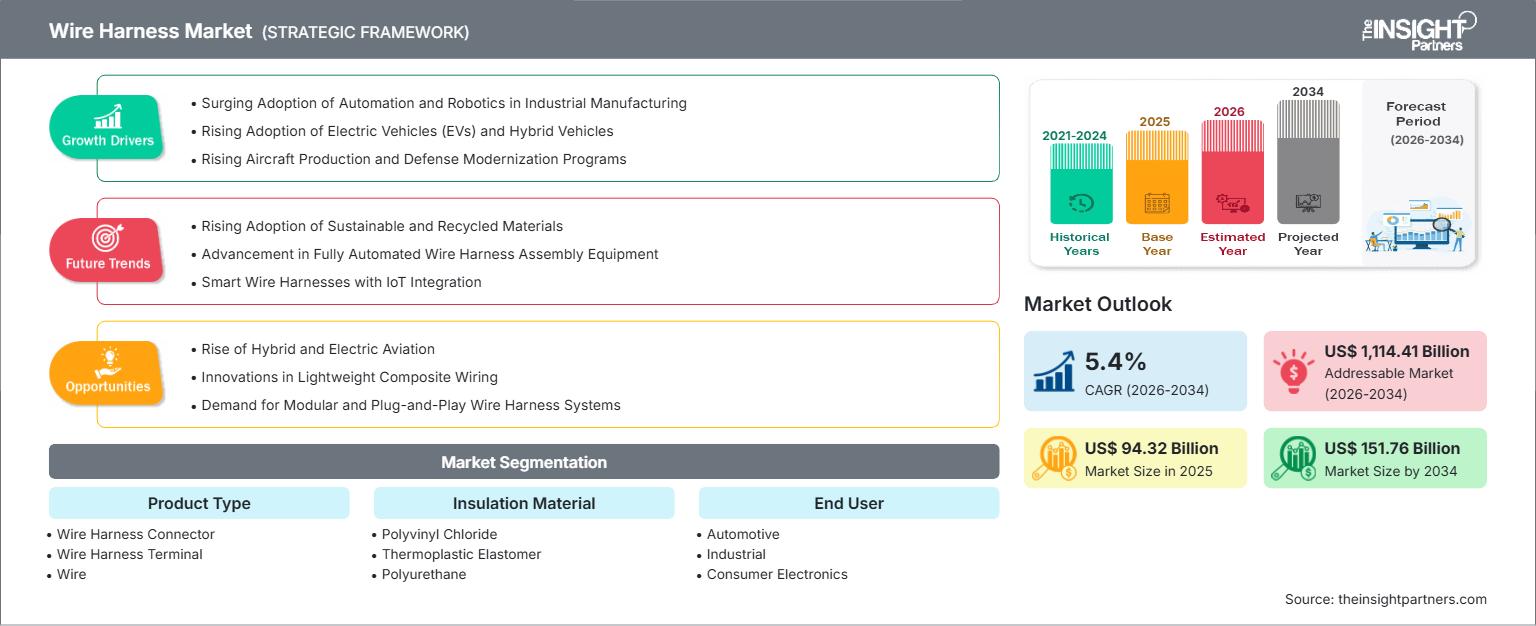
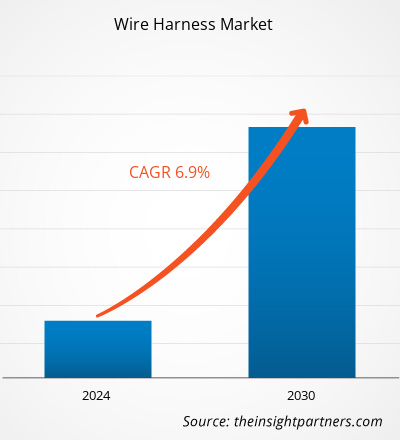
The Wire Harness Market was valued at US$ 94,316.19 Million in 2025 and is projected to reach US$ 151,755.83 Million by 2034, expanding at a CAGR of 5.4% during 2026–2034. The market reflects rising demand for organized electrical wiring assemblies that transmit power and signals across vehicles, industrial machinery, electronics, energy infrastructure, telecommunications equipment, aerospace systems, and medical devices.
The Wire Harness Market size is supported by vehicle electrification, industrial automation, renewable energy deployment, 5G infrastructure, and rising electronic content across end-use industries. Suppliers are competing on lightweight design, connector reliability, insulation performance, regional manufacturing depth, and the ability to support OEMs and aftermarket customers with customized harness assemblies.
Wire Harness Market Assessment and Insights
- North America held a 23.43% share in 2025 and is growing at a CAGR of 5.4% between 2026–2034, driven by Class 8 fleet renewal, trailer telematics, and premium light-truck demand.
- The US accounted for 67.94% of North America in 2025 and is growing at a 5.7% CAGR between 2026 and 2034, supported by long-haul trucking and luxury SUV platforms.
- Europe accounted for 22.78% share in 2025 and is growing at a CAGR of 4.9% between 2026 and 2034, led by Germany, the UK, France, Italy, and Spain.
- Asia Pacific captured 44.13% share in 2025 and is growing at a CAGR of 6.0% between 2026 and 2034, with China, Japan, South Korea, and India leading volume adoption.
- Largest Segment Wire held 51.88% market share in 2025 and is growing at a CAGR of 6.2% between 2026 and 2034.
- The High Growth Segment, Telecommunications, held a 7.31% market share in 2025 and is growing at a 8.0% CAGR between 2026 and 2034.
- Key companies analyzed in detail: DRÄXLMAIER Group, Fujikura Ltd., Lear Corp, Sumitomo Electric Industries Ltd, LEONI AG, Yazaki Corp, Furukawa Electric Co Ltd, Samvardhana Motherson International Limited (SAMIL), Nexans SA, TE Connectivity Ltd, Aptiv Plc, Amphenol Corporation, Safran SA, Collins Aerospace, and Kromberg & Schubert Automotive GmbH & Co. KG.
Source: The Insight Partners' analysis based on proprietary research, government publications, company annual reports, investor presentations, industry databases, and expert interviews.
Technology migration is influencing how OEMs define wire harness architecture. Traditional wire harness architectures are now being enhanced by the use of high-density connectors, improved terminal technology, high-performance insulation systems, and reduced routing to accommodate higher electrical and data loads. Dynamics in manufacturing are also shifting towards modules that meet the needs of automotive, industrial control, consumer electronics, telecommunications equipment, medical equipment, and power systems, using standard parts.
Electric vehicles, advanced driver assistance systems, factory automation, renewable energy plants, connected products, and high-speed communications will drive future demand. Suppliers with expertise in materials science, connector design, testing services, and global manufacturing will prefer higher voltages, harsh environments, and lighter, safer wiring systems.
Wire Harness Market Report Scope
| Report Attribute | Details |
|---|---|
| Market size in 2025 | US$ 94.32 Billion |
| Market Size by 2034 | US$ 151.76 Billion |
| Global CAGR (2026 - 2034) | 5.4% |
| Historical Data | 2021-2024 |
| Forecast period | 2026-2034 |
Wire Harness Market Analysis
The demand is increasing due to the ease of installation, fewer wiring mistakes, conductor protection, and increased system reliability in electrical applications. The Wire Harness Market growth depends on the increase in electronic components used in vehicles, automation machinery, consumer goods, telecommunications, medical electronics, and energy infrastructure.
The value chain consists of conductor companies, connector firms, terminal makers, insulation materials companies, wire harness assembly firms, testing machine firms, and original equipment manufacturers. The assembly process for the parts is critical, as customers require lightweight, safe assemblies that withstand vibrations, moisture, temperature changes, chemicals, and limited space.
The industry's positioning is based on engineering, localization, certification, and proximity to major OEM projects. Yazaki Corp, Sumitomo Electric Industries Ltd, Lear Corp, LEONI AG, Fujikura Ltd, Furukawa Electric Co Ltd, DRÄXLMAIER Group, and SAMIL operate in the automotive wiring industry. On the other hand, TE Connectivity Ltd, Aptiv Plc, Amphenol Corporation, Nexans SA, Safran SA, Collins Aerospace, and Kromberg & Schubert Automotive GmbH & Co KG have a presence in the broad interconnect and specialty-harness markets.
Funding goes to high-voltage harnesses, lightweight conductors, automation of the crimp process, sealant connectors, fiber-optic usage, and digital design tools to reduce design cycles. Winning platforms, scalability in production, testing, supply chain reliability, and the ability to satisfy the demands of OEM and aftermarket customers across different fields of application provide a strategic advantage in the industry.
● REPORT CUSTOMIZATION
Tailor This Report To Align With Your Specific Business Requirements
This report can be customized to align precisely with your business objectives, scope, and target markets. Customization options include tailored segmentation, geography, competitive analysis, and strategic insights to support informed decision-making.
Customize This Report →WHAT YOU CAN ADJUST
- ● Segmentations
- ● Geography
- ● Competitive Analysis
- ● Language Preferences
Wire Harness Market: Strategic Insights
Regional Insights
North America Wire Harness Market
The North America wire harness market share is driven by demand generated by the automotive industry's shift towards electrification, aerospace & defense applications, automation, healthcare, infrastructure, and telecom.
Customer demand for OEMs that provide high-quality, reliable harnesses and replacements is high where wiring density is high, there is a need for safety validation, and uptime expectations are high. Regional presence and capabilities to design and manufacture products quickly are essential for such customers.
U.S. Wire Harness Market
The markets in the United States are focused on electrical mobility, electronics for commercial vehicles, defense systems, medical instruments, data systems, industrial control systems, and renewable energy systems. The demand is for high-reliability wiring assemblies in which installation efficiency, connection quality, and insulation quality directly impact system performance.
TE Connectivity Ltd, Aptiv Plc, Amphenol Corporation, Lear Corp, and Collins Aerospace have regional significance for their applications in the automotive, aerospace, industrial, and interconnect sectors.
Europe Wire Harness Market
Europe is endowed with strong capabilities in automotive platforms, industrial automation, aerospace engineering, medical equipment, energy solutions, and quality standards. Countries such as Germany, France, the UK, Italy, and Spain stimulate demand by producing automobiles, components, aircraft, and advanced manufacturing infrastructure.
Some companies that enhance the region’s supplier base include DRÄXLMAIER Group, LEONI AG, Kromberg & Schubert Automotive GmbH & Co. KG, Nexans SA, Safran SA, and TE Connectivity Ltd. Europe’s demand prioritizes proven assemblies, lightweight construction, HV compatibility, and production quality assurance.
APAC Wire Harness Market
APAC continues to be an important region for both production and consumption of cable harnesses, driven by automotive manufacturing, electronics assembly, telecommunication infrastructure, industrial automation, and green energy. The Chinese, Japanese, Korean, Indian, and Southeast Asian markets support the demand from OEMs and the manufacture of exportable cable harnesses.
Yazaki Corporation, Sumitomo Electric Industries Limited, Fujikura Limited, Furukawa Electric Co Ltd., and SAMIL provide regional scale and scope. Factors driving growth include EV production, consumer electronics exports, industrial equipment production, and the localization of wire harnesses to reduce costs and risks.
Segmentation Analysis
Product Type<
Product Type segmentation includes wire harness connectors, wire harness terminals, wire, and other products. Electrical load, signal integrity, space constraints, vibration exposure, assembly complexity, and end-use reliability requirements shape product demand.
- Wire Harness Connector demand is driven by secure mating, sealing, vibration resistance, miniaturization, and compatibility with high-voltage or high-speed signal applications.
- Wire Harness Terminal demand depends on contact reliability, plating quality, crimp strength, corrosion resistance, and low electrical resistance across a long service life.
- Wire remains the core conductor category, with selection influenced by current capacity, flexibility, temperature rating, weight, and routing requirements.
- Others include protective sleeves, clips, tapes, grommets, junction components, and supporting accessories that improve installation, protection, and serviceability.
Insulation Material
Insulation Material choices determine durability, flexibility, flame resistance, temperature performance, chemical resistance, and cost. Material selection varies by application environment, voltage requirement, regulatory compliance, and lifecycle reliability expectations.
- Polyvinyl Chloride (PVC) is widely used where cost efficiency, flexibility, and general-purpose insulation performance are required.
- Thermoplastic Elastomer (TPE) is well-suited to applications requiring flexibility, abrasion resistance, and improved performance under repeated bending or movement.
- Polyurethane (PU) offers strong abrasion resistance and durability for industrial, robotic, and harsh operating environments.
- Polyethylene (PE) provides electrical insulation and moisture resistance for selected power and signal applications.
- Cross-linked Polyethylene (XLPE) is preferred for higher temperature, chemical, and electrical performance requirements.
- Polypropylene (PP) meets lightweight insulation needs and can be used in applications requiring chemical resistance and dimensional stability.
- Others include specialty compounds designed for flame retardancy, low-smoke, halogen-free performance, and extreme environmental exposure.
End User
End-user demand spans automotive, industrial, consumer electronics, energy and power, telecommunications, aerospace and defense, medical, and other applications. Each end user requires different levels of customization, certification, environmental protection, and production scale.
- Automotive remains a major demand center due to vehicle electrification, ADAS, infotainment, lighting, power distribution, and body electronics.
- Industrial demand is supported by factory automation, robotics, control panels, machinery, and ruggedized equipment wiring.
- Consumer Electronics requires compact, lightweight, and reliable harnesses for appliances, devices, displays, and connected hardware.
- Energy & Power applications include renewable energy systems, power distribution equipment, battery systems, and grid-related installations.
- Telecommunications demand is linked to 5G infrastructure, data centers, network equipment, and high-density power and signal routing.
- Aerospace & defense requires high-reliability assemblies that meet stringent weight, safety, shielding, and environmental standards.
- Medical applications require precision, traceability, cleanliness, and reliable signal transmission in diagnostic and therapeutic equipment.
- Others include construction equipment, agricultural equipment, marine systems, and specialty electrical assemblies.
Voltage Capacity
Voltage capacity segmentation includes Low Voltage (0 to 50V), Medium Voltage (50 to 300V), and High Voltage (More than 300V). The required voltage rating depends on the application, power transmission needs, insulation requirements, safety standards, and operating environment.
- Low Voltage (0 to 50V) is widely used in consumer electronics, automotive body electronics, communication devices, medical equipment, and low-power industrial control systems.
- Medium Voltage (50 to 300V) is commonly used in industrial machinery, automation systems, commercial equipment, renewable energy installations, and hybrid electric vehicle applications that require moderate power transmission.
- High Voltage (More than 300V) is primarily utilized in electric vehicles, battery packs, charging infrastructure, aerospace, energy storage systems, heavy industrial equipment, and power distribution applications where efficient high-power transmission is essential.
Conducting Material
Conducting material segmentation includes Copper, Aluminum, Optical Fiber, and Other materials. Material selection depends on electrical conductivity, weight, flexibility, corrosion resistance, mechanical strength, cost, and application-specific performance requirements.
- Copper is the most widely used conductor due to its excellent electrical conductivity, durability, flexibility, and reliability across automotive, industrial, aerospace, medical, and consumer electronics applications.
- Aluminum is preferred in weight-sensitive applications because of its lower density and cost, making it suitable for electric vehicles, aerospace, renewable energy, and power distribution systems.
- Optical Fiber is used for high-speed data transmission and electromagnetic interference immunity in telecommunications, automotive networking, aerospace, defense, and data center applications.
- Others include specialty conductor materials, alloy-based conductors, and hybrid cable constructions designed to meet specific performance, environmental, or high-temperature requirements.
Sales Channel
Sales channel segmentation includes OEMs and Aftermarket. Distribution strategies vary based on production volumes, replacement demand, customization requirements, and long-term service needs.
- OEMs represent the largest sales channel, supplying wire harnesses directly to original equipment manufacturers for integration into new vehicles, industrial machinery, aerospace systems, medical devices, consumer electronics, and energy equipment.
- Aftermarket demand is driven by replacement, repair, maintenance, retrofitting, performance upgrades, and customization of existing electrical systems across automotive, industrial, commercial, agricultural, and specialty equipment applications.
Opportunity Snapshot
| End User | Demand Signal | Trend Tag | Adoption Stage |
| Automotive | High | Electrification | Scaling |
| Industrial | Medium to High | Automation | Scaling |
| Telecommunications | High | 5G Infrastructure | Expanding |
| Aerospace & Defense | High Value | Reliability | Specialized |
Wire Harness Market Growth Drivers and Impact Analysis
Vehicle electrification and rising electronic content
EVs, hybrids, ADAS, infotainment, battery management, lighting systems, sensing technologies, and connectivity have been adding to the wiring density of each car. Wire harness assemblies ensure the organization of power and signal distribution, improving assembly efficiency and serviceability. In practice, there is increased use of high-voltage harnesses, lightweight wires, sealed connectors, and terminals that withstand heat, vibration, and packaging conditions.
Industrial automation and connected infrastructure
Industrial facilities, logistics operations, telecommunications equipment, data centers, renewable generation facilities, and smart infrastructure installations need proper cable installation and protection of electric assemblies. With the rise of sensor technologies, it has become necessary to address the needs of power distribution, signal integrity, electromagnetic compatibility, and fast installation. Thus, there is a growing demand for modular wire harness assemblies, durable insulation, fiber optics, and tested assemblies.
Quality, safety, and supply chain localization
Since wire harness failures can cause an entire product to malfunction, OEMs and system integrators expect greater traceability, testing, and quality. Reduced lead time and reduced logistics risk make localized manufacturing an attractive proposition, particularly for automotive, aerospace, medical, and energy clients. A combination of automation in crimping processes, testing, material certification, and regional manufacturing can increase confidence and justify the price.
Wire Harness Market Future Trends
High-voltage and lightweight harness architectures
Wire Harness Market trends will increasingly center on high-voltage architectures for electric mobility, battery storage, charging systems, and power electronics. Light-weighting will become increasingly significant as OEMs attempt to reduce weight and increase efficiency. While copper is critical, aluminum, optical fibers, and hybrid conductors will receive attention due to weight, bandwidth requirements, and cost-reduction considerations.
Digital design, testing, and modular production
It is anticipated that the suppliers will use technologies such as harness design software, crimp force monitoring, vision inspection, and electrical testing to minimize defects and accelerate development. The modular production platform may be used for multiple applications across the automotive, telecommunications, and energy industries, using standardized connectors, terminals, and insulation families.
Wire Harness Market Opportunities
OEM partnerships for electrified and connected platforms
Suppliers may gain additional benefits by collaborating with OEMs on EV platforms, automation systems, aircraft reconfiguration, telecommunications products, and medical applications. It will be beneficial for providing more input during the design process regarding routing, connector choices, voltage separation, shielding, and servicing. By providing engineering services, prototypes, testing, and local production, suppliers may increase switching costs and long-cycle platform revenues.
Aftermarket replacement and regional assembly expansion
As vehicles, industrial machines, telecom towers, and energy sources age and require wiring assemblies to be replaced, the need for aftermarket services is growing. Having regional assembly centers can help shorten lead times and accommodate low-volume custom needs that might not be possible for large global projects.
Recent Developments
- December 2025: Molex, a global electronics leader and connectivity innovator, introduces MX-DaSH Modular Wire-to-Wire Connectors, the newest additions to its award-winning MX-DaSH family of data-signal hybrid connectors that unify power, signal, and high-speed data connectivity in a single connector system. MX-DaSH Modular connectors utilize multiple, versatile cartridges incorporated into a single housing system to simplify wiring and harness architecture while improving automotive design flexibility, adaptability, and scalability across multiple vehicle models and applications.
- October 2025: TE Connectivity (TE), a global leader in connectors and sensors, introduces its inside device connectivity portfolio designed to support the evolving needs of automotive electronic control units (ECUs) and next-generation vehicle platforms, including software defined vehicles. The portfolio includes board-to-board, wire-to-board, flex-to-board, and wire-to-wire connector solutions, purpose-built for compact, high-performance applications.
- April 2025: Smiths Interconnect, a leading provider of electronic components, subsystems, microwave, optical, and radio-frequency products, is delighted to announce the expansion of its cable harness production capacity at its facility in Tunisia. The investment in growth will support all of the company's EMEA production sites.
Frequently Asked Questions

- Comprehensive Market Sizing and Forecast Analysis
- Detailed Segmentation Analysis
- In-Depth Market Dynamics Assessment
- Regional and Country-Level Insights
- Competitive Landscape and Company Benchmarking
- Strategic Business Intelligence
Recent Reports
Testimonials

The Insight Partners' SCADA System Market report is comprehensive, with valuable insights on current trends and future forecasts. The team was highly professional, responsive, and supportive throughout. We are very satisfied and highly recommend their services.
RAN KEDEM Partner, Reali Technologies LTDs
I requested a report on a very specific software market and the team produced the report in a few days. The information was very relevant and well presented. I then requested some changes and additions to the report. The team was again very responsive and I got the final report in less than a week.
JEAN-HERVE JENN Chairman, Future Analytica
We worked with The Insight Partners for an important market study and forecast. They gave us clear insights into opportunities and risks, which helped shape our plans. Their research was easy to use and based on solid data. It helped us make smart, confident decisions. We highly recommend them.
PIYUSH NAGPAL Sr. Vice President, High Beam Global
The Insight Partners delivered insightful, well-structured market research with strong domain expertise. Their team was professional and responsive throughout. The user-friendly website made accessing industry reports seamless. We highly recommend them for reliable, high-quality research services
YUKIHIKO ADACHI CEO, Deep Blue, LLC.
This is the first time I have purchased a market report from The Insight Partners.While I was unsure at first, I visited their web site and felt more comfortable to take the risk and purchase a market report.I am completely satisfied with the quality of the report and customer service. I had several questions and comments with the initial report, but after a couple of dialogs over email with their analyst I believe I have a report that I can use as input to our strategic planning process.Thank you so much for taking the extra time and making this a positive experience.I will definitely recommend your service to others and you will be my first call when we need further market data.
JOHN SUZUKI President and Chief Executive Officer, Board Director, BK Technologies
I wish to appreciate your support and the professionalism you displayed in the course of attending to my request for information regarding to infectious disease IVD market in Nigeria. I appreciate your patience, your guidance, and the fact that you were willing to offer a discount, which eventually made it possible for us to close a deal. I look forward to engaging The Insight Partners in the future, all thanks to the impression you have created in me as a result of this first encounter.
DR CHIJIOKE ONYIA MANAGING DIRECTOR, PineCrest Healthcare Ltd.Reason to Buy
- Informed Decision-Making
- Understanding Market Dynamics
- Competitive Analysis
- Identifying Emerging Markets
- Customer Insights
- Market Forecasts
- Risk Mitigation
- Boosting Operational Efficiency
- Strategic Planning
- Investment Justification
- Tracking Industry Innovations
- Aligning with Regulatory Trends





 Get Free Sample for