
SQUID Sensors Market Size, Share & Trends by 2034
Coverage: By Type (Low-Temperature SQUID and High-Temperature SQUID), Sensor Type (SQUID Current Sensors, SQUID Magnetometer, and Superconducting Switch), Operating Principle (DC SQUID and RF SQUID), End-use Industry (Healthcare and Medical, Industrial and Manufacturing, Research and Academia, Geoscience and Environmental Monitoring, Defense and Aerospace, and Others) and Geography (North America, Europe, Asia Pacific, Middle East and Africa, and South and Central America)
- Status : Published
- Report Code : TIPRE00043684
- Category : Electronics and Semiconductor
- No. of Pages : 271
- Available Report Formats :


- Last update date : August 14, 2026


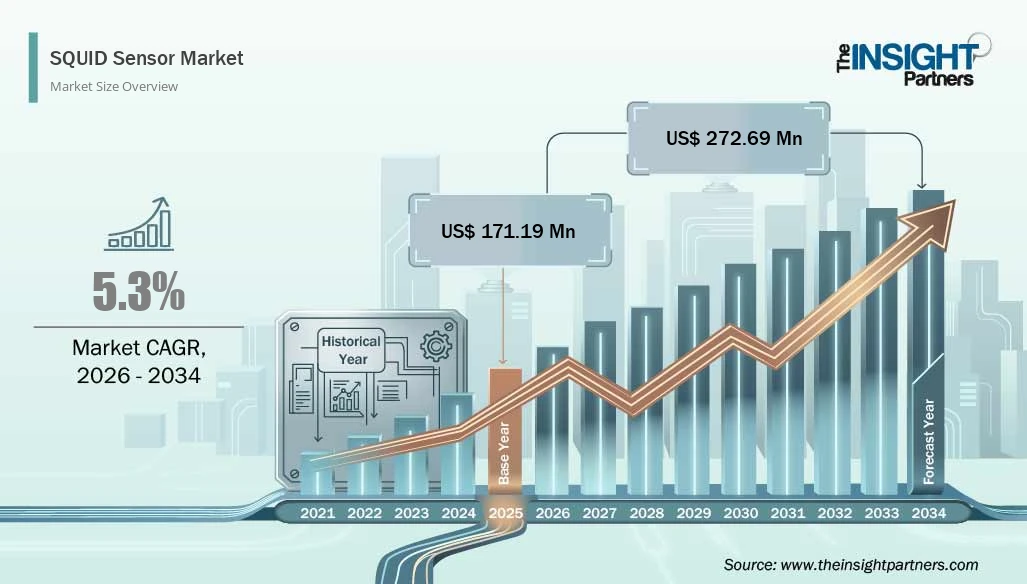
2025 Market Size
US$ 171.19 Mn
Base year value
2034 Forecast
US$ 272.69 Mn
Projected by 2034
CAGR 2026-2034
5.3 %
Growth rate
Addressable Market
US$ 2,012.41 Mn
(2026-2034)
The SQUID Sensors Market was valued at US$ 171.19 million in 2025 and is projected to reach US$ 272.69 million by 2034, registering a CAGR of 5.3% during the forecast period from 2026 to 2034. The market includes superconducting quantum interference device technologies used for ultra-sensitive magnetic field detection across healthcare, research, industrial, defense, and environmental monitoring applications requiring high precision measurement capabilities.
Increasing adoption of advanced sensing technologies is influencing the SQUID Sensors Market size, particularly across North America due to investments in biomedical diagnostics, quantum research infrastructure, and industrial measurement systems. The region benefits from established superconducting research capabilities, academic collaborations, and demand for highly sensitive detection platforms in healthcare and scientific applications.
SQUID Sensors Market Assessment and Insights
- North America holds a significant position with an estimated share of 35.45% in 2025 and is growing at a CAGR of 5.1% between 2026–2034. The region benefits from advanced research facilities, healthcare technology adoption, and quantum sensing investments.
- US represents the largest contributor within North America, accounting for 86.25% share in 2025 and expanding at a CAGR of 5.4% between 2026–2034. Growth is supported by defense research, medical imaging applications, and academic programs.
- Europe accounts for an estimated share of 25.00% in 2025 and is projected to grow at a CAGR of 4.5% during 2026–2034. Germany, the UK, and France are key markets supported by superconductivity research and industrial innovation.
- Asia Pacific represents approximately 29.98% share in 2025 and is expected to expand at a CAGR of 6.8% between 2026–2034. China, Japan, South Korea, and India are contributing through research investments and semiconductor development.
- Largest Segment: Healthcare and Medical end-use industry segment represents the largest segment with a market share of 35.36% in 2025 and CAGR of 6.3% between 2026–2034 due to diagnostic and neuroscience applications.
- High Growth Segment: High-Temperature SQUID segment represents the fastest-growing segment with a market share of 34.46% in 2025 and CAGR of 7.1% between 2026–2034 due to reduced cooling requirements and expanding industrial adoption.
- Key companies analyzed in detail: Quantum Design, Magnicon GmbH, Tristan Technologies, STAR Cryoelectronics, ezSQUID, Supracon AG, Cryogenic Ltd, Specialise Instruments, Ambature, and MagQu.
Source: The Insight Partners' analysis based on proprietary research, government publications, company annual reports, investor presentations, industry databases, and expert interviews.
The SQUID Sensors Market is undergoing transformation due to technological innovations in superconducting materials, cryogenics, and electronics design. The companies operating in the market are currently concentrating on boosting the performance of sensors, simplifying the construction of systems based on them, and creating new approaches to their cooling. Both low-temperature and high-temperature SQUID devices will become more suitable for particular applications, while the combination of the devices with electronic processing systems will enhance the accuracy of measurements. At the same time, research centers and industries remain influential customers of SQUID sensors.
Investments into quantum computing, biomedical research, and industrial control systems are expected to boost the growth of the SQUID Sensors Market in the future. New opportunities in emerging economies in the Asia Pacific region will emerge due to innovations in research facilities and technologies. The funding of scientific programs by governments, innovation in healthcare, and investment into defense technologies will also help to generate demand for superconducting sensors.
SQUID Sensors Market Report Scope
| Report Attribute | Details |
|---|---|
| Market size in 2025 | US$ 171.19 Million |
| Market Size by 2034 | US$ 272.69 Million |
| Global CAGR (2026 - 2034) | 5.3% |
| Historical Data | 2021-2024 |
| Forecast period | 2026-2034 |
SQUID Sensors Market Analysis
Key Drivers of Growth in the SQUID Sensors Market can be associated with the increasing demand for magnetic measurement instruments that surpass conventional technologies in terms of sensitivity. These devices are used for various applications, including biomagnetic measurements, material analysis, and geophysical measurements. Growing investments in sophisticated scientific equipment encourage the use of SQUIDs for research and industrial purposes.
Companies, research centers, and other entities using SQUIDs form the SQUID Sensors Market ecosystem. The supply of these sensors is affected by changes in the sphere of superconductors manufacturing and cooling, development of new fabrication technologies, and others. Manufacturers are working on enhancing performance of the sensors and minimizing complexity of operations related to their application.
Competitive Dynamics in the SQUID Sensors Market are characterized by the involvement of specialized technological providers possessing experience in the sphere of superconductors and precise instrumentation. Companies such as Quantum Design, Magnicon GmbH, Tristan Technologies, STAR Cryoelectronics enhance their position via development of innovative sensors. Key strategic focus areas include optimization of measurement performance, diversification of application range, and improvement of integration.
Trends of Investments in SQUID Sensors Market analysis include research in quantum sensing, development of technologies for health care sector, and creation of industrial monitoring equipment. The key players include such providers as ezSQUID, Supracon AG, Cryogenic Ltd, Specialise Instruments, Ambature, MagQu, and others. They contribute to market diversity via developing special-purpose products and researching.
● REPORT CUSTOMIZATION
Tailor This Report To Align With Your Specific Business Requirements
This report can be customized to align precisely with your business objectives, scope, and target markets. Customization options include tailored segmentation, geography, competitive analysis, and strategic insights to support informed decision-making.
Customize This Report →WHAT YOU CAN ADJUST
- ● Segmentations
- ● Geography
- ● Competitive Analysis
- ● Language Preferences
SQUID Sensors Market: Strategic Insights
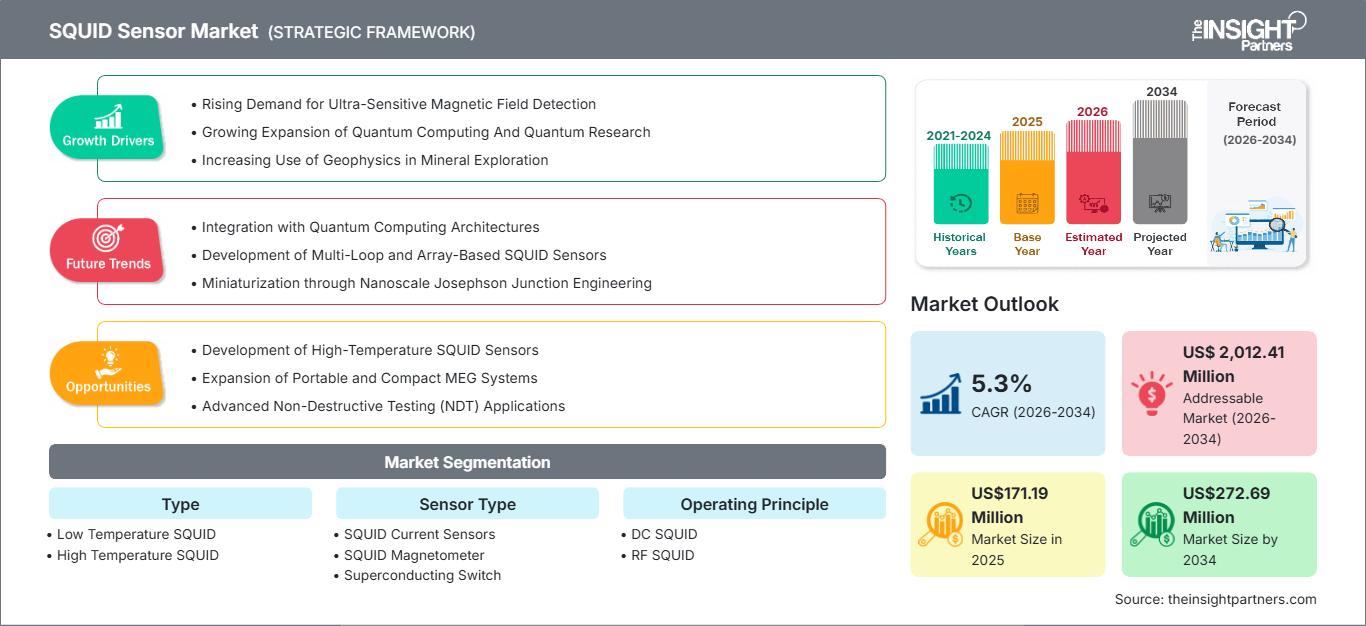
Regional Insights
North America SQUID Sensors Market
North America represents the leading regional market for SQUID Sensors Market adoption, accounting for an estimated 35.45% in 2025 and is growing at a CAGR of 5.1% between 2026–2034. The region benefits from strong research infrastructure, advanced healthcare systems, and continued investment in quantum technology development.
U.S. SQUID Sensors Market
The U.S. SQUID Sensors Market accounts for approximately 86.25% share in 2025 and expanding at a CAGR of 5.4% between 2026–2034. The country benefits from strong presence of research institutions, technology companies, and defense organizations developing advanced sensing capabilities.
Companies including Quantum Design, Tristan Technologies, and STAR Cryoelectronics maintain market presence through specialized superconducting measurement solutions. Application trends include biomagnetic research, quantum sensing experiments, and industrial inspection systems. Federal research funding and academic collaborations continue supporting innovation in superconducting sensor technologies.
Europe SQUID Sensors Market
Europe represents a major contributor to the SQUID Sensors Market, accounting for an estimated 25.00% in 2025 and is projected to grow at a CAGR of 4.5% during 2026–2034. The region benefits from established superconductivity research programs, advanced scientific infrastructure, and strong collaboration between universities and technology developers.
The United Kingdom maintains a significant position through investments in quantum research, medical technology development, and academic innovation. Germany contributes through industrial research capabilities, precision engineering expertise, and applications in scientific instrumentation. France, Italy, and Spain are expanding adoption through research institutions, healthcare innovation programs, and industrial measurement applications, supporting regional demand for highly sensitive magnetic sensors.
APAC SQUID Sensors Market
The APAC SQUID Sensors Market represents an estimated 29.98% share in 2025 and is expected to expand at a CAGR of 6.8% between 2026–2034. China leads regional growth through investments in quantum technology research, advanced manufacturing, and scientific infrastructure development.
Japan, South Korea, India, and Australia are contributing through academic research programs, semiconductor innovation, and healthcare technology advancement. Government initiatives supporting scientific capabilities and industrial modernization are creating demand for superconducting measurement systems. Expanding research activities and increasing adoption of precision sensing technologies are expected to support regional development.
Middle East & Africa SQUID Sensors Market
The Middle East & Africa SQUID Sensors Market is projected to grow at a CAGR of 3.3% between 2026–2034, supported by investments in scientific infrastructure, healthcare development, and advanced monitoring technologies. Saudi Arabia represents an emerging market due to research investments and technology diversification initiatives.
The UAE is adopting advanced scientific technologies through healthcare and research infrastructure development, while South Africa contributes through academic research and environmental monitoring applications. Rest of MEA markets remain at an early adoption stage but offer opportunities through expanding research capabilities, energy-sector applications, and industrial modernization programs.
Segmentation Analysis
Type
The Type segment includes Low-Temperature SQUID and High-Temperature SQUID. The High Temperature segment is expected to grow at a CAGR of 7.1% between 2026–2034. Adoption patterns are influenced by sensitivity requirements, cooling infrastructure availability, and application-specific performance needs. High-temperature solutions are gaining attention due to simplified operational requirements.
- Low-temperature SQUID sensors remain important for applications requiring maximum sensitivity and measurement accuracy. These systems are widely used in advanced scientific research, biomagnetic applications, and laboratories requiring extremely precise magnetic field detection capabilities.
- High-temperature SQUID sensors are gaining adoption due to reduced cooling complexity and improved operational accessibility. They support broader deployment in industrial monitoring, research applications, and environments requiring practical superconducting sensing solutions.
Sensor Type
The Sensor Type segment includes SQUID Current Sensors, SQUID Magnetometer, and Superconducting Switch. The Superconducting Switch segment is projected to grow at a CAGR of 6.5% between 2026–2034, supported by expanding use cases across medical, industrial, and scientific applications. Increasing demand for precision measurement continues influencing product development.
- SQUID current sensors support highly accurate electrical measurement applications. They are used in research environments and industrial systems requiring precise current monitoring, contributing to improved measurement capabilities and advanced instrumentation development.
- SQUID magnetometers represent a critical application area due to their exceptional magnetic field sensitivity. They are widely utilized in biomagnetic research, geoscience studies, and scientific experiments requiring accurate magnetic measurements.
- Superconducting switches enable specialized applications requiring rapid and reliable switching performance. Their importance is increasing within research systems and advanced electronic applications involving superconducting circuits and measurement technologies.
Operating Principle
The Operating Principle segment consists of DC SQUID and RF SQUID. The RF SQUID segment is expected to expand at a CAGR of 6.8% between 2026–2034. Technology selection depends on sensitivity requirements, system design preferences, and application-specific measurement conditions. Both principles continue supporting advanced sensing applications.
- DC SQUID technology is widely adopted for applications requiring high sensitivity and continuous magnetic measurement. It supports medical research, scientific instrumentation, and industrial applications where stable and precise sensing performance is required.
- RF SQUID technology provides simplified system configurations for selected measurement applications. It continues supporting research environments and specialized sensing systems where operational flexibility and integration requirements are important.
End-use Industry
The End-use Industry segment includes Healthcare and Medical, Industrial and Manufacturing, Research and Academia, Geoscience and Environmental Monitoring, Defense and Aerospace, and Others. The Healthcare and medical segment is projected to grow at a CAGR of 6.3% between 2026–2034. The SQUID Sensors Market scope continues expanding as organizations explore superconducting technologies for advanced detection and monitoring applications.
- Healthcare and medical applications represent the largest demand area, supported by biomagnetic measurement, neuroscience research, and diagnostic technology development. SQUID systems enable highly sensitive detection capabilities in advanced medical research environments.
- Industrial applications use SQUID sensors for precision inspection, material analysis, and advanced process monitoring. Adoption is supported by increasing requirements for accurate measurement technologies in manufacturing environments.
- Geoscience applications utilize SQUID sensors for magnetic field studies, geological analysis, and environmental research. These systems support accurate measurement in scientific monitoring activities
- Defense and aerospace organizations apply SQUID technology in advanced sensing and research programs. Demand is influenced by requirements for sensitive detection systems and specialized measurement capabilities.
- Other applications include specialized technology fields requiring superconducting measurement solutions. These uses contribute to market diversification through emerging research and industrial applications.
Opportunity Snapshot
| Industry Vertical | Revenue Contribution | Trend Tag | Adoption Stage |
| Healthcare and Medical | High | Biomagnetic Imaging | Scaling |
| Industrial and Manufacturing | Medium | Precision Testing | Scaling |
| Research and Academia | High | Quantum Research | Mature |
| Geoscience and Environmental Monitoring | Medium | Field Monitoring | Emerging |
| Defense and Aerospace | Medium | Advanced Detection | Emerging |
SQUID Sensors Market Growth Drivers and Impact Analysis
Growing Demand for Ultra-Sensitive Magnetic Measurement
The growing need for extremely precise magnetic field measurement is facilitating the use of superconducting sensors in several industries. Medical investigations, quantum science studies, and material science researches call for measurement tools that surpass the capacities of ordinary devices. Superconducting sensors are highly sensitive instruments that enable scientists and industries to conduct accurate measurements of weak magnetic fields. The results can be seen in medical neuroscience researches, scientific equipment, and industrial inspection operations. As companies strive to attain higher levels of measurement accuracy, there will be a growing need for advanced measurement technologies.
Expansion of Quantum Technology Research Programs
Research in quantum technology by both governmental organizations and private organizations has created a platform that allows for the implementation of superconducting sensors. SQUIDs are widely used in quantum measurement systems and scientific experiments where there is a need for control of magnetic environments. The research programs being undertaken on the continents of North America, Europe, and Asia Pacific have increased the need for specific superconducting instruments. The universities, laboratories, and companies have been working in collaboration to improve the quantum technology and its application. Such an environment encourages product innovation and improvement in superconducting material along with application fields.
Advancement of Medical Diagnostic Applications
The development of technology used in medicine has increased the interest of the development of sensitive magnetic detection systems to be applied in such cases as the detection of the brain activity and biomagnetic study. SQUID detectors help researchers to detect the weak magnetic fields produced by biology to be used in neurological research and diagnosis. The development of healthcare research infrastructure and the need for non-invasive techniques of measurement are helping in this case. Hospitals, universities and special laboratories are developing the new sensing technologies to have a better understanding of biology.
SQUID Sensors Market Future Trends
Integration with Quantum Computing and Advanced Measurement Systems
The SQUID Sensors Market will be impacted more and more by integration with quantum computing systems and high-level measuring tools. It can be anticipated that further improvements will be concentrated on the enhancement of the sensors’ ability to be compatible with quantum machines, cryostat systems, and novel scientific devices. Manufacturers will pay attention to development of small-sized construction, better signal processing systems, and efficiency. Innovations related to superconducting sensing can be stimulated due to cooperation of research centers and tech companies. This progress might lead to application of sensors not only in laboratories but also in commercial premises where exact magnetic measurements are required.
Development of Compact and Energy-Efficient Superconducting Sensors
The future of innovation of products should be towards miniaturization and simplification of cooling processes alongside energy savings. SQUID devices have always been complicated by the cryogenics used, offering room for improvement in terms of manufacturing of more viable equipment. The ongoing efforts have mainly been geared towards the development of high-temperature superconductors and minimizing the hurdles faced. Smaller sensors will make them more accessible in applications such as monitoring in industries, research in health care, and field work. Improvements in fabrication methods and superconducting materials may ensure that there is scalability without compromising on measurement precision.
SQUID Sensors Market Opportunities
Expansion of Healthcare and Biomedical Research Applications
Both healthcare and biomedical research fields offer substantial possibilities given increasing demands for non-invasive measurements and advanced diagnostics. One should consider the applications in neuroscience, biomagnetic imaging, and physiological research among others for investors and developers of technologies. The growth of the research facilities in medical science in developing countries is an additional area that offers further possibilities for implementation of advanced sensors. SQUID Sensors Market Forecasts show that there will be substantial possibilities related to innovations in the field of healthcare and especially research institutes looking for advanced sensors for sophisticated biological measurements.
Growth Potential in Industrial Monitoring and Scientific Infrastructure
There are ample opportunities for companies working towards developing their own superconducting sensors for specific applications from industrial monitoring and scientific instrumentation. The growing interest in precise manufacturing processes, environmental studies, and physics laboratories is increasing the need for measuring devices. Vendors can concentrate on technologies that tackle the complexities of the process and enhance the accessibility of the systems. There are other market opportunities through the growing research activities in Asia Pacific and the Middle East region. There are ample opportunities to collaborate with academic institutions, government labs, and industry players to expedite the adoption process.
Recent Developments
- June 2026: Quantum Design International has completed the acquisition of Qnami, a pioneer in diamond-based quantum sensing technologies. The acquisition expands Quantum Design’s portfolio in the rapidly growing quantum technology sector and strengthens its capabilities in supporting researchers and industrial customers working in quantum materials, spintronics, nanomagnetism, semiconductor research, and advanced device characterization.
- April 2026: Chinese researchers unveiled a gravity detector with world-leading precision last month, potentially broadening the military applications of the technology. The device employs a superconducting quantum interference device (SQUID) to detect objects by measuring extremely small variations in gravitational fields. According to the research team, the instrument can be applied to scientific investigations and underground resource exploration. The development also moves China closer to the capability of detecting patrolling nuclear submarines.
- Feb 2025: Quantum Design has introduced the QDM.IO, a desktop magnetic imaging system that delivers SQUID-level sensitivity while using nitrogen-vacancy (NV) centers embedded in a diamond chip. Unlike conventional NV-based microscopes that scan a single point, the QDM.IO captures magnetic field distributions across a larger area simultaneously, enabling high-sensitivity and vector magnetic field measurements. The system is designed for applications in materials science, photovoltaics, electronics, paleomagnetism, and biomagnetism.
Frequently Asked Questions

- Comprehensive Market Sizing and Forecast Analysis
- Detailed Segmentation Analysis
- In-Depth Market Dynamics Assessment
- Regional and Country-Level Insights
- Competitive Landscape and Company Benchmarking
- Strategic Business Intelligence
Recent Reports
Testimonials

The Insight Partners' SCADA System Market report is comprehensive, with valuable insights on current trends and future forecasts. The team was highly professional, responsive, and supportive throughout. We are very satisfied and highly recommend their services.
RAN KEDEM Partner, Reali Technologies LTDs
I requested a report on a very specific software market and the team produced the report in a few days. The information was very relevant and well presented. I then requested some changes and additions to the report. The team was again very responsive and I got the final report in less than a week.
JEAN-HERVE JENN Chairman, Future Analytica
We worked with The Insight Partners for an important market study and forecast. They gave us clear insights into opportunities and risks, which helped shape our plans. Their research was easy to use and based on solid data. It helped us make smart, confident decisions. We highly recommend them.
PIYUSH NAGPAL Sr. Vice President, High Beam Global
The Insight Partners delivered insightful, well-structured market research with strong domain expertise. Their team was professional and responsive throughout. The user-friendly website made accessing industry reports seamless. We highly recommend them for reliable, high-quality research services
YUKIHIKO ADACHI CEO, Deep Blue, LLC.
This is the first time I have purchased a market report from The Insight Partners.While I was unsure at first, I visited their web site and felt more comfortable to take the risk and purchase a market report.I am completely satisfied with the quality of the report and customer service. I had several questions and comments with the initial report, but after a couple of dialogs over email with their analyst I believe I have a report that I can use as input to our strategic planning process.Thank you so much for taking the extra time and making this a positive experience.I will definitely recommend your service to others and you will be my first call when we need further market data.
JOHN SUZUKI President and Chief Executive Officer, Board Director, BK Technologies
I wish to appreciate your support and the professionalism you displayed in the course of attending to my request for information regarding to infectious disease IVD market in Nigeria. I appreciate your patience, your guidance, and the fact that you were willing to offer a discount, which eventually made it possible for us to close a deal. I look forward to engaging The Insight Partners in the future, all thanks to the impression you have created in me as a result of this first encounter.
DR CHIJIOKE ONYIA MANAGING DIRECTOR, PineCrest Healthcare Ltd.Reason to Buy
- Informed Decision-Making
- Understanding Market Dynamics
- Competitive Analysis
- Identifying Emerging Markets
- Customer Insights
- Market Forecasts
- Risk Mitigation
- Boosting Operational Efficiency
- Strategic Planning
- Investment Justification
- Tracking Industry Innovations
- Aligning with Regulatory Trends





 Get Free Sample for