
Automated Sortation System Market Size, Trends & Demand by 2034
Coverage: By Type (Linear Sortation, Loop Sortation); End-Use Industry (Retail and E-commerce, Food and Beverages, Transportation and Logistics, Pharmaceutical, Others), and Geography (North America, Europe, Asia Pacific, and South and Central America)
- Status : Data Released
- Report Code : TIPRE00014070
- Category : Electronics and Semiconductor
- No. of Pages : 150
- Available Report Formats :


- Last update date : July 17, 2026


2025 Market Size
US$ 10.37 Bn
Base year value
2034 Forecast
US$ 21.96 Bn
Projected by 2034
CAGR 2026-2034
8.69 %
Growth rate
Addressable Market
US$ 144.87 Bn
(2026-2034)
The Automated Sortation System Market was valued at US$ 10.37 Billion in 2025 and is projected to reach US$ 21.96 Billion by 2034, growing at a CAGR of 8.69% from 2026 to 2034. The market reflects accelerating investment in high-speed routing, identification, induction, and diverting technologies across retail fulfillment, parcel hubs, food distribution, pharmaceutical logistics, and transport networks.
Across North America, automation spending is shifting toward systems that handle higher parcel variability, tighter delivery windows, and scarce warehouse labor. The Automated Sortation System Market size in the region is supported by fulfillment center upgrades, domestic logistics investment, and airport cargo modernization, with modeled expansion expected at 7.9%–9.9% during 2026–2034 as operators standardize modular line and loop sorters.
Automated Sortation System Market Assessment and Insights
- North America held 29%–33% share in 2025 and is expected to grow at a CAGR of 7.9%–9.9% between 2026–2034, supported by parcel hub modernization, omnichannel retail, and labor-constrained warehouse operations.
- US represented 80%–85% of North America in 2025 and is projected to grow at a CAGR of 8.1%–10.1% between 2026–2034, led by e-commerce, parcel, grocery, and pharma networks.
- Europe accounted for 23%–27% share in 2025 and is forecast to grow at a CAGR of 7.2%–9.2% between 2026–2034, with Germany, the UK, France, Italy, and Spain leading automation programs.
- Asia Pacific held 31%–35% share in 2025 and is projected to grow at a CAGR of 9.8%–11.8% between 2026–2034, supported by China, Japan, South Korea, India, and Australia.
- Largest Segment Linear Sortation held a market share of 55%–60% in 2025 and is expected to grow at a CAGR of 7.6%–9.6% between 2026–2034.
- High Growth Segment Loop Sortation held a market share of 40%–45% in 2025 and is expected to grow at a CAGR of 9.2%–11.2% between 2026–2034.
- Key companies analyzed in detail: Bastian Solutions, LLC, BEUMER Group GmbH & Co. KG, Daifuku Co., Ltd., Dematic GmbH, Honeywell Intelligrated, Interroll Holding AG, KNAPP AG, Murata Machinery, Ltd., Siemens AG, and TGW Logistics Group GmbH.
Source: The Insight Partners' analysis based on proprietary research, government publications, company annual reports, investor presentations, industry databases, and expert interviews.
The market has moved from conveyor-led routing to software-directed, sensor-rich sortation architectures. Earlier systems primarily separated cartons by lane, while current installations combine machine vision, barcode and RFID capture, induction balancing, predictive maintenance, and warehouse execution software. Production dynamics are also changing as suppliers standardize modules, localize fabrication, and design systems for mixed cartons, polybags, totes, irregular parcels, and regulated goods moving through dense distribution networks.
Future adoption will be shaped by trade volatility, e-commerce returns, airport cargo digitization, and investment in regional fulfillment nodes. Emerging geographies are prioritizing scalable systems that can start with line sorters and progress toward loop sortation as parcel complexity rises. Regulatory expectations for traceability, product safety, and cold-chain control will strengthen demand in pharmaceuticals, food, and cross-border logistics.
Automated Sortation System Market Report Scope
| Report Attribute | Details |
|---|---|
| Market size in 2025 | US$ 10.37 Billion |
| Market Size by 2034 | US$ 21.96 Billion |
| Global CAGR (2026 - 2034) | 8.69% |
| Historical Data | 2021-2024 |
| Forecast period | 2026-2034 |
Automated Sortation System Market Analysis
Demand is expanding as retailers, parcel carriers, grocery networks, and third-party logistics providers redesign facilities around smaller orders, higher return rates, and narrower carrier cut-off times. Automated Sortation System Market growth is strongest where systems improve route accuracy, reduce manual touches, and raise peak throughput without proportional labor additions. IATA’s 2025 air cargo facility roadmap also highlights automation, visibility, robotics, and connected infrastructure as core enablers for cargo resilience.
The ecosystem includes sorter manufacturers, controls vendors, machine vision providers, induction equipment suppliers, warehouse execution software developers, integrators, maintenance teams, and data analytics specialists. Supply dynamics favor modular platforms, standardized controls, remote diagnostics, and local service capacity. Buyers increasingly evaluate uptime guarantees, item handling range, software openness, energy consumption, commissioning risk, and integration with warehouse management systems.
The competitive landscape blends global intralogistics leaders with sortation specialists and industrial automation providers. Bastian Solutions, LLC, BEUMER Group GmbH & Co. KG, Daifuku Co., Ltd., Dematic GmbH, Honeywell Intelligrated, Interroll Holding AG, KNAPP AG, Murata Machinery, Ltd., Siemens AG, and TGW Logistics Group GmbH compete through engineering capability, installed base, software depth, throughput performance, and lifecycle service reach.
Investment priorities are shifting toward flexible induction, robotic loading, cross-belt and tilt-tray systems, digital twins, and predictive maintenance. Automated Sortation System Market analysis increasingly measures payback through fewer misroutes, reduced rework, higher dock-door utilization, improved labor planning, and lower downtime. Strategic positioning depends on proving facility-level outcomes rather than only equipment speed, especially in brownfield logistics environments.
● REPORT CUSTOMIZATION
Tailor This Report To Align With Your Specific Business Requirements
This report can be customized to align precisely with your business objectives, scope, and target markets. Customization options include tailored segmentation, geography, competitive analysis, and strategic insights to support informed decision-making.
Customize This Report →WHAT YOU CAN ADJUST
- ● Segmentations
- ● Geography
- ● Competitive Analysis
- ● Language Preferences
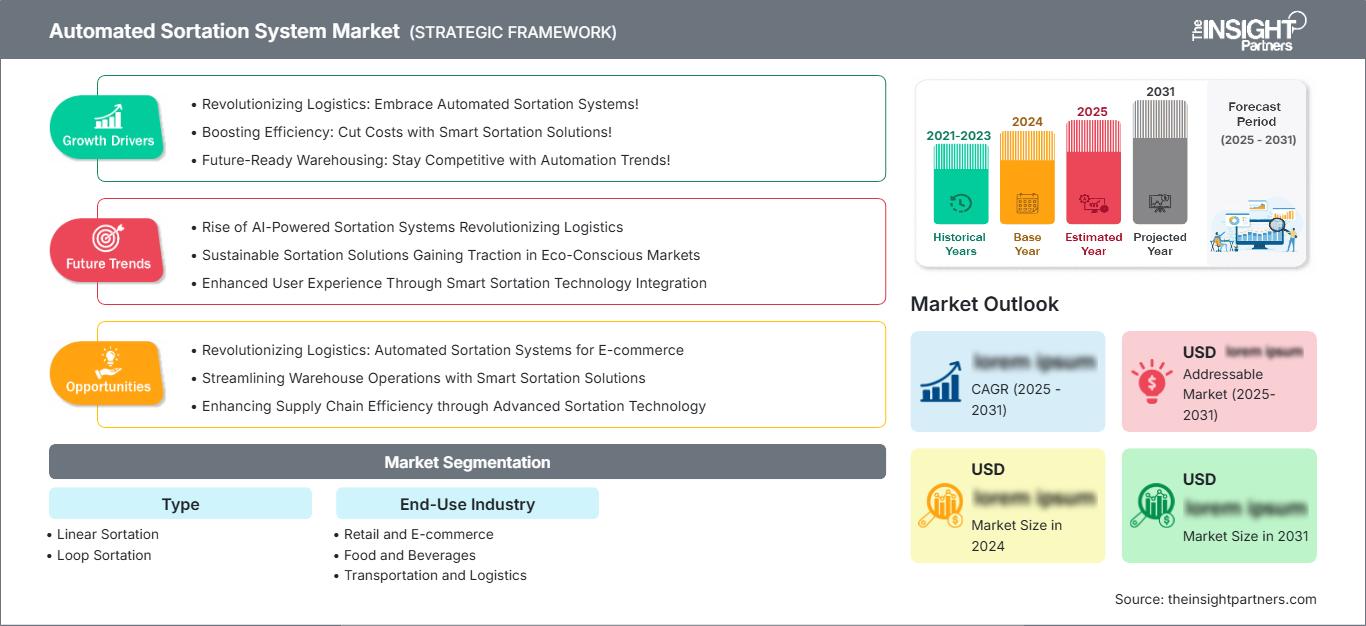
Automated Sortation System Market: Strategic Insights
Regional Insights
North America Automated Sortation System Market
North America holds an estimated 29%–33% share in 2025 and is forecast to grow at 7.9%–9.9% through 2034. The Automated Sortation System Market share is reinforced by high parcel density, omnichannel fulfillment, airport cargo modernization, and labor scarcity. Operators prioritize modular sorters, automated induction, image-based identification, and software that balances carrier cut-offs with facility throughput.
Regional demand is strongest in the United States, followed by Canada and Mexico. Logistics providers are replacing manual diverting with automated line and loop systems to improve shipment accuracy and reduce peak-season congestion. Daifuku Co., Ltd. expanded U.S. production for conveyors and sorters in 2025, indicating supplier confidence in North American automation requirements.
U.S. Automated Sortation System Market Market
The U.S. represents 80%–85% of North American demand in 2025 and is projected to expand at 8.1%–10.1%. Large retail fulfillment centers, parcel hubs, grocery distribution sites, airport cargo terminals, and pharmaceutical networks use sortation to manage order volatility. Application trends include shoe sorters, cross-belt sorters, robotic induction, irregular parcel handling, and software-led wave planning.
Company presence is broad through Bastian Solutions, LLC, Daifuku Co., Ltd., Dematic GmbH, Honeywell Intelligrated, and TGW Logistics Group GmbH. Demand is also shaped by labor retention challenges, high warehouse rents, and service-level commitments. U.S. buyers increasingly require systems that handle cartons, flats, polybags, totes, and irregular parcels within one integrated control environment.
Europe Automated Sortation System Market Market
Europe accounts for 23%–27% share in 2025 and is expected to grow at 7.2%–9.2%. Germany leads due to parcel automation, automotive logistics, machinery exports, and pharmaceutical distribution. The UK invests in e-commerce, grocery fulfillment, and returns handling, while France supports adoption through food, luxury retail, airport, and healthcare logistics.
Italy and Spain contribute through fashion logistics, ports, food processing, and regional distribution centers. European buyers emphasize energy efficiency, machinery safety, data traceability, and compact footprints because many facilities are space constrained. BEUMER Group GmbH & Co. KG, Interroll Holding AG, KNAPP AG, Siemens AG, and TGW Logistics Group GmbH support regional projects with engineering and service networks.
APAC Automated Sortation System Market Market
APAC holds 31%–35% share in 2025 and is projected to grow at 9.8%–11.8%. China leads in e-commerce, electronics, clothing, and manufacturing logistics. In Japan and South Korea, automation and robots prevail, along with speed. India and Australia, however, develop through warehouse facilities, express delivery, and cold chain logistics.
Government policies and incentives for logistics park infrastructure, industrial corridors, cargo infrastructure at airports, and digital manufacturing encourage the adoption of solutions in the region. The large players, such as Murata Machinery, Ltd., Daifuku Co., Ltd., Dematic GmbH, and KNAPP AG, and regional systems integrators, compete on efficiency. Higher regional trade and returns logistics drive even more automation needs.
Middle East & Africa Automated Sortation System Market Market
Middle East & Africa is projected to grow at 7.5%–9.5%, with the UAE taking the lead in deployment in the short term through its airports, free zones, and regional e-commerce centers. Saudi Arabia is building logistics infrastructure as part of its diversification efforts, while South Africa is encouraging selective automation in retail, pharmaceuticals, food, and parcel delivery.
Energy-related infrastructure development, port development, customs reform, and cold chain logistics determine the growth prospects for this region. The adoption of AMR is project-dependent due to varying levels of financing, maintenance, and system integration across countries. Growth in the rest of MEA is expected to occur in third-party logistics, airport logistics, healthcare logistics, and high-value consumer goods.
Segmentation Analysis
Type
Type is projected to grow at 8.3%–10.3% during 2026–2034. Automated Sortation System Market scope includes systems designed around facility footprint, item profile, routing complexity, and throughput intensity. Linear systems remain dominant in predictable carton flows, while loop architectures gain relevance where retailers and parcel operators need dense destination coverage, higher induction flexibility, and better handling of mixed parcel formats.
- Linear Sortation remains widely adopted because it fits parcel hubs, warehouses, and distribution centers requiring straightforward routing, easier maintenance, and dependable throughput across cartons, totes, and packaged goods.
- Loop Sortation is strategically important for high-destination environments because cross-belt and tilt-tray configurations support dense routing, recirculation, and careful handling of irregular or high-value products.
End-Use Industry
End-Use Industry is forecast to grow at 8.6%–10.6% during 2026–2034. Retail and e-commerce generate high deployment intensity because order cycles are compressed and returns are complex. Food and beverages require reliable flow and hygiene-aware handling. Transportation and logistics prioritize hub throughput, while pharmaceutical operators value traceability, temperature discipline, and minimized manual intervention.
- Retail and E-commerce leads adoption because fulfillment centers need rapid routing, returns processing, carrier sorting, and flexible handling of cartons, polybags, apparel, electronics, and small consumer goods.
- Food and Beverages uses sortation to improve case movement, cold-chain accuracy, batch separation, and distribution speed where freshness, traceability, and order reliability directly influence service performance.
- Transportation and Logistics relies on automated sorters in parcel, airport cargo, courier, express, and cross-dock hubs to manage destination density, peak volumes, and service-level commitments.
- Pharmaceutical adoption is driven by traceability, regulated distribution, temperature-sensitive shipments, controlled handling, and the need to reduce manual errors in healthcare logistics networks.
Opportunity Snapshot
| End-Use Industry | Revenue Contribution | Trend Tag | Adoption Stage |
| Retail and E-commerce | High | Returns Flow | Mature |
| Food and Beverages | Medium | Cold Routing | Scaling |
| Transportation and Logistics | High | Hub Speed | Mature |
| Pharmaceutical | Medium | Traceable Care | Scaling |
Automated Sortation System Market Growth Drivers and Impact Analysis
E-Commerce Fulfillment Pressure Raises Sortation Throughput
Online retailing has transformed the economics of warehousing through higher order frequency, greater SKU scatter, and higher return rates. Routing technology allows warehouses to sort items to packing stations, carrier lanes, store replenishment, and return logistics facilities without proportionately increasing staffing costs. This may be measured by fewer misroutes, reduced time spent in inventory, increased speed at which items are loaded onto the truck at the dock, and increased cut-off compliance. The need for technology that sorts cartons, soft goods, and even irregularly shaped items is another challenge facing retailers. As delivery promises tighten, automated routing becomes a service-level requirement rather than only a productivity tool.
Labor Constraints Strengthen Automation Payback
For warehousing and logistics organizations, there is an ongoing challenge in recruiting staff for physically demanding and peak-dependent sorting jobs. Automation decreases manual scanning, lifting, walking, and lane assignment, enabling employees to concentrate on exception processing, quality assurance, maintenance, and supervisory duties. This becomes crucial in areas with high labor costs, an aging labor force, or seasonal peaks. Automation also helps create safe procedures by reducing congestion near the chutes and docks. Payback increases when the sorting process is combined with labor management and ergonomics.
Traceability and Compliance Expand Regulated Applications
The logistics industry for food, beverages, medicines, and health care requires greater traceability of movement, batches, temperature conditions, and delivery routes. Sorting enhances compliance by correlating identification information with actual processes. The importance of sorting does not rely solely on time, as the company can prove ownership, identify anomalies, and process more sensitive cargo. In addition, WHO recommendations and food safety requirements require traceable movement of products. Thus, suppliers who offer sorting, sensors, software, and reporting may meet regulated processes.
Automated Sortation System Market Future Trends
AI-Orchestrated Sortation Becomes Operationally Mainstream
Automated Sortation System Market trends will increasingly center on AI-assisted routing, dynamic induction control, predictive maintenance, and real-time exception handling. The next-generation systems won’t focus only on routing packages more quickly; they will also be trained to identify congestion patterns, carrier delays, the types of goods transported, chute utilization, and labor constraints. The digital twin will enable the operator to experiment with new layouts, high-traffic scenarios, and scheduled maintenance without disrupting normal operations. The trend benefits companies with strong software and control expertise. Sortation intelligence will be seen as an improvement tool for service reliability and energy efficiency.
Robotic Induction Extends Sorter Utilization
There will be growth in robotic induction to meet the need for more consistent feed rates, ergonomic safety, and efficient utilization of sorting machines. The next level of induction cells will integrate visioning, picking, separation, and classification systems that will process mixed-parcel flows with minimal human input. It is particularly pertinent for e-commerce, fashion, pharma, and parcel operations because products come in ever-changing formats. Vendor differentiation will depend on their ability to offer integrated cell solutions, safety certification, and connectivity with warehouse management software systems.
Automated Sortation System Market Opportunities
Brownfield Logistics Upgrades Create Modular Demand
Numerous warehouses, sorting facilities, and food distribution centers do not have the luxury of taking their facilities offline for comprehensive redesign, thereby making way for modular solutions. Suppliers can focus on plug-and-play linear sorters, loop sorters, induction automation, scanners, control upgrades, and analytical layering for implementation in an existing facility. Automated Sortation System Market Forecasts call for capital allocation to phased implementations, with the initial step being to eliminate the bottleneck, followed by increasing destination density and the software's smarts. The most promising applications are those with increased order variability, reduced floor space, and a high cost of misrouting.
Airport Cargo and Pharmaceutical Networks Need Traceable Flow
Air cargo terminals and pharmaceutical distribution facilities represent lucrative business cases due to their requirement for fast processing, security, document handling, and care in handling. The 2025 vision by IATA for air cargo facilities highlights the need for connected, automated, and smart facilities that go hand in hand with sortation solutions that provide visibility and asset optimization. Pharmaceuticals will need routing processes that enable batch and temperature handling and provide evidence of compliance. The investments should be in sortation systems with scanning, weighing, dimensioning, and exception-handling facilities. Companies may create their competitive advantage by providing mechanical robustness, software reporting, validation services, and other logistics functions.
Recent Developments
- April 2026: Honeywell Intelligrated introduced Momentum Core software and the IntelliSort Irregulars Sorter, designed to improve automation visibility, agility, and irregular parcel processing. The sorter handles size, weight, and shape variability and processes 3,000–5,000 irregular parcels per hour, supporting logistics and e-commerce operations seeking predictable performance.
- September 2025: Daifuku Co., Ltd. completed expansion of Daifuku Intralogistics America Corporation’s Hobart, Indiana plant. The US$35 million project doubled production capacity for conveyors, sorters, and other material handling systems, supporting North American logistics and manufacturing automation demand driven by labor shortages and rising operating costs.
- January 2025: BEUMER Group GmbH & Co. KG announced new intralogistics solutions for LogiMAT 2025, including the BG Pouch System with AutoDrop and robotic induction for sorting systems. The launch targeted automated order fulfillment, reduced manual loading, optimized space use, and better data-driven customer support for e-commerce and distribution environments.
Frequently Asked Questions

- Comprehensive Market Sizing and Forecast Analysis
- Detailed Segmentation Analysis
- In-Depth Market Dynamics Assessment
- Regional and Country-Level Insights
- Competitive Landscape and Company Benchmarking
- Strategic Business Intelligence
Recent Reports
Testimonials

The Insight Partners provided valuable market intelligence that supported our global go-to-market strategy. Their team was professional, responsive, and attentive to our feedback, providing thoughtful analysis and helpful methodological clarifications throughout the project.
Junmo Kim Chief Financial Officer (CFO), Enertech Co., Ltd.
The Insight Partners' SCADA System Market report is comprehensive, with valuable insights on current trends and future forecasts. The team was highly professional, responsive, and supportive throughout. We are very satisfied and highly recommend their services.
RAN KEDEM Partner, Reali Technologies LTDs
I requested a report on a very specific software market and the team produced the report in a few days. The information was very relevant and well presented. I then requested some changes and additions to the report. The team was again very responsive and I got the final report in less than a week.
JEAN-HERVE JENN Chairman, Future Analytica
We worked with The Insight Partners for an important market study and forecast. They gave us clear insights into opportunities and risks, which helped shape our plans. Their research was easy to use and based on solid data. It helped us make smart, confident decisions. We highly recommend them.
PIYUSH NAGPAL Sr. Vice President, High Beam Global
The Insight Partners delivered insightful, well-structured market research with strong domain expertise. Their team was professional and responsive throughout. The user-friendly website made accessing industry reports seamless. We highly recommend them for reliable, high-quality research services
YUKIHIKO ADACHI CEO, Deep Blue, LLC.
This is the first time I have purchased a market report from The Insight Partners.While I was unsure at first, I visited their web site and felt more comfortable to take the risk and purchase a market report.I am completely satisfied with the quality of the report and customer service. I had several questions and comments with the initial report, but after a couple of dialogs over email with their analyst I believe I have a report that I can use as input to our strategic planning process.Thank you so much for taking the extra time and making this a positive experience.I will definitely recommend your service to others and you will be my first call when we need further market data.
JOHN SUZUKI President and Chief Executive Officer, Board Director, BK Technologies
I wish to appreciate your support and the professionalism you displayed in the course of attending to my request for information regarding to infectious disease IVD market in Nigeria. I appreciate your patience, your guidance, and the fact that you were willing to offer a discount, which eventually made it possible for us to close a deal. I look forward to engaging The Insight Partners in the future, all thanks to the impression you have created in me as a result of this first encounter.
DR CHIJIOKE ONYIA MANAGING DIRECTOR, PineCrest Healthcare Ltd.Reason to Buy
- Informed Decision-Making
- Understanding Market Dynamics
- Competitive Analysis
- Identifying Emerging Markets
- Customer Insights
- Market Forecasts
- Risk Mitigation
- Boosting Operational Efficiency
- Strategic Planning
- Investment Justification
- Tracking Industry Innovations
- Aligning with Regulatory Trends





 Get Free Sample for