
Automatic Labeling Machine Market Share, Growth & Demand by 2034
Coverage: By Product Type (Self-Adhesive or Pressure-Sensitive Labelers, Shrink-Sleeve or Stretch-Sleeve Labelers, Glue-Based Labelers); End-Use Industry (Food and Beverages, Pharmaceuticals, Cosmetics and Personal Care, Others) , and Geography (North America, Europe, Asia Pacific, and South and Central America)
- Status : Data Released
- Report Code : TIPRE00005693
- Category : Electronics and Semiconductor
- No. of Pages : 150
- Available Report Formats :


- Last update date : July 17, 2026


2025 Market Size
US$ 2.23 Bn
Base year value
2034 Forecast
US$ 2.68 Bn
Projected by 2034
CAGR 2026-2034
2.10 %
Growth rate
Addressable Market
US$ 22.30 Bn
(2026-2034)
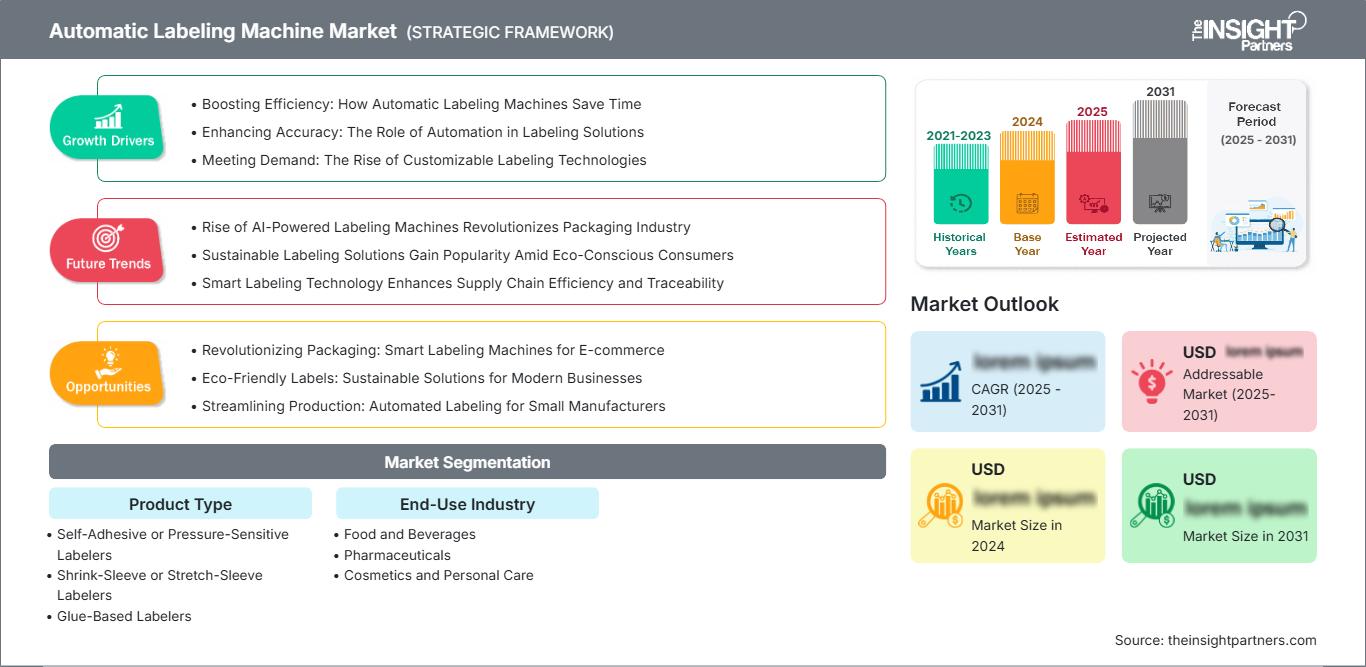
The Automatic Labeling Machine Market was valued at US$ 2.23 Billion in 2025 and is projected to reach US$ 2.68 Billion by 2034, growing at a CAGR of 2.10% from 2026 to 2034. The market reflects steady demand for accurate product identification, regulatory labeling, brand differentiation, and production-line efficiency across food and beverages, pharmaceuticals, cosmetics, and personal care manufacturing.
Across North America, automation budgets are moving toward connected labelers that reduce changeover time, mislabeling risk, and inspection rework. The Automatic Labeling Machine Market size in the region is supported by packaged food output, pharmaceutical serialization, and premium personal care launches, with validated industry sources indicating a modeled CAGR range of 1.8%–2.8% during 2026–2034 after adjusting regional equipment demand to the 2025 base year.
Automatic Labeling Machine Market Assessment and Insights
- North America held 24%–28% share in 2025 and is expected to grow at a CAGR of 1.8%–2.8% between 2026–2034, supported by packaged food, pharma serialization, and premium cosmetics.
- US represented 78%–83% of North America in 2025 and is projected to grow at a CAGR of 1.9%–2.9% between 2026–2034.
- Europe accounted for 27%–31% share in 2025 and is forecast to grow at a CAGR of 1.6%–2.6% between 2026–2034, led by Germany, Italy, France, the UK, and Spain.
- Asia Pacific held 34%–38% share in 2025 and is projected to grow at a CAGR of 2.4%–3.4% between 2026–2034, supported by China, Japan, India, South Korea, and Australia.
- Largest Segment Pressure-Sensitive Labelers held a market share of 46%–50% in 2025 and is expected to grow at a CAGR of 1.9%–2.9% between 2026–2034.
- High Growth Segment Stretch-Sleeve Labelers held a market share of 26%–30% in 2025 and is expected to grow at a CAGR of 2.5%–3.5% between 2026–2034.
- Key companies analyzed in detail: Etiquette Labels Ltd, HERMA GmbH, KHS GmbH, Krones AG, Marchesini Group S.p.A., Novexx Solutions GmbH, Pack Leader Machinery Inc., ProMach Inc., SACMI Imola S.C., and Sidel Group.
Source: The Insight Partners' analysis based on proprietary research, government publications, company annual reports, investor presentations, industry databases, and expert interviews.
The Automatic Labeling Machine Market has evolved from mechanically adjusted applicators to servo-driven, sensor-supported systems that combine label dispensing, container handling, inspection, rejection, and production data capture. Manufacturers increasingly select modular equipment capable of applying pressure-sensitive, sleeve, and glue-based labels across bottles, jars, cartons, tubes, and specialty packs. Production dynamics also favor compact footprints, tool-less changeovers, stainless-steel hygienic construction, and integration with filling, capping, cartoning, and serialization systems.
Future adoption will be shaped by emerging packaging formats, stricter product information rules, higher private-label complexity, and investments in regional manufacturing. Food, beverages, pharmaceuticals, and cosmetics producers are prioritizing label accuracy because recalls, non-compliance, and shelf rejection carry direct financial consequences. Investment tailwinds are strongest where brand owners require faster SKU launches, variable data printing, anti-counterfeit features, and traceable packaging workflows.
Automatic Labeling Machine Market Report Scope
| Report Attribute | Details |
|---|---|
| Market size in 2025 | US$ 2.23 Billion |
| Market Size by 2034 | US$ 2.68 Billion |
| Global CAGR (2026 - 2034) | 2.10% |
| Historical Data | 2021-2024 |
| Forecast period | 2026-2034 |
Automatic Labeling Machine Market Analysis
Demand is anchored in packaging lines that must maintain accuracy while handling shorter batches, wider label variants, and regulated product information. Automatic Labeling Machine Market growth is supported by the need to reduce manual relabeling, increase line availability, and connect labeling with inspection and traceability. WHO-aligned medicine distribution practices, GS1 identification standards, and food allergen disclosure rules make label reliability a compliance requirement.
The value chain includes label material suppliers, applicator manufacturers, conveyor specialists, machine vision providers, print-and-apply vendors, packaging integrators, maintenance partners, and plant automation teams. Supply dynamics favor vendors that can support validation documentation, spare parts availability, remote diagnostics, and rapid format changes. Buyers increasingly evaluate total cost of ownership, label waste, downtime, energy use, and operator training needs.
The competitive landscape combines specialist labelers with broader packaging-line suppliers. HERMA GmbH, Krones AG, KHS GmbH, Sidel Group, SACMI Imola S.C., Marchesini Group S.p.A., ProMach Inc., Novexx Solutions GmbH, Pack Leader Machinery Inc., and Etiquette Labels Ltd compete through engineering depth, installed base, application know-how, service reach, and ability to integrate labeling with filling or secondary packaging.
Investment priorities are moving toward robotics-assisted reel handling, RFID-capable pharma labels, sleeve material compatibility, and data-enabled applicators. Automatic Labeling Machine Market analysis increasingly considers rejected-label reduction, validation support, line balancing, and changeover efficiency rather than standalone speed. Strategic positioning depends on proving reliable operation across multiple container shapes, recyclable label materials, variable data, and high-speed inspection environments.
● REPORT CUSTOMIZATION
Tailor This Report To Align With Your Specific Business Requirements
This report can be customized to align precisely with your business objectives, scope, and target markets. Customization options include tailored segmentation, geography, competitive analysis, and strategic insights to support informed decision-making.
Customize This Report →WHAT YOU CAN ADJUST
- ● Segmentations
- ● Geography
- ● Competitive Analysis
- ● Language Preferences
Automatic Labeling Machine Market: Strategic Insights
Regional Insights
North America Automatic Labeling Machine Market
North America holds an estimated 24%–28% share in 2025 and is forecast to grow at 1.8%–2.8% through 2034. The Automatic Labeling Machine Market share is reinforced by packaged food line upgrades, pharmaceutical serialization, nutraceutical launches, and premium personal care packaging. Regional buyers favor pressure-sensitive systems because they handle frequent SKU changes, short runs, and variable information with comparatively low adhesive handling complexity.
Demand is concentrated in the United States, with Canada and Mexico supporting food, beverage, and contract packaging programs. Equipment purchases are tied to labor availability, retailer compliance, and brand owners’ need to reduce relabeling waste. HERMA GmbH and Sidel Group highlighted 2025–2026 labeling automation launches, including robotic and cobotic features that align with regional demand for lower intervention and higher uptime.
U.S. Automatic Labeling Machine Market
The U.S. represents 78%–83% of North American demand in 2025 and is projected to expand at 1.9%–2.9%. Food and beverages remain the largest installed-base driver, while pharmaceuticals and cosmetics add higher specification demand for serialization, tamper evidence, cleanability, and precise label placement. Application trends include wrap-around bottle labeling, vial labeling, tube labeling, and top-bottom carton labeling.
The company's presence is extensive through companies such as ProMach Inc., HERMA GmbH, Krones AG, KHS GmbH, Sidel Group, Novexx Solutions GmbH, and Pack Leader Machinery Inc. Customers now demand equipment that links printers, cameras, rejection units, and manufacturing execution systems. Similarly, contract packagers need modular machines that can change labels, packages, and product families without lengthy mechanical modifications.
Europe Automatic Labeling Machine Market
Europe accounts for 27%–31% share in 2025 and is expected to grow at 1.6%–2.6%. Germany dominates in machine exports, pharmaceutical packaging, beverage machinery automation, and engineering concentration. The Italian contribution comes from packaging machinery and beverage lines. France provides demand through cosmetics, food, wine, and pharmaceutical packaging, while the UK and Spain provide contract packing and complex retail labels.
European consumers pay attention to compliance with CE standards, hygiene, recyclability, energy conservation, and accurate consumer information. Krones AG, KHS GmbH, HERMA GmbH, Marchesini Group S.p.A., SACMI Imola S.C., and Sidel Group offer comprehensive regional engineering and servicing support. Legislative pressure on packaging waste and product information prompts labelers to use compatible materials, such as thin-film and wash-off adhesives.
APAC Automatic Labeling Machine Market
APAC has a market share of 34%–38% in 2025 and is forecast to grow at 2.4%–3.4%. China excels in beverage, dairy, personal care, and pharmaceutical packaging. Precision, robotics, and smaller-scale line integration are common in Japan and South Korea. India and Australia develop through the processing of food and medical products, as well as through new retail distribution networks.
Investment is being attracted to the region by government policies, contract manufacturing, export packaging, and branding. Food safety, pharmaceutical serialization, and the increasing number of cosmetics lead to the need for labeling technologies. Foreign suppliers attempt to compete with domestic machinery producers by offering service throughout the product lifecycle and higher system speed.
Middle East & Africa Automatic Labeling Machine Market
Middle East & Africa is projected to grow at 1.7%–2.7%, with the UAE driving short-term adoption through beverage, bottled water, cosmetics, and contract packaging applications. Saudi Arabia has a program to develop food and healthcare production capabilities as part of its diversification efforts, while South Africa is enabling selected improvements in packaged food, personal care, and pharmaceutical products.
Sales are driven by energy infrastructure developments, food security schemes, and logistics hubs. The use of the products is project-oriented because technical support, finance, and packaging materials vary from one country to another. The rest of the MEA equipment demand is associated with bottled drinks, consumer goods, medical kits, and better imported machinery.
Segmentation Analysis
Product Type
Product Type is projected to grow at 1.9%–2.9% during 2026–2034. Automatic Labeling Machine Market scope covers systems selected according to adhesive method, container geometry, label material, line speed, and inspection requirements. Pressure-sensitive systems remain broadly adopted because they suit frequent product changes, while sleeve and glue-based systems address decoration, durability, and high-volume beverage or packaged food operations.
- Self-Adhesive or Pressure-Sensitive Labelers lead adoption because they support clean application, quick changeovers, variable information, and flexible use across bottles, cartons, jars, tubes, and personal care packs.
- Shrink-Sleeve or Stretch-Sleeve Labelers are strategically important for full-body decoration, tamper evidence, contour packaging, and beverage branding where visual coverage and pack differentiation influence shelf performance.
- Glue-Based Labelers remain relevant in high-volume beverage, food, and glass-container lines where cost per label, durable adhesion, and established wet-glue or hot-melt processes matter.
End-Use Industry
End-Use Industry is forecast to grow at 1.8%–2.8% during 2026–2034. Food and beverages generate the largest deployment base because labeling is embedded in high-speed packaging lines. Pharmaceuticals require validated, traceable, and inspection-linked systems. Cosmetics and personal care brands prioritize premium appearance, frequent SKU refreshes, and accurate placement on non-standard containers.
- Food and Beverages drive high equipment utilization because bottled drinks, sauces, dairy, ready meals, and packaged foods need accurate nutrition, allergen, batch, and brand labeling.
- Pharmaceuticals require validated label placement, serialization compatibility, tamper evidence, barcode readability, and rejection systems that reduce compliance risk in medicine and healthcare packaging.
- Cosmetics and Personal Care use automatic labeling for premium container shapes, small batches, decorative labels, regulatory information, and frequent product launches across skin care, hair care, and fragrances.
Opportunity Snapshot
| End-Use Industry | Revenue Contribution | Trend Tag | Adoption Stage |
| Food and Beverages | High | Clean Labels | Mature |
| Pharmaceuticals | Medium | Serialized Care | Scaling |
| Cosmetics and Personal Care | Medium | Premium Packs | Scaling |
Automatic Labeling Machine Market Growth Drivers and Impact Analysis
Regulated Product Information Raises Label Accuracy Requirements
There is an increasing need for food, pharmaceutical, and personal care products manufacturers to include all product information in clear print on each pack. Product declarations of allergens, dosing information, barcodes, batch codes, expiration dates, and traceability codes must be printed accurately at the highest possible speeds. Automatic labeling helps reduce the chance of label error by incorporating applicators, sensing technologies, vision verification, and rejects. The greatest impact of the trend in the industry is seen when mislabeling may lead to recalls, shipment stoppages, or retailer rejections. As regulatory inspections become more data-oriented, suppliers that integrate labeling with inspection records and production reporting gain an advantage.
Shorter Production Runs Increase Changeover Value
Brands are releasing an increasing number of flavor and pack-size changes, special-edition releases, and private-label variations, leading to label changeovers. Manual adjustments reduce productivity and increase the risk of mistakes such as improper labels, misalignment, or missing variable information. Today’s automatic labeler technology addresses these needs through recipes, servo-driven alignment, format-free parts, and guided operator interaction. The result can be seen in contract packaging, cosmetics, beverages, and nutraceutical products, where batch runs must be profitable. Equipment that minimizes changeover time helps manufacturers safeguard their line capacity.
Sustainable Packaging Shifts Require Compatible Labeling
The trend toward sustainable packaging is affecting material choice for labels, package design, and adhesives. Beverage, food, and cosmetic products are experimenting with thin-film, recyclable sleeves, wash-off adhesives, paper labels, and lightweight packaging. This affects label feed, tension, shrinking, adhesion, and inspection accuracy. Labeling machine makers need to prove their equipment for new materials rather than relying on experience. The effect on the market is slow but consistent, since sustainable packaging targets typically require trials at the plant level, line changes, and cooperation from suppliers. Companies that facilitate recycling while maintaining uptime will benefit from replacement projects.
Automatic Labeling Machine Market Future Trends
Cobotic Reel Handling Reduces Operator Intervention
Automatic Labeling Machine trends will be geared more toward cobotic reel loading, automated label replenishment, and guided machine start-up for high-volume lines. The roll-out of the 2025 CoboREEL by Sidel Group is an example of how autonomous reels can reduce human intervention during beverage bottling. In the future, automatic labeling machines will rely on operator-less processes to preserve uptime in plants facing staff turnover, shift limitations, and frequent material changes. The benefit in this scenario will lie in securing production, not just improving machine ratings.
Connected Inspection Becomes a Standard Buying Criterion
Future purchasing decisions will consider inspection connectivity as an essential baseline feature. Barcode validation, Optical Character Recognition (OCR), label presence, cap orientation, and reject verification will be consolidated into a single report by more labelers. The pharma and food industries will use these records for auditing, batch release, and root cause analysis. Equipment manufacturers will offer their products through intuitive interfaces, validated reports, and interface capabilities for manufacturing execution systems. Gradually, connected inspection will enable the labeling equipment to become a part of the plant’s quality system, rather than just packaging machinery.
Automatic Labeling Machine Market Opportunities
Pharmaceutical Serialization Upgrades Create Validated Demand
Investment opportunities are available in pharmaceutical packaging lines that require accurate labeling, tamper-evident packaging, serialization, and readable codes on medicine packs. We can provide labeling, printing, inspection, and rejection for vial, syringe, carton, bottle, and autoinjector applications. Automatic Labeling Machine Market Forecasts support phased investment with pro, din, which first upgrades inspection and data capture, and then moves to higher-speed validated systems. The biggest opportunities are for vendors providing documentation, clean design, operator controls, and service support. Contract development and manufacturing organizations are especially attractive because they handle multiple products and require rapid, validated changeovers.
Cosmetics Premiumization Supports Flexible Decoration
Cosmetics and personal care brands are offering a wider range of products, including serums, creams, shampoos, perfumes, and specialized packaging containers. The labeling machine will be able to deliver value in helping ensure proper decoration, transparency, wrapping, smaller packaging containers, and non-cylindrical packaging. The investment will need to consider machines with gentle-handling capacity, quick recipe changes, good positioning capability, and the ability to use high-end labels. There is significant potential in such an investment, since brand image is closely tied to labeling. The vendors that can help customers rapidly introduce new products will succeed.
Recent Developments
- May 2026: HERMA GmbH presented a jointly developed RFID labeling solution for pharmaceutical vials with Schreiner MediPharm, targeting reliable RFID application at high cycle rates. The development supports medicine traceability, automated identification, and pharma packaging validation requirements where label integrity and reading performance are critical.
- September 2025: Krones AG introduced Flectra, a new generation of labelers developed through Kosme and Gernep for low and medium output ranges. The system targets food, beverage, home and personal care, and pharmaceutical applications with modular design, flexible station changeovers, and improved self-adhesive and cold-glue applicators.
- June 2025: Sidel Group launched CoboREEL, an automated reel loading solution that combines labeling with cobotics and offers 18-reel autonomy. The system is designed to reduce manual reel changes, improve accuracy, and support high-volume beverage packaging lines seeking lower downtime and better workforce utilization.
Frequently Asked Questions

- Comprehensive Market Sizing and Forecast Analysis
- Detailed Segmentation Analysis
- In-Depth Market Dynamics Assessment
- Regional and Country-Level Insights
- Competitive Landscape and Company Benchmarking
- Strategic Business Intelligence
Recent Reports
Testimonials

The Insight Partners provided valuable market intelligence that supported our global go-to-market strategy. Their team was professional, responsive, and attentive to our feedback, providing thoughtful analysis and helpful methodological clarifications throughout the project.
Junmo Kim Chief Financial Officer (CFO), Enertech Co., Ltd.
The Insight Partners' SCADA System Market report is comprehensive, with valuable insights on current trends and future forecasts. The team was highly professional, responsive, and supportive throughout. We are very satisfied and highly recommend their services.
RAN KEDEM Partner, Reali Technologies LTDs
I requested a report on a very specific software market and the team produced the report in a few days. The information was very relevant and well presented. I then requested some changes and additions to the report. The team was again very responsive and I got the final report in less than a week.
JEAN-HERVE JENN Chairman, Future Analytica
We worked with The Insight Partners for an important market study and forecast. They gave us clear insights into opportunities and risks, which helped shape our plans. Their research was easy to use and based on solid data. It helped us make smart, confident decisions. We highly recommend them.
PIYUSH NAGPAL Sr. Vice President, High Beam Global
The Insight Partners delivered insightful, well-structured market research with strong domain expertise. Their team was professional and responsive throughout. The user-friendly website made accessing industry reports seamless. We highly recommend them for reliable, high-quality research services
YUKIHIKO ADACHI CEO, Deep Blue, LLC.
This is the first time I have purchased a market report from The Insight Partners.While I was unsure at first, I visited their web site and felt more comfortable to take the risk and purchase a market report.I am completely satisfied with the quality of the report and customer service. I had several questions and comments with the initial report, but after a couple of dialogs over email with their analyst I believe I have a report that I can use as input to our strategic planning process.Thank you so much for taking the extra time and making this a positive experience.I will definitely recommend your service to others and you will be my first call when we need further market data.
JOHN SUZUKI President and Chief Executive Officer, Board Director, BK Technologies
I wish to appreciate your support and the professionalism you displayed in the course of attending to my request for information regarding to infectious disease IVD market in Nigeria. I appreciate your patience, your guidance, and the fact that you were willing to offer a discount, which eventually made it possible for us to close a deal. I look forward to engaging The Insight Partners in the future, all thanks to the impression you have created in me as a result of this first encounter.
DR CHIJIOKE ONYIA MANAGING DIRECTOR, PineCrest Healthcare Ltd.Reason to Buy
- Informed Decision-Making
- Understanding Market Dynamics
- Competitive Analysis
- Identifying Emerging Markets
- Customer Insights
- Market Forecasts
- Risk Mitigation
- Boosting Operational Efficiency
- Strategic Planning
- Investment Justification
- Tracking Industry Innovations
- Aligning with Regulatory Trends





 Get Free Sample for