
Automatic Tire Inflation System Market Analysis, Size, and Share by 2034
Coverage: Type (Continuous Tire Inflation, Central Tire Inflation), Vehicle Type (Passenger Cars and Commercial Vehicles), and Geography
- Status : Data Released
- Report Code : TIPTE100001365
- Category : Automotive and Transportation
- No. of Pages : 150
- Available Report Formats :


- Last update date : August 27, 2026


2025 Market Size
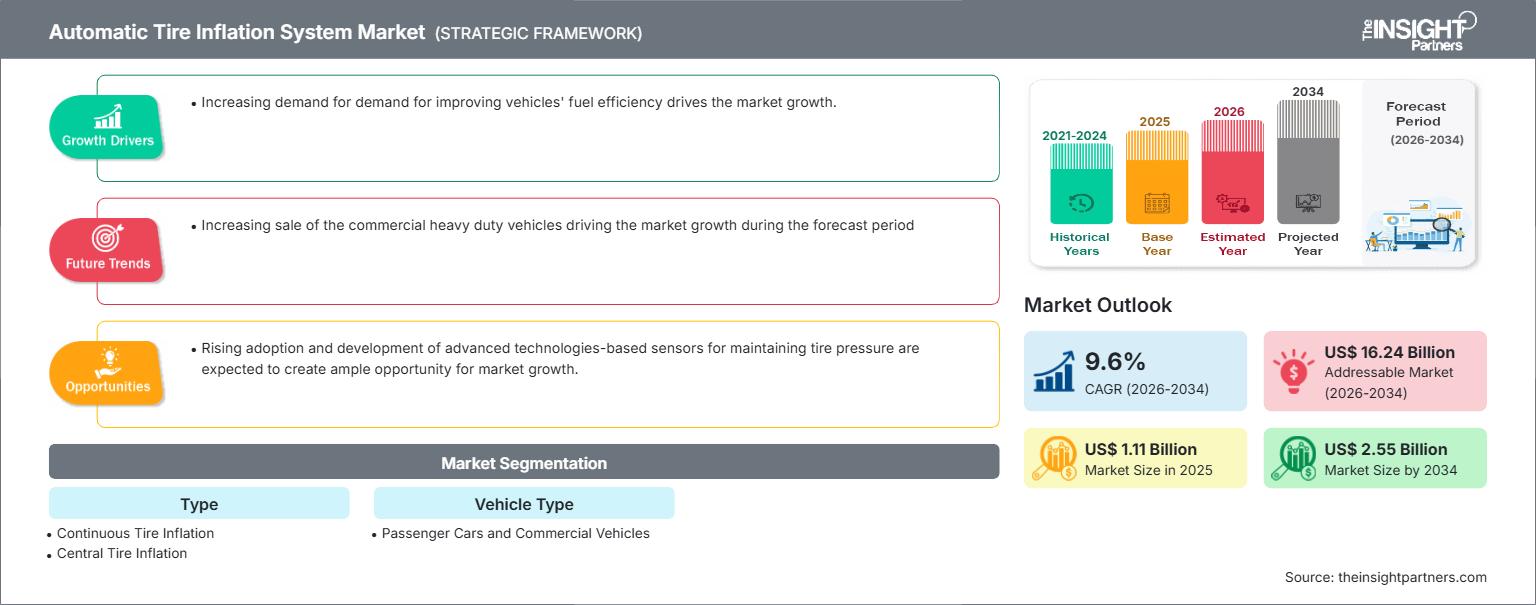
US$ 1.11 Bn
Base year value
2034 Forecast
US$ 2.55 Bn
Projected by 2034
CAGR 2026-2034
9.6 %
Growth rate
Addressable Market
US$ 16.24 Bn
(2026-2034)
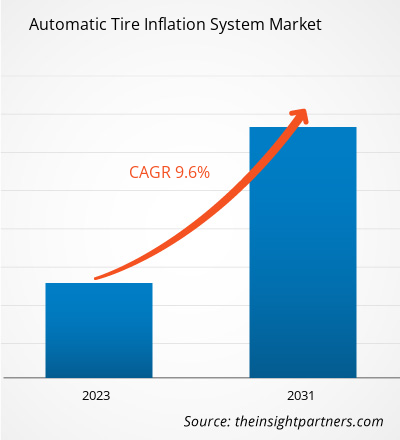
The automatic tire inflation system market was valued at US$ 1.11 Billion in 2025 and is projected to reach US$ 2.55 Billion by 2034, growing at a CAGR of 9.6 % during 2026–2034. Adoption is expanding as fleet operators, vehicle manufacturers, and tire technology providers focus on pressure stability, fuel savings, tire life extension, and lower roadside failure risk.
North America is a strong adoption base because long-haul freight, trailer fleets, military mobility, and preventive maintenance programs support automatic tire inflation system market size expansion. The region is estimated to hold 35–38% share in 2025 and grow at a CAGR of 9.1–9.8% during 2026–2034, supported by telematics integration and strict commercial vehicle uptime targets.
Automatic Tire Inflation System Market Assessment and Insights
- North America holds 35–38% share in 2025 and grows at a CAGR between 9.1–9.8% during 2026–2034, supported by commercial trailer fleets, connected tire management, and high downtime sensitivity.
- US accounts for 84–88% of North America in 2025 and grows at a CAGR between 9.0–9.7% during 2026–2034, led by long-haul trucking and fleet outsourcing.
- Europe holds 25–28% share in 2025 and grows at a CAGR between 8.6–9.3% during 2026–2034, with Germany, the UK, France, Italy, and Spain supporting connected tire adoption.
- Asia Pacific accounts for 27–31% share in 2025 and grows at a CAGR between 10.2–11.0% during 2026–2034, led by China, India, Japan, South Korea, and Australia.
- Largest Segment: Central Tire Inflation holds 56–60% market share in 2025 and grows at a CAGR between 9.2–9.9% during 2026–2034 due to strong fitment in heavy commercial and off-road platforms.
- High Growth Segment: Commercial Vehicles hold 70–74% share in 2025 and grow at a CAGR between 9.8–10.6% during 2026–2034 as fleets prioritize tire uptime and fuel efficiency.
- Key companies analyzed in detail: Aperia Technologies, Inc., Bridgestone Corporation, Continental AG, The Goodyear Tire & Rubber Company, Meritor, Inc., Michelin North America, Inc., Hendrickson USA, L.L.C., Pirelli & C. S.p.A., Dana Limited, and Parker-Hannifin Corporation.
Source: The Insight Partners' analysis based on proprietary research, government publications, company annual reports, investor presentations, industry databases, and expert interviews.
In regard to pressure management, efforts have shifted from manual inspections to automated control of tire pressure with the help of sensors. It results from technologies such as connected fleet systems, compressors on board, wheel-end inflators, and central air distribution systems, which compensate for any pressure loss. New production dynamics appear due to the collaboration of tire manufacturers, axle makers, telematics systems, and component producers within predictive maintenance processes, including inflation control.
Up-and-coming markets will thrive because of the growing professionalism of freight transportation networks and the increase in truck operations, whereas mature economies will focus on connected diagnostics, better fuel economy, and safety requirements. Possible areas of investment include actuators with reduced size, remote pressure set-point tuning, trailer retrofitting, and a service business based on data. Another reason for success in the market is that correct tire inflation contributes to meeting sustainability objectives.
Automatic Tire Inflation System Market Report Scope
| Report Attribute | Details |
|---|---|
| Market size in 2025 | US$ 1.11 Billion |
| Market Size by 2034 | US$ 2.55 Billion |
| Global CAGR (2026 - 2034) | 9.6% |
| Historical Data | 2021-2024 |
| Forecast period | 2026-2034 |
Automatic Tire Inflation System Market Analysis
The automatic tire inflation system market growth is shaped by fleet economics because tire underinflation directly affects fuel consumption, casing life, breakdown frequency, and route reliability. Long-haul carriers, trailer leasing firms, military operators, agricultural users, and construction fleets represent the core ecosystem. Suppliers create value through inflators, compressors, rotary unions, pressure sensors, control modules, valves, axle interfaces, and software dashboards that reduce inspection burden.
Supply dynamics favor systems that can be installed with limited vehicle downtime and maintained through existing service networks. Aftermarket retrofits remain important for trailers, while OEM integration is rising in heavy commercial and specialty vehicles. Buyers evaluate payback through fuel savings, fewer roadside calls, longer tread life, and improved safety, making the total cost of ownership more important than initial hardware price.
The market analysis indicates that Aperia Technologies, Inc. and Hendrickson USA, L.L.C. are important in commercial fleet inflation systems, whereas Michelin North America, Inc., The Goodyear Tire & Rubber Company, Bridgestone Corporation, Continental AG, and Pirelli & C. S.p.A. are important in the integration of tire know-how with telematics technology. Dana Limited, Meritor, Inc., and Parker-Hannifin Corporation increase the importance of drivelines, axles, and pneumatic systems in the market.
The investment focus will be on the integration of telematics with tire health monitoring, predictive analytics, remote pressure management, and easy installation for multi-axle fleets. The strategic positioning in this industry requires the integration of mechanical efficiency with telematics services that facilitate proactive actions for fleets. Companies able to integrate inflation management, monitoring, service dispatching, and tire analytics are able to generate recurring revenue.
● REPORT CUSTOMIZATION
Tailor This Report To Align With Your Specific Business Requirements
This report can be customized to align precisely with your business objectives, scope, and target markets. Customization options include tailored segmentation, geography, competitive analysis, and strategic insights to support informed decision-making.
Customize This Report →WHAT YOU CAN ADJUST
- ● Segmentations
- ● Geography
- ● Competitive Analysis
- ● Language Preferences
Automatic Tire Inflation System Market: Strategic Insights
Regional Insights
North America automatic tire inflation system market
North America holds 35–38% share in 2025 and grows at a CAGR between 9.1–9.8% during 2026–2034. The automatic tire inflation system market share is supported by high trailer density, long average route distance, and strong maintenance outsourcing. Fleet buyers use pressure automation to reduce breakdown exposure, improve fuel economy, and protect tire assets across tractors, trailers, tankers, buses, and defense vehicles.
The region also benefits from vendor partnerships between tire companies, inflator specialists, and fleet service providers. Connected dashboards are becoming more important because pressure data supports dispatch decisions and maintenance planning. Canada and Mexico add demand through cross-border freight, agriculture, mining, and construction applications, while U.S. long-haul carriers remain the primary scale driver.
U.S. automatic tire inflation system Market
The U.S. accounts for 84–88% of North America in 2025 and grows at a CAGR between 9.0–9.7% during 2026–2034. High annual truck mileage, trailer pooling, and driver shortage pressures make automated tire management valuable because fewer roadside events protect delivery schedules and reduce maintenance labor intensity.
Aperia Technologies, Inc., The Goodyear Tire & Rubber Company, Michelin North America, Inc., Hendrickson USA, L.L.C., Dana Limited, and Parker-Hannifin Corporation have strong relevance through commercial fleet channels. Applications are concentrated in dry vans, refrigerated trailers, tankers, refuse fleets, military vehicles, and vocational trucks where pressure stability supports uptime, fuel efficiency, and safety compliance.
Europe automatic tire inflation system Market
Europe holds 25–28% share in 2025 and grows at a CAGR between 8.6–9.3% during 2026–2034. Germany leads regional value because commercial vehicle engineering, logistics density, and tire technology suppliers support connected pressure management. The UK adds fleet adoption through parcel delivery, cold chain logistics, and high-maintenance outsourcing.
France, Italy, and Spain contribute through road freight, coach fleets, agriculture, and construction equipment. European buyers emphasize fuel efficiency, tire abrasion reduction, worker safety, and compliance documentation. Continental AG, Michelin North America, Inc., Bridgestone Corporation, Pirelli & C. S.p.A., and The Goodyear Tire & Rubber Company support regional adoption through tire management platforms and service networks.
APAC automatic tire inflation system Market
APAC accounts for 27–31% share in 2025 and grows at a CAGR between 10.2–11.0% during 2026–2034. China leads demand through freight expansion, mining vehicles, and domestic commercial vehicle production, while India adds growth through logistics formalization and highway development.
Japan and South Korea contribute through technology-driven fleet operations and disciplined maintenance cultures. Australia adds strong use cases in mining, agriculture, and long-distance road trains. Regional growth is supported by rising fuel cost sensitivity, safety awareness, and increasing adoption of connected fleet management.
Middle East & Africa automatic tire inflation system Market
The Middle East & Africa grows at a CAGR between 7.8–8.6% during 2026–2034, led by Saudi Arabia, the UAE, and South Africa. Desert logistics, mining, construction, and military mobility create practical demand for pressure control under heat, load, and rough-terrain conditions.
Saudi Arabia leads regional value through infrastructure and energy transport activity, while the UAE supports premium logistics and port-linked fleets. South Africa adds mining and long-haul freight demand. The rest of MEA remains at an earlier stage, but distributor-led retrofits and fleet modernization programs are widening adoption.
Segmentation Analysis
Type
Type grows at a CAGR between 9.3–10.0% during 2026–2034. The market scope across types is shaped by whether pressure correction occurs continuously at the wheel end or centrally through a vehicle air supply. Central systems dominate heavy-duty fitment, while continuous systems gain attention where simplified retrofit and position-level autonomy matter.
- Continuous Tire Inflation supports wheel-end pressure maintenance with compact inflator designs, making it attractive for trailers, drive axles, and fleets seeking retrofit flexibility without major pneumatic architecture changes.
- Central Tire Inflation remains strategically important for military, construction, agriculture, and multi-axle commercial platforms because it can adjust pressure across several tires based on terrain, load, and operating mode.
Vehicle Type
Vehicle Type grows at a CAGR between 9.5–10.3% during 2026–2034. Commercial vehicles dominate because high mileage magnifies the economic impact of tire pressure losses, while passenger cars remain a more selective opportunity. Vehicle makers and fleet operators evaluate automatic inflation through fuel savings, tire life, safety, and maintenance labor reduction.
- Passenger Cars adoption is limited but relevant for premium, off-road, and specialty models where pressure optimization improves safety, ride control, and convenience under varied driving conditions.
- Commercial Vehicles generate the greatest demand because tractors, trailers, buses, military vehicles, and vocational trucks operate under high loads where tire failures create immediate cost and safety exposure.
Opportunity Snapshot
| Vehicle Type | Revenue Contribution | Trend Tag | Adoption Stage |
| Passenger Cars | Low | Off-Road | Emerging |
| Commercial Vehicles | High | Fleet Uptime | Scaling |
Automatic Tire Inflation System Market Growth Drivers and Impact Analysis
Fleet Cost Pressure and Tire Failure Reduction
Higher costs for fuel, tires, driver delay, and emergency maintenance characterize commercial fleets. The under-inflation of tires causes increased rolling resistance and rapid casing deterioration, in addition to increasing the risk of failure of the tire on the road. Automatic inflation decreases these variables by keeping tire pressure at desired levels throughout the time of operation, particularly on trailers that get fewer checks compared to tractor tires. This can be measured in the total cost of ownership, where fleets save money on repairs, guarantee their deliveries and prolong the life span of the tire.
Connected Tire Management and Telematics Integration
Increasingly, fleet managers are interested in getting their tire data in the same dashboards where they get their routing information, maintenance data, driver information, and asset data. Tire pressure and temperature monitoring systems, which will notify you of slow deflation before failure, assist the maintenance staff in being proactive rather than reactive in dealing with tire problems. The market effect is the increased demand for intelligent systems versus mechanical products. The vendors that can provide data and manage set-points remotely can be differentiated because less is needed in terms of alerts and decisions.
Growth in Heavy Commercial and Off-Road Operations
Tire pressure is important for mining equipment, construction equipment, agricultural equipment, military equipment, and heavy long-distance haul trucks. Manual pressure management is not efficient because it is time-consuming and difficult to do. The central and continuous pressure management system can assist in maximizing traction, minimizing soil compaction, increasing the life of the tire casings, and increasing mobility in difficult circumstances. The invention will increase the market from heavy trailers to vocational trucks and special-purpose vehicles.
Automatic Tire Inflation System Market Future Trends
Remote Pressure Optimization by Route and Load
The automatic tire inflation system market trends will increasingly focus on pressure set points that change based on payload, road surface, speed, temperature, and route profile. Instead of using one static pressure target, connected systems will recommend or apply optimized settings for specific operating conditions. This will improve fuel economy on highways and traction in off-road environments. The trend will require better sensors, secure controls, and fleet policies that define when automated changes are allowed. Suppliers offering reliable analytics will gain preference among large fleets.
Bundled Tire-as-a-Service Models
Going forward, the future acceptance by commercial users will be guided by service packages involving high-end tires, automatic inflation systems, monitoring, roadside assistance, and performance analysis. More and more companies are now choosing operating costs and outsourced tires because their drivers and technicians have limited capabilities. The Tire as a Service approach can help integrate inflation technology within an overall uptime agreement rather than a capital investment. It will be helpful for tire makers, inflation technology firms, and fleet management companies that can prove their savings through reduced failures, proper inflation, and extended tire life.
Automatic Tire Inflation System Market Opportunities
Aftermarket Retrofit Programs for Trailer Fleets
The automatic tire inflation system market Forecasts indicate a strong opportunity in trailer retrofits because trailers often remain in service for many years and are inspected less frequently than tractors. Suppliers can offer modular installation kits, fleet training, and telematics-ready packages that reduce downtime during rollout. Leasing companies, refrigerated transport operators, and parcel fleets are attractive targets because pressure failures disrupt high-value service commitments. Retrofit programs also create recurring revenue through parts, software, and maintenance support while helping customers avoid full vehicle replacement cycles.
Pressure Control for Mining, Agriculture, and Defense
Specialty vehicle categories provide high value due to the impact that tire pressure has on mobility, fuel consumption, soil damage, and machinery efficiency. Mining trucks need durability in tough terrain conditions; farming tractors must be able to have appropriate pressure adjustment in order to protect the soil; defense trucks need traction in varied terrain. The integration of inflation systems with strong compressors, well-protected valves, and appropriate software can be positioned by suppliers in this kind of applications.
Frequently Asked Questions

- Comprehensive Market Sizing and Forecast Analysis
- Detailed Segmentation Analysis
- In-Depth Market Dynamics Assessment
- Regional and Country-Level Insights
- Competitive Landscape and Company Benchmarking
- Strategic Business Intelligence
Recent Reports
Testimonials

The Insight Partners' SCADA System Market report is comprehensive, with valuable insights on current trends and future forecasts. The team was highly professional, responsive, and supportive throughout. We are very satisfied and highly recommend their services.
RAN KEDEM Partner, Reali Technologies LTDs
I requested a report on a very specific software market and the team produced the report in a few days. The information was very relevant and well presented. I then requested some changes and additions to the report. The team was again very responsive and I got the final report in less than a week.
JEAN-HERVE JENN Chairman, Future Analytica
We worked with The Insight Partners for an important market study and forecast. They gave us clear insights into opportunities and risks, which helped shape our plans. Their research was easy to use and based on solid data. It helped us make smart, confident decisions. We highly recommend them.
PIYUSH NAGPAL Sr. Vice President, High Beam Global
The Insight Partners delivered insightful, well-structured market research with strong domain expertise. Their team was professional and responsive throughout. The user-friendly website made accessing industry reports seamless. We highly recommend them for reliable, high-quality research services
YUKIHIKO ADACHI CEO, Deep Blue, LLC.
This is the first time I have purchased a market report from The Insight Partners.While I was unsure at first, I visited their web site and felt more comfortable to take the risk and purchase a market report.I am completely satisfied with the quality of the report and customer service. I had several questions and comments with the initial report, but after a couple of dialogs over email with their analyst I believe I have a report that I can use as input to our strategic planning process.Thank you so much for taking the extra time and making this a positive experience.I will definitely recommend your service to others and you will be my first call when we need further market data.
JOHN SUZUKI President and Chief Executive Officer, Board Director, BK Technologies
I wish to appreciate your support and the professionalism you displayed in the course of attending to my request for information regarding to infectious disease IVD market in Nigeria. I appreciate your patience, your guidance, and the fact that you were willing to offer a discount, which eventually made it possible for us to close a deal. I look forward to engaging The Insight Partners in the future, all thanks to the impression you have created in me as a result of this first encounter.
DR CHIJIOKE ONYIA MANAGING DIRECTOR, PineCrest Healthcare Ltd.Reason to Buy
- Informed Decision-Making
- Understanding Market Dynamics
- Competitive Analysis
- Identifying Emerging Markets
- Customer Insights
- Market Forecasts
- Risk Mitigation
- Boosting Operational Efficiency
- Strategic Planning
- Investment Justification
- Tracking Industry Innovations
- Aligning with Regulatory Trends





 Get Free Sample for