
Automobile Carburetor Market Trends, Size & Forecast by 2034
Coverage: By Type (Float Carburetor, Diaphragm Carburetor); Barrel Type (2 barrels, 4 barrels); Application (Passenger Cars, Commercial Vehicles, Others (Racing Cars, Motorcycles)) , and Geography (North America, Europe, Asia Pacific, and South and Central America)
- Status : Data Released
- Report Code : TIPRE00026049
- Category : Automotive and Transportation
- No. of Pages : 150
- Available Report Formats :


- Last update date : August 24, 2026


2025 Market Size
US$ 2.94 Bn
Base year value
2034 Forecast
US$ 4.69 Bn
Projected by 2034
CAGR 2026-2034
5.32 %
Growth rate
Addressable Market
US$ 34.60 Bn
(2026-2034)
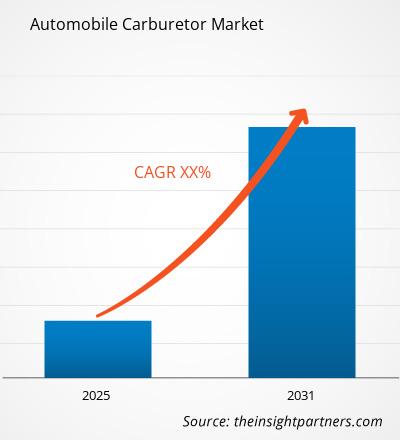
The automobile carburetor market was valued at US$ 2.94 Billion in 2025 and is projected to reach US$ 4.69 Billion by 2034, growing at a CAGR of 5.32% during 2026–2034. Demand remains tied to legacy gasoline engines, restoration vehicles, motorsport tuning, small commercial platforms, and cost-sensitive markets where mechanical fuel metering still provides practical maintenance and affordability advantages.
North America remains a specialized but profitable regional base as restoration workshops, racing suppliers, classic vehicle owners, and aftermarket distributors support the automobile carburetor market size. The region is estimated to hold 21–24% share in 2025 and grow at a CAGR of 4.7–5.3% during 2026–2034, supported by enthusiast spending, parts availability, and premium performance applications.
Automobile Carburetor Market Assessment and Insights
- North America holds 21–24% share in 2025 and grows at a CAGR between 4.7–5.3% during 2026–2034, supported by performance tuning, collector vehicles, and strong specialty aftermarket distribution.
- US accounts for 84–88% of North America in 2025 and grows at a CAGR between 4.6–5.2% during 2026–2034, led by racing, restoration, and DIY repair demand.
- Europe holds 18–21% share in 2025 and grows at a CAGR between 4.4–5.0% during 2026–2034, with Germany, the UK, France, Italy, and Spain supporting classic vehicle servicing.
- Asia Pacific accounts for 39–43% share in 2025 and grows at a CAGR between 5.8–6.5% during 2026–2034, led by China, India, Japan, South Korea, and Australia.
- Largest Segment: Float Carburetor holds 56–60% market share in 2025 and grows at a CAGR between 5.0–5.6% during 2026–2034 because of broad fitment across older passenger cars and utility engines.
- High Growth Segment: Diaphragm Carburetor holds 40–44% share in 2025 and grows at a CAGR between 5.6–6.3% during 2026–2034 as small engines and off-road applications sustain demand.
- Key companies analyzed in detail: Holley Performance Products, Inc., Dellorto S.p.A., EControls, LLC, Edelbrock, LLC, Keihin FIE Private Limited, Kunfu Group, Mikuni American Corporation, Ruixing Carburetor Manufacturing Co., Ltd., Youall Industry and Trade, Inc., and ZAMA Corporation.
Source: The Insight Partners' analysis based on proprietary research, government publications, company annual reports, investor presentations, industry databases, and expert interviews.
Carburetor demand has evolved to be more focused on aftermarket applications for recreational and specialty-performance applications rather than mainstream passenger vehicles. Although electronic fuel injection is dominant in new platforms, carburetors continue to hold value due to their easy-to-repair nature and cost-effective mechanical tuning ability. It can be said that the future demand for carburetors will depend on the trade-off between pressure for electrification and the longevity of current internal combustion engines.
In emerging geographies, carburetor demand will be driven through motorcycles, small utility vehicles, agricultural engines, and low-cost repair systems. In developed countries, high-value demand will come from restoration and motorsports activities. Manufacturers have already invested in using better materials, increased tolerance to ethanol and a digital inventory management system.
Automobile Carburetor Market Report Scope
| Report Attribute | Details |
|---|---|
| Market size in 2025 | US$ 2.94 Billion |
| Market Size by 2034 | US$ 4.69 Billion |
| Global CAGR (2026 - 2034) | 5.32% |
| Historical Data | 2021-2024 |
| Forecast period | 2026-2034 |
Automobile Carburetor Market Analysis
The key driver behind the market growth is the aftermarket replacement, since the existing stock of old gas engines requires periodic cleaning, rebuilding, and replacement of components. The highest demands will arise in the regions where owners of vehicles favor repairability over conversion. The commercial network, including distributors, repair shops, restoration shops, online spare parts portals, and performance retailers, is the supply chain that fuels the needs for carburetors even when their share in OEMs drops.
The supply side of the market relies on the quality of castings, fuel compatibility, calibration precision, and range of fitments. Engine manufacturers produce carburetors for a wide range of applications, including passenger cars, light trucks, motorcycles, generators, marine engines, and off-road vehicles. Growing ethanol content in fuels contributes to the higher demand for seals, gaskets, needles, and corrosion-proof materials.
Holley Performance Products, Inc. and Edelbrock, LLC continue to be prominent players in performance four-barrel carburetors, with Dellorto S.p.A., Mikuni American Corporation, Keihin FIE Private Limited, and ZAMA Corporation targeting motorcycles and other niche markets. Ruixing Carburetor Manufacturing Co., Ltd., Kunfu Group, and Youall Industry and Trade, Inc. improve value-based logistics.
Capital expenditure is geared towards the aftermarket, product extension, and technical services rather than full-scale vehicle initiatives. EControls, LLC becomes relevant due to its knowledge of fuel control and engine management systems. Organizations that possess mechanical product expertise, online fitment capability, and international logistics will be able to generate profitability in the areas of restoration, racing, industrial equipment, and servicing developing markets.
● REPORT CUSTOMIZATION
Tailor This Report To Align With Your Specific Business Requirements
This report can be customized to align precisely with your business objectives, scope, and target markets. Customization options include tailored segmentation, geography, competitive analysis, and strategic insights to support informed decision-making.
Customize This Report →WHAT YOU CAN ADJUST
- ● Segmentations
- ● Geography
- ● Competitive Analysis
- ● Language Preferences
Automobile Carburetor Market: Strategic Insights

Regional Insights
North America automobile carburetor market
North America holds 21–24% share in 2025 and grows at a CAGR between 4.7–5.3% during 2026–2034. The automobile carburetor market share in the region is supported by classic car ownership, drag racing, hot rod builds, marine engines, and outdoor power equipment. Specialist suppliers benefit from high average spending per unit because buyers often choose premium calibrated carburetors over low-cost substitutes.
Regional demand is less dependent on new vehicle production and more tied to aftermarket culture. Online retail, restoration forums, motorsport events, and parts distributors help sustain visibility. Ethanol compatibility, easy tuning, and brand reputation influence purchasing decisions. The region is mature, but premium four-barrel products and rebuild kits keep margins attractive.
U.S. automobile carburetor Market
The U.S. accounts for 84–88% of North America in 2025 and grows at a CAGR between 4.6–5.2% during 2026–2034. The demand for carburetor products is supported by the local muscle car market, pickup trucks, drag racing, and the local tradition of DIY repairs. Holley Performance Products, Inc. and Edelbrock, LLC have high visibility for their products through websites, specialty stores, and performance shows.
Current applications of the product include four-barrel carburetors, intake systems, cleaners for the throttle body, repair parts, and tuning equipment. Additionally, workshops perform repairs on carbureted marine and utility engines during certain seasons. Customers require the products to be compatible with the current type of fuel and to have good idle performance.
Europe automobile carburetor Market
Europe holds 18–21% share in 2025 and grows at a CAGR between 4.4–5.0% during 2026–2034. Germany leads regional value through classic vehicle restoration, precision repair culture, and motorsport participation. The UK adds demand from heritage car clubs, racing suppliers, and imported performance parts, while France, Italy, and Spain support motorcycle and small-engine replacement needs.
Regional adoption is shaped by emission rules, vehicle inspection standards, and preference for high-quality replacement components. Dellorto S.p.A. benefits from long-standing European recognition, while imported U.S. performance brands serve enthusiasts. Europe is not a large new-vehicle opportunity, but restoration spending and professional maintenance keep demand resilient.
APAC automobile carburetor Market
APAC accounts for 39–43% share in 2025 and grows at a CAGR between 5.8–6.5% during 2026–2034. China leads regional volume through manufacturing scale and aftermarket exports, while India supports demand from two-wheelers, older small commercial vehicles, and repair-focused rural mobility.
Japan and South Korea contribute through small-engine precision, motorcycle heritage, and legacy vehicle servicing. Australia adds demand from recreational vehicles, marine applications, and classic car communities. APAC remains the strongest volume region because affordability, repairability, and installed combustion-engine bases remain commercially relevant.
Middle East & Africa automobile carburetor Market
The Middle East & Africa grows at a CAGR between 4.2–4.9% during 2026–2034, led by Saudi Arabia, the UAE, and South Africa. Demand is linked to older vehicles, generators, agricultural equipment, marine engines, and repair networks where simple mechanical systems are valued.
Saudi Arabia leads regional value through vehicle ownership and desert utility applications, while the UAE supports premium restoration and imported performance parts. South Africa has a developed aftermarket base. The rest of MEA remains price-sensitive, but distributors serving older engine platforms sustain replacement demand.
Segmentation Analysis
Type
Type grows at a CAGR between 5.1–5.8% during 2026–2034. The market scope across types is defined by engine position, fuel supply method, operating angle, and maintenance needs. Float carburetors dominate older cars and performance engines, while diaphragm carburetors remain important in portable, off-road, and vibration-prone applications.
- Float Carburetor demand is supported by classic passenger cars, four-barrel performance upgrades, and repairable fuel bowls that allow precise jetting, tuning, and rebuild service across older gasoline platforms.
- Diaphragm Carburetor remains strategically important for small engines, motorcycles, and equipment operating at varied angles because flexible fuel metering supports compact design and vibration tolerance.
Barrel Type
Barrel Type grows at a CAGR between 5.0–5.7% during 2026–2034. Demand differs by airflow requirement and engine output. Two-barrel designs support simpler engines and value replacements, while four-barrel carburetors generate premium aftermarket revenue because performance buyers value higher airflow, secondary throttle response, and compatibility with V8 restoration projects.
- 2 barrels serve older six-cylinder, small V8, light commercial, and marine applications where moderate airflow, simpler calibration, lower cost, and reliable drivability matter more than peak power.
- 4 barrels remain central to performance and restoration demand because they provide higher airflow capacity, secondary fuel delivery, and tuning flexibility for classic muscle cars and racing engines.
Application
Application grows at a CAGR between 5.2–5.9% during 2026–2034. Passenger cars generate the largest value through restoration, collector ownership, and enthusiast upgrades, while commercial vehicles contribute replacement demand in regions where older light trucks, utility vehicles, and field-service engines remain active.
- Passenger Cars dominate demand through classic vehicles, hot rods, motorsport builds, and aftermarket tuning, where owners choose carburetors for authenticity, simplicity, and visible mechanical customization.
- Commercial Vehicles maintain relevance in developing markets, farms, workshops, and fleet niches where older gasoline engines continue operating and low-cost repairability outweighs electronic conversion.
Opportunity Snapshot
| Application | Revenue Contribution | Trend Tag | Adoption Stage |
| Passenger Cars | High | Classic Builds | Mature |
| Commercial Vehicles | Medium | Field Repair | Scaling |
Automobile Carburetor Market Growth Drivers and Impact Analysis
Aging Combustion Engine Fleet
There still exist many old internal combustion engine vehicles, motorbikes, boat engines, generators, and agricultural machinery because of the high cost of replacement in certain areas. Such engines need frequent servicing, including carburetor cleaning, replacing gaskets, adjusting floats, servicing jets, and changing the entire carburetor assembly of the carburetor. The result is a steady income for the aftermarket due to the diminishing installation of new car carburetors in the production of new vehicles.
Restoration and Performance Tuning Culture
Classical car restoration, hot rod assembly, drag races, and vintage motorcycle collecting remain some of the main reasons for purchasing high-end carburetors. Most people tend to favor a mechanical way of delivering fuel because it retains the originality of the vehicle, as well as providing tuning options that can be seen. This driver increases the average sales price through four-barrel carburetors, intake systems, reconditioning kits, jets, and calibration kits. This market influence is more prominent in North America and Europe.
Repairability in Cost-Sensitive Markets
The carburetor is still favored because of the simplicity of the tool and low cost of its components, and the fact that the maintenance process does not involve any electronic diagnostics. Rural mobility, commercial transport, motorbikes, pumps and generators will all enjoy serviceable fuel delivery systems. This driver drives demand in Asia Pacific, Latin America, and some areas in Middle East & Africa. It also favors local manufacturing and distribution because the consumer favors immediacy and interchangeability of the product over retrofits.
Automobile Carburetor Market Future Trends
Fuel-Compatible Materials and Calibration Kits
The automobile carburetor market trends will increasingly focus on compatibility with ethanol-blended fuels, cleaner gasoline formulations, and varied fuel quality across regions. Suppliers are expected to improve gaskets, seals, needles, floats, and coatings to reduce swelling, corrosion, and leakage. Calibration kits will become more important as users tune older engines for modern fuels. This trend strengthens premium aftermarket positioning because buyers will pay for reliability, easier adjustment, and reduced service complaints.
Digital Fitment and Direct Aftermarket Sales
Sales in the future will depend more on online fitment systems, engine-specific suggestions, installation videos, and storefronts. People who buy old cars find it difficult to know the right carburetor to purchase, the rebuild kits available, and the jet sizes. The use of digital catalogs will lower the number of returns. Companies that integrate technical information and product availability will benefit from DIY enthusiasts, restorers, and international buyers of old, discontinued systems.
Automobile Carburetor Market Opportunities
Premium Restoration Kits and Bundled Components
The automobile carburetor market Forecasts indicate opportunity in bundled kits that combine carburetors, intake manifolds, gaskets, fuel lines, jets, and tuning instructions for classic applications. Bundles simplify purchasing, reduce compatibility risk, and raise order value. Performance brands can target muscle cars, vintage trucks, and motorsport builds with application-specific packages. This approach also supports distributors because complete kits are easier to merchandise online and provide clearer value than individual low-cost replacement components.
Emerging Market Workshop Partnerships
Suppliers can grow by partnering with repair shops, distributors, and training networks in markets where carbureted engines remain common. Workshop-focused programs can include fitment guides, rebuild education, inventory planning, and quality tiers for different income groups. This opportunity is strongest in India, Southeast Asia, Africa, and Latin America, where repairability influences purchasing. Trusted supplier relationships can shift demand away from unbranded substitutes toward durable assemblies and repeat replacement parts.
Frequently Asked Questions

- Comprehensive Market Sizing and Forecast Analysis
- Detailed Segmentation Analysis
- In-Depth Market Dynamics Assessment
- Regional and Country-Level Insights
- Competitive Landscape and Company Benchmarking
- Strategic Business Intelligence
Recent Reports
Testimonials

The Insight Partners' SCADA System Market report is comprehensive, with valuable insights on current trends and future forecasts. The team was highly professional, responsive, and supportive throughout. We are very satisfied and highly recommend their services.
RAN KEDEM Partner, Reali Technologies LTDs
I requested a report on a very specific software market and the team produced the report in a few days. The information was very relevant and well presented. I then requested some changes and additions to the report. The team was again very responsive and I got the final report in less than a week.
JEAN-HERVE JENN Chairman, Future Analytica
We worked with The Insight Partners for an important market study and forecast. They gave us clear insights into opportunities and risks, which helped shape our plans. Their research was easy to use and based on solid data. It helped us make smart, confident decisions. We highly recommend them.
PIYUSH NAGPAL Sr. Vice President, High Beam Global
The Insight Partners delivered insightful, well-structured market research with strong domain expertise. Their team was professional and responsive throughout. The user-friendly website made accessing industry reports seamless. We highly recommend them for reliable, high-quality research services
YUKIHIKO ADACHI CEO, Deep Blue, LLC.
This is the first time I have purchased a market report from The Insight Partners.While I was unsure at first, I visited their web site and felt more comfortable to take the risk and purchase a market report.I am completely satisfied with the quality of the report and customer service. I had several questions and comments with the initial report, but after a couple of dialogs over email with their analyst I believe I have a report that I can use as input to our strategic planning process.Thank you so much for taking the extra time and making this a positive experience.I will definitely recommend your service to others and you will be my first call when we need further market data.
JOHN SUZUKI President and Chief Executive Officer, Board Director, BK Technologies
I wish to appreciate your support and the professionalism you displayed in the course of attending to my request for information regarding to infectious disease IVD market in Nigeria. I appreciate your patience, your guidance, and the fact that you were willing to offer a discount, which eventually made it possible for us to close a deal. I look forward to engaging The Insight Partners in the future, all thanks to the impression you have created in me as a result of this first encounter.
DR CHIJIOKE ONYIA MANAGING DIRECTOR, PineCrest Healthcare Ltd.Reason to Buy
- Informed Decision-Making
- Understanding Market Dynamics
- Competitive Analysis
- Identifying Emerging Markets
- Customer Insights
- Market Forecasts
- Risk Mitigation
- Boosting Operational Efficiency
- Strategic Planning
- Investment Justification
- Tracking Industry Innovations
- Aligning with Regulatory Trends





 Get Free Sample for