
Automotive Air Conditioning Compressor Market Share, Size & Demand by 2034
Coverage: By Type (Swash Plate, Scroll, Rotary Vane); Vehicle Type (Passenger Cars, Light Commercial Vehicles, Heavy Commercial Vehicles); Distribution Channel (OEMS, Aftermarket), and Geography
- Status : Data Released
- Report Code : TIPRE00008795
- Category : Automotive and Transportation
- No. of Pages : 150
- Available Report Formats :


- Last update date : August 26, 2026


2025 Market Size
US$ 26.46 Bn
Base year value
2034 Forecast
US$ 34.4 Bn
Projected by 2034
CAGR 2026-2034
2.96 %
Growth rate
Addressable Market
US$ 276.32 Bn
(2026-2034)
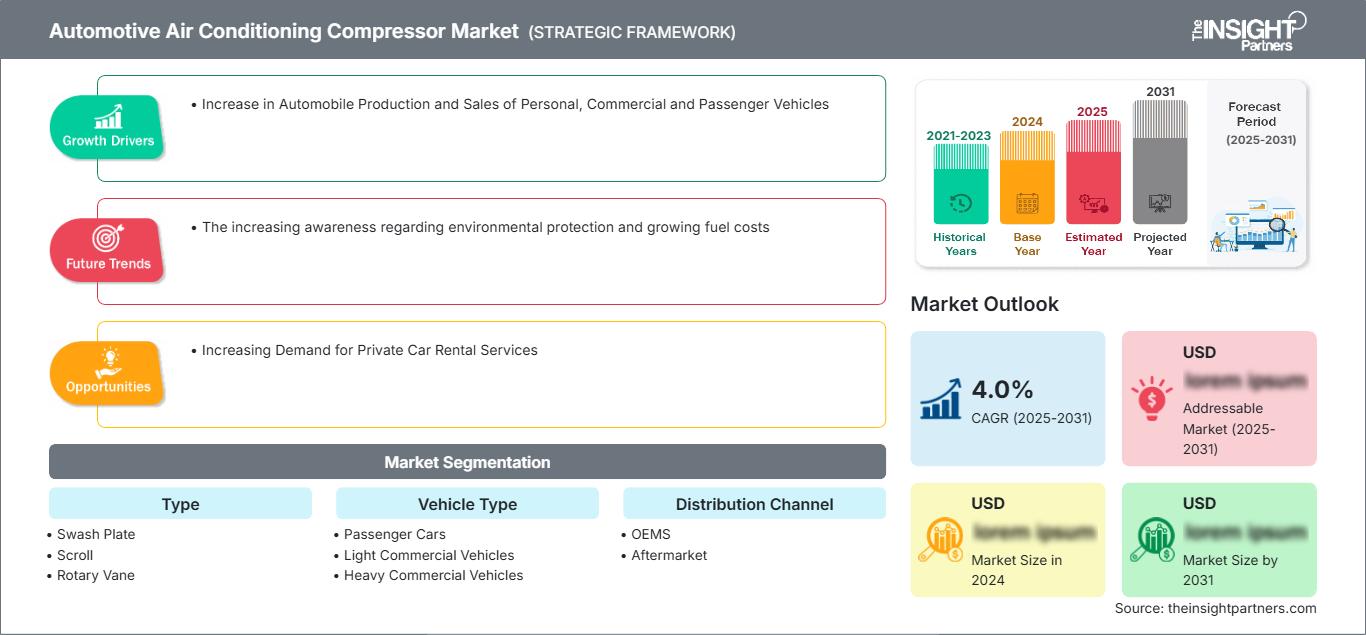
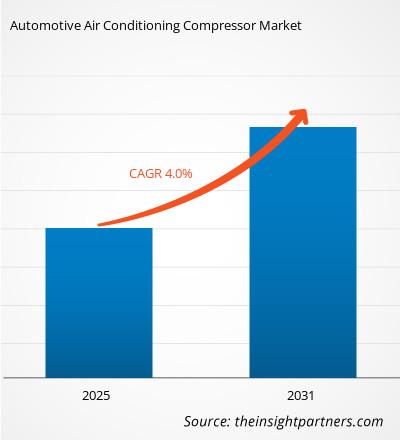
The automotive air conditioning compressor market was valued at US$ 26.46 Billion in 2025 and is projected to reach US$ 34.40 Billion by 2034, registering a CAGR of 2.96% during 2026–2034. Demand is supported by rising cabin comfort expectations, hybrid vehicle adoption, thermal management requirements, and replacement demand for compressors used in passenger cars, light commercial vehicles, and heavy commercial vehicles.
North America automotive air conditioning compressor market size is expected to expand at a CAGR range of 2.5–2.9% during 2026–2034, supported by a large vehicle parc, strong aftermarket service networks, and high pickup and SUV penetration. Regional demand also benefits from hotter climate exposure, fleet maintenance cycles, and increasing use of variable displacement and electric compressors.
Automotive Air Conditioning Compressor Market Assessment and Insights
- North America accounted for 24–27% share in 2025 and is expected to grow at a CAGR of 2.5–2.9% during 2026–2034, supported by replacement demand, fleet maintenance, and SUV penetration.
- US represented 77–81% of North America demand in 2025 and is projected to grow at a CAGR of 2.6–3.0% during 2026–2034.
- Europe held 21–24% share in 2025 and is likely to expand at a CAGR of 2.3–2.7%, led by Germany, the UK, France, Italy, and Spain.
- Asia Pacific captured 40–44% share in 2025 and is projected to grow at a CAGR of 3.2–3.7%, led by China, Japan, South Korea, India, and Australia.
- Largest Segment: OEMS held 66–70% market share in 2025 and is expected to grow at a CAGR of 2.7–3.1% because compressors are platform-specific thermal system components.
- High Growth Segment: Scroll compressors held 24–28% share in 2025 and are projected to grow at a CAGR of 3.8–4.3% due to electric compressor adoption in hybrid and battery electric vehicles.
- Key companies analyzed in detail: Continental AG, Hanon Systems, Keihin Corporation, Michigan Automotive Compressor, Inc., Sanden Corporation, MAHLE GmbH, Robert Bosch GmbH, DENSO Corporation, Valeo SE, and Subros Limited.
Source: The Insight Partners' analysis based on proprietary research, government publications, company annual reports, investor presentations, industry databases, and expert interviews.
Compressor technology is shifting from engine-driven fixed designs toward variable displacement, scroll, and electrically driven systems. This evolution reflects tighter efficiency requirements, changing refrigerants, and the need to maintain cabin cooling when hybrid engines shut off. The automotive air conditioning compressor market is therefore becoming more connected to power electronics, battery thermal management, and integrated HVAC modules than earlier mechanical compressor cycles.
Future demand will be influenced by the production of vehicles in the Asia Pacific, warmer city temperatures, and government regulations requiring the reduction of refrigerant leaks and electricity usage. Companies are developing small scroll compressors, better clutch mechanisms, silent operation, and localized production. Opportunities exist for firms that are capable of meeting the needs of traditional vehicles and scaling up electric compressor products for hybrid and electric vehicles.
Automotive Air Conditioning Compressor Market Report Scope
| Report Attribute | Details |
|---|---|
| Market size in 2025 | US$ 26.46 Billion |
| Market Size by 2034 | US$ 34.4 Billion |
| Global CAGR (2026 - 2034) | 2.96% |
| Historical Data | 2021-2024 |
| Forecast period | 2026-2034 |
Automotive Air Conditioning Compressor Market Analysis
Automotive air conditioning compressor market growth is anchored in vehicle HVAC adoption, aftermarket replacement, and rising expectations for cooling performance during extreme weather. Compressors compress and circulate refrigerant, making them the costliest and most critical moving parts in many vehicle air conditioning systems. The value chain includes aluminum casting, bearings, clutches, seals, electric motors, inverters, refrigerant compatibility testing, module assembly, and service distribution.
The dynamics of supply depend on vehicle manufacturing plans, compressor core availability, power electronics sourcing, and preparation for refrigerant changeover. OEMs seek out quieter, more lightweight, and low-power models, whereas services seek fitment accuracy and availability of the reconditioned products. The heat pump system used in electric vehicles creates additional difficulty as the compressor provides conditioning and battery heating.
Automotive air conditioning compressor market analysis shows that competition is led by suppliers with thermal system integration, high-volume manufacturing, and OEM validation strength. DENSO Corporation, Hanon Systems, Valeo SE, Sanden Corporation, MAHLE GmbH, Robert Bosch GmbH, Continental AG, Subros Limited, Michigan Automotive Compressor, Inc., and Keihin Corporation compete through efficiency, durability, refrigerant compatibility, and vehicle platform coverage.
The investments are geared towards high voltage electric compressors, scroll designs, low NVH, and thermal management modules. The strategic positioning involves striking a balance between traditional compressor sizes and electric vehicle programs. The suppliers who have localized manufacturing close to the automobile manufacturers and software-calibrated thermal management are strategically placed for future platform awards.
● REPORT CUSTOMIZATION
Tailor This Report To Align With Your Specific Business Requirements
This report can be customized to align precisely with your business objectives, scope, and target markets. Customization options include tailored segmentation, geography, competitive analysis, and strategic insights to support informed decision-making.
Customize This Report →WHAT YOU CAN ADJUST
- ● Segmentations
- ● Geography
- ● Competitive Analysis
- ● Language Preferences
Automotive Air Conditioning Compressor Market: Strategic Insights
Regional Insights
North America automotive air conditioning compressor market
North America held 24–27% automotive air conditioning compressor market share in 2025 and is projected to grow at a CAGR of 2.5–2.9% during 2026–2034. Demand is supported by a large vehicle parc, hot summers, pickup and SUV ownership, and the replacement of compressors in aging vehicles.
The American aftermarket still matters due to the necessity for service whenever a compressor fails. The fleets that work in transportation, construction, first response, and ride-share operations have high load requirements for their air conditioning systems, thus favoring robust compressors and remanufactured compressors.
U.S. automotive air conditioning compressor Market
The U.S. accounted for 77–81% of North America demand in 2025 and is expected to grow at a CAGR of 2.6–3.0% during 2026–2034. According to the Automotive Air Conditioning Compressor Market forecast, high vehicle ownership and a broad repair infrastructure sustain replacement volumes.
This company's presence exists with DENSO Corporation, Hanon Systems, Valeo SE, Sanden Corporation, MAHLE GmbH, Robert Bosch GmbH, and Michigan Automotive Compressor, Inc. Applications include passenger cars and light trucks, while commercial vans and heavy-duty vehicles require a reliable cooling system when idling, stop-and-go, and under high-load operation.
Europe automotive air conditioning compressor Market
Europe accounted for 21–24% share in 2025 and is expected to grow at a CAGR of 2.3–2.7% during 2026–2034. Germany leads through premium vehicle production, supplier engineering depth, and early integration of heat-pump-ready electric compressors.
The UK contributes towards the replacement demand via established service channels, whereas France, Italy, and Spain make contributions through passenger vehicle production and warmer climatic conditions. Refrigerant regulations, hybrid car usage, and vehicle platform efficiency ensure the demand for low-leakage, compact, and electronically controlled compressors.
APAC automotive air conditioning compressor Market
APAC held 40–44% share in 2025 and is projected to grow at a CAGR of 3.2–3.7% during 2026–2034. China leads because of vehicle production scale, EV adoption, and domestic compressor supply chains.
Thermal engineering technology is well developed in Japan and South Korea. The Indian market experiences growth due to increasing car numbers and the penetration of air conditioning. The Australian market benefits from replacement needs in a hot-running environment.
Middle East & Africa automotive air conditioning compressor Market
The Middle East & Africa market is projected to grow at a CAGR of 2.2–2.7% during 2026–2034, supported by harsh heat, vehicle imports, logistics fleets, and construction activity. Saudi Arabia and the UAE lead demand.
South Africa contributes through passenger vehicle service networks, while the rest of MEA remains fragmented. High ambient temperatures increase compressor workload, making durability, refrigerant sealing, and workshop availability critical purchase factors.
Segmentation Analysis
Type
Type defines the automotive air conditioning compressor market scope because compressor architecture determines efficiency, cooling output, packaging, noise, and suitability for conventional or electrified powertrains. The segment is expected to grow at a CAGR of 2.9–3.3% during 2026–2034 as OEMs balance cost, durability, and energy use.
- Swash Plate compressors remain widely used in conventional vehicles because they offer proven reliability, scalable output, and cost-effective integration with belt-driven HVAC systems across mass-market passenger cars and commercial vehicles.
- Scroll compressors are gaining share in hybrid and electric vehicles because they provide smooth compression, compact packaging, lower vibration, and efficient operation when paired with electric drive motors.
- Rotary Vane compressors serve selected compact and specialty applications where steady flow, simple construction, and packaging flexibility matter, although broader adoption is limited by efficiency and durability trade-offs.
Vehicle Type
Vehicle Type is projected to grow at a CAGR of 2.8–3.2% during 2026–2034 because cooling demand differs by cabin size, duty cycle, idle time, and fleet utilization intensity.
- Passenger Cars generate the greatest demand because consumers expect reliable cooling, defogging, and comfort across entry, SUV, premium, hybrid, and electric platforms in varied climate conditions.
- Light Commercial Vehicles require durable compressors for delivery vans, service vehicles, and ride-hailing fleets that face frequent stops, urban heat, idle operation, and high daily usage.
- Heavy Commercial Vehicles use robust compressors for long-haul trucks, buses, construction equipment, and vocational fleets where driver comfort and uptime are linked to productivity and safety.
Distribution Channel
Distribution Channel is expected to grow at a CAGR of 2.7–3.1% during 2026–2034 because compressors are supplied through factory-installed programs and replacement-driven service channels.
- OEMS dominate revenue because compressors are engineered into vehicle thermal systems, validated for refrigerant type, noise targets, power draw, engine layout, and warranty performance.
- Aftermarket demand is supported by compressor wear, leakage, clutch failure, and service replacement in aging vehicles, especially where hot climates accelerate HVAC component stress.
Opportunity Snapshot
| Vehicle Type | Revenue Contribution | Trend Tag | Adoption Stage |
|---|---|---|---|
| Passenger Cars | High | EV Cooling | Mature |
| Light Commercial Vehicles (LCV) | Medium | Fleet HVAC | Scaling |
| Heavy Commercial Vehicles (HCV) | Medium | Driver Comfort | Scaling |
Automotive Air Conditioning Compressor Market Growth Drivers and Impact Analysis
Rising Demand for Cabin Comfort in Hotter Urban Conditions
The cooling of the cabin has become an essential factor, not a luxury option, particularly for metropolitan areas that experience more heat waves and traffic congestion. There is increased demand for compressors to work under conditions like idling, stop-go traffic conditions, and running delivery routes where doors open. This factor helps to support replacement demand in the mature market and installation at the factory level in emerging markets, where first-time vehicle buyers look forward to air conditioning in their vehicles.
Electrification and Battery Thermal Management Requirements
Both hybrid vehicles and battery electric cars will need compressors that can run independently of the speed of the engine and also be capable of providing air conditioning in addition to cooling the battery pack. There is an increasing demand for electric scroll compressors due to the fact that the compressors combine the motors, the inverters, and the refrigerant management into one compact system. This results in increased value per part when compared with traditional belt compressors.
Aftermarket Replacement Across Aging Vehicle Fleets
High pressures, oil circulation, aging seals, clutch operation, and leaking of refrigerant are sources of wear for compressors. Hence, aging vehicle stock provides opportunities for repeat repairs, especially in North America, Middle East, India, and other warm areas. Compressor replacements are typically done professionally due to the need for refrigerant management, flushing, and refilling that can be achieved only by qualified professionals. The effect will be profitable for distributors, rebuilders, and workshops with wide catalogs. An assured aftermarket availability will encourage vehicle ownership since owners will be able to fix HVAC issues.
Automotive Air Conditioning Compressor Market Future Trends
Electric Scroll Compressors for Integrated Thermal Control
Automotive air conditioning compressor market trends will increasingly center on electric scroll compressors that support cabin comfort, battery conditioning, and heat-pump operation in one integrated thermal loop. These systems separate the cooling effect from the engine speed and enable better control when charging, idling, and operating at low speeds. More adoption is expected as hybrid and battery electric vehicles will need better heating and cooling capability while maintaining their range. Companies that develop efficient inverters, have good acoustics, and are able to work with refrigerants will become more relevant.
Low-GWP Refrigerant Compatibility and Leak Reduction
Regulatory pressure on refrigerants will result in suppliers focusing on compressors with design features appropriate for low GWP fluids and proper sealing and durability testing. The compressors need to address the issues of lubrication, pressure, and temperature differential with the new generation of refrigerants. Suppliers will be preferred by original equipment manufacturers who can provide testing facilities, leak-free design, and service information for global models. It will also have an effect on the repair work in the aftermarket since improper refrigerant use increases the chances of failure.
Automotive Air Conditioning Compressor Market Opportunities
Localized Electric Compressor Production Near EV Hubs
Automotive air conditioning compressor forecasts indicate opportunity in localizing electric compressor production near EV manufacturing clusters in China, India, Europe, Mexico, and North America. Localization reduces logistics risk, helps meet regional content rules, and improves launch responsiveness for automakers. Suppliers can capture value by combining motor assembly, inverter integration, and compressor testing in regional plants. This approach is especially attractive as vehicle makers standardize heat-pump systems and seek partners that can support volume ramps, warranty targets, and cost reduction across multiple platforms.
Aftermarket Programs for Severe-Climate Replacement Demand
The severe climate creates great opportunities for the distribution network and compressor rebuilders since the higher temperatures in these climates increase the wear and tear of seals, stress on clutches, and leakage of refrigerants. Manufacturers can provide service kits, re-manufactured compressors, training for technicians, and product lines with warranties to workshops in North America, the Middle East, India, and Australia. This opportunity is actionable since buyers need a quick supply in the case of an HVAC system breakdown due to its impact on comfort and safety.
Frequently Asked Questions

- Comprehensive Market Sizing and Forecast Analysis
- Detailed Segmentation Analysis
- In-Depth Market Dynamics Assessment
- Regional and Country-Level Insights
- Competitive Landscape and Company Benchmarking
- Strategic Business Intelligence
Recent Reports
Testimonials

The Insight Partners' SCADA System Market report is comprehensive, with valuable insights on current trends and future forecasts. The team was highly professional, responsive, and supportive throughout. We are very satisfied and highly recommend their services.
RAN KEDEM Partner, Reali Technologies LTDs
I requested a report on a very specific software market and the team produced the report in a few days. The information was very relevant and well presented. I then requested some changes and additions to the report. The team was again very responsive and I got the final report in less than a week.
JEAN-HERVE JENN Chairman, Future Analytica
We worked with The Insight Partners for an important market study and forecast. They gave us clear insights into opportunities and risks, which helped shape our plans. Their research was easy to use and based on solid data. It helped us make smart, confident decisions. We highly recommend them.
PIYUSH NAGPAL Sr. Vice President, High Beam Global
The Insight Partners delivered insightful, well-structured market research with strong domain expertise. Their team was professional and responsive throughout. The user-friendly website made accessing industry reports seamless. We highly recommend them for reliable, high-quality research services
YUKIHIKO ADACHI CEO, Deep Blue, LLC.
This is the first time I have purchased a market report from The Insight Partners.While I was unsure at first, I visited their web site and felt more comfortable to take the risk and purchase a market report.I am completely satisfied with the quality of the report and customer service. I had several questions and comments with the initial report, but after a couple of dialogs over email with their analyst I believe I have a report that I can use as input to our strategic planning process.Thank you so much for taking the extra time and making this a positive experience.I will definitely recommend your service to others and you will be my first call when we need further market data.
JOHN SUZUKI President and Chief Executive Officer, Board Director, BK Technologies
I wish to appreciate your support and the professionalism you displayed in the course of attending to my request for information regarding to infectious disease IVD market in Nigeria. I appreciate your patience, your guidance, and the fact that you were willing to offer a discount, which eventually made it possible for us to close a deal. I look forward to engaging The Insight Partners in the future, all thanks to the impression you have created in me as a result of this first encounter.
DR CHIJIOKE ONYIA MANAGING DIRECTOR, PineCrest Healthcare Ltd.Reason to Buy
- Informed Decision-Making
- Understanding Market Dynamics
- Competitive Analysis
- Identifying Emerging Markets
- Customer Insights
- Market Forecasts
- Risk Mitigation
- Boosting Operational Efficiency
- Strategic Planning
- Investment Justification
- Tracking Industry Innovations
- Aligning with Regulatory Trends





 Get Free Sample for