
Automotive Air Filter Market Size, Share & Growth by 2034
Coverage: By Type (Air Intake Filters, Cabin Air Filters); Vehicle Type (Passenger Car, LCV, MandHCV) , and Geography (North America, Europe, Asia Pacific, and South and Central America)
- Status : Data Released
- Report Code : TIPRE00005233
- Category : Automotive and Transportation
- No. of Pages : 150
- Available Report Formats :


- Last update date : August 26, 2026


2025 Market Size
US$ 5.36 Bn
Base year value
2034 Forecast
US$ 9.11 Bn
Projected by 2034
CAGR 2026-2034
6.07 %
Growth rate
Addressable Market
US$ 65.52 Bn
(2026-2034)
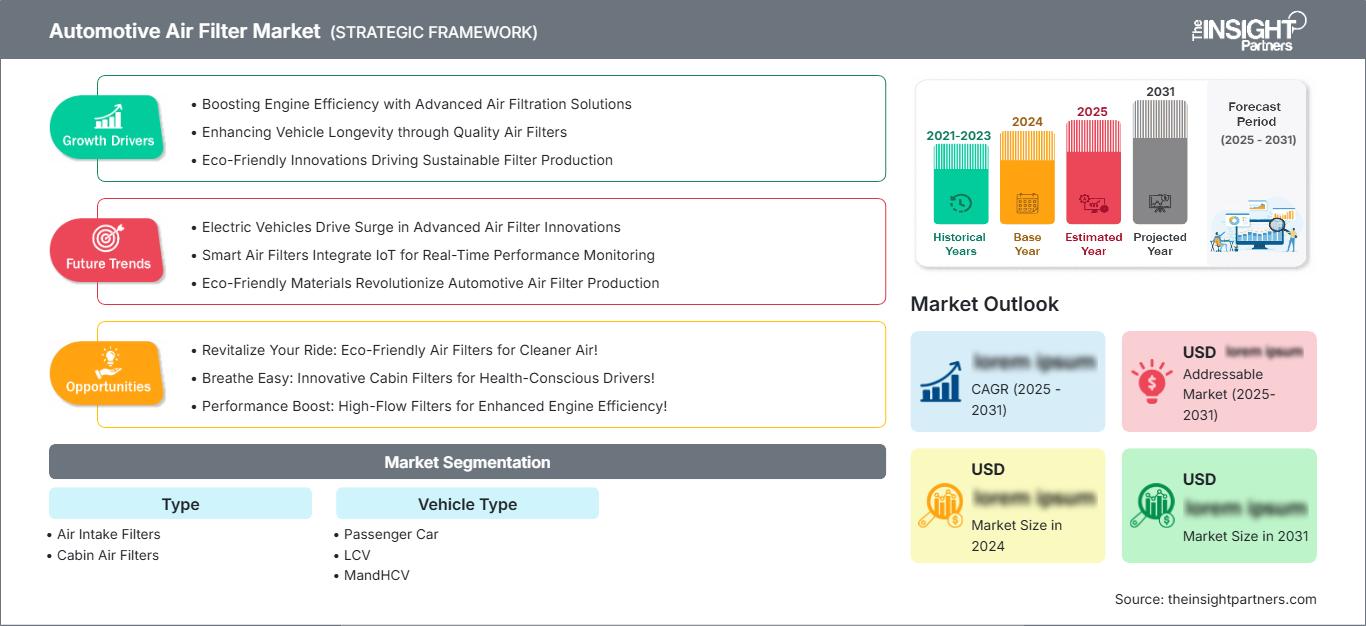
The automotive air filter market was valued at US$ 5.36 Billion in 2025 and is projected to reach US$ 9.11 Billion by 2034, registering a CAGR of 6.07% during 2026–2034. Demand is supported by rising vehicle production, stricter emission expectations, higher cabin comfort requirements, and recurring replacement cycles for engine intake and HVAC filtration across passenger cars, LCVs, and medium and heavy commercial vehicles.
The North America automotive air filter market size is expected to expand at a CAGR range of 5.6–6.0% during 2026–2034, supported by high vehicle ownership, strong aftermarket replacement behavior, and rising consumer attention to in-cabin air quality. Demand is also strengthened by pickup fleets, urban pollution exposure, and premium filter adoption in service networks.
Automotive Air Filter Market Assessment and Insights
- North America: Accounted for 25–28% share in 2025 and is expected to grow at a CAGR of 5.6–6.0% during 2026–2034, supported by aftermarket replacement, fleet maintenance, and cabin air quality awareness.
- US: Represented 77–81% of North America demand in 2025 and is projected to grow at a CAGR of 5.7–6.1% during 2026–2034.
- Europe: Held 22–25% share in 2025 and is likely to expand at a CAGR of 5.4–5.8%, led by Germany, the UK, France, Italy, and Spain.
- Asia Pacific: Captured 38–42% share in 2025 and is projected to grow at a CAGR of 6.5–7.0%, led by China, India, Japan, South Korea, and Australia.
- Largest Segment: Air intake filters held 56–60% market share in 2025 and are expected to grow at a CAGR of 5.8–6.2% because they protect engines and support emission performance.
- High Growth Segment: Cabin air filters held 40–44% share in 2025 and are projected to grow at a CAGR of 6.7–7.2% due to health awareness and advanced HVAC filtration.
- Key companies analyzed in detail: ACDelco, ALCO Filters Ltd., Cummins Filtration, DENSO Corporation, Donaldson Company, Inc., FILTRAK BRANDT GmbH, MAHLE GmbH, MANN+HUMMEL International GmbH & Co. KG, Robert Bosch GmbH, and Sogefi S.p.A.
Source: The Insight Partners' analysis based on proprietary research, government publications, company annual reports, investor presentations, industry databases, and expert interviews.
Filter technology is evolving from basic dust capture toward multi-layer media, activated carbon, nanofiber layers, and higher-efficiency particulate removal. Engine intake filters are being optimized for lower airflow restriction, while cabin filters are increasingly positioned as health and comfort components. The automotive air filter market is also influenced by electrification, because battery electric vehicles reduce engine intake demand but increase emphasis on HVAC filtration and cabin air quality.
Forward demand will be shaped by replacement intervals, urban pollution, hybrid vehicle production, and service awareness in emerging markets. Suppliers are investing in sustainable filter media, compact packaging, and stronger aftermarket catalogs. The automotive air filter market outlook favors companies with broad vehicle coverage, validated filtration efficiency, regional distribution depth, and the ability to serve both OEM fitment and replacement channels.
Automotive Air Filter Market Report Scope
| Report Attribute | Details |
|---|---|
| Market size in 2025 | US$ 5.36 Billion |
| Market Size by 2034 | US$ 9.11 Billion |
| Global CAGR (2026 - 2034) | 6.07% |
| Historical Data | 2021-2024 |
| Forecast period | 2026-2034 |
Automotive Air Filter Market Analysis
The Automotive air filter market growth is driven by a need for regular replacements due to degradation from dust loading, humidity, soot, pollen, and road particles. The market value chain consists of filter media, pleaters, housing makers, HVAC assembly, engine system makers, distribution channels, workshops, and retailers. This market is highly resilient since clogged filters may lead to low airflow, increase fuel consumption, decrease engine durability, and reduce passenger comfort.
Supply chain factors include nonwoven media, cellulose, synthetic fibers, activated carbon, adhesives, plastic frames, and logistics. The OEM segment requires high performance throughout the established service interval, while the aftermarket cares about a wide range of fitment, pricing, and branding. The Automotive air filter market report reveals the trends that premium automotive air filters are becoming popular as they are associated with respiratory health and car reliability.
Competitive positioning in the market depends on filtering efficiency, catalog availability, distribution coverage, and the relationship with automobile makers. MANN+HUMMEL International GmbH & Co. KG, MAHLE GmbH, DENSO Corporation, Robert Bosch GmbH, Donaldson Company, Inc., Cummins Filtration, Sogefi S.p.A., ACDelco, ALCO Filters Ltd., and FILTRAK BRANDT GmbH engage in competition by utilizing media science, OE certification, and availability in the aftermarket.
The industry investments will be directed towards the development of nanofiber media, activated carbon for odor reduction, antimicrobial coating, and low-carbon materials. The automotive air filter market enjoys easy replacement economics but has to deal with competitive pressures from private-label parts. Certified performance data and training services, along with regional manufacturing, will allow suppliers to sustain their margins.
● REPORT CUSTOMIZATION
Tailor This Report To Align With Your Specific Business Requirements
This report can be customized to align precisely with your business objectives, scope, and target markets. Customization options include tailored segmentation, geography, competitive analysis, and strategic insights to support informed decision-making.
Customize This Report →WHAT YOU CAN ADJUST
- ● Segmentations
- ● Geography
- ● Competitive Analysis
- ● Language Preferences
Automotive Air Filter Market: Strategic Insights
Regional Insights
North America automotive air filter market
North America held 25–28% automotive air filter market share in 2025 and is projected to grow at a CAGR of 5.6–6.0% during 2026–2034. Demand is supported by a large vehicle parc, long commutes, strong quick-lube networks, and high consumer familiarity with scheduled maintenance.
The fleet owners increase demand using vans, pickups, buses, and construction equipment subjected to dust, idling, and rough roads. The cabin filters get more attention due to factors like wildfires, pollen seasons, and urban particulates. Premium activated carbon and efficient filters are available in the retail market and e-commerce stores.
U.S. automotive air filter Market
The U.S. accounted for 77–81% of North America demand in 2025 and is expected to grow at a CAGR of 5.7–6.1% during 2026–2034. According to the Automotive Air Filter Market forecast, high vehicle ownership, large pickup and SUV fleets, and broad aftermarket distribution sustain replacement volumes across intake and cabin categories. Company presence is strong through ACDelco, Donaldson Company, Inc., Cummins Filtration, Robert Bosch GmbH, MAHLE GmbH, and MANN+HUMMEL International GmbH & Co. KG. Passenger cars and LCVs dominate applications, while medium and heavy commercial vehicles require durable filters for construction, logistics, agriculture, and long-haul use.
Europe automotive air filter Market
Europe accounted for 22–25% share in 2025 and is expected to grow at a CAGR of 5.4–5.8% during 2026–2034. Germany is the leader in the development of premium cars, strict maintenance practices, and efficient filtration suppliers for OE and aftermarkets.
The UK drives replacement through an established servicing infrastructure, whereas France, Italy, and Spain help through passenger vehicle parc and air quality issues. In the region, consumers prefer cabin filters with activated carbon and fine particle filtration. On the other hand, engine intake products are driven by fuel efficiency norms and hybrids.
APAC automotive air filter Market
APAC held 38–42% share of the automotive air filter Market in 2025 and is projected to grow at a CAGR of 6.5–7.0% during 2026–2034. China leads because of vehicle production scale, urban pollution exposure, and growing consumer awareness of in-cabin air quality.
India gains from growth arising out of service network in relation to two wheelers, passenger cars and LCVs, whereas Japan and South Korea offer advanced filtration technology. Australia offers replacement demand due to dust ridden operation environment.
Middle East & Africa automotive air filter Market
The Middle East & Africa automotive air filter Market is projected to grow at a CAGR of 4.9–5.4% during 2026–2034, supported by dust-intensive driving, logistics fleets, mining, construction, and imported vehicle maintenance. Saudi Arabia and the UAE lead demand for durable intake filters.
While South Africa participates via passenger vehicles, commercial vehicle fleets, and the aftermarket, the rest of MEA is still disorganized. While cabin filters are picking up slowly, engine intake filters are critical due to sand, heat, and long distances, contributing to frequent clogging and replacements.
Segmentation Analysis
Type
Type defines the automotive air filter market scope because intake and cabin filters serve different systems, replacement triggers, and buyer priorities. The segment is expected to grow at a CAGR of 6.0–6.4% during 2026–2034 as filtration becomes linked to both engine efficiency and occupant health.
- Air Intake Filters remain the largest category because they protect combustion systems from dust and abrasive particles while supporting airflow, fuel economy, emission performance, and longer engine component life.
- Cabin Air Filters are gaining importance as consumers focus on pollen, fine particles, odors, and urban pollution, making HVAC filtration a comfort, health, and premium ownership feature.
Vehicle Type
Vehicle Type is projected to grow at a CAGR of 6.1–6.5% during 2026–2034 as filter demand varies by vehicle use, mileage, operating environment, and replacement discipline.
- Passenger Car demand is strongest because a large vehicle parc, cabin comfort expectations, and routine service intervals support recurring intake and cabin filter replacement across entry, SUV, and premium models.
- LCV demand is expanding as delivery vans, service vehicles, and small logistics fleets operate in urban routes with frequent stops, dust exposure, and high cabin ventilation use.
- MandHCV applications require robust intake filtration for long operating hours, heavy dust exposure, and engine protection in logistics, mining, agriculture, construction, and intercity transport.
Opportunity Snapshot
| Vehicle Type | Revenue Contribution | Trend Tag | Adoption Stage |
|---|---|---|---|
| Passenger Car | High | Cabin Health | Mature |
| LCV | Medium | Urban Fleets | Scaling |
| M&HCV | Medium | Dust Defense | Scaling |
Automotive Air Filter Market Growth Drivers and Impact Analysis
Recurring Replacement Across Large Vehicle Parc
Air filters are consumable parts, so the installed vehicle base matters as much as new vehicle production. Engine intake filters collect dust and road debris, while cabin filters capture pollen, soot, odors, and fine particles. Once the filter media becomes loaded, airflow declines and service quality is affected. This creates predictable replacement cycles for workshops, quick-lube chains, online sellers, and fleet garages. The impact is strongest in countries with older vehicles, dusty roads, and high annual mileage. Suppliers benefit from catalog depth, inventory availability, and clear service guidance that encourages timely replacement.
Rising Awareness of Cabin Air Quality
The focus of consumers has been diverted from emissions to the air breathed by the occupants inside the vehicle. Increased levels of pollution caused by traffic jams, smoke generated by wildfires, and pollen levels, in addition to health issues have increased the need for better cabin filters. Filters based on activated carbon, electrostatic, HEPA-like, and nanofiber technology offer suppliers an opportunity to differentiate themselves from the basic filtration offered by the category through the unique technology used in their products.
Commercial Vehicle Use in Dust and High-Load Conditions
LCVs and other types of medium to heavy trucks operate under conditions that lead to filter blocking, such as construction sites, mines, farms, highways, and highly urbanized routes. Inadequate filtration can lead to engine inefficiency, increased risks of maintenance problems, and increased downtime. This makes it essential for operators to use reliable filters that have demonstrated dust-holding ability and stability of airflow. This makes sense because filter replacement will happen more often compared to normal passenger vehicles due to harsh operating conditions. This is an opportunity for suppliers to earn continuous income from their clients.
Automotive Air Filter Market Future Trends
Nanofiber and High-Efficiency Cabin Media
Automotive air filter market trends will increasingly center on fine-particle capture without excessive pressure drop. The use of nanofibers and new synthetic materials ensures that small particulates get filtered without blocking the airflow in HVAC systems. This is significant as the buyers assess the comfort of the interior, odor reduction capabilities, and health benefits of the vehicle. Premium cars, electric cars, and polluted urban environments will be the first adopters. The suppliers who have verified PM1, PM2.5, allergen, and odor filters will find it easy to differentiate themselves over low-cost substitutes.
Sustainable Media and Lower-Carbon Filter Designs
There will be an increased production of reusable, renewable and eco-friendly raw materials by filter suppliers as the automobile manufacturers analyze lifecycle impact on the service components. The filters are made of paper, synthetic materials, plastic frames, adhesives and packaging, which means there are many opportunities for improvement. The challenge lies in maintaining dust holding capacity, moisture tolerance and structural stability despite the reduction of environmental impact. It is highly probable that such innovations will be seen first in the premium and OEM services.
Automotive Air Filter Market Opportunities
Premium Aftermarket Filters in Urban Markets
Air filter for automobile market forecasts suggest an opportunity lies in the sale of high-end aftermarket filters in cities that suffer from pollution, allergens, smog, and odor problems. The distributors and workshops can upgrade the customers from standard filters to activated carbon, nanofiber, and high-end filters, with explanations of the advantages of such filters presented in a simplified manner. This opportunity is lucrative due to the fast and low-cost nature of the installation process, as opposed to more expensive repairs.
Fleet Programs for Severe-Duty Intake Filtration
There is an opportunity for suppliers who will be able to improve productivity by the proper selection of intake filters in commercial fleets. Most construction, mining, agricultural, logistic and municipal fleets work in dusty environments, which implies that low-quality filters decrease their service interval or engine vulnerability. Suppliers can provide auditing, application-specific media, volume supplies and replacement schedules to generate real value. It is an action opportunity as fleet owners react in terms of uptime, total cost and warranties. Also, heavy-duty filter programs help build relations with distributors.
Frequently Asked Questions

- Comprehensive Market Sizing and Forecast Analysis
- Detailed Segmentation Analysis
- In-Depth Market Dynamics Assessment
- Regional and Country-Level Insights
- Competitive Landscape and Company Benchmarking
- Strategic Business Intelligence
Recent Reports
Testimonials

The Insight Partners provided valuable market intelligence that supported our global go-to-market strategy. Their team was professional, responsive, and attentive to our feedback, providing thoughtful analysis and helpful methodological clarifications throughout the project.
Junmo Kim Chief Financial Officer (CFO), Enertech Co., Ltd.
The Insight Partners' SCADA System Market report is comprehensive, with valuable insights on current trends and future forecasts. The team was highly professional, responsive, and supportive throughout. We are very satisfied and highly recommend their services.
RAN KEDEM Partner, Reali Technologies LTDs
I requested a report on a very specific software market and the team produced the report in a few days. The information was very relevant and well presented. I then requested some changes and additions to the report. The team was again very responsive and I got the final report in less than a week.
JEAN-HERVE JENN Chairman, Future Analytica
We worked with The Insight Partners for an important market study and forecast. They gave us clear insights into opportunities and risks, which helped shape our plans. Their research was easy to use and based on solid data. It helped us make smart, confident decisions. We highly recommend them.
PIYUSH NAGPAL Sr. Vice President, High Beam Global
The Insight Partners delivered insightful, well-structured market research with strong domain expertise. Their team was professional and responsive throughout. The user-friendly website made accessing industry reports seamless. We highly recommend them for reliable, high-quality research services
YUKIHIKO ADACHI CEO, Deep Blue, LLC.
This is the first time I have purchased a market report from The Insight Partners.While I was unsure at first, I visited their web site and felt more comfortable to take the risk and purchase a market report.I am completely satisfied with the quality of the report and customer service. I had several questions and comments with the initial report, but after a couple of dialogs over email with their analyst I believe I have a report that I can use as input to our strategic planning process.Thank you so much for taking the extra time and making this a positive experience.I will definitely recommend your service to others and you will be my first call when we need further market data.
JOHN SUZUKI President and Chief Executive Officer, Board Director, BK Technologies
I wish to appreciate your support and the professionalism you displayed in the course of attending to my request for information regarding to infectious disease IVD market in Nigeria. I appreciate your patience, your guidance, and the fact that you were willing to offer a discount, which eventually made it possible for us to close a deal. I look forward to engaging The Insight Partners in the future, all thanks to the impression you have created in me as a result of this first encounter.
DR CHIJIOKE ONYIA MANAGING DIRECTOR, PineCrest Healthcare Ltd.Reason to Buy
- Informed Decision-Making
- Understanding Market Dynamics
- Competitive Analysis
- Identifying Emerging Markets
- Customer Insights
- Market Forecasts
- Risk Mitigation
- Boosting Operational Efficiency
- Strategic Planning
- Investment Justification
- Tracking Industry Innovations
- Aligning with Regulatory Trends





 Get Free Sample for