
Automotive Air Intake Manifold Market Share, Size & Demand by 2034
Coverage: By Product Type (Single Plane Manifold, Dual Plane Manifold); Vehicle Type (Passenger Cars, Light Commercial Vehicles, Heavy Commercial Vehicles); Build Material (High Performance Plastics, Composite Materials, Metals); Sales Channel (Original Equipment Manufacturers (OEMs), Aftermarket), and Geography
- Status : Data Released
- Report Code : TIPRE00009127
- Category : Automotive and Transportation
- No. of Pages : 150
- Available Report Formats :


- Last update date : August 26, 2026


2025 Market Size
US$ 35.51 Bn
Base year value
2034 Forecast
US$ 50.33 Bn
Projected by 2034
CAGR 2026-2034
3.95 %
Growth rate
Addressable Market
US$ 389.84 Bn
(2026-2034)
The automotive air intake manifold market was valued at US$ 35.51 Billion in 2025 and is projected to reach US$ 50.33 Billion by 2034, registering a CAGR of 3.95% during 2026–2034. Demand is supported by internal combustion engine optimization, hybrid powertrain growth, stricter emission rules, and the shift toward lightweight manifolds that improve airflow distribution, fuel efficiency, and engine response.
North America automotive air intake manifold market size is expected to expand at a CAGR range of 3.5–3.9% during 2026–2034, supported by replacement demand, pickup and SUV production, and adoption of high-performance plastic and composite intake systems. Regional suppliers are also benefiting from turbocharged gasoline engines, aftermarket tuning demand, and tighter fuel economy requirements.
Automotive Air Intake Manifold Market Assessment and Insights
- North America accounted for 24–27% share in 2025 and is expected to grow at a CAGR of 3.5–3.9% during 2026–2034, supported by SUVs, pickups, and aftermarket replacement.
- US represented 76–80% of North America demand in 2025 and is projected to grow at a CAGR of 3.6–4.0% through 2034.
- Europe held 22–25% share in 2025 and is likely to expand at a CAGR of 3.3–3.7%, led by Germany, the UK, France, Italy, and Spain.
- Asia Pacific captured 39–43% share in 2025 and is projected to grow at a CAGR of 4.2–4.7%, led by China, Japan, South Korea, India, and Australia.
- Largest Segment: Original equipment manufacturers held 68–72% market share in 2025 and are expected to grow at a CAGR of 3.7–4.1% because intake manifolds are platform-specific engine components.
- High Growth Segment: High-performance plastics held 34–38% share in 2025 and are projected to grow at a CAGR of 4.6–5.1% due to lightweighting and design flexibility.
- Key companies analyzed in detail: Marelli Holdings Co., Ltd., Röchling SE & Co. KG, Holley Performance Brands, Sogefi S.p.A., Hitachi Astemo Indiana, Inc., AISIN Corporation, MAHLE GmbH, Donaldson Company, Inc., Mikuni Corporation, MANN+HUMMEL International GmbH & Co. KG, Toyota Boshoku Corporation, and Novares Group.
Source: The Insight Partners' analysis based on proprietary research, government publications, company annual reports, investor presentations, industry databases, and expert interviews.
Technology development is shifting the automotive air intake manifold market from cast-metal distribution parts toward integrated air management modules. These materials support intricate runners, embedded sensors, resonators, and charge-air capabilities, and help minimize weight. The need for precise flow balance, heat and vibration resistance in turbocharged and downsized engines makes manifold development more related to combustion efficiency and emissions regulations.
The future market will depend on hybrid production, regional engine platforms and recycling technology of polymers. While the best opportunity for volume lies in the Asia Pacific region, North America and Europe will focus on performance after-market and advanced materials.
Those suppliers who have knowledge of molding process, acoustic engineering, and experience in working with original equipment manufacturers will find themselves at an advantage due to stricter fuel efficiency standards and improvements in combustion engines.
Automotive Air Intake Manifold Market Report Scope
| Report Attribute | Details |
|---|---|
| Market size in 2025 | US$ 35.51 Billion |
| Market Size by 2034 | US$ 50.33 Billion |
| Global CAGR (2026 - 2034) | 3.95% |
| Historical Data | 2021-2024 |
| Forecast period | 2026-2034 |
Automotive Air Intake Manifold Market Analysis
Automotive air intake manifold market growth is anchored in the need to deliver balanced airflow to every cylinder while reducing engine weight and improving fuel economy. The intake manifold plays an important role in determining torque, throttle response, combustion performance, and emissions. Value chain includes resin suppliers, aluminum and magnesium casters, mold makers, sensors manufacturers, gasket manufacturers, engine manufacturers, and performance distributors.
The supply dynamics of intake manifolds will be determined by factors such as car production, downsizing of engines, presence of turbocharger, hybrid platforms, and availability of raw materials. OEMs are leaning towards parts that integrate air distribution, charge cooling, noise management, and sensor mounting. Demand from the aftermarket sector is still significant for tuning purposes.
Automotive air intake manifold market analysis shows that competition is concentrated among suppliers with engine system integration capability. Marelli Holdings Co., Ltd., Röchling SE & Co. KG, Sogefi S.p.A., AISIN Corporation, MAHLE GmbH, Donaldson Company, Inc., Mikuni Corporation, MANN+HUMMEL International GmbH & Co. KG, Toyota Boshoku Corporation, Novares Group, and Holley Performance Brands compete through material engineering, airflow simulation, tooling scale, and OEM approvals.
In terms of investments, they are going in the direction of recyclable nylon, reinforced polymer resins made of glass fiber, charge air modules and manifolds for hybrid thermal cycles. The key to strategic positioning will be to support gas, diesel and hybrid engines and at the same time deal with decreased requirements for battery electric cars.
● REPORT CUSTOMIZATION
Tailor This Report To Align With Your Specific Business Requirements
This report can be customized to align precisely with your business objectives, scope, and target markets. Customization options include tailored segmentation, geography, competitive analysis, and strategic insights to support informed decision-making.
Customize This Report →WHAT YOU CAN ADJUST
- ● Segmentations
- ● Geography
- ● Competitive Analysis
- ● Language Preferences
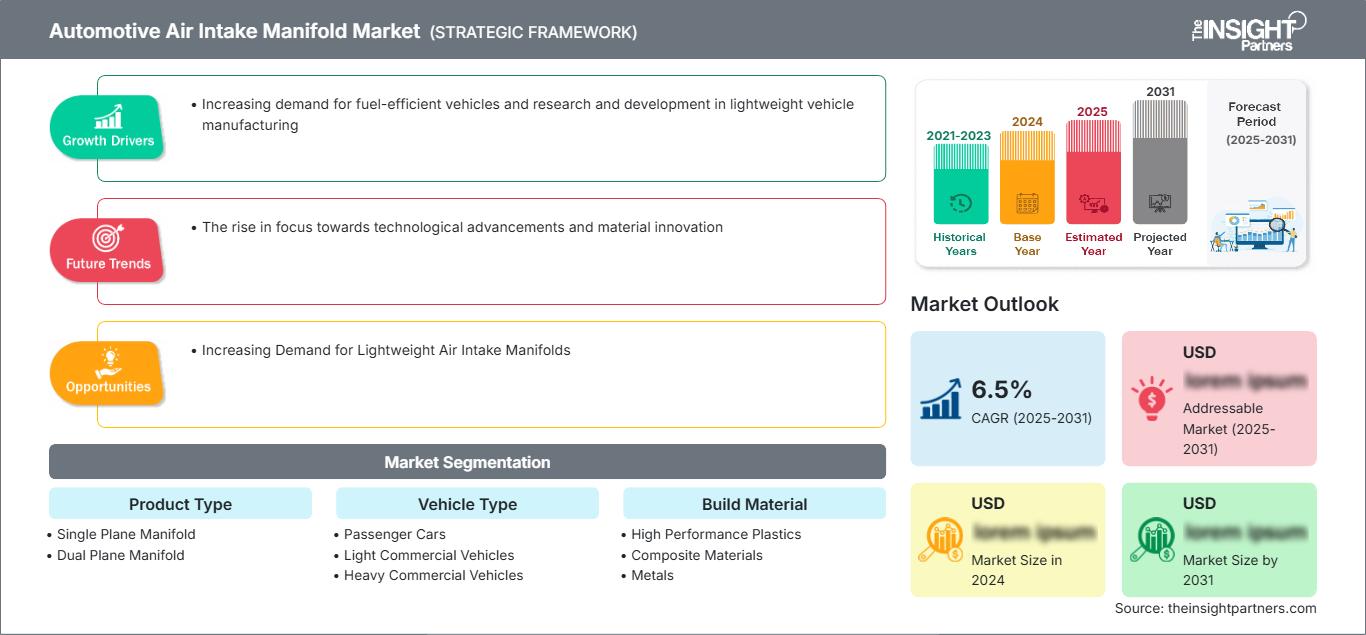
Automotive Air Intake Manifold Market: Strategic Insights
Regional Insights
North America automotive air intake manifold market
North America held 24–27% automotive air intake manifold market share in 2025 and is projected to grow at a CAGR of 3.5–3.9% during 2026–2034. Demand is supported by pickup trucks, SUVs, performance vehicles, and engine replacement activity across a large installed vehicle base.
Turbocharged gasoline engines, tuning of stock engines and hybrid engine models contribute to regional growth. Increasing use of plastic/composite materials for the manufacture of intake manifolds is seen because these materials have low weight and can be used for the manufacture of integrated runner chambers and acoustic chambers.
U.S. automotive air intake manifold Market
The U.S. accounted for 76–80% of North America demand in 2025 and is expected to grow at a CAGR of 3.6–4.0% through 2034. According to the Automotive Air Intake Manifold Market report, large pickup, SUV, and performance car populations support both original equipment and replacement demand.
Company presence is broad through Holley Performance Brands, Donaldson Company, Inc., MAHLE GmbH, Marelli Holdings Co., Ltd., and MANN+HUMMEL International GmbH & Co. KG. Passenger cars and light commercial vehicles dominate applications, while aftermarket buyers continue to value intake upgrades for airflow, throttle response, and engine tuning flexibility.
Europe automotive air intake manifold Market
Europe accounted for 22–25% share in 2025 and is expected to grow at a CAGR of 3.3–3.7% during 2026–2034. According to the Automotive Air Intake Manifold Market forecast, Germany leads because of engine engineering depth, premium vehicle production, and advanced supplier networks serving gasoline, diesel, and hybrid platforms.
The UK supports aftermarket and niche performance demand, while France, Italy, and Spain contribute through passenger car production and fleet replacement. Regional emphasis on lower emissions and lifecycle materials supports lightweight polymers, integrated charge-air functions, and recyclable intake modules that meet strict OEM validation standards.
APAC automotive air intake manifold Market
APAC held 39–43% share of the automotive air intake manifold Market in 2025 and is projected to grow at a CAGR of 4.2–4.7% through 2034. China leads regional demand through vehicle production scale, localized engine platforms, and hybrid model expansion.
Japan and South Korea support advanced powertrain engineering, India adds volume through small cars and light commercial vehicles, and Australia contributes replacement demand. Supplier localization, export engine production, and policy pressure for fuel efficiency support wider use of plastic and composite manifolds.
Middle East & Africa automotive air intake manifold Market
The Middle East & Africa automotive air intake manifold market is projected to grow at a CAGR of 3.0–3.5% during 2026–2034, supported by vehicle imports, commercial fleets, and high-temperature operating conditions. Saudi Arabia and the UAE lead demand for durable intake systems.
South Africa contributes through vehicle assembly and aftermarket channels, while the rest of MEA remains fragmented. Dust exposure, heat, and long driving distances increase demand for stable sealing, airflow consistency, and materials that resist deformation under severe service conditions.
Segmentation Analysis
Product Type
The product type segment of the automotive air intake manifold market defines automotive air intake manifold market scope because manifold geometry determines airflow velocity, torque behavior, and suitability for engine speed ranges. The segment is expected to grow at a CAGR of 3.8–4.2% during 2026–2034 as OEMs balance efficiency, drivability, and packaging.
- Single Plane Manifold is preferred in performance applications where high-rpm airflow and simpler runner layouts support racing, tuning, and engines that prioritize peak power over low-speed torque.
- Dual Plane Manifold serves broader street and light-duty applications because separated runner paths improve low and mid-range torque, drivability, and fuel mixing under common operating conditions.
Vehicle Type
The vehicle type segment of the automotive air intake manifold market is projected to grow at a CAGR of 3.7–4.1% during 2026–2034 as demand differs by engine size, load profile, emission rules, and replacement cycles across passenger and commercial platforms.
- Passenger Cars generate the largest volume because compact, mid-size, SUV, and hybrid models require lightweight manifolds that support fuel economy, packaging efficiency, and stable combustion.
- Light Commercial Vehicles require durable manifolds for frequent stops, payload variation, and urban delivery use, making airflow consistency and heat resistance important for uptime and efficiency.
- Heavy Commercial Vehicles use robust intake systems designed for higher displacement engines, long duty cycles, and harsh operating environments where sealing integrity and thermal durability matter.
Build Material
The build material segment of the automotive air intake manifold market is expected to grow at a CAGR of 4.0–4.4% during 2026–2034 as automakers replace metal parts with engineered polymers where heat, pressure, and structural requirements permit.
- High-performance plastics are gaining share because they reduce weight, enable complex shapes, integrate functions, and support lower manufacturing cost through injection molding at scale.
- Composite Materials offer strength, dimensional stability, and heat resistance for turbocharged and hybrid engines where airflow precision and under-hood durability are both required.
- Metals remain important for performance, heavy-duty, and high-temperature applications where aluminum or magnesium manifolds provide rigidity, heat tolerance, and proven mechanical reliability.
Sales Channel
The Sales Channel segment of the automotive air intake manifold market is projected to grow at a CAGR of 3.6–4.0% during 2026–2034 because intake manifolds are supplied through both platform-specific OEM contracts and replacement-oriented aftermarket channels.
- Original Equipment Manufacturers dominate demand because manifolds are engineered around engine platforms, emissions calibration, airflow targets, packaging space, and warranty validation requirements.
- Aftermarket demand is supported by replacement needs, performance upgrades, repair cycles, and enthusiast tuning, especially where older vehicles remain in service for longer periods.
Opportunity Snapshot
| Vehicle Type | Revenue Contribution | Trend Tag | Adoption Stage |
|---|---|---|---|
| Passenger Cars | High | Lightweight Modules | Mature |
| Light Commercial Vehicles (LCV) | Medium | Fleet Efficiency | Scaling |
| Heavy Commercial Vehicles (HCV) | Medium | Durable Intake | Scaling |
Automotive Air Intake Manifold Market Growth Drivers and Impact Analysis
Stricter Emission and Fuel Economy Requirements
The pressure to meet emission and fuel economy standards has led to the need for improved airflow management, as opposed to the previous perception that the intake manifolds are just passive elements. Improved runner design will enable combustion stability, reduce pumping loss, and facilitate small displacement turbos. These gains are most felt where emission regulations for light-duty vehicles are becoming stringent and where there is the need for increased efficiency for hybrid systems. The supplier gets an advantage where it has managed to include sensors, resonators, charge air cooling, and material technology into one validated unit.
Shift Toward Lightweight Plastic and Composite Designs
Lightweighting plays an important role in this area, as even one kilogram saved translates into better fuel efficiency, emission requirements, and efficient use of hybrid range. Manifolds made from plastic and composites will weigh less than their counterparts made from metal, while also having the ability to form channels inside to improve airflow. Moreover, the injection molding process allows integration of brackets, ports, flaps, and acoustic features, thereby reducing assembly time. It is clear in cars and light commercial trucks where price, weight, and packaging are crucial factors. Materials are still important since manifolds must withstand heat, vibrations, pressure waves, and chemicals.
Growth in Turbocharged and Hybrid Powertrains
The intake system needed by turbo and hybrid engines is one that can cope with high pressures, varying operating cycles, and fast-changing temperatures. The smaller turbo engines rely on proper flow management in order to provide torque without having too much fuel usage. The hybrid cars continue using a combustion engine, but operate in an intermittent fashion, which leads to a completely different way of cooling and heating. Such a trend favors the need for stronger sealings, improved material stability, and the integration of charge air features in the manifold.
Automotive Air Intake Manifold Market Future Trends
Integrated Air Management Modules
Automotive air intake manifold market trends will increasingly focus on combining airflow distribution, charge-air cooling, sensors, valves, and acoustic control in one module. This reduces parts count, improves packaging, and gives automakers tighter control over combustion calibration. The trend is especially relevant for downsized turbo engines and hybrids, where space is limited and thermal conditions change quickly. Suppliers will need a stronger system engineering, not only component molding capability. Modular intake systems can also simplify assembly and reduce warranty risk when validated as complete air management solutions.
Recycled and Lower-Carbon Polymer Adoption
As the automakers review the emissions along the entire lifecycle of the components' supply chain, material sustainability will play a more important role in procurement. Recycled nylon, biopolymers, and reduced carbon footprint from the resin sourcing process may become the focus of interest if they can be validated for performance. The intake manifold provides good opportunities for this since the use of polymers is currently practiced by many light-duty applications. Success will be determined by factors such as burst pressure, thermal cycling, dimensional stability, and chemical resistance.
Automotive Air Intake Manifold Market Opportunities
Hybrid Engine Platform Localization
Air Intake Manifold for Automotive Engine Hybrid Engine programs offer opportunities in localized applications in China, India, Southeast Asia, Europe, and North America. There is still a demand for combustion air systems for hybrid engines, although OEMs look for local suppliers that are able to meet cost, timing, and validation needs. Companies can capitalize on this opportunity by developing local manufacturing capabilities, resin supply, and testing capabilities. The opportunity is actionable since localization helps to mitigate logistics risk, respond quickly to launches, and comply with local content requirements.
Performance Aftermarket and Retrofit Channels
Aftermarket performance demand represents a niche offering beyond large-scale OEM production. Car enthusiasts, shops, and specialty fabricators buy manifolds for performance enhancements by increasing airflow, throttle response, and power output in popular fuel-burning engines. Suppliers have the ability to provide single-plane, dual-plane, aluminum, composite, or custom-engineered kits with proven compatibility. Such distribution channels justify a high price point since consumers look for tangible performance benefits and brand recognition. Collaboration with tuning companies, e-commerce sites, and installer networks is possible.
Frequently Asked Questions

- Comprehensive Market Sizing and Forecast Analysis
- Detailed Segmentation Analysis
- In-Depth Market Dynamics Assessment
- Regional and Country-Level Insights
- Competitive Landscape and Company Benchmarking
- Strategic Business Intelligence
Recent Reports
Testimonials

The Insight Partners' SCADA System Market report is comprehensive, with valuable insights on current trends and future forecasts. The team was highly professional, responsive, and supportive throughout. We are very satisfied and highly recommend their services.
RAN KEDEM Partner, Reali Technologies LTDs
I requested a report on a very specific software market and the team produced the report in a few days. The information was very relevant and well presented. I then requested some changes and additions to the report. The team was again very responsive and I got the final report in less than a week.
JEAN-HERVE JENN Chairman, Future Analytica
We worked with The Insight Partners for an important market study and forecast. They gave us clear insights into opportunities and risks, which helped shape our plans. Their research was easy to use and based on solid data. It helped us make smart, confident decisions. We highly recommend them.
PIYUSH NAGPAL Sr. Vice President, High Beam Global
The Insight Partners delivered insightful, well-structured market research with strong domain expertise. Their team was professional and responsive throughout. The user-friendly website made accessing industry reports seamless. We highly recommend them for reliable, high-quality research services
YUKIHIKO ADACHI CEO, Deep Blue, LLC.
This is the first time I have purchased a market report from The Insight Partners.While I was unsure at first, I visited their web site and felt more comfortable to take the risk and purchase a market report.I am completely satisfied with the quality of the report and customer service. I had several questions and comments with the initial report, but after a couple of dialogs over email with their analyst I believe I have a report that I can use as input to our strategic planning process.Thank you so much for taking the extra time and making this a positive experience.I will definitely recommend your service to others and you will be my first call when we need further market data.
JOHN SUZUKI President and Chief Executive Officer, Board Director, BK Technologies
I wish to appreciate your support and the professionalism you displayed in the course of attending to my request for information regarding to infectious disease IVD market in Nigeria. I appreciate your patience, your guidance, and the fact that you were willing to offer a discount, which eventually made it possible for us to close a deal. I look forward to engaging The Insight Partners in the future, all thanks to the impression you have created in me as a result of this first encounter.
DR CHIJIOKE ONYIA MANAGING DIRECTOR, PineCrest Healthcare Ltd.Reason to Buy
- Informed Decision-Making
- Understanding Market Dynamics
- Competitive Analysis
- Identifying Emerging Markets
- Customer Insights
- Market Forecasts
- Risk Mitigation
- Boosting Operational Efficiency
- Strategic Planning
- Investment Justification
- Tracking Industry Innovations
- Aligning with Regulatory Trends





 Get Free Sample for