
Automotive Airbag Inflators Market Size, Share & Demand by 2034
Coverage: By Type (Pyrotechnic inflators, Hybrid inflators, Others); Application (Passenger vehicles, Heavy commercial vehicles, Light commercial vehicles) , and Geography (North America, Europe, Asia Pacific, and South and Central America)
- Status : Data Released
- Report Code : TIPRE00021954
- Category : Automotive and Transportation
- No. of Pages : 150
- Available Report Formats :


- Last update date : August 26, 2026


2025 Market Size
US$ 5.82 Bn
Base year value
2034 Forecast
US$ 10.71 Bn
Projected by 2034
CAGR 2026-2034
7.02 %
Growth rate
Addressable Market
US$ 74.67 Bn
(2026-2034)
The automotive airbag inflators market was valued at US$ 5.82 Billion in 2025 and is projected to reach US$ 10.71 Billion by 2034, registering a CAGR of 7.02% during 2026–2034. Demand is supported by stricter crash safety rules, higher airbag fitment rates, and growing use of frontal, side, curtain, knee, and pedestrian protection airbags across passenger vehicles, light commercial vehicles, and heavy commercial vehicles.
The North America automotive airbag inflators market size is expected to expand at a CAGR range of 6.3–6.8% during 2026–2034, supported by vehicle safety recalls, mature crash testing standards, and demand for advanced occupant protection in SUVs and pickup trucks. Replacement activity and OEM adoption of multi-stage inflators also support steady regional revenue.
Automotive Airbag Inflators Market Assessment and Insights
- North America accounted for 22–25% share in 2025 and is expected to grow at a CAGR of 6.3–6.8% during 2026–2034, driven by safety compliance, recalls, and premium vehicle adoption.
- US represented 78–82% of North America demand in 2025 and is projected to grow at a CAGR of 6.4–6.9% through 2034.
- Europe held 20–23% share in 2025 and is likely to expand at a CAGR of 6.1–6.6%, led by Germany, the UK, France, Italy, and Spain.
- Asia Pacific captured 48–52% share in 2025 and is projected to grow at a CAGR of 7.4–7.9%, led by China, Japan, South Korea, India, and Australia.
- Largest Segment: Pyrotechnic inflators held 61–65% market share in 2025 and are expected to grow at a CAGR of 6.7–7.1% because of proven deployment speed and cost efficiency.
- High Growth Segment: Light commercial vehicles held 14–17% share in 2025 and are projected to grow at a CAGR of 7.8–8.4% due to delivery fleet expansion and safety regulation uptake.
- Key companies analyzed in detail: ACS Industries, Inc., Aptiv PLC, Autoliv, Inc., ARC Automotive, Inc., Daicel Corporation, Joyson Safety Systems, Simgrosys, Toyoda Gosei Co., Ltd., Tenaris S.A., and ZF Friedrichshafen AG.
Source: The Insight Partners' analysis based on proprietary research, government publications, company annual reports, investor presentations, industry databases, and expert interviews.
Technology development is moving inflator engineering toward lower heat output, optimized gas generation, lighter housings, and multi-stage deployment. Automakers are redesigning restraint systems around new cabin layouts, larger displays, advanced driver assistance sensors, and electric vehicle platforms. The automotive airbag inflators market is therefore shifting from basic frontal protection toward integrated occupant safety modules that balance speed, packaging, cost, and reliability.
Future demand will be influenced by new vehicle production, safety awareness among consumers, and regulations demanding wider airbag deployment. Manufacturers are focusing on pyrotechnic development, hybrid gas systems, quality assurance, and local production facilities close to the OEM concentration areas. The future is bright for manufacturers who have crash simulation knowledge, high-volume production capabilities, and recall management systems.
Automotive Airbag Inflators Market Report Scope
| Report Attribute | Details |
|---|---|
| Market size in 2025 | US$ 5.82 Billion |
| Market Size by 2034 | US$ 10.71 Billion |
| Global CAGR (2026 - 2034) | 7.02% |
| Historical Data | 2021-2024 |
| Forecast period | 2026-2034 |
Automotive Airbag Inflators Market Analysis
Automotive airbag inflators market growth is anchored in occupant protection mandates and rising airbag content per vehicle. Passenger cars increasingly use driver, passenger, side, curtain, and knee airbags, while commercial vehicles are adding protection as fleet safety expectations rise. The value chain includes propellant producers, metal tube suppliers, sensor integrators, electronic control unit providers, inflator assemblers, and module manufacturers.
Supply dynamics depend on steel, aluminum, initiators, propellants, seals, and high-precision assembly capacity. Inflators must meet strict performance consistency because milliseconds determine airbag deployment quality. Quality assurance, traceability, and environmental durability testing are central purchasing criteria after past industry recalls highlighted the cost of chemical instability and moisture exposure.
According to the automotive airbag inflators market analysis, the rivalry is dominated by safety systems suppliers with solid OEM programs and regional manufacturing operations. These include Autoliv, Inc., Daicel Corporation, Joyson Safety Systems, Toyoda Gosei Co., Ltd., ZF Friedrichshafen AG, ARC Automotive, Inc., Aptiv PLC, ACS Industries, Inc., Tenaris S.A., and Simgrosys.
Growing areas of investment are going to be small-size inflators, reduced-emission propellants, dual-stage inflation, and modular airbags for adaptable cabin designs. Competitiveness will be determined by the ability to deliver products that meet automakers' cost requirements and demonstrate field reliability during the long lifespan of a car.
● REPORT CUSTOMIZATION
Tailor This Report To Align With Your Specific Business Requirements
This report can be customized to align precisely with your business objectives, scope, and target markets. Customization options include tailored segmentation, geography, competitive analysis, and strategic insights to support informed decision-making.
Customize This Report →WHAT YOU CAN ADJUST
- ● Segmentations
- ● Geography
- ● Competitive Analysis
- ● Language Preferences
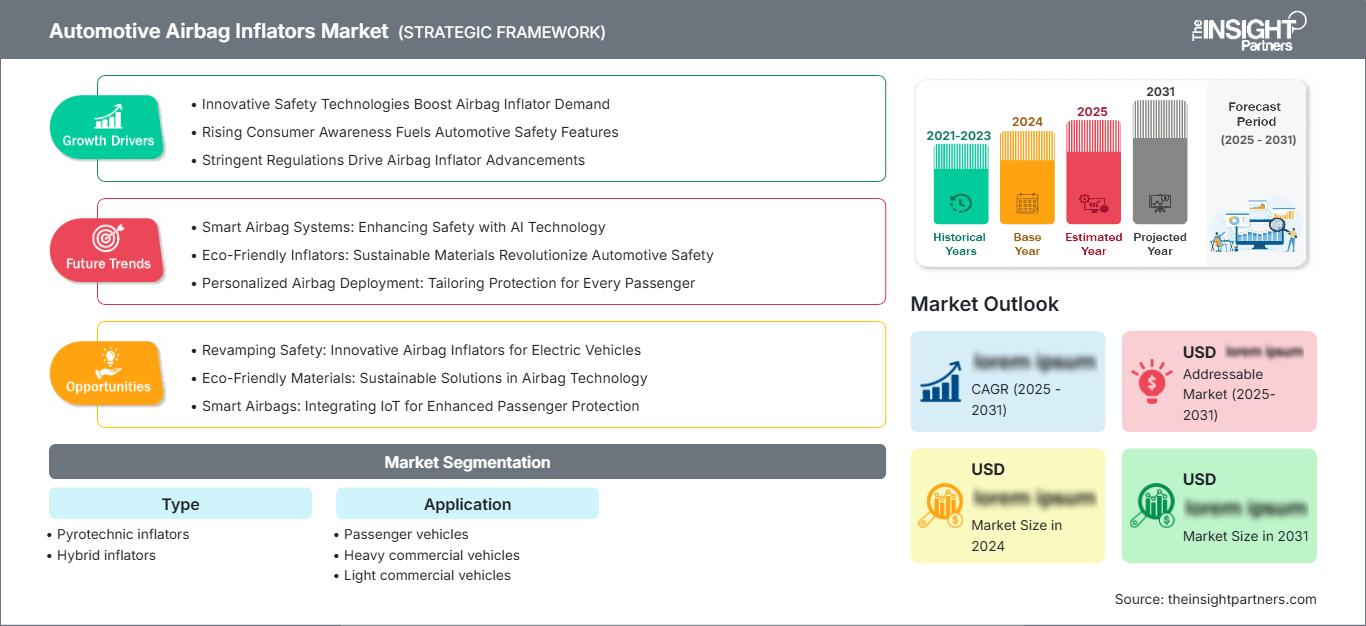
Automotive Airbag Inflators Market: Strategic Insights
Regional Insights
North America automotive airbag inflators market
North America held 22–25% automotive airbag inflators market share in 2025 and is projected to grow at a CAGR of 6.3–6.8% during 2026–2034. Demand is supported by strict safety expectations, large SUV and pickup fleets, and continued upgrades to side-impact and rollover protection.
OEMs and suppliers benefit from mature crash testing, recall oversight, and high consumer awareness. Multi-stage inflators are increasingly specified for vehicles with varied occupant sizes, seating positions, and advanced restraint logic. Aftermarket demand remains limited because inflators are safety-critical parts, but recall replacement programs create measurable service activity.
U.S. automotive airbag inflators Market
The U.S. accounted for 78–82% of North America Automotive Airbag Inflators Market demand in 2025 and is expected to grow at a CAGR of 6.4–6.9% through 2034. High vehicle ownership, federal safety standards, and strong litigation sensitivity make airbag reliability a strategic priority.
Company presence is significant through Autoliv, Inc., ZF Friedrichshafen AG, Joyson Safety Systems, ARC Automotive, Inc., and Aptiv PLC. Passenger vehicles dominate application demand, while light commercial fleets increasingly adopt advanced airbags as e-commerce vans and service vehicles operate in dense urban traffic.
Europe automotive airbag inflators Market
Europe accounted for 20–23% share of the Automotive Airbag Inflators Market in 2025 and is expected to grow at a CAGR of 6.1–6.6% during 2026–2034. Germany leads demand through premium vehicle production, strong engineering standards, and early adoption of advanced occupant safety systems.
The UK supports replacement and vehicle approval demand, while France, Italy, and Spain contribute through passenger car production and fleet renewal. European buyers value compact modules, recyclable materials, and compliance with safety assessment programs, supporting the adoption of inflators designed for side, curtain, and knee airbag coverage.
APAC automotive airbag inflators Market
APAC held 48–52% share of the Automotive Airbag Inflators Market in 2025 and is projected to grow at a CAGR of 7.4–7.9% through 2034. China leads because of vehicle production scale, EV platforms, and expanding use of multi-airbag packages.
Japan and South Korea support advanced safety engineering, India adds growth through safety regulation upgrades, and Australia sustains demand through strict crash standards. Localized supply chains and OEM export programs reinforce the region’s leadership in high-volume inflator production.
Middle East & Africa automotive airbag inflators Market
The Middle East & Africa Automotive Airbag Inflators Market is projected to grow at a CAGR of 5.4–5.9% during 2026–2034, supported by vehicle imports, premium SUVs, logistics fleets, and gradual safety regulation tightening. Saudi Arabia and the UAE lead premium adoption.
South Africa contributes through passenger vehicle assembly and replacement demand, while the rest of MEA remains fragmented. Harsh climate exposure increases the importance of inflator stability, sealing, and long-term material reliability across imported vehicle fleets.
Segmentation Analysis
Type
According to the Automotive Airbag Inflators Market report, Type defines the automotive airbag inflators market scope because inflator architecture determines deployment speed, thermal profile, storage requirements, packaging efficiency, and overall cost. The segment is expected to grow at a CAGR of 6.9–7.3% during 2026–2034 as OEMs continue optimizing occupant restraint systems to enhance vehicle safety, regulatory compliance, and crash protection performance across passenger and commercial vehicle categories.
- Pyrotechnic inflators dominate because they deliver rapid gas generation, proven mass-production reliability, and cost-efficient integration across driver, passenger, side, curtain, and knee airbag modules.
- Hybrid inflators combine stored gas and pyrotechnic activation, offering controlled pressure output, lower thermal impact, and suitability for larger airbags or applications requiring smoother deployment characteristics.
Application
Application is projected to grow at a CAGR of 7.0–7.5% during 2026–2034 as passenger, heavy commercial, and light commercial vehicles adopt broader restraint packages based on crash exposure, regulation, and fleet safety economics.
- Passenger vehicles generate the largest demand because multi-airbag systems are standard across many models, with safety ratings influencing purchase decisions and OEM platform specifications.
- Heavy commercial vehicles are gaining inflator content as fleet operators prioritize driver protection, liability reduction, and safety compliance for long-distance trucks, buses, and vocational vehicles.
- Light commercial vehicles are expanding quickly as delivery vans and service fleets add airbags to protect drivers operating in dense traffic, frequent stops, and mixed urban routes.
Opportunity Snapshot
| Application | Revenue Contribution | Trend Tag | Adoption Stage |
|---|---|---|---|
| Passenger Vehicles | High | Multi-Airbag | Mature |
| Heavy Commercial Vehicles | Medium | Driver Safety | Scaling |
| Light Commercial Vehicles | Medium | Fleet Vans | Scaling |
Automotive Airbag Inflators Market Growth Drivers and Impact Analysis
Stricter Crash Safety Regulations and Rating Programs
The regulatory push is the largest demand driver due to the importance of airbags within the regulations regarding occupant protection, as well as crash test ratings for consumers. Automotive manufacturers need to satisfy the requirements for frontal protection, side impacts, rollover protection, and pedestrian protection in more types of vehicles. This means that there will be a greater number of inflators needed per vehicle, as well as an increase in the demand for validated airbag deployment performance. The largest effect can be seen in developing nations, where safety regulations are now lagging behind more developed areas.
Rising Multi-Airbag Content Per Vehicle
The car interior is equipped with more restraint system positions compared to previous platforms, where driver, passenger, side, curtain, knee, center, and pedestrian airbags are commonly found in cars with high crash safety ratings. An additional airbag means an additional inflator or module. This development is fueled by customer safety awareness, premiumization, and automakers’ drive to improve crash test scores. The actual business case involves increased demand per unit when the production rate increases at a modest pace. Inflator providers capable of developing small, efficient and specific modules for inflators can benefit from this development.
Vehicle Production Growth in APAC and Emerging Markets
The size of the APAC manufacturing base provides inflator makers with a huge growth base, as China, India, Japan, and South Korea provide for local sales and export needs. The developing countries are transitioning from basic frontal airbags to more complex side and curtain bags as their regulations and expectations, along with OEM safety strategies, develop. Locally made inflators are reducing the cost of logistics and assisting the auto manufacturer in controlling platform costs. The implications include investments in testing, propellant, and inflator manufacturing facilities by the inflator maker.
Automotive Airbag Inflators Market Future Trends
Low-Heat and Efficient Deployment Architectures
Automotive airbag inflator market trends will increasingly focus on inflator designs that reduce heat generation while maintaining fast and controlled gas output. Larger bags for flexible cabins, reclined seats, and EV interiors will need efficient inflation without undue heat generation. Single-stage efficiency, two-stage control, and hybrid designs will continue to be improved to accommodate different occupant positions. Module size, propellant weight, and cost reduction, while meeting safety criteria, will make suppliers more relevant to OEMs.
Inflators Designed for New Cabin and EV Platforms
Electric cars and Software Defined Vehicles are driving changes to interior design, dashboard displays, steering mechanisms, and seating positions. Next-generation inflators will need to work in thin dashboards, large displays, different steering options, and complex sensing environments. There is a need for adaptable modules that inflate safely in unconventional occupant positions. Automotive manufacturers will need more simulation, sled testing, and integration assistance prior to launch. Inflator suppliers that integrate restraint system engineering into their processes will have a competitive edge.
Automotive Airbag Inflators Market Opportunities
Localized Supply for High-Volume Safety Platforms
Automotive airbag inflators market Forecasts show opportunity in localized production near vehicle assembly hubs in China, India, Mexico, Eastern Europe, and Southeast Asia. Local production helps keep a check on costs, delivery time, and compliance with safety regulations. The suppliers can develop facilities to manufacture propellants, form tubes, do automated assembly, and set up validation laboratories in order to achieve OEM localization goals. The prospects look best when there is government encouragement for local manufacturing of vehicles along with strict safety standards.
Advanced Inflator Modules for Commercial Vehicle Safety
Commercial vehicles represent an underpenetrated opportunity because driver protection is gaining importance in logistics, public transport, mining, and construction fleets. Heavy trucks and delivery vans face long operating hours, urban collision risks, and high liability exposure. Suppliers can develop rugged modules for driver airbags, side protection, and rollover scenarios. Fleet operators and OEMs may justify higher safety content when it reduces injury risk, downtime, and insurance exposure. This creates room for application-specific inflators beyond passenger car platforms.
Frequently Asked Questions

- Comprehensive Market Sizing and Forecast Analysis
- Detailed Segmentation Analysis
- In-Depth Market Dynamics Assessment
- Regional and Country-Level Insights
- Competitive Landscape and Company Benchmarking
- Strategic Business Intelligence
Recent Reports
Testimonials

The Insight Partners' SCADA System Market report is comprehensive, with valuable insights on current trends and future forecasts. The team was highly professional, responsive, and supportive throughout. We are very satisfied and highly recommend their services.
RAN KEDEM Partner, Reali Technologies LTDs
I requested a report on a very specific software market and the team produced the report in a few days. The information was very relevant and well presented. I then requested some changes and additions to the report. The team was again very responsive and I got the final report in less than a week.
JEAN-HERVE JENN Chairman, Future Analytica
We worked with The Insight Partners for an important market study and forecast. They gave us clear insights into opportunities and risks, which helped shape our plans. Their research was easy to use and based on solid data. It helped us make smart, confident decisions. We highly recommend them.
PIYUSH NAGPAL Sr. Vice President, High Beam Global
The Insight Partners delivered insightful, well-structured market research with strong domain expertise. Their team was professional and responsive throughout. The user-friendly website made accessing industry reports seamless. We highly recommend them for reliable, high-quality research services
YUKIHIKO ADACHI CEO, Deep Blue, LLC.
This is the first time I have purchased a market report from The Insight Partners.While I was unsure at first, I visited their web site and felt more comfortable to take the risk and purchase a market report.I am completely satisfied with the quality of the report and customer service. I had several questions and comments with the initial report, but after a couple of dialogs over email with their analyst I believe I have a report that I can use as input to our strategic planning process.Thank you so much for taking the extra time and making this a positive experience.I will definitely recommend your service to others and you will be my first call when we need further market data.
JOHN SUZUKI President and Chief Executive Officer, Board Director, BK Technologies
I wish to appreciate your support and the professionalism you displayed in the course of attending to my request for information regarding to infectious disease IVD market in Nigeria. I appreciate your patience, your guidance, and the fact that you were willing to offer a discount, which eventually made it possible for us to close a deal. I look forward to engaging The Insight Partners in the future, all thanks to the impression you have created in me as a result of this first encounter.
DR CHIJIOKE ONYIA MANAGING DIRECTOR, PineCrest Healthcare Ltd.Reason to Buy
- Informed Decision-Making
- Understanding Market Dynamics
- Competitive Analysis
- Identifying Emerging Markets
- Customer Insights
- Market Forecasts
- Risk Mitigation
- Boosting Operational Efficiency
- Strategic Planning
- Investment Justification
- Tracking Industry Innovations
- Aligning with Regulatory Trends





 Get Free Sample for