
Automotive Anti-Theft System Market Trends, Demand & Growth by 2034
Coverage: by Product Type (Steering Lock, Central Locking, Remote Keyless Entry, Immobilizer, Alarm System, Biometric Capture Device); Technology (Real Time Location System (RTLS), Automotive Biometric Technology, Global Positioning System (GPS), Global Radio Frequency Identification, Global System for Communication (GSM), Face Detection System); Vehicle Type (Passenger Car, Commercial Vehicle, Off-Highway Vehicle) , and Geography (North America, Europe, Asia Pacific, and South and Central America)
- Status : Data Released
- Report Code : TIPRE00011350
- Category : Automotive and Transportation
- No. of Pages : 150
- Available Report Formats :


- Last update date : August 27, 2026


2025 Market Size
US$ 17.82 Bn
Base year value
2034 Forecast
US$ 31.47 Bn
Projected by 2034
CAGR 2026-2034
6.52 %
Growth rate
Addressable Market
US$ 222.88 Bn
(2026-2034)
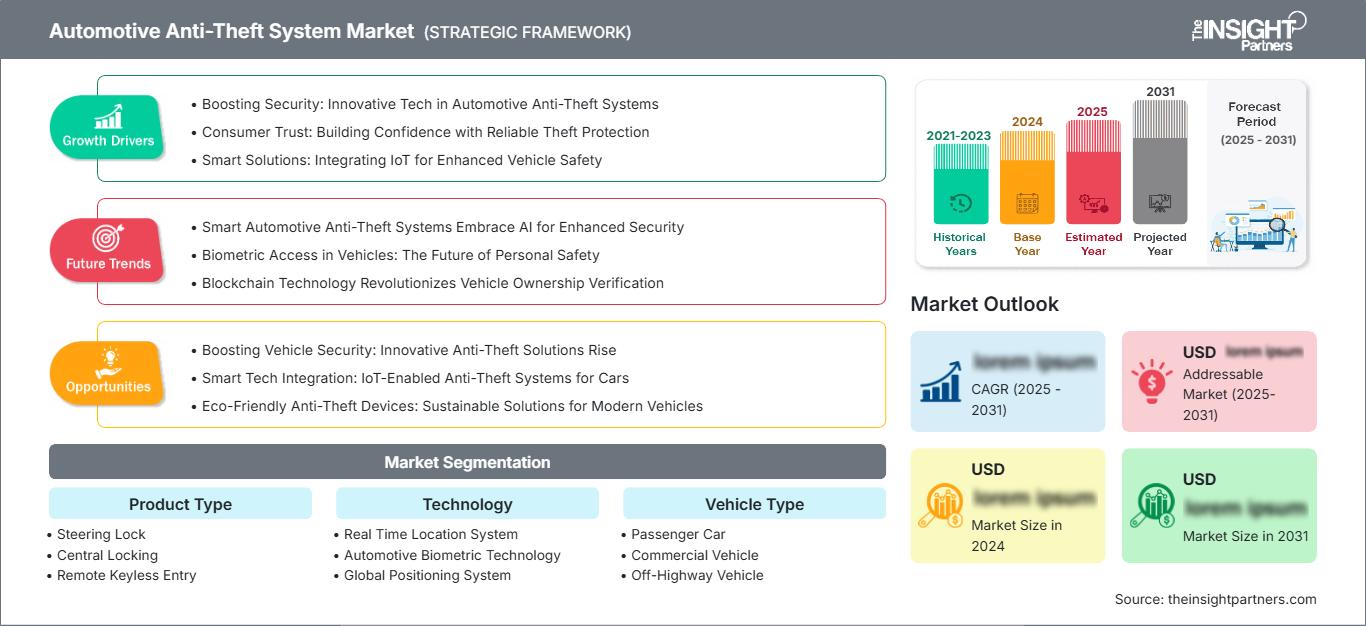
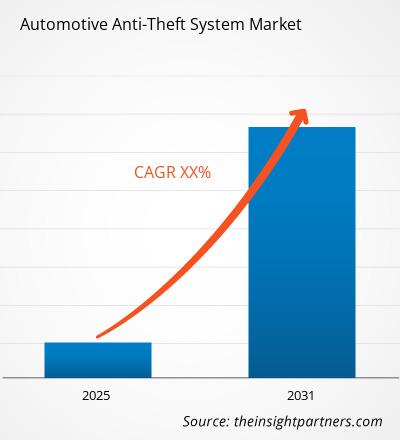
The automotive anti-theft system market was valued at US$ 17.82 Billion in 2025 and is projected to reach US$ 31.47 Billion by 2034, registering a CAGR of 6.52% during 2026–2034. Demand is driven by rising vehicle theft techniques, connected vehicle adoption, insurance-linked security requirements, and OEM integration of immobilizers, alarms, keyless access, biometric authentication, and location-based tracking systems.
North America automotive anti-theft system market size is supported by high vehicle ownership, theft prevention regulations, insurer incentives, and strong adoption of factory-installed electronic security. The region is expected to grow at a CAGR range of 6.0–6.4% during 2026–2034 as automakers expand digital key, telematics, and immobilizer features across passenger cars and commercial fleets.
Automotive Anti-Theft System Market Assessment and Insights
- North America accounted for 27–30% share in 2025 and is expected to grow at a CAGR of 6.0–6.4% during 2026–2034, supported by connected security adoption, insurance incentives, and fleet telematics.
- US represented 78–82% of North America demand in 2025 and is projected to grow at a CAGR of 6.1–6.5% through 2034, led by OEM-installed immobilizers and digital key systems.
- Europe held 24–27% share in 2025 and is likely to expand at a CAGR of 5.8–6.2%, led by Germany, the UK, France, Italy, and Spain.
- Asia Pacific captured 31–34% share in 2025 and is projected to grow at a CAGR of 6.8–7.3%, led by China, Japan, South Korea, India, and Australia.
- Largest Segment: Immobilizer held 35–39% market share in 2025 and is expected to grow at a CAGR of 5.9–6.3% because it is embedded in OEM vehicle security architecture.
- High Growth Segment: Biometric Capture Device held 7–10% share in 2025 and is projected to grow at a CAGR of 8.0–8.6% due to premium access control and identity-based ignition use cases.
- Key companies analyzed in detail: AB Volvo, Continental AG, Delphi Technologies, Lear Corporation, Mitsubishi Electric Corporation, Robert Bosch GmbH, Tesla, Inc., TOKAI RIKA CO., LTD., VOXX International Corporation, and ZF Friedrichshafen AG.
Source: The Insight Partners' analysis based on proprietary research, government publications, company annual reports, investor presentations, industry databases, and expert interviews.
The development of technology is changing the dynamics of automobile security from physical deterrents to digital protection. Central lock, steering lock, and alarms are still relevant for budget-conscious markets, but technologies like immobilizers, remote keyless entry, GPS, GSM, RFID, location technology, and facial recognition are gaining importance in connected automobiles.
Future demand will be shaped by emerging theft methods, regulatory expectations, cybersecurity concerns, and the rising value of onboard electronics. The automotive anti-theft system market growth outlook favors suppliers that can combine hardware reliability, encrypted authentication, software updates, mobile alerts, and OEM validation for both private vehicles and professionally managed fleets.
Automotive Anti-Theft System Market Report Scope
| Report Attribute | Details |
|---|---|
| Market size in 2025 | US$ 17.82 Billion |
| Market Size by 2034 | US$ 31.47 Billion |
| Global CAGR (2026 - 2034) | 6.52% |
| Historical Data | 2021-2024 |
| Forecast period | 2026-2034 |
Automotive Anti-Theft System Market Analysis
Automotive anti-theft system market growth is anchored in the need to prevent unauthorized access, relay attacks, key cloning, vehicle towing, component theft, and fleet asset loss. OEMs increasingly install security systems at the factory because integrated electronics are more reliable than fragmented aftermarket add-ons. Demand also comes from commercial operators that require real-time alerts, vehicle tracking, geofencing, and driver authorization across logistics, rental, delivery, and construction fleets.
Supply trends depend on the availability of semiconductors, cost of sensors, encryption ability, wireless protocol usage, and compatibility with body control modules, infotainment systems, and telematics systems. Automotive OEMs are stepping out of providing stand-alone locks and focusing on offering software-based security systems, which will have the ability to update and be connected to mobile applications or fleet dashboards.
Automotive anti-theft system market analysis shows that competition is concentrated around electronics integration, access authentication, and connected services. Continental AG, Robert Bosch GmbH, ZF Friedrichshafen AG, Mitsubishi Electric Corporation, Lear Corporation, Delphi Technologies, TOKAI RIKA CO., LTD., VOXX International Corporation, AB Volvo, and Tesla, Inc. compete through OEM programs, platform engineering, sensor integration, and aftermarket reach.
The investments are moving towards ultra-wideband digital keys, biometrics, remote diagnosis, and tamper monitoring. Those suppliers who are able to show cybersecurity awareness, scalability in electronic component manufacture, and compatibility across various vehicles will have an advantage as auto manufacturers look for secure technologies that minimize warranty exposure and satisfy insurance companies.
● REPORT CUSTOMIZATION
Tailor This Report To Align With Your Specific Business Requirements
This report can be customized to align precisely with your business objectives, scope, and target markets. Customization options include tailored segmentation, geography, competitive analysis, and strategic insights to support informed decision-making.
Customize This Report →WHAT YOU CAN ADJUST
- ● Segmentations
- ● Geography
- ● Competitive Analysis
- ● Language Preferences
Automotive Anti-Theft System Market: Strategic Insights
Regional Insights
North America automotive anti-theft system market
North America held 27–30% automotive anti-theft system market share in 2025 and is projected to grow at a CAGR of 6.0–6.4% during 2026–2034. Demand for the technology is underpinned by ownership of high-end vehicles, security requirements related to insurance, connectivity in vehicles, and threats associated with theft via keyless entry systems, pickups, SUVs, and commercial vehicle fleets.
The OEMs and aftermarket parts suppliers can capitalize on retail distribution, dealer services, and the adoption of fleet telematics technology. Immo technology and remote keyless entry technology continue to be the dominant technologies, while GPS technology, mobile alerts, and digital keys have gained consumer popularity.
U.S. automotive anti-theft system Market
According to the Automotive Anti-Theft System Market report, the U.S. accounted for 78–82% of North American demand in 2025 and is expected to grow at a CAGR of 6.1–6.5% through 2034. The substantial vehicle parc, the high risk of vehicle theft in urban centers, and the rising focus of insurers on theft prevention technologies will all continue to contribute to consistent market uptake. There is a healthy demand from both the OEMs and the aftermarket segment as customers seek to adopt new anti-theft solutions that include immobilizers, vehicle tracking technology, alarms, and connected safety technologies. Firm reach is widespread via manufacturers, electronics firms, dealers, internet vendors, and fleet solution providers. There is high demand for applications in passenger vehicles, pickups, commercial vans, rentals, and logistics vehicles.
Europe automotive anti-theft system Market
According to the Automotive Anti-Theft System Market forecast, Europe accounted for 24–27% share in 2025 and is expected to grow at a CAGR of 5.8–6.2% during 2026–2034. Demand in Germany is high due to the high number of premium automobiles in the country, advanced OEM engineering, and high penetration of integrated immobilizers, keyless entry systems, and connected security units. The increased emphasis on vehicle protection, the development of technologies for connected cars, and increased use of electronic anti-theft devices will contribute to market growth in the region.
The UK has a consistent demand for protection from insurance companies and threats of theft in cities, while France, Italy, and Spain are contributing to the market because of the increasing number of passenger cars and aftermarket alarms and fleet protection systems.
APAC automotive anti-theft system Market
APAC held 31–34% share of the automotive anti-theft system Market in 2025 and is projected to grow at a CAGR of 6.8–7.3% through 2034. China leads regional demand because of vehicle production scale, connected car adoption, EV platforms, and rapid use of smartphone-based access technologies.
Japan and South Korea support advanced electronics integration, India adds volume through passenger car and two-wheeler security awareness, and Australia contributes fleet and aftermarket demand. Industrial policy, urbanization, digital connectivity, and expanding middle-class vehicle ownership support strong regional adoption.
Middle East & Africa automotive anti-theft system Market
The Middle East & Africa automotive anti-theft system Market is projected to grow at a CAGR of 5.5–6.0% during 2026–2034, supported by premium vehicle demand, infrastructure fleets, logistics activity, and asset monitoring requirements. Saudi Arabia and the UAE favor GPS, immobilizer, and remote tracking solutions.
South Africa contributes through passenger vehicles, commercial transport, and security-conscious aftermarket channels, while the rest of MEA remains fragmented. Demand is shaped by theft recovery, fleet visibility, and protection for vehicles operating across long-distance routes and remote work sites.
Segmentation Analysis
Product Type
Product Type defines the automotive anti-theft system market scope because each product addresses a different theft risk, from physical access prevention to electronic authorization and identity confirmation. The segment is expected to grow at a CAGR of 6.2–6.6% during 2026–2034 as vehicles adopt layered security combinations.
- Steering Lock remains relevant in aftermarket and cost-sensitive markets because it offers visible theft deterrence, simple installation, and compatibility with older vehicles lacking embedded electronic protection.
- Central Locking is widely adopted as a baseline convenience and security feature, supporting synchronized door access control across passenger cars, commercial vans, and multipurpose vehicles.
- Remote Keyless Entry supports user convenience and theft deterrence, but its growth depends on stronger encryption, relay attack prevention, and integration with mobile-based access management.
- Immobilizer is the largest product category because it prevents engine start without authenticated keys or electronic codes, making it a standard OEM security layer.
- Alarm System retains strong aftermarket demand by providing audible deterrence, tamper alerts, and visible protection for vehicles parked in high-risk or unsupervised environments.
- Biometric Capture Device is emerging in premium and connected vehicles, using fingerprint, facial, or identity-based inputs to strengthen driver authentication and personalized access control.
Technology
The technology segment of the automotive anti-theft system market is projected to grow at a CAGR of 6.5–6.9% during 2026–2034 as security systems move toward connectivity, location intelligence, and encrypted identity verification across vehicle platforms.
- Real Time Location System enables continuous asset visibility, geofencing, and theft recovery support, making it valuable for commercial fleets, rental operators, and high-value vehicle owners.
- Automotive Biometric Technology improves access security by linking vehicle operation to verified users, reducing dependence on physical keys and supporting premium cabin personalization.
- Global Positioning System remains central to stolen vehicle recovery, route monitoring, and fleet visibility, especially when paired with mobile alerts and telematics dashboards.
- Global Radio Frequency Identification supports short-range authentication and key recognition, providing established utility in immobilizers, access modules, and vehicle authorization systems.
- Global System for Communication enables remote alerts, tracking updates, and communication between the vehicle, owner, fleet manager, or recovery service.
- Face Detection System is gaining attention for hands-free authentication, cabin monitoring, and driver-specific access, although cost and privacy considerations limit mass adoption.
Vehicle Type
Vehicle Type is expected to grow at a CAGR of 6.3–6.7% during 2026–2034 as passenger, commercial, and off-highway vehicles require different combinations of deterrence, access control, tracking, and recovery features.
- Passenger Car demand is strongest because a large vehicle parc, consumer safety awareness, connected infotainment, and OEM-installed immobilizers drive regular adoption across economy and premium models.
- Commercial Vehicle adoption is expanding as fleets protect cargo, manage driver authorization, reduce downtime, and use GPS-enabled security to support logistics visibility and theft recovery.
- Off-Highway Vehicle demand reflects theft exposure at construction, mining, and agricultural sites, where remote operating locations increase the need for tracking, immobilization, and access control.
Opportunity Snapshot
| Vehicle Type | Revenue Contribution | Trend Tag | Adoption Stage |
|---|---|---|---|
| Passenger Car | High | Digital Keys | Mature |
| Commercial Vehicle | Medium | Fleet Tracking | Scaling |
| Off-Highway Vehicle | Low | Site Security | Emerging |
Automotive Anti-Theft System Market Growth Drivers and Impact Analysis
Rising Vehicle Theft Complexity and Electronic Attack Methods
Vehicle theft is evolving from physical attack methods to electronic manipulation and relay attack, key cloning, CAN bus hacking, and parts theft. The implication of this trend on manufacturers and suppliers is the need to improve immobilizer technology, keyless entry cryptography, alarm circuitry, and telematics alert systems. The effect is evident within the OEM and aftermarket sales channel due to the fact that old vehicles must be upgraded, while new ones must be protected at the point of manufacture. There is also growing consumer demand for security due to the location of parking and the value of their vehicle.
Factory Integration of Immobilizers, Digital Keys, and Telematics
OEM integration acts as another significant factor because systems integrated directly into cars are much more difficult to circumvent and integrate into car electronics. Immobilizers, central locking systems, digital keys, keyless entry systems, and telematics controllers could be connected to body control units, mobile applications, and cloud-based services. This will minimize the problem of inconsistency during installation and facilitate post-sale software updates. OEMs gain from this solution in terms of improved security perception, reduced risks of warranty claims, and compliance with regulations or insurance policies. Suppliers receive long-term development periods and high-volume orders.
Fleet Security Requirements Across Logistics and Construction
Commercial fleets are threatened by the potential theft of the vehicle, goods carried, tools, fuel, batteries, and valuable machinery. More and more logistics, rentals, construction companies, and municipal fleets are turning to the use of GPS tracking, geofencing, immobilization, driver verification, and instant notifications to secure their assets. But there is more than just theft prevention in effect since security solutions are also helping to optimize utilization, incident handling, and insurance reporting processes. Off-road vehicles become especially vulnerable when parked on open sites or remote construction sites.
Automotive Anti-Theft System Market Future Trends
Ultra-Wideband Digital Keys and Secure Smartphone Access
Automotive anti-theft system market trends will increasingly center on secure smartphone access, ultra-wideband localization, and digital credentials that reduce relay attack exposure. Unlike conventional key fobs, UWB can estimate device distance more accurately, helping vehicles confirm whether the authorized user is genuinely nearby. Automakers are likely to pair this with mobile wallet keys, temporary access sharing, and cloud-based revocation. Adoption will start in premium vehicles but expand as hardware costs fall and consumers expect phone-first ownership experiences. Suppliers with encryption expertise and cross-device compatibility will gain strategic relevance.
Biometric Authentication and Cabin-Based Identity Verification
As automobiles evolve into more personal and connected forms of transportation, biometric authentication will shift from feature concepts to selective production implementations. Fingerprint readers, face recognition, and driver identification systems can provide access and ignition, seat adjustments, infotainment settings, and payment authentication for known users. This technology is most compelling when there are multiple users sharing the same vehicle, whether family-owned, fleet, rental, or subscription-based. Privacy, false-reject rates, and price will limit widespread implementation, but premium lines and enterprise services might implement biometrics for accountability and limited use.
Automotive Anti-Theft System Market Opportunities
Aftermarket Upgrades for Older Connected and Non-Connected Vehicles
Automotive anti-theft system forecasts indicate a strong opportunity in vehicles that lack modern embedded security or use older keyless entry technology. Aftermarket suppliers can address this gap with GPS trackers, alarms, immobilizer add-ons, mobile alerts, and steering locks tailored for different price points. The opportunity is especially relevant in countries with aging vehicle fleets and high urban theft exposure. Retailers, installers, insurers, and fleet maintenance providers can bundle certified products with service plans, installation support, and recovery assistance to improve customer confidence and recurring revenue.
Security Platforms for Shared Mobility and Fleet Operators
Companies that provide shared transportation, renting, delivery, and logistics services require security solutions that can handle multi-user management, vehicle management, route management, and access management. Such platform-based solutions will be able to integrate digital key, driver authentication, geofencing, immobilization, and recovery functionality on a single operating console. The integration of such technologies will provide more business prospects for Tier-1 suppliers, telematics providers, and software companies as they can monetize their products in a subscription model. Fleet owners prefer measurable effects, including decreased thefts, increased incident handling, and reduced unauthorized access.
Frequently Asked Questions

- Comprehensive Market Sizing and Forecast Analysis
- Detailed Segmentation Analysis
- In-Depth Market Dynamics Assessment
- Regional and Country-Level Insights
- Competitive Landscape and Company Benchmarking
- Strategic Business Intelligence
Recent Reports
Testimonials

The Insight Partners provided valuable market intelligence that supported our global go-to-market strategy. Their team was professional, responsive, and attentive to our feedback, providing thoughtful analysis and helpful methodological clarifications throughout the project.
Junmo Kim Chief Financial Officer (CFO), Enertech Co., Ltd.
The Insight Partners' SCADA System Market report is comprehensive, with valuable insights on current trends and future forecasts. The team was highly professional, responsive, and supportive throughout. We are very satisfied and highly recommend their services.
RAN KEDEM Partner, Reali Technologies LTDs
I requested a report on a very specific software market and the team produced the report in a few days. The information was very relevant and well presented. I then requested some changes and additions to the report. The team was again very responsive and I got the final report in less than a week.
JEAN-HERVE JENN Chairman, Future Analytica
We worked with The Insight Partners for an important market study and forecast. They gave us clear insights into opportunities and risks, which helped shape our plans. Their research was easy to use and based on solid data. It helped us make smart, confident decisions. We highly recommend them.
PIYUSH NAGPAL Sr. Vice President, High Beam Global
The Insight Partners delivered insightful, well-structured market research with strong domain expertise. Their team was professional and responsive throughout. The user-friendly website made accessing industry reports seamless. We highly recommend them for reliable, high-quality research services
YUKIHIKO ADACHI CEO, Deep Blue, LLC.
This is the first time I have purchased a market report from The Insight Partners.While I was unsure at first, I visited their web site and felt more comfortable to take the risk and purchase a market report.I am completely satisfied with the quality of the report and customer service. I had several questions and comments with the initial report, but after a couple of dialogs over email with their analyst I believe I have a report that I can use as input to our strategic planning process.Thank you so much for taking the extra time and making this a positive experience.I will definitely recommend your service to others and you will be my first call when we need further market data.
JOHN SUZUKI President and Chief Executive Officer, Board Director, BK Technologies
I wish to appreciate your support and the professionalism you displayed in the course of attending to my request for information regarding to infectious disease IVD market in Nigeria. I appreciate your patience, your guidance, and the fact that you were willing to offer a discount, which eventually made it possible for us to close a deal. I look forward to engaging The Insight Partners in the future, all thanks to the impression you have created in me as a result of this first encounter.
DR CHIJIOKE ONYIA MANAGING DIRECTOR, PineCrest Healthcare Ltd.Reason to Buy
- Informed Decision-Making
- Understanding Market Dynamics
- Competitive Analysis
- Identifying Emerging Markets
- Customer Insights
- Market Forecasts
- Risk Mitigation
- Boosting Operational Efficiency
- Strategic Planning
- Investment Justification
- Tracking Industry Innovations
- Aligning with Regulatory Trends





 Get Free Sample for